Author: Sandi Sadar Šoba
Interview date: 22.10.2007
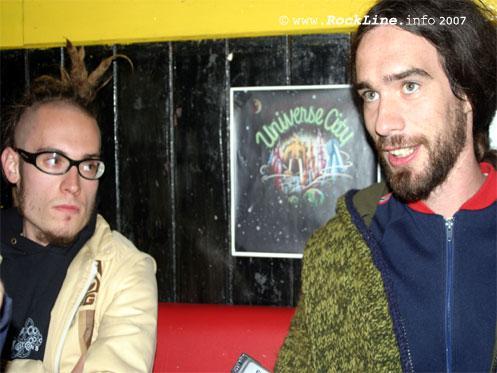
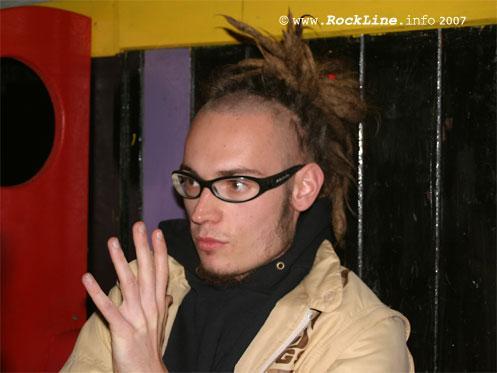
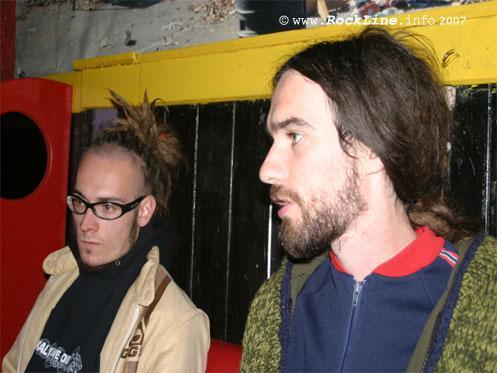
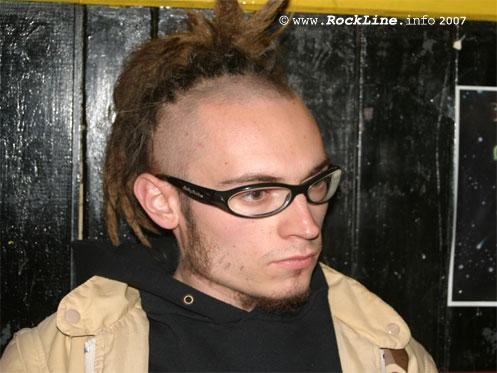
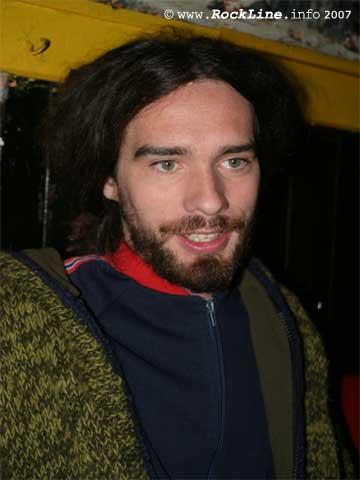
Monday’s rainy day was sliding into its final phase, and Metelkova, wrapped in a light mist and drizzle, was sitting there pretty empty. In a creative kind of way. At the agreed time I stop in front of Gala Hala. The sound of a hidden pulse drifts out of the darkened interior. Backstage was having rehearsals, while I was waiting for other artists from the Kapa label – my interviewees from Moveknowledgement, the Novo mesto heavyweights of fusion – dub – jungle – rock sounds, a band that is still pretty anonymous here at home despite all its incredible achievements abroad, even though plenty of people have already heard of them. Around seven in the evening the door opens and two guys walk into the heart of the temple of alternative culture: N’Toko, the band’s charismatic singer, and the dreadlocked guru of low-frequency sounds and funky dub beats from the Novo mesto sound shamans, bassist Dejan Slak.
RockLine: Guys, it’s a pleasure to finally sit down at the same table – well, you two sit and I’ll just stand – and to try to get at least partly to the core of all the beauty and everything Moveknowledgement stands for. You’ve got a couple of gigs abroad behind you, which spread your good name beyond the borders once again. What are your impressions and thoughts after the shows in Hungary and Germany?
N’Toko: Actually Germany came first – our first gig was in Berlin at the Popkom festival, and the whole thing looked pretty underground. The friends who were there said that what played out in front of us was a proper Berlin underground gig in a pretty small place. There were quite a few people, but despite everything the rock atmosphere was really authentic and good. We had a really great time. And of course we were thrilled about Berlin, just because it’s Berlin. The vibe was totally fine.
RockLine: For a lot of people that was the first encounter with your music and with what Moveknowledgement stands for. What was the main thread, or what expectations did you take to Berlin? Were those expectations met?
N’Toko: Wherever we go, our expectation is always just to play as well as we possibly can and have the best gig, given the conditions available to us there, of course. It’s hard to predict what’s waiting for you – it can be a truly amazing place, with great sound and everything, but not a single person shows up, or it can be some hole where you can barely, with enormous effort, put it all together, the stage and everything, but the crowd and the vibe make up for all the trouble. You can never foresee everything to the extreme. And we don’t have any expectations like we’ll show up somewhere and somebody will discover us or whatever. Basically wherever we go, we go there with the basic goal of having a gig that’s as good as possible, if not the best.
RockLine: Still, there’s a difference between home stages and foreign ones. People have much higher expectations of local acts. With foreign acts, simply because they’re foreign, they’re often a lot less critical. How would you compare the climate of home stages and stages abroad?
Dejan: At home it’s always different, because folks know you, so in your home turf a lot more people can show up. Abroad the number of people fluctuates – sometimes fewer, sometimes, you know… it depends, because abroad is always different from what Slovenia offers, since people there know you differently than here. There people come to hear you as a band, as Moveknowledgement.
RockLine: So where do you enjoy playing more – at home or abroad?
N’Toko: Everywhere, because it can be either great or awful anywhere. We’ve had good gigs and bad gigs anywhere. Of course it has its own special charm to step onto a stage where people came to a concert to hear you, your music, because elsewhere you’re actually in the position where people are there by chance, seeing you for the first time and have no clue what to expect from the band or what the band is actually going to do and present on stage. But we’re so used to that by now that we need, and really want, to get in front of new folks every time, where you have to prove yourself from scratch and show you’re worth listening to.
RockLine: You mostly play material from the new record Listen To Nebukadnezar. Sound-wise it’s quite different from what you did on Sun Sun and on the album Ant People. You actually had to rebuild the concept and sonic identity of your band from scratch, since most of the lineup changed. What’s the main, red thread, given that listening to the album gives the feeling of a concept album?
Dejan: We weren’t exactly playing around with some kind of concept. It just came out spontaneously. Before there was a bigger lineup, now it’s different folks, or rather the ranks thinned out. Now there are five of us, which is fewer than before. Each of us is, at least partly, versed in producing, and each has their own vision, with music at the forefront, but ground out in a different way, and everybody contributes to it. The sound changed because back in the day, unlike today, one person wrote all the lyrics and music, and now we all do it together. So that thread is totally intuitive. Everything just came out spontaneously, like the chemistry between the five of us.
RockLine: The main message is carried by the lyrics. Given that you (N’Toko) were put in the position for the first time of having to take on the mic completely on your own, and you’re not just a rapper anymore. Now you’re the main mouthpiece delivering the Moveknowledgement message to the masses. Which themes did you focus on in this record as the band’s solo voice?
N’Toko: Generally, my philosophy about lyrics lately is to try not to send some message right off the bat or literally suggest something to people, but to leave things as energetically open as possible. I don’t want the songs to be set up in a hermetic way, like when you can say at a gig: “This song is about ecology, this one is about what we think about this and that…” It seems to me that there comes a time when you have to stop handing out verdicts on the things you see and feel in the world, the things you’ve always had an opinion about, and instead you just try to hint at them, wrapped in the context of the lyrics. Not so much physically, more spiritually. So – there are no steel-hard themes, but rather impressions and visions, pictures – real and unreal ones, whatever I’ve got to offer. Just like the other guys don’t send a message directly with every riff, I don’t do that with some rhyme of mine either, I want to achieve a similar effect to what they do with a riff.
RockLine: Given that you dug into the pile of history and picked the figure of Nebuchadnezzar as someone you tie everything together with – why Nebuchadnezzar?
N’Toko: I’ll answer that one… (laughs) They always ask the other members something like that, and they say Miha just made it up (laughs). Nebuchadnezzar is simply a word that sounds great to us, and beyond that he’s a really interesting historical figure, painted in a negative light in the Bible, and history itself rates him similarly badly. He was the Babylonian king who enslaved the Israelites, and not just them, but most of the world known at the time. For us he was the antipole of all that reggae mythology which, in our opinion, at some point sank its teeth too deep into some people’s minds, and we wanted to make some dub music sailing the same waters, but with a more Babylonian mentality. Nebuchadnezzar was for us the icon of doing a more modern, more realistic, or if you like – more Babylonian trip.
Kaja (the band’s PR person chimes in from the background): The question is how many of them you actually managed to convert with that… (and points at Dejan, who sports some pretty impressive dreadlocks) (laughs)
N’Toko: Yeah, he used to be a rasta… (laughs)
Dejan: Now I’m pretty much a skin. A skin rasta.
N’Toko: Less and less rasta.
RockLine: Given that music can be perceived on multiple levels. On one side there’s the vibe, on the other the ideology you represent as a musician. Which side pulls you more? Which principle do you consistently stand behind?
Dejan: First of all, music comes first.
N’Toko: We don’t have an ideology we’d strive for. What’s more: all of us are against any ideology that would breed blind believers. We try to focus on making music that, lyrics included, stays distanced from trying to represent some narrow mental concept. The music wants to be what it is – just like it’s given to the nature of every person. Some people then identify with certain views, places, some concept, but we just want to be what we are and not slap on labels that belong to the domain of some movements or ideologies.
RockLine: And what’s the origin story of Moveknovledgement itself? How did you all come together from every corner and kick the whole thing off as a full-blooded band?
N’Toko: That’s a pretty long story. It’s about ten years of people coming and going. The founders are still our current guitarist Uroš Weinberger and Goran Baloh, who sadly passed away. Those two had a series of bands, but they always wrote songs together. Then things settled when I joined the duo, and we were a trio that didn’t play live and didn’t have a band, we just wrote music and songs at Uroš’s place. Then, after about a year, we invited the current drummer David Cvelbar, since we already knew him, then another bassist came along, then we found a keyboardist. Then we started playing in that lineup, after which a female singer (Sandra Tomovič) joined us, and after two or three years that lineup settled, and we also brought in some wind players. That was the crew behind the album Sun Sun. That lineup held until the album Ant People, when we swapped out the keyboardist and bassist – that’s when the current bassist Dejan came into our ranks. After Ant People we shrank back down to five members again.
RockLine: If we focus on recreating the album’s musical design live – what’s the next logical step Moveknowledgement could take sonically in the future, or which path are you maybe already taking? Do you have any material for an upcoming new record?
Dejan: There are definitely some songs already available. You could scrape together enough for an EP.
N’Toko: We’re still three songs short of a full record. Of course there’s still a bit of work to do. We already know, roughly, where it’s pulling us…
Dejan: We’ll wait a bit longer to finish them.
RockLine: So when can we expect a worthy successor to Nebukadnezar?
N’Toko: Good question. We learned from the earlier records that it’s best to talk as little as possible and not announce when the next thing is coming. Say, when we’re totally happy with everything. We already know where we want to take the music, we’re just waiting for the right feeling.
Dejan: For the next record we’ll try to find a badder dictator who could lead the threads of a new creative genesis (laughs)
RockLine: Which won’t be possible unless you take Hitler for this round…
Dejan: No. That wouldn’t suit us (laughs)
N’Toko: That would be an ideology thing again… (laughs)
RockLine: Besides the lineup change, switching labels was also a big leap. You moved from the Goga label to Kapa Records. How happy are you under the new wing, and what do you expect from the new label going forward as a band?
Dejan: Hmmm… (laughs)
N’Toko: It’s, basically… Now I have to watch what I say (points at Kaja) (laughs). Actually, Kapa is our first real label. Before, it was just bare-bones cooperation, where somebody put out your record for you. And that was where it ended. There was no joint development in the sense of having a shared plan for what to do with the record after it came out. We’ve been working with Kapa for two records now, and as friends and concert organizers they more than deliver. They expect professionalism from us on the musical level, but that’s great, because things feel better laid out, since there’s a shared vision of where we go next with the music.
RockLine: Producers are the ones who shape the final look of a record. If you had the chance and an unlimited budget – who would you pick as the producer on the next record?
Dejan: I think for that money we’d rather build our own studio. And do it all ourselves. (laughs)
N’Toko: Either that or Rick Rubin. (They chant the name Rick Rubin) (laughs)
RockLine: Given that your music has so many different influences: what could you point to as the musical influences that bind you together, or what’s the stuff you’d find on your music shelves?
Dejan: That’s tricky, because everybody’s looking for something different in music.
N’Toko: We listen to totally different things and each of us leans in our own direction. As far as that goes, the influences are too varied to say what the basic particles of Moveknowledgement’s chemistry are…
RockLine: Then let’s focus on your own influences. Like, say, NoMeansNo or Tool, which is something I’m a big believer in…
N’Toko: That’s easier, yeah.
Dejan: Tool too, definitely (laughs). Deftones, a lot of French dub, old punk, Durchmarsch and that kind of scene. Just all sorts: old music – the 70s, 80s… There’s a ton of music. Hard to say. In my direction it’s dub that sticks out. At least in this band.
N’Toko: For me maybe more the Japanese scene. All kinds of noise bands, I’m pretty into that…
RockLine: Mono…
N’Toko: Cool, yeah. Myself, I listen to a lot of different acoustic music, folk and stuff, which can’t possibly show up in Moveknowledgement. Thank God! (laughs) But…
RockLine: So you’ll do the next record in the Vowen Hand scene…
N’Toko: No, no… (laughs) Lately I’ve been listening to a lot of 90s dance music, and that’s what I’ve been tripping on recently… (laughs)
Dejan: Snap.
N’Toko: Snap and stuff like that (laughs)
RockLine: Well, well… The groove is in there. What about short-term and long-term goals? Short-term: what big things are cooking over the next year? Long-term: what goes beyond that narrow time frame?
Dejan: Short-term – we’ve got Animateka on December 9th at Kino Dvor. That’s one project. In February we’re touring Germany and France again. That’s it for now.
N’Toko: That’s what we know. Long-term: make some kind of record. A better one. Keep developing the music and play as many gigs as possible.
RockLine: And finally – the grand finale – do you have any message for our readers?
Dejan & N’Toko: DANCE !!! JUST DANCE!!!
Dejan: I thought you’d send the other 90s message?
N’Toko: No, because you gave the wrong cue, but it’s cool! DANCE!!! With three exclamation marks!!!
photo: Jani Lah
Photo Gallery