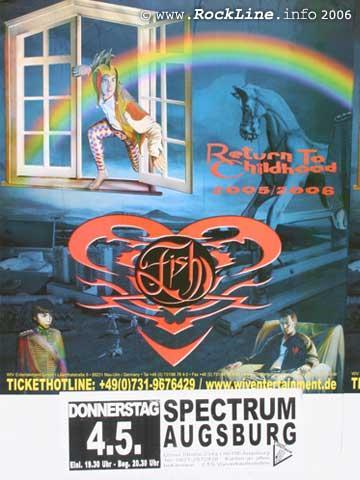
Date: Thursday, May 4, 2006
Location: Augsburg / Spectrum / Germany
Most of our RockLine crew decided that Fish’s show was an event you simply could not miss. In this year’s drought of progressive rock concerts, Fish’s “Return To Childhood” tour and his gig in Augsburg, Germany came at just the right time for all fans of Marillion and his solo work. It was also perfect for those of us who last got our neo-prog catharsis at Arena’s show in Vienna last year and were seriously hungry for something similar. Fish still holds a special and important place for most Marillion fans. In the 80s it was his unforgettable voice, his stage acting, his interpretation of his excellent lyrics and his all-around charisma that gave the band the recognition that later made them one of the main hopes of “second-generation” progressive rock, the so-called neo-progressive rock. Fish undoubtedly deserves the lion’s share of the credit, and plenty of people still regret his leaving the band in 1988. But that was then, and in the meantime both Marillion and Fish have taken completely different musical paths. Still, their joint work, i.e. those four “classic” Marillion albums they recorded together, remains the band’s best for
many of their fans. Since then Fish has built a very solid solo career with quite a few very likable albums that stand out for their variety, and unlike Marillion he has never given up playing their classics live. Just last year he came up with the idea of performing the whole of “Misplaced Childhood” (1984) live. It’s Marillion’s most successful album and, for most, their best, and the band themselves haven’t “dared” to play it in full since 1986. That was one more reason this show couldn’t be missed, because chances like this are rare, and Fish and his band very seldom stray outside Western and Northern Europe.
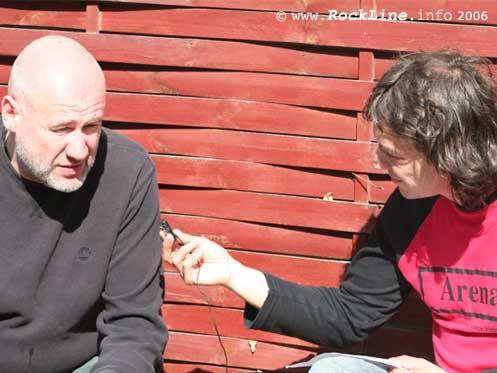
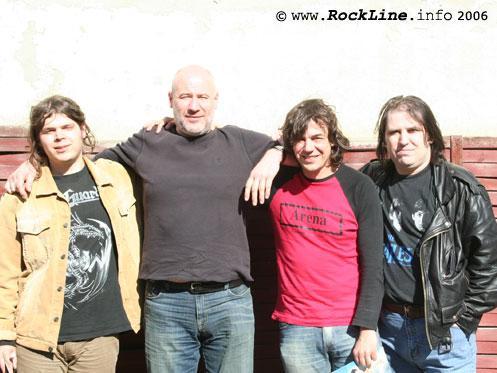
So we hit the road bright and early and, without any major hiccups or long stops, rolled into Augsburg, a picturesque and pleasant little German town near Munich that surprised us with how homey it felt. After a short look around, we headed straight for the Spectrum club, a venue that looked only a little bigger than an ordinary pub from the outside, but as it turned out later, it was plenty big enough for the show. We gathered everything we needed for possible autographs and an interview and devoutly hoped we’d manage to interview the legendary singer before the show. There was nobody in front of the entrance yet, so we decided to peek through the door leading toward the stage. The roadies were already unloading and setting up the instruments and the rest of the gear. We were a bit unpleasantly surprised by the tables set up near the stage, though luckily they didn’t get in the way in the middle of the show. After checking out the hall and a long wait, we finally managed to arrange an interview. We went out to the yard behind the hall and spotted a mighty, two-meter-tall figure sitting on a bench, munching a sandwich, and in an instant it was clear who was sitting in front of us. After the interview, in which we got to know Fish as an artist who is not only an excellent musician, singer and actor but also a man of exceptional heart and intelligence, we planned to take a short walk through the city streets before the show. And as we’re standing at a pedestrian crossing, lo and behold, Fish suddenly shows up right in front of us! He had obviously decided he liked our company, and we set off together through the city streets. It was a pretty unusual bunch, because most of us were still in a state of disbelief that we were chatting with one of our favorite musicians. I have to admit I had a whole pile of questions for him deep inside, but I was so worked up that the words simply wouldn’t come out. Besides, any questions about his solo career and Marillion just didn’t seem appropriate at that moment. On the way we also stopped at a flower shop, because Fish is a passionate gardener who never misses the chance to check out the nearest florist in every city he visits. Along the way he told us enthusiastically about how he plans to grow asparagus at home, and about the fatherly troubles he has with his 15-year-old daughter. Then we sat down outside a café and started talking about all sorts of things, not just music. As expected, Fish proved to be a very interesting conversation partner, full of questions about us and the place we come from. His approachability was downright incredible. There’s nothing starry about him at all, and it’s more than obvious that he now looks on all that almost with disdain, because he learned a lot from his days with Marillion. Even though he still likes to knock back a pint or two in moderation (he only had one beer during our chat), Fish’s typically rock’n’roll lifestyle is long behind him. He doesn’t like remembering his famous days with Marillion. Crooked managers alienated him from the music and the essence of the band. Sudden fame also played its part, and by all accounts he never wanted it, even though he’s a bon vivant by nature. So he made a thorough U-turn, and now he runs all the business of his solo career and his band himself, and through self-releasing he has complete control over all his releases. He also told us how he played in Bosnia with his band in 1996, just a year after the war ended, and that it was probably his favorite concert ever, or at least the one that stuck with him the most. The conversation drifted back to things unrelated to music. Among other things, football and the recent match between Scotland and Slovenia. And the sights of our countries. The chat ended with us inviting Fish to drop by Slovenia sometime, which he gladly accepted. He probably would have stayed at the table even longer if he hadn’t been in a hurry to get ready for the show, which was not far off. We wished each other luck and said our goodbyes (until showtime). It was hard to believe: sitting down for a drink with a progressive rock legend is definitely not something that happens every day.
As we headed back toward the hall, full of deep impressions, we got hit with another shock. As if we were mentally linked, Fish came through the crossing right behind us at that very moment, carrying three big crates of drinks, for the band members and the crew, as it turned out later during the show. Since he was already in a bit of a rush, he greeted us quickly and bolted off toward the entrance. The crowd that had slowly started gathering in front of the hall stayed completely cold and indifferent as he walked past them, and didn’t pay him any mind at all! The proverbial German coolness showed itself in all its glory this time. We also made our way toward the entrance, because there really wasn’t much time left before the show. Before that we checked out the incredibly rich merchandise table, which was positively sagging under all sorts of shirts, CDs and DVDs. Especially tempting was “Curtain Call”, a set of three double live albums by Marillion, for the immodest price of 60 euros. There was no sign of a new DVD from the current tour. When we got back into the hall it was still filling up, but the tables in front of the stage were already packed. The crowd was stocking up on pizza and beer before the show, and at first it almost seemed like they’d come just to hear background music for dinner and chatting with their buddies, not for a concert by the musician who in the 80s indirectly helped raise progressive rock from the dead, and whom many back then proclaimed Peter Gabriel’s successor.
Unfortunately, there was still a support act before our new friend. Specifically, a cute-looking girl with an acoustic guitar, whose name I sadly don’t remember, and who had the bad luck that her otherwise likable set musically didn’t fit this show at all. She did show a certain musical talent, especially when it comes to singing, but her very brave solo performance started to get boring after a few minutes with its repetitiveness and clichés. In her own way she did her set properly and thanked Fish for giving her a spot as the support act on his tour. Yes, Fish truly has a heart of gold to have taken her along on tour. Though I don’t approve of his choice of (any) support act, it’s still better that he picked her than some local “heroes”. It’s no secret that Fish likes to use female backing vocalists at his shows in the style of Peter Gabriel and Pink Floyd (and I have to admit, very successfully), but usually only in bigger halls, so some people’s fear that the girl would come back out in the middle of Fish’s set was completely unnecessary, even though I have no doubt her backing vocals would have blended well with most of his solo material. After the show we spotted her again at the merchandise table, where she was selling her own solo album, among other things.
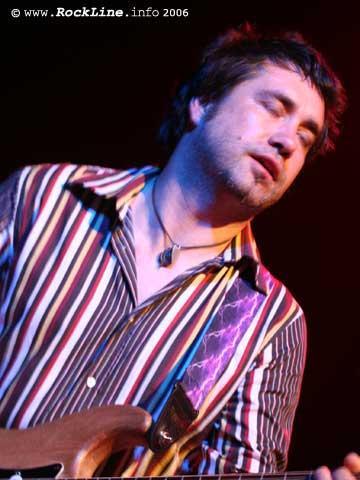
By then the atmosphere before Fish’s set was fully heated up, and we waited impatiently for him to appear on stage with his band: longtime guitarist Frank Usher, second guitarist Andy Trill, keyboardist Tony Turnell, bassist Steve Vantsis and drummer Dave Innes, who recently replaced John Tonks. His decision to have two guitarists in the band was no surprise, since he reportedly wanted to add different, extra textures on guitar and so rework the Marillion classics and his own solo material a bit. Definitely a good move, because I didn’t even want Fish to play the whole of “Misplaced Childhood” as a perfect copy of the studio version. This progressive move of his, adding some of his own band’s soul to it, can only be applauded.
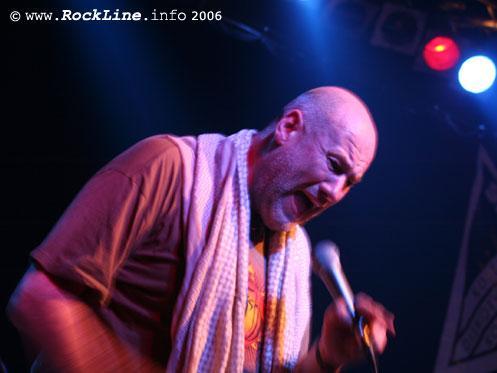
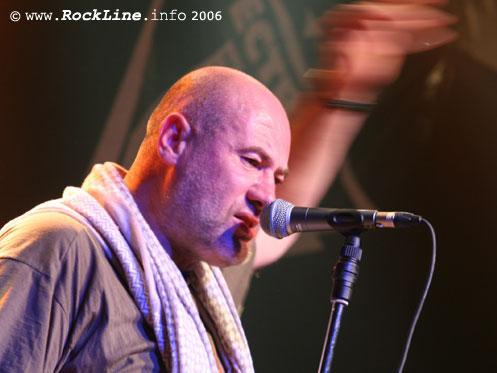
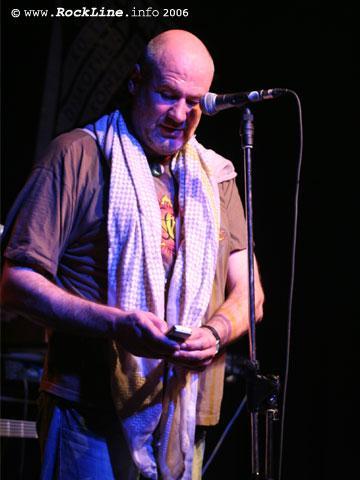
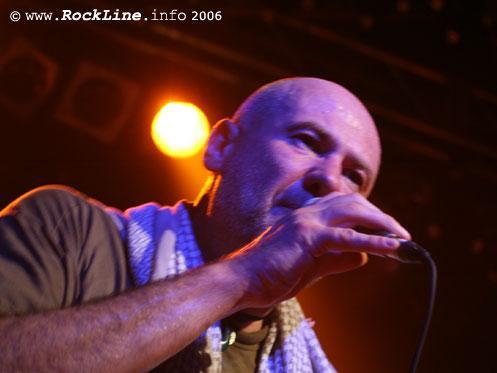
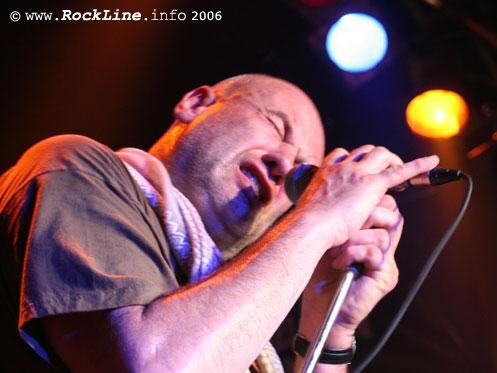
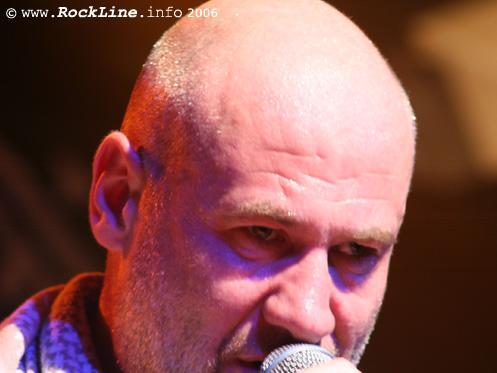
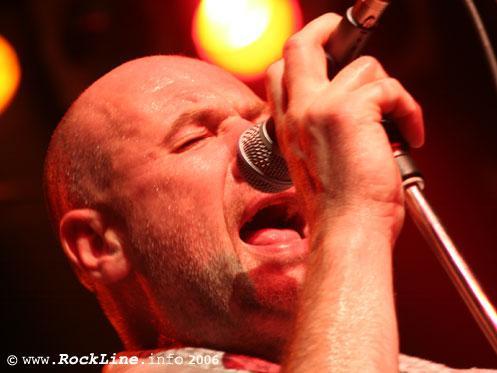
Fish strode onto the stage wrapped in a Palestinian scarf, his obligatory accessory since his first live performances with Marillion. That’s also all that’s left after all these years of his “Gabrielesque” props, because the guy is, after all, 48 years young, and it would probably be a bit odd if he showed up on stage dressed as the court jester from the Marillion covers or in a Celtic mask like he used to. He opened the show with the wound-up “Big Wedge”, a potential hit from his first album “Vigil In a Wilderness of Mirrors” (1990). Even though the refrain lacked the female backing vocals typical of the studio version, it was played at an outstanding level, and we in the audience more or less made up for the backing vocals anyway. Fish proved right away that he’s an excellent stage actor who completely immerses himself in the performance, and he won all of us over with his direct and genuine connection with the audience. During the more progressive “Moving Targets” (Field Of Crows, 2004), for example, at one point he mimed shooting a rifle and wrapped himself completely in his Palestinian scarf. Among the instrumentalists, I was most impressed here by bassist Vantsis with his grooving bass line, and this is also where Fish first showed his dramatic side in the singing, which has hardly faded over the years. The dramatic instrumental outro of the song served up the best of what makes Fish and his band great. After this song he also didn’t forget to mention his “new friends from Slovenia,” and the audience’s attention turned our way for a moment. Fish’s hard-rock-tinged prog really came into its own on the excellent “Brother 52” (Sunsets On Empire, 1996), where in the middle of the set he got everyone laughing by phoning his father, who was just celebrating his birthday, on a mobile during the instrumental section. Before he called, Fish gave us “instructions,” and when he gave us the nod we sang “happy birthday”. Making phone calls mid-concert is a trick Ian Anderson (Jethro Tull) likes to use in particular, but Fish’s very witty gesture felt completely genuine. This song’s closing instrumental part was especially pleasing, with a Celtic touch, something Fish likes to use in his songs, and it’s where both guitarists, especially Trill with his soloing, wowed us for the first time. From “Sunsets On Empire” came “Goldfish and Clowns” next, a mid-tempo song that impressed with Fish’s vocal acrobatics, especially the shifts in his tone of voice, plus excellent solos from both guitarists. The high point of Fish’s solo set list was undoubtedly the excellent performance of “Raingods Dancing”, the central part of the epic “Plague of Ghosts” (Raingods With Zippos, 1999), which is split into six interconnected songs that would make a 25-minute epic if recorded in one piece. It’s definitely his most ambitious solo work, as he also said during the interview. With its dramatic refrain and epic line, this song really lifted the atmosphere in the hall. Lead guitarist Frank Usher wowed us again here with his superb and original solo. This is my favorite Fish solo track (really the whole suite, but this is simply its best part), so I was especially glad they played it. “Raingods Dancing” flowed straight into the closing part of the suite, “Wake Up Call (Make It Happen)”, which closed the suite just like on the album. That song caused an anticlimax of its predecessor, and with its Floydian passages on guitar and keyboards it sent the atmosphere in the hall drifting off into another dimension. That way Fish let everyone who doesn’t know him as a solo musician understand that he’s more than capable of creating progressive epics whenever he feels like it. During “Innocent Party” (Field Of Crows, 2004) his hard rock elements came to the fore again, since this song is one of his heaviest and at the same time has an exceptionally epic refrain. In that, it’s already on the edge of prog metal. I could say almost the same about “Long Cold Day” (Fellini Days, 2001), which has an extremely raw guitar sound before its mood changes completely. Here Fish showed off his wonderful, deeply personal interpretation, which at the time the song was written was probably the result of a broken heart. “Credo” (Internal Exile, 1991), one of his most popular solo songs, was a wonderful close to the first part of the show, with the main refrain building until all the musicians left the stage, led by Fish. The crowd chanted “Credo” together and Fish was very pleased with the response. He then handed the singing over completely to the crowd while he himself left the stage. The band members gradually followed his example, each continuing the rhythm on his instrument while the crowd sang along. The last one off the stage was drummer Innes, who almost treated himself to a little solo spot, since the energy of the audience had clearly pulled him along. Fish made a very clever move. He split his show into two parts. In the first he played his best-known solo pieces as a warm-up, especially the ones with more hard rock punch, which warmed the audience up thoroughly, and he saved the best, that is the performance of “Misplaced Childhood” and the other Marillion classics, for the second part, when the mood was already well heated. That way he managed to keep the attention of those who don’t know his solo work well and left them in tense anticipation of the main part of the show.
The climax of the show was approaching and the atmosphere in the hall reached its peak. Rossini’s “La Gazza Ladra” was the taped intro that told every Marillion “connoisseur” that now it was getting serious. The dramatic keyboard opening announced the start with “Pseudo Silk Kimono”. In all his vocal melancholy, Fish opened the stage in the best style for the next song, one that’s also known by plenty of people who don’t otherwise know Marillion’s music and move in more commercial musical waters. What followed was “Kayleigh”, the band’s biggest hit and also their best-known song. The crowd exploded with excitement then, and I was very surprised that most people in the front rows knew almost the whole album’s lyrics by heart. Here Trill managed to catch Rothery’s spirit completely in the central riff and solos, while Usher impressed with his solo additions that aren’t on the original. This song is simply made for Fish and perhaps reflects his personality in the best way, or at least the Fish we’ll remember from Marillion: the “obscure, broken-hearted Scottish poet”. “Lavender” followed, another big hit, where Fish delivered one of his best vocal moments of the whole show. It’s interesting how noticeably his voice became even more dramatic and immersive when playing the Marillion classics than it was in the first part of the show. For a moment, if you closed your eyes, it really felt like you were at a Marillion gig in the mid-80s, despite the addition of one more guitar. The dramatic “Bitter Suite” came next, where in the intro Fish’s acting skills and his exceptional recitals came into full force. As he sat hunched in front of the drums at the start of the song, holding his head, he really looked like a wreck of a man whose heart had just been broken. I was especially curious how the guitarists would fare on this excellent epic, since they had the tough job of reviving the magic of Rothery’s unsurpassed atmospheric solos. Both surprised me very positively. One of the highlights was definitely “Heart of Lothian”, which Fish sang the way only he can, completely faithful to the studio version. The other musicians impressed especially in the melodic passage, particularly the keyboardist and both guitarists, who harmonized very successfully with each other in the solos. We sang the main refrain together, and here Fish tested for the first time which half of the audience was more “in it”. Two shorter but extremely atmospheric songs followed. The dramatic-to-the-extreme “Waterhole (Expresso Bongo)” really stirred up the atmosphere in the hall, while “Lords of the Backstage” ratcheted the tension up further with Fish’s vocal theatrics. The tension suddenly let go with “Blind Curve”, played in all its epic grandeur. Both guitarists wowed us again with the solos that Rothery used to play back in the day. During the central melancholic part, Fish once again impressed with his singing and acting, as in the recitals “I’ve never been so wasted” and “I can sense a child” he once more portrayed a man whose world is collapsing in front of his eyes after he denied the child within him. The part where he built up the word “childhood” was especially dramatic, followed by an excellent keyboard solo from Turnell in which he managed to capture the spirit of Mark Kelly while adding something of his own, just like both guitarists. For me, “Childhoods End?” was definitely one of the highlights. It’s one of my favorite Marillion songs, and every time I hear it, its atmosphere hits me hard. It sounds like that honest revelation when a person rediscovers the child they denied within themselves and realizes that childhood never ends: “there’s no childhoods end!” “White Feather”, with its optimistic mood, outstanding message (one of Fish’s best lyrics) and the building of the main refrain, closed out the unforgettable rendition of the legendary album. For me it even exceeded all expectations. “They call me the Fish” and then came the temporary farewell.
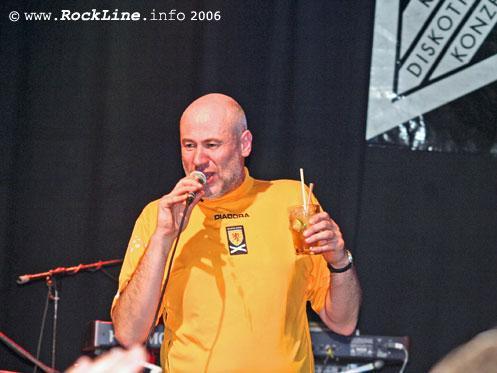
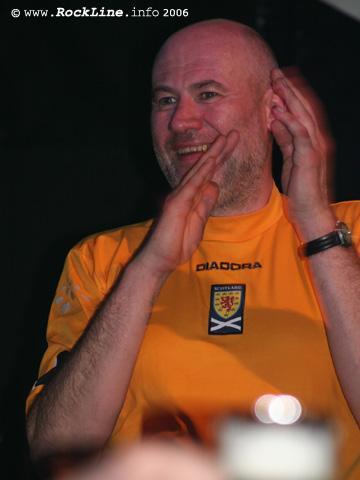
Soon the first encore followed, with two unforgettable Marillion classics. Fish came back on stage dressed in a Scotland national football team jersey and wondered aloud how it was possible that most of the locals, meaning Germans, wouldn’t be able to afford to attend this year’s World Cup, which is being held in their own country. He dedicated the next song, which is about the pitfalls of fame and too much drinking, to all the football fans and drinking buddies in the hall. It wasn’t hard to guess which song he meant, and “Incommunicado” (Clutching At Straws, 1987) followed, which with its extremely wound-up rhythm
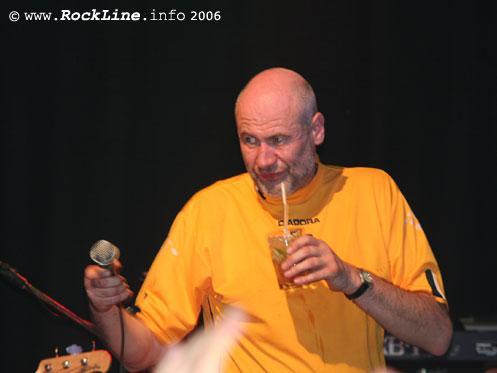
raised the temperature in the hall again. As Marillion’s wittiest creation, every time I listen to it, it paints that unforgettable video in front of my eyes, in my opinion their best, where Fish shines as an actor in the role of a drunk, and at the end all the Marillion members dance a round dance, arm in arm. And so it went this time too, except that as the song closed and the main refrain built up, Fish and the band danced the round dance with glasses full of cocktails, which were plentiful as the waitresses walked from the stage to the bar throughout the whole show. The vibe of “Clutching At Straws” was thus perfect. The youngest attendee of the show also got his moment in the spotlight then: Teodor from Romania, whom Fish invited right up on stage and handed a microphone. On top of that, it was a very symbolic gesture that fit perfectly with the concept of “Misplaced Childhood”, of forgotten childhood, and so in a way this boy brought the main character of this album back to life, the one Robert Mead drew on the cover. Hm, or maybe it’s just me looking for symbolism in everything? The direct continuation followed with “Marquet Square Heroes”, Marillion’s legendary first single from 1982. With its first bars and the burst of energy that followed, even those “sleepyheads” in the front rows, who had by then gone still from exhaustion, finally came to life. A guy next to me, who had been fairly stoic for most of the show, suddenly started jumping and singing. With these two classics I’d especially praise the keyboardist, who managed to catch the authentic Kelly keyboard sound from the 80s. A second encore followed with the unforgettable epic “Fugazi” from Marillion’s album of the same name from 1984. The performance of this epic was top-notch and unsurpassed in all of Fish’s dramatics, and it’s hard to describe in words. He simply couldn’t have picked a better song to close the show, and when it was over some of us still stayed put, hoping for yet another encore.
What is there left to say after all this? Even though the guitarists didn’t quite manage to capture Rothery’s sophistication, they impressed with their almost flawless technical delivery and original additions to the solos. Fish’s decision to have two guitarists, which changed the basic sound of the songs while adding something new to them, turned out to be a smart one. Fish also completely convinced us. After all these years he’s still in excellent vocal form, and his voice has lost only a little of its former color. All you can barely notice is that over the years he’s lost some of that dramatically villainous edge, which he’s replaced with maturity. He never runs out of stage charisma, either. His recitals in the middle of individual songs were a special experience too. I can say that the performance of the legendary album exceeded all expectations. The same goes for the whole show. The audience’s response was decent despite the chairs and the constant pouring of drinks during the set. The euphoria always stayed within reasonable limits and any shoving was out of the question, given that the crowd was made up of people of mature years. In some cases they even surprised me positively with their reaction. And not only during the Marillion classics.
The legendary concept came to life again before our eyes. Every Marillion fan should attend a Fish show at least once, because besides the unforgettable solo performance and the very likable solo works, he still plays, in top-notch fashion, pieces that Marillion probably forgot how to play long ago. This was a show that we at RockLine will remember for a long time and keep in the best of memories. I simply can’t find enough words to describe all the impressions that stayed with me for days after the show. I certainly hope this was only the beginning of our concert-going and friendship with the “father” of neo-progressive rock: a Scottish giant with a gentle heart and a sharp pen. All thanks for the unforgettable experience before and during the show go to this great musician with an even greater heart. And for all of you who wanted to attend this show but had to skip it for one reason or another, take this as a consolation: “there is no childhoods end!”
author: Peter Podbrežnik
photos: Bojan Horvat
1.) Big Wedge
2.) Moving Targets
3.) Brother 52
4.) Goldfish and Clowns
5.) Raingods Dancing
6.) Wake Up Call (Make It Happen)
7.) Innocent Party
8.) Long Cold Day
9.) Credo
—end of first part of the show—
10.) Pseudo Silk Kimono
11.) Kayleigh
12.) Lavender
13.) Bitter Suite: Brief Encounter/Lost Weekend/Blue Angel
14.) Heart of Lothian: Wide Boy/Curtain Call
15.) Waterhole (Expresso Bongo)
16.) Lords of the Backstage
17.) Blind Curve: Vocal Under a Bloodlight/Passing Strangers/Mylo/Perimeter Walk/Threshold
18.) Childhoods End?
19.) White Feather
—first encore—
20.) Incommunicado
21.) Market Square Heroes
—second encore—
22.) Fugazi