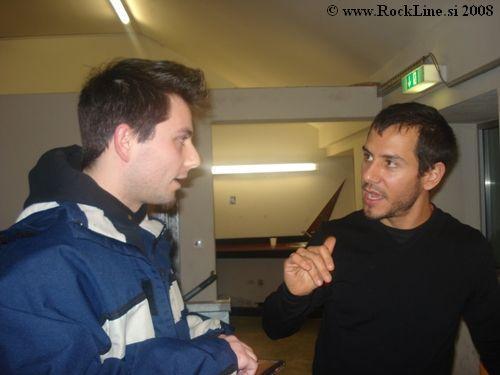
Author: Rok Klemše
Location: Arena, Vienna
Interview date: 07.12.2008
Last year, the legendary American band Cynic reunited after fifteen years, hit the road on a reunion tour and earned huge praise from fans and media alike. This year, fifteen years after the groundbreaking album Focus, they released its successor, Traced in Air, and played it live on tour with Opeth. The closest they came to us was Vienna’s Arena, and before the show I got the chance to interview the band’s leader, guitarist and vocalist Paul Masvidal. All I can say is that this was the most pleasant interview I’ve ever done, and Paul is an incredibly easygoing guy to talk to, open and down to earth. Judging by how he answered my question about all the reunions the fans keep getting, I don’t think he fully realizes just how big a band Cynic are, or how big a presence Paul and Sean are in the eyes of the fans.
RockLine: So, Cynic are back after 15 years. Why did it take so long to get back together and return?
Paul: Simply because we didn’t want to come back. We had closed and sealed that door, and I never wanted to open it again. What actually happened was a totally cosmic thing, over the span of two weeks, a year and a half ago, when Cynic came back into our lives. You’ve probably seen in other media that it all started with a dream of a Russian fan, who emailed me to say he’d dreamed of seeing a reunited Cynic play at a festival, and that he hoped it would really happen someday. Two weeks later, Cynic showed up. I remember that I just finally surrendered to it and felt capable of doing it. I called Sean and told him I thought the time had come, and he understood me completely. We got to work, and at first it was just a reunion, a way to reintroduce Focus to people. The album is a whole other story, one we can still touch on.
RockLine: In the meantime, you and Sean were active in Portal and Aeon Spoke.
Paul: Yeah, Portal was actually the end of Cynic. The Cynic album came out in 1993, we spent the next two years as Portal, and in 1996 we split up. That was kind of the post-Focus era. I then moved to Los Angeles, where I got into film music and music for TV series. I basically became a studio composer, with no intention whatsoever of ever going back to writing albums. After all those years of doing that, I started writing songs again, which happened as a totally natural process and led to Aeon Spoke. We put out our latest album last year, and in between we got back together with Cynic, so now I’m juggling both, but it’s been an incredible journey.
RockLine: During the years Cynic were dormant, there were countless pleas, wishes and demands for Cynic to come back. Did you ever feel obliged to fulfill those wishes, or was Cynic entirely in the hands of you and Sean?
Paul: For me, what matters is that you truly feel what you’re doing. It’s one thing to want to please the fans, but if you’re not sincere about what you do, the fans will know. If you’re not telling the truth, why even bother? For us it had to become genuine again, which is why it took so long: we simply didn’t feel Cynic. But now Cynic are here again, and it feels completely natural, like they’re part of my body. Obviously the time was right.
RockLine: Did you know from the start that you’d record albums, or did you decide that during the reunion shows?
Paul: Yeah, partly. But when we got back from the Eastern European tour in October 2007, I already had a new song, Evolutionary Sleeper, ready as an experiment. The shows and the energy at them really left a mark on me. I went home, sat down in the studio with a guitar and felt like an antenna had shot into my brain, and it was simply the Cynic radio station. All the songs were written within nine months, and then the record was recorded, but I didn’t feel like I wrote it, I felt like it wrote me. I had to stay open to the creative process, and the experience was truly incredible. That was it. When I showed Sean a few ideas, we both realized we had something again, something really good and new that was Cynic. That was enough for me to decide we’d go all in.
RockLine: In the past year or two there have been countless reunions of old bands, even obscure ones that broke up ages ago. What’s your take on that? Do you think it’s good that younger fans get to discover the music of old bands, or is it just living off past glory?
Paul: I think it totally depends on the individual band and their intentions, whether it’s just about the money, or they want to relive the old glory, or they genuinely want to relive old memories. Who knows? I really don’t know why so many bands are coming back, but it’s a real phenomenon, and it’s specifically bands from the early days who are returning. It’s probably just that one band came back and that inspired and encouraged the rest. I think most bands, especially from the Florida scene, don’t even realize what kind of legacy they left behind. For us it was a thing of the past, and we don’t even look at it that way.
RockLine: How would you compare the old Florida death metal scene with today’s scene?
Paul: I don’t know, even back then there was a ton of garbage and a ton of great bands, just like today. It’s just that there’s way more of everything now: a few really good bands and even more mediocre ones. That seems to be the nature of metal, or any genre, but I think the standards are higher today, and a lot of bands are pushing things in even more extreme directions, which is honestly incredible, because even back then we were wondering how this could possibly get any crazier, and it’s still happening. I wonder what it’ll be like in 2030 (laughs).
RockLine: How do you look back today on working with Master on On the Seventh Day God Created… Master and with Death on the classic Human?
Paul: Human was a historic collaboration between me and Chuck. We’d already been playing together back when I was in high school, and I also played on the tour for Leprosy and Spiritual Healing, so we’d known each other since we were kids. Master was a one-day thing. Scott Burns produced their record and called me for help, since they’d just fired their guitarist, and asked if I could fly in for the recording. I actually flew in and recorded all the guitars in 24 hours. Human is a fond memory, because it was a long journey and a creative collaboration with Chuck. It was really fun.
RockLine: Would you say you and Sean pushed Chuck into more technical waters on Human?
Paul: Yeah, absolutely. I think that’s exactly why he asked us to work with him, because he knew we were jazz nerds, younger, and open to different approaches. I think it was Sean’s drumming and his interpretation of Chuck’s riffs that changed everything, because the previous Death drummer was a classic death metal drummer.
RockLine: Were you ever surprised by the metal crowd’s reaction to Cynic, considering you actually come from jazz, fusion and seventies progressive rock?
Paul: Yeah, of course. I put my whole self into Focus, and it’s great to see that kind of response and love for the music, because it’s such an important piece of work for me. When people understand and embrace something you’ve made, it’s one of the best things for an artist. Even though in the end we do it for ourselves, it’s nice to hear how people react. It also helped that a ton of bands were inspired by Cynic, and when bands say so, they’re speaking to the fans too.
RockLine: Would Focus have sounded different if the hurricane hadn’t destroyed all the recordings, and without the other troubles that dogged the recording and release of the album?
Paul: Yeah, definitely. Focus is the sum of several factors, from the hurricane to the fact that our gear got left behind in Europe after the Human tour. That hurricane was the biggest one ever to hit south Florida, and it left us with a year to grow and become even better. It was a really important year for everyone involved in Cynic. The hurricane was actually a blessing in disguise. We too rarely realize that chaos is a blessing.
RockLine: Did you ever think about disbanding Cynic back then?
Paul: Of course, we had a truly huge amount of trouble. Cynic was such a big part of life for Sean and me that we often wondered what else there was beyond it, who I am and what my life is. Those questions bubbled up to the surface a lot, because we didn’t know anything but the band, and sometimes you want to live a life without that structure. I think that’s what was decisive in ending Cynic. At some point you just get sick of the music industry and want to live a different life.
RockLine: So this time, the decision to release the new album on a smaller label, Season of Mist, was entirely yours?
Paul: Yeah, we had seven offers, some from major labels, and Season told us we’d be a big fish in their pond. That suits me much better than being a small fish among the rest. These days labels are only part of the deal, since a lot of bands do much of it themselves and work together with the label. I look at labels differently now, and I think the perfect label doesn’t exist, they’re all flawed and hopeless. But some are better and have cleaner intentions than others, and it certainly doesn’t hurt that the president of Season of Mist is a huge Cynic fan.
RockLine: Did it bother you that some fans simply expected Focus number two?
Paul: No, people will always want what they want, and Cynic have always been a band that wants to be remembered as a great band that didn’t bow to the rules, wasn’t stuck in the mold of a single genre, and could do whatever it wanted and write songs however it wanted. That’s the kind of freedom we want. I never want to repeat myself.
RockLine: I think most Cynic fans get this, maybe more than the fans of any other band.
Paul: Exactly. Some of the more extreme death metal fans accuse us of drifting away from death metal, but there’s nothing wrong with that, since we were never really part of it.
RockLine: Over the years you’ve had a huge number of lineup changes. Is it hard to record an album with, say, Sean Malone, who only did one tour with you, and then play live with someone else?
Paul: Sean is a complex person, just like all of us. He’s definitely not a touring guy, and that’s our decision, because a person has to be ready for the road and we weren’t convinced Sean was. But he’s an incredible musician and works great at the recording level, both for Focus and for Traced in Air. The core of Cynic was always Sean and me, and that works no matter what. Right now we have what I think is the strongest lineup yet, the guys are great.
RockLine: So how did you actually find Tymon?
Paul: I’ve known him for a while, and our little Cynic world too. We’ve been email buddies for ten years, and at first I didn’t even think of him when I was looking for a guitarist, someone who could also growl. Then my buddy Aad from Epica mentioned Tymon, so I wrote to him to ask if he was interested, and he immediately replied YES (laughs). He and Robin play together in their own fusion group, and both of them are truly incredible musicians.
RockLine: How do you react to the rare negative reviews of Traced in Air that attack the album’s length, saying that after fifteen years you’ve put out an album that’s only half an hour long?
Paul: The length of the album was calculated, it wasn’t that we didn’t have enough songs. We actually recorded one more song that didn’t make the album. Personally, I prefer concentrated, short, intense music. I don’t like three-minute guitar solos, although sometimes they can be fitting, but Cynic have always primarily served the songs rather than showing off technical chops. The music is so structured, powerful and layered that even though it’s short, I always recommend that Cynic fans keep listening, because there are surprises waiting. The songs still surprise me too. The picture is really dense and deceptive at the same time, because on the surface you hear songs that hide much more inside. Just yesterday a fan in Munich told me he can play the whole of Focus, but the songs from Traced in Air are giving him trouble, and I thanked him for noticing, because I think a real musician notices that the new songs are even harder and more complicated.
RockLine: That’s why so many musicians respect Cynic.
Paul: Exactly! I don’t want to be a technician, I just want to make good music.
RockLine: Cynic draw inspiration from Eastern religion, philosophy and mythology. Did that come to Cynic because you practice yoga and meditation, or did you arrive at those insights through Cynic?
Paul: Yeah, that’s how I grew up. My mom was a kind of new-age hippie, and I’ve been interested in the esoteric and the spiritual since I was young, and I think it’s a big part of life. If I write lyrics at all, they’re going to be about that, because it’s just natural for me. I think the new stuff is more grounded, more Buddhist than Hindu and more psychological, but there’s a lot of honesty and nakedness in the lyrics, and I think that’s as it should be.
RockLine: How’s the tour with Opeth going, and how did it actually come about?
Paul: The tour is going really incredibly. The shows are fantastic, and I think Opeth have very open-minded fans who appreciate intensity and melody, so they overlap with Cynic fans. A mutual friend introduced me to Mikael, and then I suggested touring together.
RockLine: One last question about the future of Cynic. Another album, and another reunion sometime down the road?
Paul: It’s definitely not a reunion thing anymore, not a one-off. The wish is to keep moving forward. I don’t know how or when, I can only think about today. But I feel open to both Cynic and Aeon Spoke, and I think I can do both projects. I feel great on stage these days and I’m enjoying the work, and as long as I have that, I don’t see why we wouldn’t keep going.
RockLine: That’s it, Paul, thanks a lot for the interview, it was an honor.
Paul: Thank you!
Photos: Nina Grad
Photo Gallery