Location: Ljubljana / Kino Šiška / Slovenia
Interview date: 15.02.2011
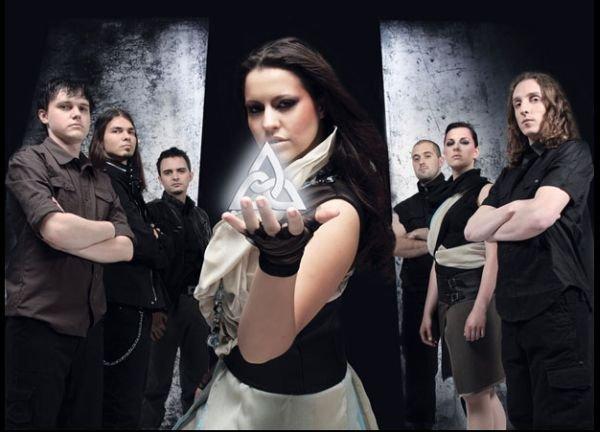
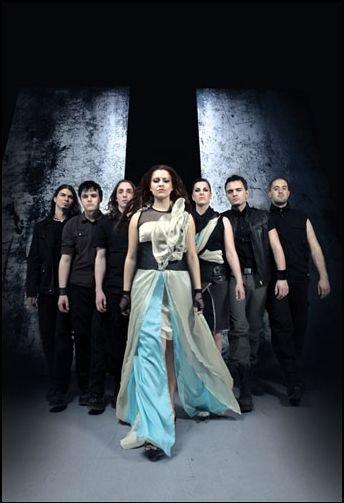
Aperion are real oddballs of the Slovenian music scene. They’ve just given birth to their studio debut “Act Of Hybris” (RockLine review HERE), which took several years to shape into its final form. It was worth every minute of the wait, because this is an outstanding artistic achievement that fills a genre gap in Slovenia when it comes to gothic symphonic folk. And then some. Aperion, as the band’s name itself hints, don’t limit themselves to one genre. This is a band that loves to experiment and, in doing so, loves to surprise in a good way. There are eight musicians in the lineup! Aperion know nothing of synthetic makeup like keyboards. Their richly layered sound is organic through and through, and the red thread of the band’s authentic musical statement keeps the level of theatricality, motivic variety and dynamics demandingly high.
RockLine: You’ve released your studio debut. It took several years to come together, and the songs grew and transformed into a final shape that’s quite different in many ways from the versions of the first originals. How would you comment on this gradual development and on the very beginnings of your debut?
Črt: We already had material back in 2005 that we wanted to record, but it never happened. So we kept reworking the material the whole time. The overall overhaul only came later, though, at a point when things had matured enough that we knew an album recording was around the corner. We reshaped the oldest songs especially and breathed some freshness into them. That’s also when it became totally clear what kind of sound we wanted on the album. We needed half a year just to rearrange some of the songs. That was in the stretch right before we actually went into the studio.
Zala: I joined the band in 2005. When you join a band, you obviously spend some time finding your place at first. The first phase of reshaping the material was of course tied to my arrival in the band, and the second to the period right before the album recording. The lineup has stuck together for four years now, and in that time we’ve strengthened our relationships even more, found a common language, and we know much better today what we want from our music than we did at the start.
RockLine: Your studio debut has some seriously powerful and clearly polished moments musically. You can tell you spent a long time honing the arrangements. For a debut, the album reaches a high quality standard. It manages to combine a bold level of motivic variety with a clear, compact red thread in the same breath. The song Shine, for example, is a case of exceptionally graduated mood-building, dramatic escalation,…
Črt: Shine is actually the youngest song on the album. It marks the point on which we’ll keep building our music. From here on we’ll be building our future musical vocabulary. It also went through the fewest revisions of any song on the album, which of course shows that over these five years we’ve matured enough that the newest song reached its final form quickly, since our focus on what we want is much clearer than it was a few years ago. Let’s just say we’re more experienced.
Zala: I felt totally at home with the vocals here too. As a trained musician, I bring operatic vocals into rock music. As an opera singer, a song like Shine suits me extremely well.
Črt: Since Zala joined the band, we’ve written only five more songs. Those five are tailored to her voice, while the rest were reworked. They were written back in the days of the previous singer, who had a completely different vocal color. That took quite a lot of work.
RockLine: You can feel the Slovenian-ness of the album. Some of the folk moments you include in the arrangements give it a flavor where you can tell right away it was made in Slovenia. Of course it’s natural that we Slovenes write music like this, but still. Did you use any specific folk motif and build it into the music, or are those nicely placed decorative folk touches entirely your own ideas?
Črt: It surprises me to hear someone say you can tell our music is Slovenian. I haven’t come across that so far. Everyone says exactly the opposite.
Zala: Actually, you could say that about two songs. Dajte and The Truth. Those two are the most Slovenian, the rest less so.
Črt: Dajte is a folk song that we reworked and turned into our own track. Hence that feeling.
RockLine: Fairytale Mind is a song whose melody gets under your skin instantly.
Črt: The Slovenian version of that song is called “Uspavanka”. We’re actually in talks right now to release exactly this song as a single. It’s a shame we don’t have a Slovenian version of it ready at the moment. We’ll try to break through with the English version first and see how it fares. At concerts, though, we still play the Slovenian version today. I mean the shows in Slovenia.
RockLine: Right after it on the album comes a song from a completely different batch. It’s called Black Flies. You’ve worked a didgeridoo into it.
Zala: We absolutely love that instrument.
Črt: Yes. We’ll use the didgeridoo in the future too, for the new album, on a song or two. Even though it gives just one single tone, you can do whatever you want with the rhythm.
Zala: And the sound of that tone is unique.
Črt: Yes. That sound carries you off somewhere far away,…
RockLine: One of the phenomena of Aperion is that you don’t use keyboards.
Črt: Instead of keyboards we use classical instruments. It simply looks nicer when you glance at the stage. We’re believers in natural sounds, coaxed out of classical instruments. Synthetic stuff really isn’t close to our heart. It doesn’t belong in our music.
Zala: From my standpoint as a singer, I can confirm that the cello and the voice are very similar to a large degree. You have to play it by ear, and on top of that it’s the most emotional instrument. The piano certainly too. The cello, and the viola as well, are even more emotional instruments… The cello is also really hard to play, it’s a very romantic instrument.
Črt: You feel the cello more. For a simple reason. If you want to play it, you have to put it between your legs and literally embrace it.
RockLine: There are eight of you in the band. Does it ever happen that you quarrel or have a harder time getting on the same page about goals, or about some musical idea?
Črt: We don’t write songs the way a typical rock band does, where you come to rehearsal with a riff and tell the drummer to play along. Martin, our violist, and I come up with ideas and record them at home. We add the necessary computer samples and “click together” everything from the drums on… Once we have a solid demo, we meet at rehearsal and try to play it, to see how it actually works live, how it holds up. Afterwards each member adds a bit of their own ideas. So the first basic idea comes from one member, who prepares a sketch as an MP3 file. Then the band polishes the track together until it’s done. There are always some changes after the fact. There are quite a lot of ideas, after all. Of course, it depends on the situation. It doesn’t always run like an assembly line, sometimes disagreements pop up too, but that’s normal in a collective like this anyway.
RockLine: You’ve always been skilled at building your outward image too, especially on stage. It’s well known that dance groups take part in your concerts. When did you sense the importance of these two attributes in your musical artistry?
Zala: The collaboration with the dancers is a special project. The dancers’ choreography is the work of Goga Erjavec, who runs the Celjski plesni forum. The costume design for our band and for the dancers is the work of my sister Nataša. Nataša is our stylist. Besides designing our outward image, she was also in charge of designing the CD. We’re a theatrical band and our concerts are meant, in quotation marks, as kind of theater performances too. So people shouldn’t come to the shows just to listen to our music, we want to offer them the whole spectacle in one. This idea worked out great, and for the future, if we get to go on a bigger tour, we’d love for our shows to be made up of these two segments. As far as theatricality and costume design go, those two elements have been at the top of our list from the very beginning, so we take them very seriously. Looks matter a lot. With your appearance and your acting facial expressions, you hint at what you want to tell someone. Besides our acoustic concerts and our electric ones, meaning the rock shows, the collaboration with the dancers is the third segment of our live activity. The Ionosfera project, that is.
Črt: The idea for Ionosfera came up while we were chatting with one of the dancers about the possibilities of working together. More as a joke than seriously. Soon after, the director of the dance forum called me and asked me to send her our music, saying they were already working on the scenography and getting ready. We didn’t think or ponder much about it, it just happened by itself. And those things are usually the best.
RockLine: How did you get in touch with the legendary Finnish producer Mika Jussila?
Črt: Mika took care of the mastering. Martin (Martin Bezjak, viola, Aperion, editor’s note) and I did everything on the production side, and Martin mixed the album. We were blown away by the mastering of Nightwish’s album “Once”. We definitely didn’t want to model ourselves on that band’s music, but on the final master of the album. Martin dug around to find out who was responsible for that sound. Mika Jusilla. We got hold of his contacts and asked if he was interested. He agreed and we sent him the material. We’re very happy with the result. We’re also happy for the simple reason that working with any other producer handling the mastering of our record would probably have fallen short of our needs and wishes. Mika has incredible mileage behind him. He did the job at lightning speed. He did a preview of the album in one day, and within a week he sent us the final master.
RockLine: So the world abroad demands Aperion and is calling for you.
Črt: Yes. We’re working on it and putting all our energy into breaking through abroad. The album, which came out in Slovenia last autumn, will be released in German-speaking countries on 04.03.2011 through the labels G Records and Rough Trade. We’re teaming up with Gordeon Promotions to handle distribution of our album in Switzerland, Austria and Germany. Promotion of the album has been running in the German-speaking countries since the beginning of this January. We hope the album sells as well as possible. We’re also in talks with one of the bigger booking agencies, and since we don’t have official confirmation yet, I can’t reveal its name for now, about heading out on a bigger European tour this April and May. If all of that comes together, we become a European band. That would throw every door wide open for us in the future.
Zala: Right now we feel we’ve reached a level of maturity that demands affirmation on a wider stage. We’re perfectionists and always critical of our own work. Our ambitions are high and we can’t be satisfied with where we’ve gotten after all the grinding. We prepared for Europe for a long time and grew into it. We honestly wouldn’t dare step onto foreign markets with average demo recordings.
Črt: It’s interesting reading foreign reviews of our album. Everyone compares us to the most prominent names of the gothic symphonic metal scene, from Nightwish to Epica to Within Temptation. Maybe they’re taking things a bit too much to heart, since these top bands in that genre have already put out a good dozen albums, while we’re only at our debut. But if things keep going like this, we’ll soon reach the level of recognition of those bands. With comparisons like that right at the start, we’d definitely have to surpass it in the future.
RockLine: On the other hand, that’s rather stepmotherly treatment of Aperion, since your arrangements are more demanding, your sound warmer and far more organic than the instant synthesizing on the albums of the bands cited.
Zala: Yes. The arrangements are pretty demanding and the album doesn’t go straight into the ear. You have to listen to it several times. I remember when I joined the band, the song Uspavanka felt familiar right away, it grew on me instantly, whereas a song like Ü is built so that you need more time for it to settle in your ear. The same goes for Black Flies, for example. On the other hand, it gives you an extra challenge that only fuels you, and that’s very good.
Črt: We don’t compose songs by the classic formula: verse-chorus, verse-chorus, solo, chorus. That mold bores us, to put it mildly. So we try not to stick to that framework, which makes our songs more interesting.
RockLine: How does the partnership between Aperion and the head of the Slovenian branch of Rock Hard magazine, Pascal Rogl, work?
Črt: Pascal is our link to the booking agency, the labels, the distribution. Where Pascal is right now, in Germany, in Berlin, Aperion should be instead of him. He’s our connection abroad, really a window to the world. For that dedication and faith in Aperion, I respect and value him very much. The funny thing is that he hadn’t even heard our music before. He only knew we were hardworking. He’d already been in Germany for two months, and then he decided to help us. Us and the band Dekadent. When Pascal heard our album, he listened to it nonstop for two weeks, he was that thrilled with it.
RockLine: You mentioned a single earlier. When exactly is it coming out?
Črt: It’ll come out together with the European release of the album, on 04.03.2011, with the single for the song Fairytale Mind. I hope Slovenian radio stations will spin it, because for Slovenian bands, especially young and unestablished ones, it’s insanely hard to break through on the radio.
RockLine: What’s behind the title of your record? What does “Act Of Hybris” mean?
Črt: Hybris is a Greek goddess. So, similar to the name of our band, which also comes from the Greek language and embraces the notion of “limitlessness”. Hybris is the goddess of arrogance, haughtiness, egoism. The album carries a red thread running through the questions of good and evil. Of course, the starting target is humanity. “Act Of Hybris” thus means a kind of reflection, a mirror of our attitude toward planet Earth through the actions of humanity. And the actions of humanity actually personify the goddess Hybris. Humanity has done many bad things. Yet there remains hope that things will get better. It’s enough to simply turn toward love.
RockLine: And what about the lyrics of the song Ü? What nation does it belong to?
Zala: None. The verses are completely made up. What mattered was that these invented words fit the music of the song. That’s what we wanted to achieve.
RockLine: A one-of-a-kind idea.
Črt: The lyrics for Ü are completely invented, while for the verses of the lyrics of Urma we used Sanskrit. We allowed ourselves a bit of experimenting there.
Zala: For Dajte we used the Slovenian language, because at its core that song is a Slovenian folk song. It’s only right that the world abroad gets a chance to hear the Slovenian language through this song of ours.
Črt: The funny thing is that for all three songs that aren’t written in English, foreigners think they’re in Slovenian. In reality, only one of them is in Slovenian.
photos courtesy of the official photo archive of the band Aperion
Photo Gallery