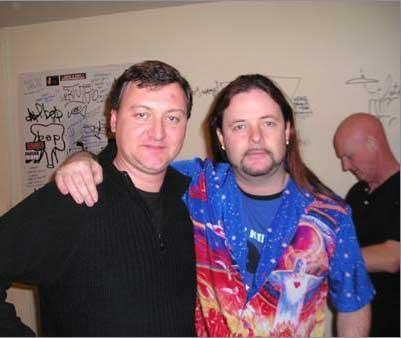
Author: Jernej Vene
Interview date: 24.01.2005
That January evening, the Bavarian capital München was covered in a layer of fresh snow, which the wind often blew around, and on stage the guys uncovered important chapters of their musical history in a similar way, full of fresh wind, you might say. Their attitude to music and performing is proof that they’re artists of a special breed. At the show we got to enjoy a selection of older, proven hits and new songs. Asia sound musically very fresh, and they’re best known for the song Heat of the moment. Asia is led by keyboardist Geoffrey Downes, known from the pop duo The Buggles (you surely remember the song Video Killed The Radio Star) and from Yes. Alongside him is seasoned drummer Chris Slade (formerly of Manfred Mann’s Earth Band, Uriah Heep and AC/DC), the excellent bassist and vocalist John Payne, and the versatile young guitarist Guthrie Gowan, who shamelessly nails every trick his predecessors left behind in the band, especially Steve Howe. This lineup has been playing together for four years, which is a record for Asia, considering that almost fifty musicians have passed through the band, counting the ones who jumped in for a gig or two. Asia are best known for their first two records, which featured guitarist Steve Howe of Yes, bassist and vocalist John Wetton (who played in King Crimson, Uriah Heep, Uk, Family, Mogul Thrash and many others), drummer Carl Palmer of Emerson, Lake and Palmer, and the aforementioned Geoff Downes, who’s still sticking with Asia today. In the beginning Asia were counted among the supergroups, since they were made up of musicians who had already proven themselves as superb artists.
Geoff Downes told us about his musical beginnings:
Downes: “I grew up in a musical family, so it was pretty natural that I’d end up doing music. I started out with classical training, but pretty soon I got interested in the music of the bands from the sixties, like Manfred Mann and that sort of thing. I was into pop music. Even my studies at the academy in Leeds included a lot of modern music and jazz. Maybe some famous musicians who are masters of their instruments don’t need formal musical training. Steve Howe, for example, is an excellent guitarist, and he’s still self-taught. You can get your musical education in different ways, and mine was just like this.”
On the start of his musical career (he played in the band of disco singer Tina Charles):
Downes: “Yes, I played disco, basically anything it took to make a living. I recorded commercials and did guest spots on recording sessions. In between I studied arranging, which helped me with my work on TV ads.”
Where did he meet his future collaborator and today’s renowned producer Trevor Horn?
Downes: “I met Trevor Horn in Tina Charles’s band, where he was the musical director and bassist. We soon realized we had very similar musical tastes. When Tina stopped performing, we carried on working together. We wrote new songs, and that’s how The Buggles came about.”
On the secrets of success for young musicians:
Downes: “That’s very hard to pull off. At the end of the seventies you had to be in London. I come from the north of England, and even though there was a scene in Liverpool and elsewhere, you still had to go to London. Despite the heavy competition, you have to believe in what you’re doing and hope something happens. Back then we worked slowly but surely. But when we got a record deal on the strength of three demos, one of which was Video killed the radio star, we got the feeling that a bright future was ahead of us. At that point we focused only on working in the band.”
On joining Yes:
Downes: “Actually, Trevor’s and my arrival in Yes was a combination of two things going on. Mr. Abrams, who was a music editor at some American radio station, played our music and talked a lot about our work. Even though there are disco influences in Buggles’ music, you can also find elements of hard rock. A kind of electronic pop sound. Then the other angle is that at the time the same team was looking after both Buggles and Yes. Brian Lane, who was the boss, asked us to write a song for Yes. We wrote You can fly from here and recorded it with bassist Chris Squire and drummer Bill Bruford. That’s when things started cooking. Jon Anderson and Rick Wakeman left Yes. Trevor sang similarly to Anderson, and it wasn’t hard for me to play their melodies on keyboards. So they asked us to go on tour with them under the name Yes.”
On the record Silent Nation:
Downes: “It’s livelier than a few of the previous ones, where John Payne, the singer, and I were the main writers. Back then some session musicians helped us out. Now we work more as a team, we want to get closer to the way we worked on our debut, when all four of us collaborated. We don’t want to put too much technology into the production process so the sound doesn’t get too artificial. That kind of process is also better for live shows, because we can play in a more down-to-earth and clear way.”
Singer John Payne spoke about the current pop music on the charts:
Downes: “I like all kinds of music, from classical and opera to heavy metal. The charts full of rap and pop with cover versions aren’t exactly interesting. Lots of covers get recorded these days, but they’re mostly bad reworkings of good originals. That way the whole thing loses its meaning. Sadly, young people don’t know the originals. All those talent contests like the various Pop Idols are disgusting and off-putting to me too. Today’s pop music is shallow, it has no substance. I call it McDonald’s music. Most acts like that won’t be around in twenty years, they’re happy if they last a year. So, today’s hits aren’t close to my heart. In the US and Europe we’re lucky to have the label Inside out looking after us, which supports progressive rock, and that genre has quite a lot of followers around the world. The Canadian band Rush played one of the biggest European tours last year. Yes also had well-attended shows. Dream Theater are one of my favorite bands. It’s good that this kind of music doesn’t want to be trendy. Of course there’s a market for classical, punk or progressive rock. But middle-of-the-road pop strikes me as pretty rotten.”
What Geoff Downes thinks about the current state of the music industry:
Downes: “The music industry is definitely not what it used to be. It’s completely changed shape. DVD is a strong format, and there are lots of reissues of old records with extras. All of that changes how people follow music. The internet has changed people’s awareness of how they take in new music. People don’t go to record shops anymore for new records by particular artists, they buy music in department stores, like they’re buying a cardigan or something. They used to go to a music shop on purpose to buy a particular record. Today the music industry has already melted into the general consumer industry. But it’s not my place to say whether that’s right or wrong.”
Many artists have a lot of songs in stock before they start recording. What about you?
Payne: “For the Silent Nation record we had fifty to sixty songs ready before we started the real recording. Then we went through them and found one or two that we felt represented what we’re looking for as our current musical direction. The rest of the songs we save on the computer and rarely use later. I produced Silent nation myself, I helped with the songwriting, and the producing and technical work was a big challenge for me, even though it was exhausting.”
Downes and Payne talked about balancing work with family life:
Downes: “Obviously, personal relationships are a complicated matter. Our lifestyle is very different from that of ordinary people. But you get used to everything.
Payne: “The hardest thing is keeping a relationship going. If you’re away from home most of the year, it’s hard to have a family. Our cycle is record-tour, record – tour, and it’s very exhausting.”
On the huge success of the first record, titled Asia, from 1982, and its impact on Geoff Downes:
Downes: “That record affected everyone’s lives. When a new band steps onto the scene and has an extremely successful record like our debut, it leaves its mark. Differently on everybody, but we hadn’t expected that kind of success. We got used to it quickly, though. We couldn’t control the situation, it was like a huge avalanche. Our manager helped us there, he had experience with Yes and knew how to hold a band of big stars together. We had huge sales, Heat of the moment was a big pop hit, which surprised everyone. Even less demanding listeners heard us, because the song burned itself into their subconscious since it was played everywhere all the time.”
What kind of audience comes to your shows?
Downes: “They’re mature people, no screaming teenage girls among them, which is a shame. But mostly our listeners still have their own teeth.”
Has digital technology helped you create music?
Downes: “Not really, actually I never had trouble with it, if I can put it better. I started playing when digital technology was only just developing in terms of use with keyboards. Its real boom began in the early eighties, and I followed it from the start. I was among the first to use the Fairlight sampler, back when I was still with Yes. Technology helps a lot with making music if it’s in the right hands. But it’s become accessible to people who aren’t necessarily musicians. Anyone with a bit of money can get the gear and record an album as their own master. The days of recording in big studios with famous producers are gone. Today the way of working is much more fragmented. The sad thing about digital technology is that the artistic soul died with its arrival. Technology isn’t an end in itself, the person using it is what matters. We use technical aids too, to help us live, but we think the musical foundation has to be played on real instruments. The other elements we just add on top.”
How much influence did the label have on the choice of songs for the record Silent nation?
Downes: “We had complete freedom, so we decided on them ourselves. They relied on us, because they knew we’d make a good record.”
Jernej Vene
Photo gallery