Author: Peter Podbrežnik
Location: Gugl stadion / Linz / Austria
Concert date: 18.06.2007
Attendance: 21
Ticket price: 75.00 €
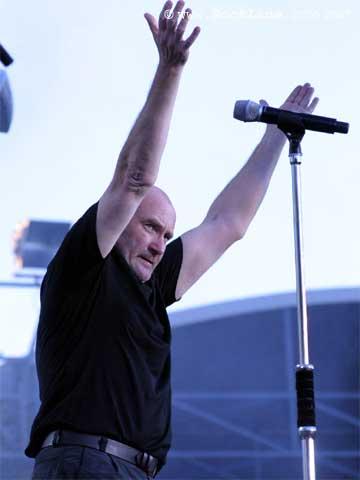
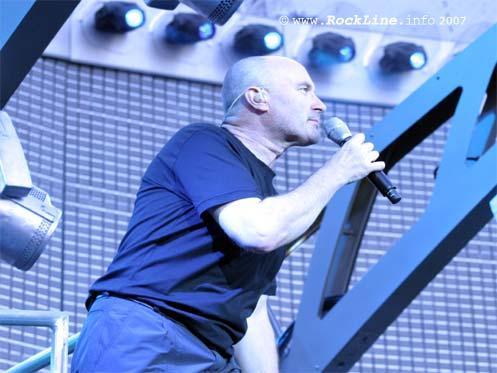
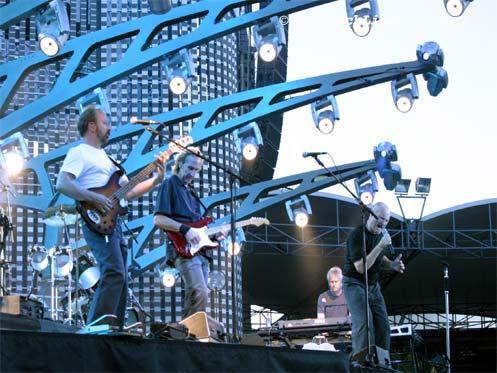
The band, which got its most famous lineup back together after fifteen years for this year’s world tour, managed to pack Linz’s Gugl stadium nicely. The giant stage set and the sound system let the crowd enjoy the show to the fullest. The entire backdrop behind the stage was actually a light screen, and on the left and right they added two big video screens that brought the action on stage up close. Over a thirty-year career Genesis have had two eras, since they adapted pretty thoroughly to the music market over the decades. The gentlemen put the setlist together smartly, giving exactly as much time to the older, more demanding songs from the progressive rock era as to the more melodic, easier-to-digest ones from the eighties. For thirty years now, two exceptional musicians have accompanied the Genesis trio on tour. Drummer Chester Thompson played a convincing drum duet with Collins, while guitarist and bassist Daryl Stuermer shone especially in the instrumental guitar passages, where he stood in with feeling for the excellent Steve Hackett, who played with the band in the seventies. Genesis played for two hours and 45 minutes, which is a lot considering that some lesser acts play much less for the same money. A truly stunning set with choreographed projections takes time, too. Genesis have three identical stage setups, and each one needs 40 trucks and 10 buses for the crew. When this year’s tour was announced in winter, tickets sold like hotcakes, and they reportedly sold as many as 800 thousand for the European leg. Phil Collins is also known as a solo artist, and last night he won us over as a witty, sparkling joker too. Three times he made the effort to read out a few German words, which delighted the crowd. Since we live in the digital age, he took a few photos of us for his photo album, and he kept thrilling us with competent singing and excellent drumming. It’s almost unbelievable how routinely the five of them swap instruments and yet still play with the fire of twenty-year-olds. Experience and love of music bring good results. Some missed singer Peter Gabriel, who wasn’t there this time.
At the end of the main set Genesis treated the audience to a short but lovely fireworks display. In the encore they played the mega-hit I can’t dance, with a nice projection and some stage acrobatics, in which Collins led the way. The last song was The carpet crawlers, which Collins said has lyrics that embody everything Genesis have strived for in music over the years. After the final thank-you and goodbye, this concert went into my personal album in capital letters, because they gave me an exceptional musical experience.
CONCERT REPORT (2):
If anyone had told me just a year ago that I’d ever see Genesis, one of the fathers of progressive rock (alongside King Crimson, Yes, Jethro Tull, Pink Floyd and ELP, the regular members of the “big six”), and at the same time one of the biggest pop rock attractions of the 80s and a band that plays a pretty important role in my life, I would have just smiled cynically and replied that it was a pretty bad joke. Back then I would have taken it for granted that the band hadn’t been active for a full eight years and that their last studio album came out as “long ago” as 1997. Well, in the meantime speculation about a revival of the legendary name got more and more frequent, and this year the long-awaited reunion finally happened. It wasn’t quite what all the fans wanted, though, since two important members of their “golden” lineup (1971-1975) didn’t rejoin: original singer Peter Gabriel, who preferred to focus on his solo tour this year, and guitarist Steve Hackett, who still harbors some old grudges connected to his departure from the band. So in the end Genesis reunited as the trio of Phil Collins, Mike Rutherford and Tony Banks, three old pals from their most commercially successful incarnation, which in the past made its name with some of the most beloved hits in pop rock history to this day.
Just Collins’ return alone, the great darling of all romantic hearts and an enterprising star of the entertainment industry (the fact that he’s one of the best drummers of his generation is usually forgotten), after the commercially unsuccessful adventure with the Scot Ray Wilson (Stiltskin, solo), meant that the guys were serious this time and that a big world tour starting in Europe was being prepared. Before that they held an extensive press conference, where they announced the “Turn It On Again” tour and answered a few burning questions, mostly about which material they plan to play. Many fans of their progressive era (which, from a strictly artistic point of view, was also far better) were pretty disappointed by the news that the lineup wouldn’t include Gabriel and Hackett, while those with a bigger dose of rationality accepted that this might be one of the last chances to see the legends live. Quite a few, though, quietly hope this is only the overture to the much-desired reunion with Gabriel and Hackett. Time will tell on that one. The replacements for the two absent darlings of progressive rock were, as so many times before, two American masters of their craft: Daryl Stuermer (ex-Jean-Luc Ponty, Phil Collins) on guitar/bass and jazz rock fusion legend Chester Thompson (ex-Weather Report, Frank Zappa) behind the drums. Once again, Thompson successfully covered for Collins during his many trips to the microphone, while as a drum duet the two formed one of the main attractions of the evening.
After a relatively long and exhausting drive to Linz, shortened mostly by the witty quips of our brave Mr. Jernej and the interesting stories of Croatian fan Robert Medvedec, who first saw Genesis back in 1986, we arrived at the “scene of the crime”, where under the scorching sun people were swarming like ants in an anthill. It was pretty funny to watch them rush forward like a headless herd the moment the doormen opened the gates of the giant stadium, which normally hosts football matches. All of it just to get to the front rows. The view of the gigantic stage, surrounded by huge jumbotron screens, mountains of lights and cameras, was simply astounding, because I got to see the most magnificent stage setup I can remember. Next to it, my memory of the last time I saw Yes on an indoor stage (just as a comparison) felt like a memory of some bar gig. The commercially far more successful Genesis (with Collins, of course) still don’t skimp on anything, in any respect, and have been a very successful business for years, as shown by the extensive choice of “souvenirs”, which even included glasses with the band’s logo. Meanwhile, a single glance around the stadium, packed almost to the brim from the floor to the seating on both sides, spoke volumes about how Genesis, in one lineup or another, can still fill a stadium to nearly its last corner without any trouble, while many of their peers today play (if they still exist) in little more than dives.
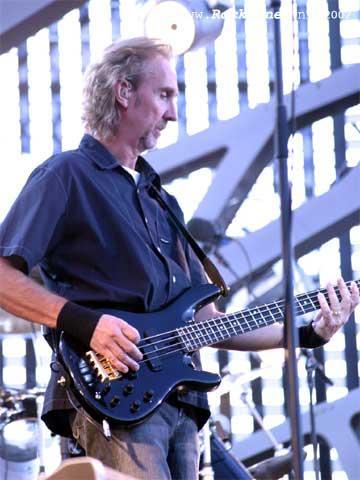
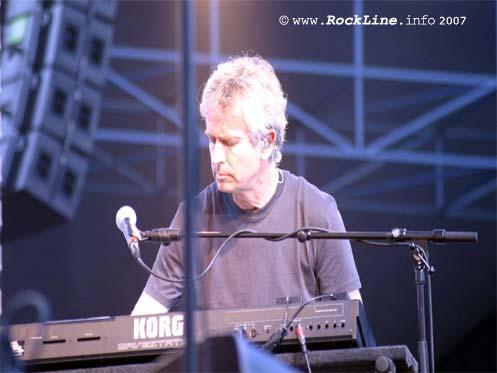
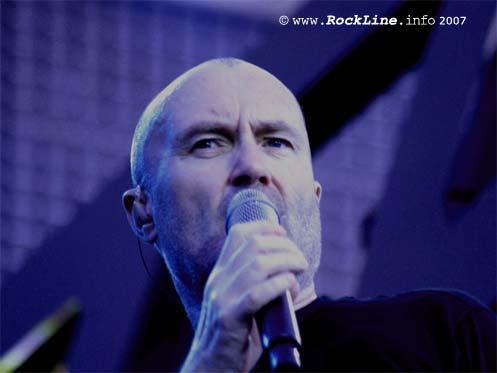
Like proper English family gentlemen, Genesis usually keep to the agreed times for the start of the show (it’s worth mentioning that, luckily, they don’t suffer any support acts). They strode onto the stage at twenty past eight, as soon as it got dark enough, which was more or less in line with the original announcements. The stadium shook with excitement when the well-known cheerful little man, with a few days of stubble on his chin and a big bump in the middle of his bare skull, marched out accompanied by his comrades and waved very quickly to the crowd. Then he threw himself behind his own custom-tailored drum kit. The rest of his entourage also took to their instruments with decisive steps and kicked in with an energetic “Behind The Lines”, an excellent opening song that usually appeals to fans of both prog and pop. Well, I can say Genesis followed this recipe very well all evening, distributing and balancing their program excellently. They tailored the selection from their extensive tour so that in the end even those of us who hoped for as much as possible from the progressive era were satisfied, although some of those pieces were noticeably shortened. Most of them were combined into various “medleys”, which has been their established practice for years as a way to fit as much material as possible from their vast career. This time with an important difference, though: the medleys included some pop songs, too. The stage was that classic concert scene from their commercially most successful days. Collins and Thompson each had their own palette of drums, which buckled under the hail of their blows. Rutherford and Stuermer often swapped between guitar and bass, with Stuermer usually covering the original Hackett parts, meaning he used the guitar on most of the more complex songs from the progressive era and played most of the solos too. Rutherford is a solid guitarist, but you could see he’s always been much more at home on bass, especially on his famous 12-string double-neck Rickenbecker bass. Behind the keyboards sat, of course, the man who in my view deserves the most credit for the Genesis flame staying alive for so long in turbulent and unpredictable musical waters. Tony Banks, with his eternally serious look of a tidy English gentleman, did just what you’d expect from such a master and, with his nimble fingers, delivered some of the most magnificent and also most moving moments of the evening.
With “Behind The Lines”, which they ended just before the vocal part, they moved via “Duke’s End” into the hit “Turn It On Again”, the song the tour is named after and whose main riff is handy for warming up the audience at the start. Collins left his drum stool several times here and went to the microphone, where from start to finish, with some funny gestures too, he proved why he’s one of the most charismatic frontmen, with stagecraft in his blood since birth. His “star” presence was without a doubt the connecting thread of the evening, even though most of us know that Genesis once had a far more charismatic singer behind the mic, whom I rarely thought of during this show. The string of pieces from the album “Duke” (1980) was tied together by the unforgettable instrumental “Duke’s End”, which finished where “Behind The Lines” began. Having satisfied the widest circle of the audience right from the start, they moved on to “No Son Of Mine”, the big hit from the super successful album “We Can’t Dance” (1991). On the giant screens, where even those in the back rows could see enlarged images of all the musicians on stage, the first of many screen projections began, which only boosted the musical magic. Rutherford and Stuermer swapped guitar and bass for the first time here, and this was also the first moment where Collins really came into his own as a singer, since this is one of those pop pieces that truly suit him, and he performed it with real authority. Between songs he kept trying to address the crowd in German, but even with the help of a sheet of paper it gave him quite a bit of trouble, which is somewhat surprising for someone with so much international concert pedigree behind him.
Suddenly the screen showed the three faces of the grotesque, heavily caricatured puppets of Phil, Mike and Tony from one of the most notorious videos of all time. It was time for the unforgettable “Land Of Confusion”, probably their best-known hit ever and the song through which, thanks to its massive exposure on MTV, most of the younger generations heard of Genesis for the first time. By this point all the members had loosened up nicely and delivered an excellent version of this pop rock classic. We prog fans then got our fix for the first time with an excellent medley of some of the “hottest” pieces of their career, overtured by the claustrophobic “In The Cage”, the first of the masterpieces from Gabriel’s era on the program that evening. Besides a consistent and very convincing performance, we also got a nice computer animation of a runner behind bars. The mysterious and unpredictable journey continued with a portion of “The Cinema Show”, including Banks’ excellent solo, which developed into that famous spacey solo, endlessly pleasing to me, that makes up “Duke’s Travels”. It was here that the newly risen Genesis finally convinced me that I was witnessing the continuation of a never-forgotten legend. My enthusiasm had barely settled when they switched to the atmospheric-romantic “Afterglow”, which always makes for a superb finish. With “Hold On My Heart”, the first of the evening’s five ballads, they reined the horses in a bit again. Collins sat down on his stool and sang one of their loveliest ballads in his famous manner, which isn’t all that different from his solo work.
That was followed by one of the highlights of the evening, because Mr. Collins invited us into a mysterious house by the sea, where scary apparitions wander at night and won’t let its residents sleep. When I realized that the prog/pop epic “Home By The Sea/Second Home By The Sea”, built on atmospheric pentatonic scales, was up next, I was no less delighted than if a piece from the Gabriel era had followed, since it’s one of my favorite pieces from their pop era. The song, which holds so many refined pop finesses as well as excellent instrumental sections, came alive amid witty animations of ghosts and vampires that only heightened the esoteric mood. The waning crescent moon certainly added its bit too, fitting even better with the excellent performance of their best-known ballad, “Follow You Follow Me”, which marked the beginning of their move into a world of pop steeped in love and romance. Besides the exceptionally heartfelt approach (Thompson swapped his huge drum kit for a simple African drum here, which created a special effect), the performance featured probably the best animation of the evening, in which we could watch some of the main “heroes” of their album covers (the swaying main character from the album “Duke” made a particular impression). The most moving moment of the evening, though, was undoubtedly the end of the song and the scene where the father and son from the “We Can’t Dance” cover met again on the screen. The whole thing even reminded me a little of that cult Italian cartoon that was translated here as Črta.
Next came a moment when most of those present were swept up for a short while by honest nostalgia for the Gabriel era, to which the trio, with both guests, paid tribute through performances of two classics from “Selling England By The Pound” (1973), in the opinion of most fans their best album. First they played the central part of the legendary “Firth Of Fifth”, where Stuermer and Banks made a name for themselves with their monumental solos, and then they launched into the best-known hit of the Gabriel era, “I Know What I Like (In Your Wardrobe)”, in my view the only Gabriel song that Collins sings better than the lovable uncle with the big forehead. Projections of some moments from their past, especially the days with Gabriel and Hackett, who thus at least symbolically joined the other members on stage, took care of even more nostalgia. After reviving fond memories of their best times, Phil invited us to visit the red-light district, where our old acquaintance “Mama” was waiting for us. Even after all these years it sounded tremendously convincing and even stood as one of the atmospheric peaks of the concert. It was played just as it should be, in full and with all the instrumental expansions offered by its perfect mix of prog and pop, with an additional animation without the honorable lady. The grotesquely obscure peak of the show was without doubt Phil’s famous mocking “eh-heh-he” laughs straight into the camera, while lighting his face with yellow light so that he looked like some mischievous imp, surely scaring a few of the grandchildren of the fans standing in the front rows. Collins then returned to his patched-up German and announced a song that would carry us from the red-light district to paradise, or rather to a world ruled by fairies and elves. The eternal joker Collins doesn’t even need to transform into a gnome for that, although he shaved off his beard long ago and gave up on the idea that his hair would ever be a source of pride (in the middle of his smooth skull bulged a big bump he got who knows where). But let’s leave such jokes at the artist’s expense for another time, because “Ripples” was next, to me even their most beautiful ballad, which perhaps more than any other song at the concert carried me into that special state I felt most strongly years ago at Yes in Budapest, eloquent proof that even these “old farts” are still in excellent form when it comes to creating emotional astral dimensions. Banks’ gorgeous piano arrangements and Collins’ deeply lived-in singing really did carry me off for a moment into a heavenly world of myths and legends. The performance of the lovely but much-missed ballad “Throwing It All Away” is one proof that their commercially most successful album, “Invisible Touch” (1986), still makes up a good share of their live performances.
Collins again provided laughs when he announced the next song as an illustration of the domino effect, with different parts of the stands and the floor responding to his shout, demonstrating how strongly every corner of the stadium breathes with the band. Many already guessed that “Domino” was next, one of the more complex pieces from the pop era, where Collins pulled off a series of those trademark stage antics that made him famous as a solo performer too. Among other things he juggled a tambourine and threw in a series of his typical gestures and glances at the audience, which didn’t need any extra encouragement to sing and chant. Along with the closing “dance”, this was the peak of his physical activity as a singer (behind the drums, on the other hand, he’s doing fine), since the man has long been far from the youngest in his trade. At one point some of us could even see ourselves on the screens, as the cameras turned on the audience, which truly came alive then like one big happy family.
And then came the moment for the big highlight of the concert, a moment I’d been waiting for with great interest long before the show began. What followed was the drum duet, or rather the clash between Collins and Thompson. The two men first played standing, hitting their own standing percussion sets at astonishing speed. Then they slowly moved to their respective drum kits, and a real epic battle between “good” and “evil” began (who represented which side everyone could of course decide for themselves). It would be very hard to pick a winner here, but it still seemed to me that old Chester, whose services Zappa once used so well on the excellent album “Studio Tan” (1978), set his tempo slightly faster. But you have to take into account that Phil had to play the double role of singer and drummer the whole time. When I watched a drum battle at Spock’s Beard years ago, it never crossed my mind that I’d one day witness two inventors of this kind of duel, who still outplay most of their younger peers on this instrument. All of that was just an overture, a mere appetizer for a much tastier slice of cake, which they cut when the rest of the members joined the two drummers on stage and moved into the majestic “Los Endos”, perhaps even their best progressive instrumental and the closest they ever came to jazz rock fusion. A real feast for the ears and eyes followed, especially for all lovers of live jams, and at that moment I realized I was probably witnessing the best concert I’d ever seen (at least as far as atmosphere goes). It was one of my most beautiful concert moments, and I’ll remember it for a long time.So that fans of radio melodies wouldn’t be shortchanged of romantic tunes in any way, they then briskly and somewhat unexpectedly tackled the hit ballad “Tonight, Tonight, Tonight”, from which they moved into the ultra-hit “Invisible Touch”, a song I’m not much of a fan of myself, while most of the audience went completely nuts (though since most were of mature age, they behaved in a very exemplary way when it comes to the ethics of watching a show). Phil undoubtedly had his star moment of the evening here, and with the help of his comrades he took us back with an energetic approach to the 80s and the golden age of pop rock. At the end of the performance, rockets flew up and cracked for a short fireworks display to close the main set.
A fairly expected encore followed with “I Can’t Dance”, which, even though I’m sick and tired of this song because of its still massive exposure on every possible medium, was one of the highlights when it comes to combining music and stage show. As expected, Phil, Mike and Daryl performed, one after another in a line, that famous dance from the video and earlier tours. Meanwhile their doubles accompanied them on the screens in every possible color palette. It was no surprise at all that they saved both of their biggest hits for the end. Still, they didn’t finish the concert as a pop band but as the kind of group most of us will remember them as. The time for goodbye came and Phil announced “Carpet Crawlers”, the last song of the evening, which means a great deal to them as a band, regardless of lineup, and represents the soul of the group (in 1999 they even re-recorded it as a Gabriel-Collins vocal duet). When people learned it was the last song of the night they roared in protest, but it was no use, since Phil admitted that at their age they’re usually in bed by eleven. A very good and moving performance of this classic from their most ambitious project, “The Lamb Lies Down On Broadway” (1974), was also a symbolic gesture that the door is wide open for its two co-creators, who weren’t on stage that night. If Gabriel returns, we can rightly expect that he and Collins will sing it as a duet. And so ended an evening I’ll be telling future generations about for a long time. At last I’ve seen Genesis, and besides them only a very small handful of bands remain for whom I’d go to the other end of the world to see them.
After such a good concert, which knocked me off my feet from head to toe for several more days, it’s usually extremely hard to sum up impressions, so it took me quite a bit longer than usual to write this report. The performance of the “curtailed” Genesis, whose curtailment by the loss of both progressive heavyweights hardly showed in the choice of songs (it’s actually almost impossible to compare two completely different bands), turned out in the end to be one of the most magical shows I’ve ever seen from them. Asked whether I witnessed the progressive or the pop Genesis, I’d answer that I witnessed the universal Genesis, who successfully, and with excellent sound, captured some of the best moments of their career. The only thing I could “reproach” them for is shortening some of the classics and the absence of “The Musical Box”, which Collins should have relearned to perform, since it’s an indispensable piece. But then the concert would have lasted at least four hours, which at their age is anything but an easy feat (they played almost three hours without any longer break in between). Even though they don’t hide their age, they powered through the show as if they were 30 years younger and without any trace of routine. Their faces shone the whole time, showing they were playing together again purely for their own enjoyment, since money will never run out for them even without Collins’ famous enterprising streak. The realization followed that I’d have made a big mistake if I’d skipped it because of my favoritism for the classic incarnation. That mystical atmosphere, which they can conjure only in the classic lineup and through Gabriel’s performances, has long been clear to be gone for good, even with his possible return. But Genesis proved more than successfully that they’re a truly universal band, uniting many generations of all kinds of music lovers (it was nice to see that I was far from the youngest among the attendees). Still, I can’t shake the damned thought of what it would have been like if Gabriel and Hackett had been on stage too. I reckon my spirit wouldn’t have come back from the heavenly plains into my body for a long time after the show, and the report would have read more like some poetic ode to joy. Phil, Mike, Tony, Daryl and Chester – thanks once again for one of the most beautiful evenings of my life.
Setlist
1. Behind the Lines / Duke’s End / Turn It On Again
2. No Son Of Mine
3. Land of Confusion
4. In The Cage / The Cinema Show / Duke’s Travels / Afterglow
5. Hold on My Heart
6. Home by the Sea / Second Home By The Sea
7. Follow You Follow Me
8. Firth of Fifth / I Know What I Like
9. Mama
10. Ripples
11. Throwing It All Away
12. Domino
13. Drum Duet / Los Endos
14. Tonight, Tonight, Tonight / Invisible Touch
15. I Can’t Dance
16. Carpet Crawlers
LINEUP:
Phil Collins – vocals, drums
Tony Banks – keyboards, vocals
Michael Rutherford – bass, guitar, vocals
Daryl Stuermer – guitar
Chester Thompson – drums
Photo gallery