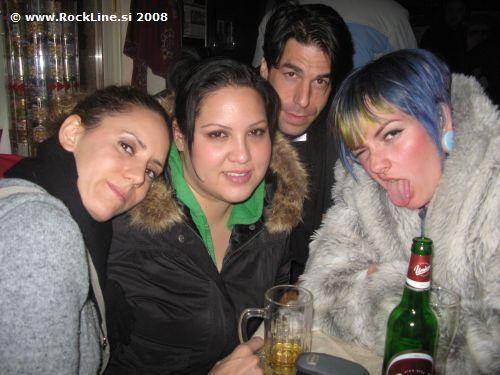
Location: Che bar / Ljubljana / Slovenia
Interview date: 24.11.2008
The hot California girls of Go Betty Go landed in Europe a day early, before kicking off their first European tour. And they landed right in Slovenia. On the invitation of the Kurz Rock Vibe agency, which I’d like to thank on behalf of the RockLine crew for setting up the interview, I dropped by the Che Bar café in Bežigrad on Monday, 24.11.2008. The band was already comfortably settled around a table, and the girls and the group’s new member, bassist Phil, had already knocked back a few beers together…
RockLine: How are you feeling after the exhausting flight from the US to Europe?
Aixa: Good.
Emily: Tired, we just got here, to Ljubljana.
RockLine: You’re right at the start of your European tour. What’s the mood like?
Emily: Yeah. We play for the first time tomorrow.
Aixa: We’re a little nervous, caught up in the anticipation, the whole thing feels super exciting to us, and we’re also freezing. But above all that, we’re really happy to be here. We landed 14 hours ago and we’re still kind of adjusting to your European body clock. It’s a kind of unwinding process.
RockLine: The first snow of the year fell here just today. Must be a shock when you come from sunny California?
Aixa: Yes. It’s been so hot back home these days that last week there were fires in several places in California.
Phil: Just yesterday I was still wearing shorts.
RockLine: How did you girls find each other, and how did you end up sitting here today in this lineup?
Aixa: A friend introduced Betty to me and my sister, who I’d already played with. We clicked really well. We started writing music and playing shows. Then my sister left the band because she wanted to get on with a normal life, she wanted to finish her studies. After that another friend came along, and she introduced us to Emily, and now Emily’s been with us for two years…
Emily: Almost three years.
Aixa: Right. Almost three years.
RockLine: If I’m not mistaken, you’ve put out one album?
Aixa: Actually two, and we’re writing the third one right now.
Phil: Yep. The new one will be Emily’s first.
Aixa: Right now we’re wrestling with the material for the new album, and for the first time we’re touring here in Europe, which is a big challenge and test for us.
RockLine: What message does your music carry?
Emily: It’s very simple. Be who you are, no pretending, and find freedom in that by expressing yourself through music. The point is to follow your heart and create what you feel, what your heart tells you to.
Aixa: Our songs are about our everyday life experiences, the different situations we face day after day. There’s nothing especially abstract hiding in the lyrics.
Emily: The basic message is: “Fight for what you believe in.”
RockLine: So straight-up rock ‘n’ roll, no detours left or right, right?
Emily: Yes.
Aixa: Exactly.
RockLine: Your musical inspiration and influences? Where do you draw inspiration from, where do your influences come from?
Aixa: Each of us grew up on different musical influences. And Betty really stands out in our crew. Betty, tell us what you listen to?
Betty: Spanish rock (probably meaning Texan and Mexican, editor’s note) and hip hop.
Aixa: You can’t really hear that in our music. Every now and then we throw a little pinch of it into a song.
Emily: Personally I love listening to jazz, Nina Simone, Janis Joplin.
RockLine: And you, how and when did you start playing bass?
Phil: I started out on guitar. We had a singer who played bass, but whenever he wanted to sing he’d forget to play, so doing both at once gave him real trouble. At first there were two guitarists in the band. One day I just decided I’d try playing bass. And I figured out I could become a much better bassist than I’d ever be a guitarist. I also love the sound of Motown, all the way back to James Jameson. And I learned a lot from Kyle Kyle, the bassist of Bang Tango. He was an outstanding bassist from Bag Tango, who came up during the Guns N’ Roses boom. I knew the band’s singer, who introduced me to him, and I learned a ton from him about playing bass.
RockLine: How does your bass work when you’re playing with the girls?
Phil: After my first gig with them, they gave me a big compliment. Later I was in touch with Aixa over email and asked her: “So how did it feel?” And I got an answer back that they were counting on me for the next gig and that they’d show me their whole repertoire.
Aixa: He adds a special accent to our songs, a special, extra vibe, an extra “feel” and flavor.
Betty: Our sound is also gaining from the multi-part vocal harmonies. Before, we were strictly an all-girl band. Phil’s also a really good singer, which we use to back up Emily’s vocals, since his tenor adds a special color to the harmonies.
Phil: Either way, I’m not trying to be a carbon copy of the band’s former bassist, Michelle. I’m trying to bring my own bass style to it.
RockLine: Is Phil still on probation? On the promo flyer it’s only the three of you in the photo?
Aixa: Of course we’re still going to test him a bit, ha, ha, ha…
Phil: You know how I felt when we walked into this café? Everybody rushed over to just the three of them, and everybody wanted pictures of only the three of them. Like I wasn’t even there.
Emily: Aw, you poor little thing.
Aixa: Don’t take it too much to heart, it’ll pass.
Phil: I’m fine, really.
Emily: I think Phil can secure himself a permanent spot with us. We’ll see how this European tour turns out, how we work together.
Phil: This tour is a test for me.
Betty: As long as he behaves himself the whole time and carefully changes the strings on my guitar and polishes it before every gig, ha, ha, ha…
Phil: See? Look how they pick on me, it’s going to drive me nuts.
RockLine: Is it hard for a young band these days to break through and get noticed with their music?
Emily: It wasn’t always like that, but today it’s pretty much true. In the age of digital distribution, with the internet becoming the main source of profit for bands. Not for all of them. For some, the internet has done a lot of damage. It’s especially hard in Los Angeles.
Aixa: There, every apartment block has its own band.
Emily: Block? Every yard of parking along the street. That’s what makes it so much harder. You have to stand out with something of your own, something different. Different from what most people are doing. We’ve been together for quite a while now and we’ll see where the road takes us. But it’s hard to do what you do out of love while also trying to break through and become a bigger band. It’s tough to combine the two. But that’s the only way the thing can work in a healthy way. It’s not easy.
Aixa: That’s right. People often think you don’t have to put in much effort, when you answer the question of what you do and say you’re a musician. They have no real idea. There are lots of challenges, sacrifices, and disappointments too. It’s a grind.
Emily: You give and put in more than you ever get back. A doctor, for example, also works hard and grinds, but gets paid fairly for it.
RockLine: I assume you mostly handle your own promotion and look after your interests as a band yourselves?
Aixa: We do have a deal with a label, but really we do everything ourselves. That’s how we’ve been used to working from the very beginning. It’s the same with this European tour. We don’t have an agency that takes care of us and organizes our tours. We also organized our last US tour completely on our own. It’s simple. If you want to do well and have things work the way you want, you have to do everything yourself. If you become dependent on others to look after you, it’s hard to get anywhere.
RockLine: What do you expect from this European tour?
Betty: Getting to know bands similar to us.
Phil (cynically): Big venues and big cities.
RockLine: How does the audience in the US take to your music? How do people react at your shows back home?
Emily: They have a great time, it’s not hard to get them into the “mosh pit” either, and overall you can feel that people in the US really appreciate our music and our efforts. Crowds react differently in different corners of the world, but we never leave an audience cold at our gigs.
Phil: I can’t answer that question totally objectively, because I’ve hardly played any shows with Go Betty Go yet. But I remember when I was in the crowd before a Go Betty Go show. Before the gig nobody was really paying attention to the fact that a show was about to happen. But when the girls hit the stage, people suddenly appeared “out of nowhere”. The place had been totally empty before. Then the front rows went absolutely fanatical. Four days ago we had a show too. The situation was almost identical, but once we started playing, the club filled up to the last corner.
Aixa: It definitely gives you motivation and an extra push when you see that after hard years of sticking it out in this business, there’s still so much interest in your shows.
RockLine: That flow of energy between the crowd and the band, right?
Aixa: Yes. Exactly that.
Emily: I think that’s the most important thing. Creating that flow of vibes.
RockLine: Are you afraid of how Europe will respond to Go Betty Go and your live shows?
Emily: Not at all. I’m sure it’ll be an energetic and intense tour. I know people here in Europe appreciate us and that there’s interest in our music. And we respect and appreciate that too.
photos: Aleš Podbrežnik
Photo gallery