Location: MC Pekarna / Maribor / Slovenia
Interview date: 09.05.2010
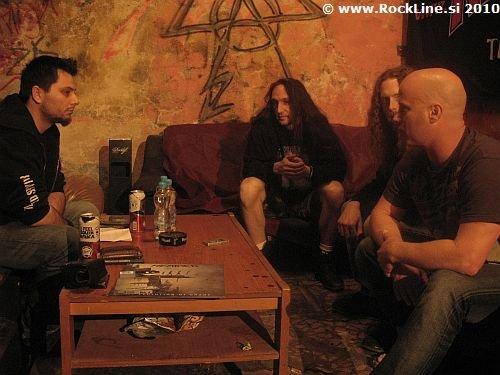
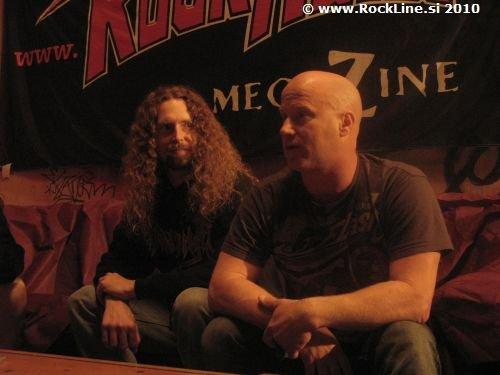
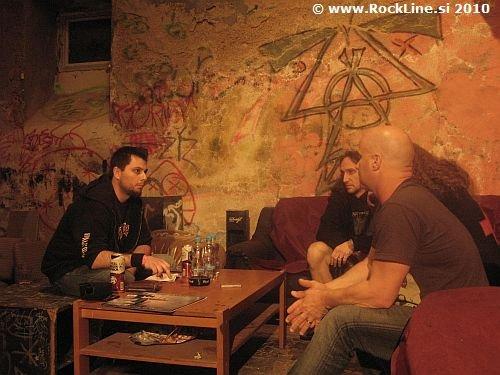
Ahead of the long-awaited comeback show by Bay Area thrash metallers Heathen in Maribor, we had the great honor of sitting down for a chat with the whole band in the room. Only the front line actually took part in the conversation, though: the superb guitar duo of Lee Altus and Kragen Lum, plus lead voice David White. The guys, who rolled in on a short European tour to present their new studio album “Evolution Of Chaos” (Mascot Records, 2010), didn’t hide their cheerful mood and the huge enthusiasm that surrounds the revived Heathen – a band that has always floored people with its own distinctive, virtuoso mix of top-notch playing technique, a blast of unbridled thrash metal aggression, witty yet intricate twists, and a brilliantly implanted touch of melody.
RockLine: We’ve finally got you here. With a new album, a new tour. Why did you hesitate for so long?
Lee: Because we’re really lazy by nature, ha, ha,…
David: Ah, no, no… After we put out “Victims Of Deception”, Lee went off to play in Die Krupps. Five years went by before he finally got sick of flying from the US to Germany and back… In 2001 we played the Thrash Of The Titans festival. We had a blast there, and in 2002 the organizers of Wacken Open Air invited us to play. After that show we decided to try to get Heathen going again for real. It took a while to pull ourselves together and consolidate the ranks. We went through some lineup changes – guitarist Ira Black left, then Mike “Yaz” Jazstremski went too. He later sadly passed away during detox treatment. Terry Lauderdale joined us, and we recorded a demo with him. The covers album “Recovered” came out. It also took a while to land a deal with a proper label. So yeah, it was a relatively long process.
RockLine: When you recorded the “Demo” for Mascot Records in 2005, did you already plan for those three tracks on it to end up on a later studio album?
David: Definitely. We wanted them on the album. We never write songs that are just fillers. We always go all in, because we want to give the best we’ve got. Those three songs went through the same process.
RockLine: You mentioned Thrash Of The Titans earlier. It’s kind of ironic that Chuck’s illness actually helped consolidate the thrash metal scene and bring it back to life. How do you see that?
David: Ten bands played that festival. That event set off a spark in our thrash metal community,… even Anthrax showed up to play back then. It’s hard for me to explain, but soon after that event, things suddenly started opening up. A whole pile of young thrash metal bands popped up…
Kragen: I was at Thrash Of The Titans myself. I wasn’t in the band yet, just a fan. It was an incredible event, and it was an amazing experience to see all those fans who came to support thrash metal. From all over the world, even Japan. It was proof of how much people still love this kind of music. The bands that took the stage that night realized it too. That’s when they saw the chance to try to get active again.
RockLine: You’ve just shot a video for the song Dying Season. Why did you pick that one? Because it’s the first track on the album, or because it hits so hard?
Kragen: Actually both.
David: Before we went on tour we shot some material. The video is in the works. There’s even a chance we’ll put together a few different versions of it. We’ll see what suits us best.
RockLine: Where did the idea to name the new studio album “Evolution Of Chaos” come from?
David: We didn’t have a title during the recording. Kragen came up with the idea. We simply skimmed through our lyrics, tied them to the current state of affairs in the world, tried to find a link to the essence of our band, and the idea worked for us.
Kragen: When you look at the world, chaos has always ruled it, and you can even watch it evolve. Chaos is everywhere, even on the internet.
RockLine: Kragen, you joined Heathen in 2007. Where did the guys find you?
Kragen: After the Thrash Of The Titans festival in 2001, a friend who worked at some label got in touch when my band Prototype was looking for a singer. That’s how I met David. He came out to Los Angeles and recorded a demo with us. David did a few rehearsals with us. Around then the former singer, who also played guitar, offered to come back. Later David invited me to audition for Heathen, which I absolutely wasn’t going to turn down, since I’d always loved Heathen’s music.
RockLine: One more question, not directly about Heathen. What’s the status of former Agent Steel singer Bruce Hall in Psychosis?
Kragen: We’ve accepted him as Psychosis’s new singer.
RockLine: On “Evolution Of Chaos” it’s hard to miss the great chemistry in the dialogue between the two guitars. Lee, was it hard for you to get used to a new guitarist in the band?
Lee: To be honest, in my head I’d already resigned myself to the idea that I’d never find the right guitarist to build Heathen’s music with on equal terms. The kind of chemistry Heathen always had isn’t easy to create. Lots of guys went through the lineup. They were great musicians, but you just couldn’t feel the right chemistry between us. The spark simply wouldn’t jump. When Kragen came to rehearsal, my own expectations were very low. Then he showed what he could do, and it got me fired up, and I said to myself: “Wow, there’s still somebody out there!” I couldn’t be happier with anyone than I am with Kragen. He knows exactly what Heathen is about. Also when it comes to the way we write songs and riffs. We communicate really well.
RockLine: You two work as equals. Technically you reach an extremely high level, and at the same time you deliver a noticeable melodic component. And that was always an integral part of Heathen’s music.
Lee: Yeah. At auditions a bunch of guitarists came through who were great soloists but less successful at holding down the rhythm. Or the other way around. As for Kragen, he embodies both in one package. He’s a great soloist and a great rhythm guitarist! And like you said, we’re not your average thrash metal band. We’re more complex. We’re a band that can PLAY.
Kragen: In Heathen we combine a lot of influences. Also from seventies rock, especially the guitar-playing breakthroughs of that time. Back then they didn’t just make great solos, they wrote solos that stuck in your ears. The same goes for guitar phrases. A dash of influence from those old bands helps shape the final face of Heathen’s music.
Lee: If you look at the Bay Area movement, it was always typical for the bands to focus on melody. And that melody had to come from the guitars. As for the Bay Area, we always wanted to play thrash metal, but also try out plenty of other things alongside it. We never wanted to limit ourselves. Metallica left a big mark on us. They opened up a lot of new angles for us. So it was never a bad thing to write an acoustic ballad or build passages with guitar harmonies. The first musicians who shaped the Bay Area scene were open to that, and to this day I’m very grateful to them for it. Same goes for the people in charge at the labels. They were open to experimenting, and we could still play thrash while doing it.
RockLine: “Evolution Of Chaos” has a lot of guest musicians. How did the decisions about that come about?
Lee: Like David already said, we’re really lazy. The more you let other people play on your album, the less you have to play yourself, ha, ha, ha,…
David: We’ve always been open to other musicians working with us in the studio. To give the creative spirit a chance to step into the shaping of the songs. That’s how Steve DiGiorgio joined us and played sitar as well as fretless bass. We told him not to worry about what we want, just to play exactly what he feels.
Lee: It was a natural process of the album coming together. When we got to a point in some song where the idea popped up that adding a sitar would be interesting, we asked ourselves: “Okay, who should we get to play that?” Steve was right there. Same when my Exodus buddies Gary Holt and Rob Dukes came on board. They basically snapped at me that they wanted to be on the album.
RockLine: If we jump back to the start of your career, what do you make of the decision, at a time when the scene was fiercely set against glam rock and glam metal, to pick Sweet’s Set Me Free as your first single?
Lee: That was mostly cooked up by our label at the time, not so much Heathen. Sweet are one of my favorite bands, but I agree that choosing that cover for our first single wasn’t the right move. Maybe it would’ve been better as the second or third Heathen single, not the first, because a cover like that simply fails to introduce a new band to the scene properly, or show its essence, its core. Back then we were young and new to the music business, and we listened to other people’s advice, so we trusted the management and the label of the time. They also forced their own producer on us. That was Ronnie Montrose. I always thought Montrose wasn’t the right fit for producing the Heathen sound. Personally I always wanted a producer like Mark Whitaker. Someone who would understand our new sound. But things didn’t go the way we wanted. These days I can’t even listen to our debut. Strictly because of the production.
RockLine: Did you ever think about re-recording your studio debut, like Testament did with “First Strike Still Deadly”?
Lee: We’ve never talked about anything like that, but as they say: “Never say never!”
David: It is what it is. We have to move forward, not go back or look over our shoulders.
Lee: Maybe we’d play those songs live one day and put out a live album with really modern production.
RockLine: What do you think of the heap of young thrash metal bands that have sprung up on the scene in the last few years, Warbringer being one of them,…
Lee: It’s great. Somebody has to pick up the baton. We’re slowly getting old. It’s nice to realize that young bands appreciate what we did when we arrived on the scene. And of course, with their own approach they try to take our musical discoveries to some new, even higher level. They simply have to do that in order to survive.
RockLine: Over your careers, the paths of Heathen and Exodus have always crossed a bit. At one point the late Paul Baloff even ended up in Heathen’s singer spot. How did that happen?
Lee: Those were dark times for Heathen again. We listened to other people’s advice. When you don’t follow your instincts, you end up trapped. They kept lecturing us: “Everything’s great, it’s just that your singer is too melodic. If you had a punchier singer, you’d become the biggest band in the world. Just imagine it!” You slowly fall for other people’s opinions like that. And that’s why things go wrong. And that’s how Paul ended up in the lineup. Even though I’m a huge Exodus fan, especially of the “Bonded By Blood” era, you realize the combination with Paul isn’t right and that this isn’t Heathen anymore. And it didn’t last long. We went back to square one and called David back.
RockLine: David, your vocals have always been seen as the centerpiece of Heathen’s music. Plenty of thrash metal bands put a blast of raw energy and aggression first in their music, while Heathen didn’t hide a strong sense of melody.
David: As an individual I come from a somewhat different musical background than the other guys in the band. We blended those two approaches really well, and that’s what sets us apart from a heap of other bands. We hit the nail on the head, because we happily merged primal aggression with melody into a recognizable style.
RockLine: How did you pick the covers for your album “Recovered”? The choice of Queen’s Death On Two Legs is especially interesting.
Lee: We picked songs by bands we’ve always loved.
David: Death On Two Legs is my favorite Queen song.
Lee: We wanted that album to be a little different. That’s why we also went with a cover of Sweet Savage, who never released a single studio album in their career, they only recorded a few demos.
RockLine: What does it feel like to be touring in 2010? You’ve got families now, and Lee plays with Exodus too. Is it harder to get out on the road now than it used to be? I’m thinking of your visits to European stages.
Lee: Things are really very different from the nineties and eighties. At the same time, you’re thrown into a situation where you realize that playing on tours matters more than ever. Record sales around the world are in steep decline now. In the eighties you could sell 100,000 copies of an album or more. Today record sales bring a band no profit at all. A band can only survive by touring regularly. Say, from selling official merch on tour. It’s not easy, but you have to spit in your hands, get out there and hope for the best. Being active only in the studio is nowhere near enough.
RockLine: So what does the future hold for Heathen?
Lee: We’ll try to stay together as long as possible and put out as many studio records as we can. It’s a bit harder, since we all have families and we need to make adjustments. When we were 18, we didn’t feel any burden or any time pressure. Today is a different story. You can’t always even find time to rehearse, whereas back then you could practice 24 hours a day. On top of that, some members are involved in other bands too. If we manage to make some kind of breakthrough, doors open and we get more options. Then we’ll be in a situation where time can work for us. Right now we still have to adapt to time. I just hope we put out as many albums as possible and do as many new tours together as we can.
interview by: Rok Klemše
text translated and edited by: Aleš Podbrežnik
photos: Aleš Podbrežnik
Photo gallery