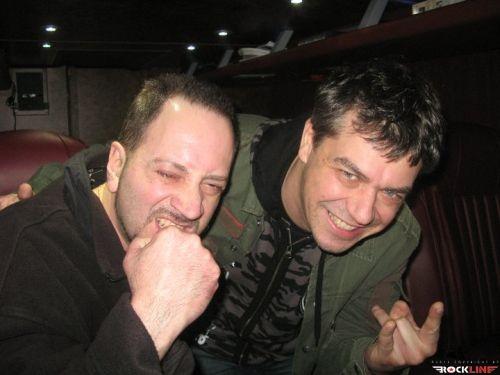
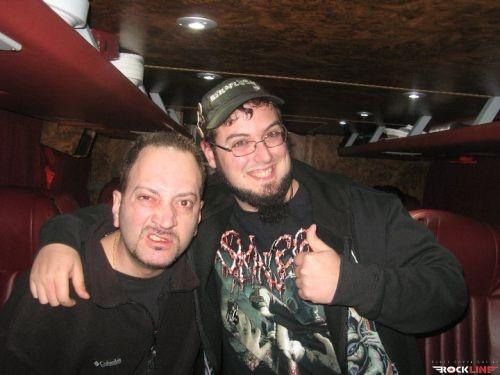
Location: Ljubljana / Metelkova / Slovenia
Interview date: 24.11.2010
Macabre are at heart a death metal band from Chicago. This long-running outfit has never changed its lineup in its whole career, and it has developed a style all its own, a unique and instantly recognizable fusion of thrash, black, death metal and grindcore. Throw in elements of jazz, acoustic guitars, even nursery rhymes, and out comes something extravagant. Especially when you wrap it all around lyrics about serial killers. You’re witnessing a new dimension of metal, called »murder metal«. In November 2010 Macabre toured Europe alongside Napalm Death, Immolation and Waking the Cadaver, and that included a show in Ljubljana at Metelkova.
For a gripping tale of serial killers, the band’s leader, vocalist and guitarist Lance Lencioni, known by the stage name »Corporate Death«, sat down with RockLine.
RockLine: Your new album »The Grim Scary Tales« brings a new approach to your sound. The history of murder takes center stage, so it feels like a concept album, but it’s a different approach than on »Dahmer«. So what crazy killer sightseeing tour is Macabre serving up with the new album?
Lance: The stories are presented on the album in chronological order. There is a concept on the album, but not in the style of »Dahmer«, which drew on the story of one man. Our focus for the new album was basically to find the most mentally sick people in human history. Like butchers, guys who shot a dozen people and so on,… The album starts in the time of the Roman Empire, with a girl poisoning Nero’s father, a Roman emperor, then it goes on to Nero, and there’s Vlad II, known as Count Dracula, and Countess Bathory,… As for the song Countess Bathory, it’s actually a cover of Venom. At first I was working on my own original version about Countess Bathory, but the Venom version sounded so appealing that I said to myself: »Why the hell don’t you try to learn it, ha, ha, ha,..?« And it worked out. Our new album ends chronologically with World War I. A second part will follow, starting from World War II and going chronologically up to modern times. About serial killers like Ted Bundy, Albert Fish,.. We start work on the next album next year.
RockLine: What was behind the new album taking so long to make? We waited almost eight years for it.
Lance: I needed a break. Sometimes you simply need a break because you can’t find the inspiration to write music. I came back stronger. I didn’t read anything about killers for a few years. It was only about two years ago that I started writing material for the new album. Usually I combine both. I write music and verses, but I’m better with verses, so those usually come first, and the ideas for the musical motifs follow. Sometimes a melody reveals itself in my head while I’m writing verses. I rush home, grab the recorder and a guitar and quickly record those ideas, otherwise they drift off into complete oblivion even faster. There are many approaches and it’s hard for me to give a general formula for creating, but each of them works and in the end always brings the results I want.
RockLine: The most recent thing we got from Macabre is also the release of the EP »Human Monsters«. But it came out only on vinyl. Why did you decide to go that way?
Lance: We were in the studio to start work on the album »The Grim Scary Tales«. With the engineer Geoff Montgomery. He’s a huge Macabre fan, so at one point he said: »Guys, I’d like to do a demo for you!« He offered completely for free, to show us his studio and give us a feel for how Geoff works in his new studio, how the studio actually functions, and to make sure we’d really like the place. We liked the studio, we liked how Geoff works, so the thing made its way to Curby, one of the organizers of the Obscene Extreme festival, who put out a release in the Czech Republic limited to 1000 copies. Vinyl only. We went back into the studio and re-recorded some songs, the same ones as on the EP but reworked for the CD release, as well as others. Since the CD recording took longer, there was also more time to polish the sound, so of course we’re happier with the sound of the CD. But the sound of the vinyl EP »Human Monsters« is by no means shabby either. It seemed really handy to us to put out something interesting before the real album. That was this EP. People like it and that’s what matters. I hope the record »The Grim Scary Tales« can come out on vinyl too.
RockLine: Given that your new album is already available for »download« ahead of its official release, I’m curious what you think about illegal »downloading« of albums, in relation to Macabre and in general?
Lance: It definitely hurts all of us at least a little, but it’s not really worth getting worked up about. Today what matters for a band is to play, to show up on tours, because albums don’t sell anymore. What saves you is the money from touring, including official merch sales. Even bigger bands don’t sell albums in the quantities they used to. CD stores are closing and so on. Opinions are divided here. Personally, as a rule I don’t burn CDs, I do it only as an exception, when I can’t get a certain album that’s, say, out of print. For me the point of an album is that when I get it, it has to be in its original packaging, with the lyrics and so on…. Our fans are like that too. They want Macabre CDs that are original.
RockLine: Let’s go back to the album »Dahmer«. It’s conceptualized around the story of the serial killer Jeffrey Dahmer. How come you decided to pick this concept for an album? Is he perhaps your favorite killer, or what?
Lance: Not at all. It’s just that at the time this album was made, the media were full of Jeffrey Dahmer. At first we only meant to record one song about Jeffrey Dahmer, but then, during the recording, a pile of information the media were pushing out into the public turned up and we said: »Let’s record a whole album about Jeffrey Dahmer then«. That whole story, from his childhood, when he dissected dogs and stuck their heads on stakes, became a serious alcoholic before he was even an adult, all the way to the day he was put in handcuffs and later was himself violently murdered in prison, that whole story felt like a logical reason for a concept album. After that we recorded »Morbid Campfire Songs«. It’s an acoustic EP of five songs. It’s designed like music for kids, with »pretty« vocals (clean singing, editor’s note), with music based exclusively on acoustic guitars. I actually started writing an album about Albert Fish, which was supposed to be called »Fish Tales«. So it was supposed to be an album about Albert Fish with music for kids, about how Albert Fish ate kids. The album isn’t finished and has never come out. Maybe it will in the future. So the idea of such a completely acoustic album about Albert Fish was born while we were making the concept album about Jeffrey Dahmer.
RockLine: So who’s your favorite among serial killers?
Lance: I think it’s Albert Fish. He’s the most interesting of them all. Picture a little old man walking around, looking for kids and then eating them. There’s so much »derangement« in those acts, and perversion too, I’d recommend you read a book or two about it sometime. Like the book »The Cannibal«, which tells the story of Albert Fish. That’s an excellent book.
RockLine: How did you manage to keep the band’s lineup basically intact over 25 long years? I can’t name a single band that’s pulled that off.
Lance: We started the band in 1981, when we met in high school. It definitely wasn’t always sunshine and roses around us. There were hard times too, but you get through it. We’re not the kind of people who, when sparks fly, would immediately confront each other with: »That’s it! Let’s stop Macabre!« We always settle disagreements by talking. We sort everything out among ourselves. Changing the members of our crew is not the way. It doesn’t lead anywhere. We don’t like it at all, and neither do the people who follow us and listen to our music.
RockLine: Macabre were on the scene when death metal began. You’re considered a pioneering band and one of the co-founders of the genre. Still, you somehow got overlooked, and never got the real recognition and credit on the scene for your work. How do you see that, or how do you explain it?
Lance: You know, none of us has ever really thought seriously about that. We always wanted to be fast, loud and different. I like a lot of different death metal. I don’t know much about pioneering. We were one of the early bands in the genre that showed up on the scene back then.
RockLine: But you also influenced the later development of grind and the like?
Lance: Okay, we’ve surely inspired other bands too. When you sing about killers it’s not really death metal or black metal anymore, it’s murder metal. There we can talk about pioneering, in the sense that we brought stories about serial killers into metal. But hundreds of years ago there were troubadours. They wandered around and, putting the news stories they’d heard in various places into verse, sang songs about killers among other things. We’re actually doing the same. Just in different times.
RockLine: You’re known as fusionists of many metal genres. From thrash, death and black metal to grindcore, with elements of jazz, plus nursery rhymes and children’s songs. How did this crazy idea develop, and with it such crazy songs?
Lance: I like variety. If I only did one style, I’d get really bored. The same would go if I used only one style of singing. I’ve listened to a lot of classical music, and still do. I like the works of J.S. Bach, I like the music of The Beatles too,…
RockLine: We already mentioned the EP »Morbid Campfire Songs«, which came out in 2002. It’s a completely acoustic EP. Is there a chance we’ll see another similar acoustic EP from Macabre in the future?
Lance: That’s what I was talking about a moment ago. I’d like the band to finish the second part of the album »The Grim Story Tales«, which should happen next year. After that, I’ll tackle finishing the Albert Fish material. Not before, because a new studio album demands the most attention and concentration, but there’s a good chance that after the new studio album we’ll finish the Albert Fish work too. A lot of material for it is already written. And believe me, that material is »sick as hell«, the verses included, heh heh heh….
RockLine: Have you heard of the infamous Slovenian killer Metod Trobec?
Lance: No.
RockLine: He was known for usually raping his victim, killing her and setting her on fire…
Lance: Really? You know, there are so many killers I can barely keep up with it all, ha, ha, ha,…
RockLine: So what are the band’s short-term plans?
Lance: The new album comes out in January 2011, followed by a spring tour. We’ll be headlining it, and we’re taking General Surgery with us. All of that will happen in April. I’m talking about a European tour. The tour will last a month, but I don’t know exactly which countries and cities we’ll visit.
RockLine: Are you preparing any special surprises for the shows on the new tour?
Lance: We’ll deepen and expand the scenography and the stage theater itself. We’ll dress up as »peasants«, then »killers« will join us on stage, like The Zodiac Killer, Albert Fish, and others,… We’d like to back all of that up with video documentation too. We’ll see what the future brings.
RockLine: How are you finding the current tour with Napalm Death and Immolation? Do you get along with those guys?
Macabre: We’re having a great time. It feels amazing, especially when you see a packed house of people watching you on stage for the first time, getting totally into it, and then buying your CDs and shirts. I’m very happy with how the current tour is going. We’ve played with Napalm Death and Immolation on previous tours and the guys from both bands are really great. That goes for the opening band of this package, Waking The Cadaver, too. This is our first time touring with them, but they’re good guys as well.
You can read RockLine’s report from the Macabre show of 24.11.2010 in Ljubljana (Menza p.k.) HERE.
questions prepared by: Rok Klemše
interview conducted by: Petar Mačinkovič
text translated and edited by: Aleš Podbrežnik
Photo gallery