My wife (back then still my girlfriend, or rather — ahem, more age-appropriately put, my partner, hehe) and I fell head over heels for Iceland when we first visited almost five years ago. Since then we’ve been back four more times and covered the country pretty much from top to bottom. There’s no point going on and on here about all the incredible (natural) gifts this amazing country has to offer tourists, but the best description of Iceland I’ve come across is from British TV presenter and mathematician Hannah Fry, who said it’s special in its specialness. Couldn’t be more true. And I do owe an apology to all my friends and acquaintances for constantly going on about Iceland — I promise we’ll try to tone it down (sort of, hehe). Ok, enough romance, let’s get to the facts.
So we used our fifth trip to Iceland to combine the already-enjoyable with the even-more-enjoyable, meaning some metalizing at the Sátan festival, which this time around took place in the small town of Stykkishólmur for the third year running. And no — let me clear this up right away — the festival’s name has nothing to do with the biblical Devil, Beelzebub, or Lucifer; it’s a clever play on words. Sátan (pronounced ‘sautan’) means hay bale in Icelandic and ties into the myths and legends surrounding Stykkishólmur. According to local folklore, the surrounding hills are actually petrified hay bales tossed aside by a local troll as she fled from the rising sun (which would have turned her to stone if it caught her). Stykkishólmur is about a 3-hour drive from the capital through breathtaking, jaw-dropping scenery, and with just over 1,000 inhabitants it’s the largest settlement on the Snæfellsnes peninsula, often called Iceland in miniature. Within a relatively small area you can see an astonishing amount — various rock formations of volcanic origin, geothermal hot springs, black volcanic sand beaches, stunning mountains, seals, whales, and Icelandic horses — and at the western tip of the peninsula, the glacier Snæfellsjökull reigns dramatically, beneath which hides the volcano Jules Verne used as the entry point to the center of the earth in his Journey to the Center of the Earth. Stykkishólmur has also found its place on screen, appearing in Ben Stiller’s The Secret Life of Walter Mitty (standing in for Nuuk, Greenland).
From the geography, let’s move on to a few technical details about the festival itself; Sátan is something of a spiritual successor to the now-defunct Eistnaflug festival, which ran for several years in the east of the country. Icelandic bands have pride of place at the festival, as the headliner closing each day is exclusively an Icelandic act (a nice touch that speaks to the respect both the organizer and the audience have for domestic music[1]), while in previous years the festival has hosted bands like Vader, Carcass, Taake, Discharge, High Parasite (in 2025) and Vltimas, Arcturus, Blood Red Throne (in 2024). The festival takes place in the town sports hall (which, naturally, shares an entrance with the town swimming pool — Iceland’s culture of soaking in geothermal water was recently added to UNESCO’s Intangible Cultural Heritage list, not without good reason), which by my layman’s estimate can comfortably hold at least one to two thousand people, though attendance for at least the first two days was pretty sparse. So here’s a deep bow to the main organizer Gísli Sigmundsson (also bassist and vocalist of Iceland’s first death metal band, Sororicide), who manages to pull off what looks like the impossible with an army of volunteers. And to be clear, I’m not writing off any other festival — I know how financially and otherwise demanding organizing one is these days (partly or mainly thanks to people like a certain orange lunatic), our own Tolminator included! — but you have to factor in that Iceland has only 400,000 inhabitants and in that context a micro metal scene, plus every foreign band has to be shipped out to a remote rock in the middle of the Atlantic.
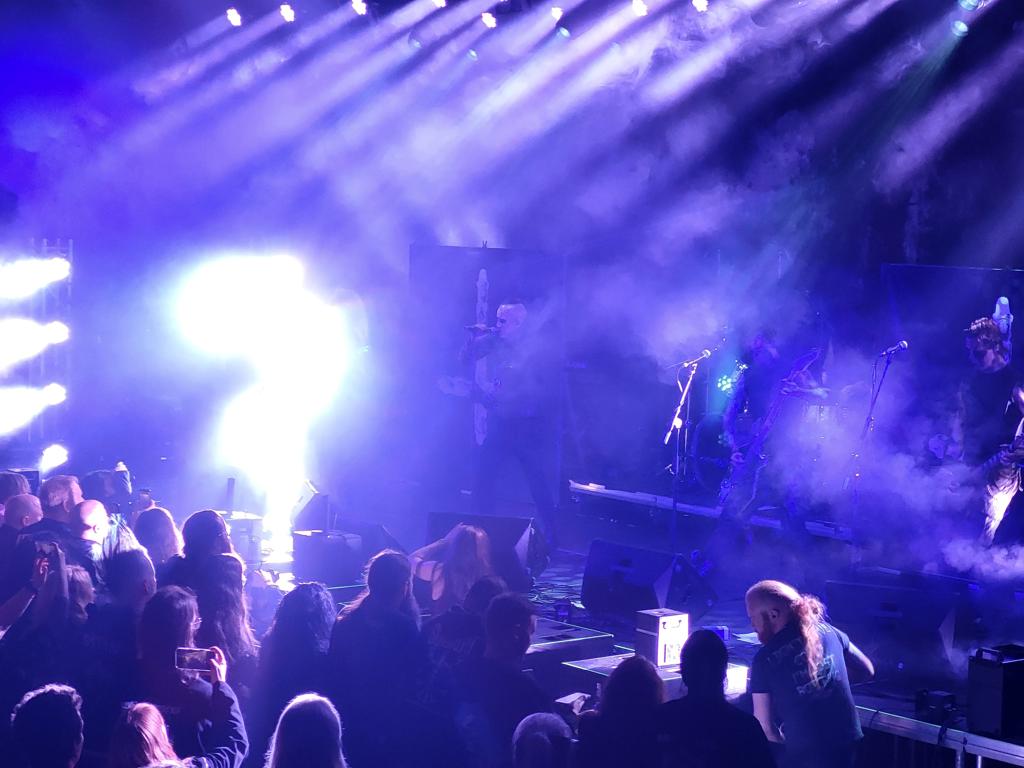
Even though the festival takes place in a venue not built for the purpose, you’d barely notice — the performers had a proper stage, top-level lighting, and above all the sound deserves serious praise, being pretty much excellent throughout. This year the action spilled over into a tent outside the hall as well, where the ReykjaDoom concert organizers took charge of the programme. Inside the tent, anyone could strap on a guitar or sit behind a drum kit for a bit of improvisation, and by evening, several local bands played there each day, with the energetic hardcore act Gaddavír probably the best-known of the bunch. The town has enough accommodation and bars for visitors, and from what we saw, the locals have already fully embraced the festival and its attendees. There’s a bar inside the hall and a burger stand out front. Prices? A minor grievance. A small session IPA in a can runs about 11 EUR (lager a euro or two less). A (vegan) McDonald’s-style burger around 15 EUR. Yeah, the bar inside the hall was genuinely never crowded — even the locals would vanish like morning mist on the last beat of every band and go drink in the parking lot. On top of all that, Sátan also has a packed side programme — this year there was Metal Bingo and a Metal Pub Quiz, and for the first time ever, a metal golf tournament. Following the model of Norway’s Inferno festival, Sátan holds various panel discussions on interesting topics during the morning hours (more on those in the Day 2 and Day 3 reports), plus guitar and drum clinics with members of the performing bands. On day one we caught an interesting conversation with Nergal and Dagur (Misthyrming) about how the Sventevith collaboration came about — the project was to make its live debut later that same day — and I personally had the honor and privilege of representing Tolminator as a delegate and taking part in the panel titled »Getting Booked: What Festivals Are Really Looking For?«
Unfortunately, due to a long drive from northern Iceland and sheer exhaustion, we missed the festival’s first band — Sót, the Icelandic winners of Wacken Metal Battle and locals from Stykkishólmur — but we did catch the veterans of Icelandic thrash, Bootlegs. The band, with a few breaks along the way, has been going since 1986 and is one of the oldest still-active Icelandic metal bands, so drawing parallels with our own Sarcasm isn’t far off. Over their career they’ve released three studio albums, the latest being Ekki fyrir viðkvaema[2] in 2015. Bootlegs delivered a solid dose of classic thrash metal that ranged somewhere between Metallica and early Exodus, with a pinch of German thrash thrown in, and a few tracks with their quirky riffs also brought Voivod to mind. Energetic and loud — more than a fitting start to the festival!
With the next act, Carpe Noctem, I got to tick off a wish — hearing and seeing Icelandic black metal on Icelandic soil. The Reykjavík outfit dragged the room into the abyss of depressive, slower-but-crushing black metal over a good forty-plus minutes — something close to Deathspell Omega, or fellow Icelandic cult act Svartidauði. Carpe Noctem ground everything dark and heavy with ultra-long tracks that average out somewhere around the nine-minute mark. Within those tracks they take you through everything from calmer, slower passages full of dissonant guitar chords to chaotic explosions with constantly shifting rhythmic patterns. Presiding over all of it is the psychotic, bestial vocal of Alexander Dani Vilhjálmsson, who sounded like he was screaming from the bottom of a deep pit of despair, and stoically didn’t address the audience with a single word. Carpe Noctem are definitely not an easy listen, and certainly not the kind of black metal that belongs on your everyday playlist — but when you need Nietzsche’s abyss to stare back at you, something like Carpe Noctem is what crawls out of it.
The honor of performing as the first foreign act went to British heavy metal hopefuls Tailgunner, who launched onto the Sátan stage with brilliant sound and the hit Midnight Blitz, the title track of their album released this past February, produced by none other than K.K. Downing. Just about a week before the Iceland show, news broke that founding member and bassist Thomas Hewson was stepping away from the band pending clarification of allegations of alleged sexual assault (if only our own anti-corruption, principled, immaculate, oh-so-virtuous politicians would handle things the same way…), and guitarist Rhea Thompson also left the band in connection with this. Tailgunner performed at the festival with a session guitarist and bassist, though this made absolutely no difference to the overall sound — the guys did their job brilliantly and even got the characteristically reserved Icelandic crowd moving a little. Most of the credit for that goes to charismatic vocalist Craig Cairns, who delivered not just a superb vocal performance but also worked the crowd superbly. Tailgunner focused most of their set on the new album, with the epic Tears in Rain and the balladic War in Heaven standing out, before heading back to their debut album at the close with a souped-up Guns For Hire played a few gears faster than on the record.
The next foreign act, Cadaver, I only vaguely knew by name and reputation on the Norwegian death metal scene, as they count among the older Norwegian metal bands. They’ve been active since 1988, led by the indestructible boss Anders ‘Neddo’ Odden. The Norwegian three-piece won over the stage and the crowd with their very first track, delivering exactly what you’d expect from Cadaver — fast and straightforward but catchy death metal that genre-wise recalled the likes of Autopsy or even mid-period Carcass, minus the melodic interludes. Cadaver aren’t exactly charting warm (geothermal, hehe) waters, but any lack of excessive originality is more than made up for by their honest approach, excellent execution, and a charismatic Neddo who held the set together with effective black humor. Already after the first track he was goading the crowd into chanting ‘Norge, Norge!’ What is without doubt original about Cadaver is the instrument played by bassist Eilert Solstad, who doesn’t play a regular bass guitar but rather a double bass adorned with a scythe blade. An impressive sight, rarely if ever seen in metal, though live it unfortunately didn’t come through as strongly sound-wise as it did visually. Cadaver managed, from what we saw and heard, to leave a strong impression on the Icelandic crowd — strongest of all with Decomposed Metal Skin and its simple, unforgettable refrain: ‘Jesus — Jesus — Jesus — Jesus is dead!’
Canadian heavy-hitters and thrash oddballs Voivod are frequent visitors on mainland Europe, but in Iceland they were performing for the very first time, and based on conversations with locals, they were among the most anticipated acts. Which made it somewhat funny to watch the audience follow them so stoically and coolly — though I believe that wasn’t really the case beneath the surface. Voivod, under the command of their chief Alien, vocalist Denis ‘Snake’ Bélanger, took the stage like a tornado (they also played a track by that name) and won the crowd over instantly with their infectious energy. The Canadians’ effective set was further lifted by projections of Away’s artwork and above all by the onstage rampaging of Chewy and Blacky, which showed no signs of stopping, their curly manes headbanging non-stop from the very first beat. The band was clearly in great spirits, and Snake was as charismatic and talkative as ever. Before playing the only track from the Eric Forrest era, Nanoman, Snake reminded the crowd that E-Force is currently battling cancer and that donations via GoFundMe mean a great deal to him, while the classic Warriors of Ice was dedicated to the Icelandic crowd. Voivod said goodbye, naturally, with the anthemic Voivod and once again left more than a good impression.
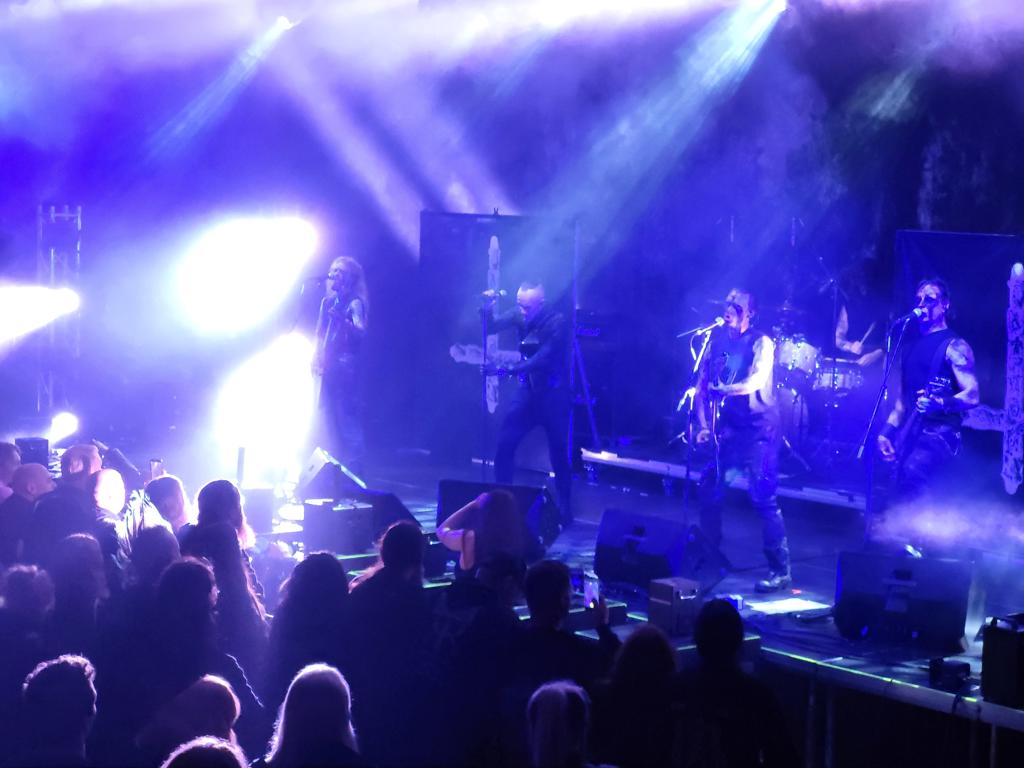
Then came arguably the most anticipated performance of day one, if not of the entire festival. The stage was set for the very first live show of the Sventevith project, in which Nergal of Behemoth joined forces with Icelandic black metal force Misthyrming, with the goal of performing the first Behemoth album from 1995, Sventevith (Storming Near the Baltic), in its entirety. In the morning interview, Nergal explained that the idea of playing the debut album this way came to him when he watched Proscriptor (Absu) live, joined by Greek black metal outfit Zemial to perform The Sun of Tiphareth on its 30th anniversary. He also said that Misthyrming are one of the rare bands that convinced him so strongly in a live setting that he couldn’t imagine realizing the project with anyone else (of Behemoth he said they would have played the album too perfectly, whereas what he wanted was for the thing to sound more natural, raw, and wild). Since this was the project’s very first performance, of course nobody quite knew what to expect. What was clear was that compared to the pomp of modern-day Behemoth, this would be a much more stripped-down version of Nergal — a fact telegraphed by the simply decorated stage, nowhere near as decked out as you’d get with Behemoth. I’ll admit I’m not exactly a Behemoth fan, early or late era, and Sventevith hasn’t aged all that nobly in my ears either, so I went into the set with relative restraint and fairly modest expectations. But the guys shut me up within the first moments — what a blast! Holy hell, as they’d say on the Slovenian coast! The ‘Storming’ from the Baltic to the North Atlantic didn’t let up from the first seconds of Chant of the Eastern Land to the final seconds of Transylvanian Forest, and as the cherry on top the guys added Pure Evil and Hate from the EP And the Forests Dream Eternally. A clearly good-humored Nergal didn’t push himself to the front and didn’t say much either — but the music spoke for itself, with Misthyrming elevating it to a completely different level. With the excellent sound, the vocal performance shone — Nergal’s live voice naturally quite different from the seventeen-year-old Nergal on the album, lower and grittier, but convincing all the same, and especially when all three Misthyrming vocalists joined in, the whole thing sounded mighty and epic. I haven’t seen a performance this intense in a long time, and for fans of Behemoth (and Misthyrming) — and frankly anyone — missing the nine or ten shows the project has planned for this year would be a sin.
Day one was closed out by Icelandic horror/shock rock legends Stripshow, but exhaustion had done its work and we ended the day with a walk back to the hotel under the midnight sun.
P.s.: The low-quality photos are just a sample and a rough glimpse of what Sátan has to offer
[1] Icelandic national pride shows up in music the same way it does in sport — you’ll remember those lovable Icelandic fans at the football (and basketball) championships a few years back, right?
[2] As a fun fact: the cover features Svarti Álfur from the Icelandic punk museum, one of the more charming museums in the capital Reykjavík — housed in a former public toilet;