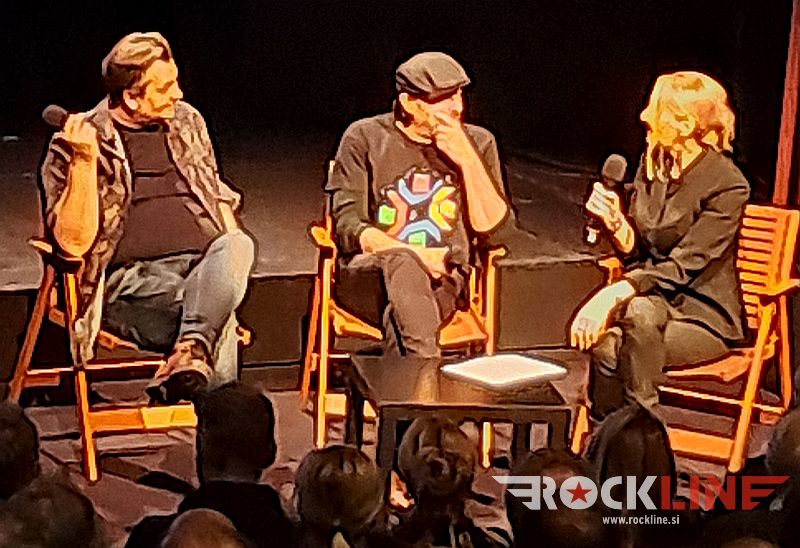
Date: Friday, 24 January 2025
Venue: Ljubljana, Slovenia
Performers: Zabranjeno pušenje, documentary Svjetla Sarajeva
Yours truly ended up, completely out of the blue and on a special invite from a special someone, at a cultural event smack in the middle of a foggy capital.
Zabranjeno pušenje visited Ljubljana as part of a mini tour (Sarajevo, Ljubljana, Zagreb), on which they’re presenting the award-winning documentary Svjetla Sarajeva. The film follows the band on their journey back to the Skenderija hall, where they play their biggest Sarajevo concert to mark the venue’s fiftieth anniversary. Along the way we also learn about the grueling process of rebuilding the band after the war. The story neatly sidesteps any unnecessary debate about Dr Nele Karajlić, and the real storyteller — the band’s alpha and omega — Sejo Sexon steps up with his well-timed anecdotes. We also get a quick introduction to a few characters from the band’s song catalogue, like the cop Mrga, Lepi, and the unforgettable duo Pišonja and Žuga.
I enjoyed the film — it captured the spirit of the era, the city, and the band beautifully. Since we’re metalheads at heart, I’ll mention as a fun aside that lead guitarist in the band for the past several years has been Toni Lović, who made his name in Croatian metal band Sauron.
Then came a needless Q&A where we didn’t learn anything particularly interesting, followed by a fifteen-minute break.
When we came back into the hall, the stage was set up for an unplugged band, bar stools up front. The lineup was Sejo on lead vocals and guitar, Toni on guitar, Robi on violin, Branko on drums and backing vocals, Dejan on bass, Anđela on lead and backing vocals, and one more guy on harmonica. Sejo announced they’d reworked songs that they don’t normally play live and that hold a special place in his heart. Worth keeping in mind that Sejo is not, professionally speaking, a singer — he’s a storyteller, a bard, a troubadour, call him what you will. Accordingly, the quality of Zabranjeno pušenje‘s songs rests on the lyrics more than the music itself — though the music is hardly throwaway stuff either.
So the first half went by with mostly songs I didn’t know, and I followed along by reading the lyrics on my phone, which made a real difference to the experience. Stripped back to acoustic, the tracks had a totally blues-and-country feel and were pretty similar to each other in style and rhythm. Two standouts in this section were Počasna salva, dedicated to the late Bora Đorđević, and Pismo Elvisu, where singer Anđela really shone. The guitar riff in Počasna salva was (intentionally or not) borrowed from Status Quo and their track Gerdundula — credit to Gorazd for spotting that one. As it turned out, the songs closest to Sejo‘s heart are the confessional ones he wrote after the band reformed, since most of the first half’s setlist came from that period.
The audience in the sold-out Linhartova dvorana was visibly loving it, with quite a few die-hards and connoisseurs in the crowd — including the guy sitting behind me, who sang along to most of the lyrics in a trance. Unfortunately his vocal abilities didn’t quite match his enthusiasm.
Because you can’t get away without the hits no matter how much you’d like to, the closing stretch kicked off with the much-loved Možeš imat moje tjelo from the comeback album Fildžan viška. Then came a run of hits including Balada o Pišonji i Žugi, Posljednja oaza (with the legendary Fikreto), Djevojčice kojima miriše koža, Lutka sa naslovne strane, Poso, kuća, birtija. Fildžan viška drew the biggest crowd reaction (that’s the Sarajevo crowd for you!!!), while my personal highlight was the once-controversial ode to gay love, Javi mi, which — thanks to its not-exactly-on-the-nose lyrics — managed to slip past any serious censorship from the ever-watchful ears of the Udba.
We got a great concert from a quality band that clearly enjoys playing and enjoys each other’s company. Sejo‘s storytelling vocal style was nicely supported by Anđela‘s and Branko‘s backing vocals. The sound was (aside from early issues with Anđela and the violin being too loud) full and clean, every instrument came through clearly, and every now and then violinist Robi and guitarist Toni got a chance to shine. It definitely would have worked better to go straight from the film into the concert, which could also have been a couple of songs shorter. Five hours of sitting is a lot, even with good music and an interesting film.
Sejo is a brilliant lyricist and writer, and I find myself relating quite a bit to him and his experience of Sarajevo. I knew that city in all its pre-war glory, and in its post-war misery too. I spent quite a few good days there and stayed up through some wild nights. But I also had one of the most unpleasant experiences of my life there — so despite Sejo‘s rose-tinted nostalgia, I can say with confidence that even the folks from Sarajevo are, when all is said and done, just… folks.
Text and (terrible) photos: Igorac