Author: Sandi Sadar Šoba
Photos: Aleš Podbrežnik
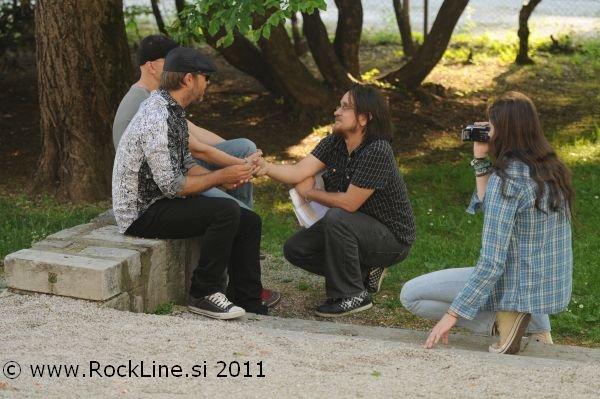
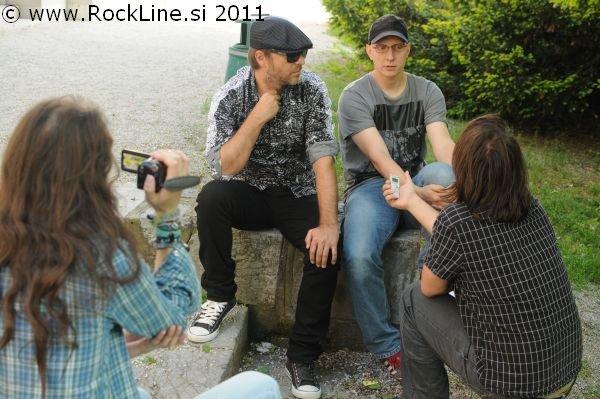
Location: Ljubljana / Navje park / Slovenia
Interview date: May 18, 2011
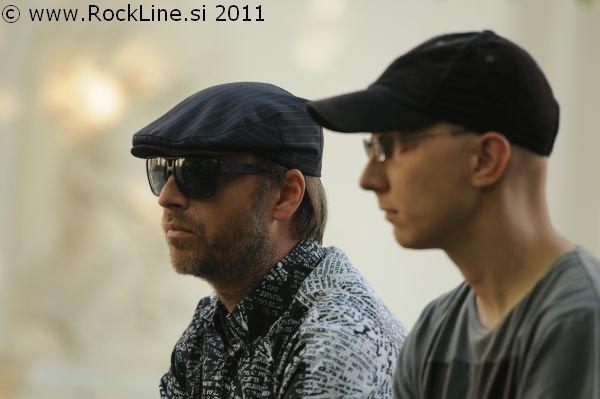
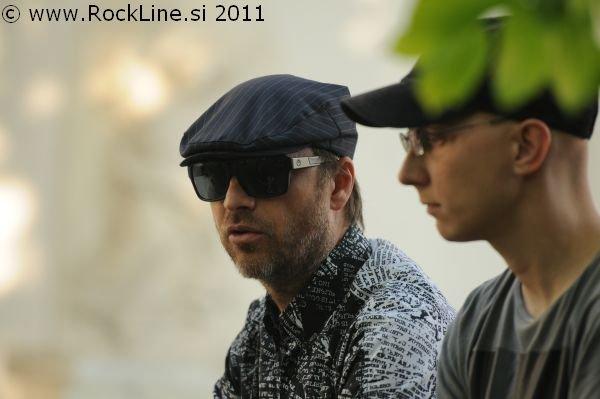
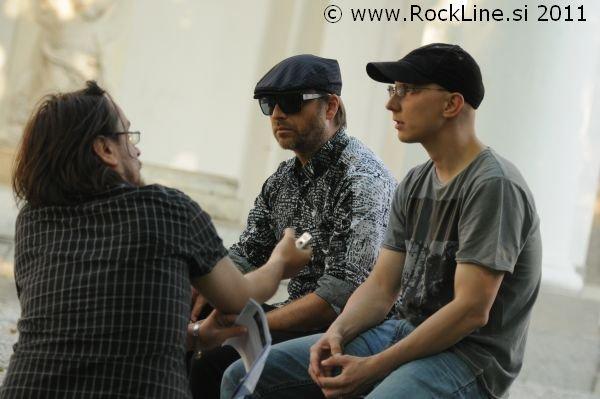
Siddharta! Just the name stirs up strong feelings in the hearts of Slovenian rock fans. The guys are coming back to the scene this year in a big way. In mid-June they’re putting on a real concert feast at the new stadium in Ljubljana. At that show they’ll premiere a completely new album in full and record it at the same time for a release planned this fall. With this big event in mind, we met up in the pleasant surroundings of the park in Ljubljana’s Navje with the band’s guitarist Primož B. and bassist Jani H. We looked back over Siddharta’s road from the very beginnings to today, and talked about what they expect from the new milestone for the band, which will be immortalized by their show at the stadium in Ljubljana’s Stožice on June 18, 2011.
RockLine: First off, a warm welcome to you both. Eight years after the big concert spectacle at the Bežigrad stadium, you’re cooking up another huge concert treat in Slovenia. A return in grand style. What are you going to show our audience?
Primož B.: First and foremost, at the concert we’ll play our new record in full, as a premiere, and record it at the same time. Besides that new material, which is ten to twelve songs, over three hours we’ll also play a “best of” from our iron-clad repertoire. Those so-called “folk-ified” songs, the ones that have become part of the national soundtrack, will fill out the rest of the running time. We’re talking a good three hours of stadium rock n’ roll, this time in Stožice, at the new stadium. Events like this don’t exactly pop up often over here, so it’s that much more tempting for us, and the urge to present ourselves to Slovenian audiences this way is that much bigger.
RockLine: I assume the event will come with some extra artistic flair. Are you planning any special surprises?
Jani H.: First of all, it’s about presenting the band. That’s the essence. So unlike at Bežigrad, we won’t bring in an orchestra. Rock n’ roll will be front and center; the lineup will maybe be joined by just an extra percussionist and possibly a backing vocalist. Negotiations about that are happening in our camp right these days. As for special guests, Laibach have already confirmed 90%, and, as it looks, your outlet is the first to hear this, Josipa Lisac. Of course I don’t want to make promises in advance, because something can fall through at the last minute and you have no control over that, but roughly, we can expect a show along those lines. It’s not final yet, though. We might change something, add something, take something away.
RockLine: What attendance do you expect at the Stožice stadium?
Primož B.: We’re not going to break the record of 30,000 people from Bežigrad. Capacity with all the stands open is 23,000 people. Given that the floor is available, meaning the grass, the stands empty out, since most people will grab a spot on the grass. Personally, I expect 15,000 to 19,000 people.
RockLine: How are you preparing, as individuals and as a band, for such a mammoth spectacle?
Jani H.: One of the most important preparations for this event happened a couple of weeks ago in Los Angeles, where we went to finish writing and recording demos, or let’s say sketches, for the new tracks we’re about to record. So the hardest part is behind us. Now we need to get all of this to the point where all these songs, these new songs, which are still being polished, get played live for the first time in front of such a huge crowd. That’s the most appealing part for us. On one hand you know you can’t screw up while playing them, but on the other, if you do screw up, you screw up, and that moment gets caught on tape. It also unleashes a ton of adrenaline, so the prep for this event is more intense than for an ordinary gig.
RockLine: Your website already has the song Sam up for listening. To what extent does this song hint at the overall musical picture of the new album?
Primož B.: Sam is already the seventh or sixth track you can listen to on our site. Let me split the new material into two parts. The first covers the work in Ljubljana, the second what came together in Los Angeles. Sam was written specifically in Los Angeles and is one of two or three slower-tempo songs on the new record. The rest are more typical of us: rockier, faster, punchier. The sound we’re striving for, or had in our heads while writing the songs and arrangements for the new album, and the lyrics too, is the stadium itself. What inspires you in an environment like a stadium. So, an album of strong rhythms and big stadium anthems. This time it’s not a concept album in the sense of “Saga”, but a record that’s more “big”, if I can put it that way, even more open and, in the end, more positive. Lyrically we leaned on the joy of living. They describe the things we love doing most in life. As a band we’ve also grown closer and grown up during this time.
RockLine: What did working with Ross Robinson bring Siddharta, in your view? What’s the added value Ross brought to the band, and which direction did that push you artistically?
Jani H.: When we started working with Ross, the first thing to go was the “click”. The “click” is something that often helps in studios these days when recording. The first thing that fascinated me was that Ross loves tempo swings and drifts. Even when you listen to old records, you actually like it when someone rushes a bit here, someone lags there, someone flubs a note, a chord happens that nobody knows the proper name of, and then everyone goes hunting for its name and so on… That’s how Ross enriched our music. Before that, a mild German pattern always clung to us. Very precise. From that exact band we turned into more of a “jeu de vivre” band, not in a jokey sense either. Suddenly more started happening. The interactions between us changed too. Not everything is predictable anymore. And that carried over to the gigs. Someone, for example, “wanders off” mid-show in their own direction, and someone else follows, or not. We no longer call that a “mistake”, but a fact. That’s how all of us, all the band members, started opening up more. Ross showed us that through his way of thinking about life, which carries over into the studio work too. When you look in the mirror you see a kid in a garage with an incredible drive to change the world while making music. Sometimes you lose the basic point and start doing things too systematically. But that’s not music. Music is: “Let’s go!” Music is “flow”!
RockLine: Is there any other big rock producer you’d like to test your musical horizons with in the future?
Primož B.: Rick Rubin’s work, for example, isn’t something I think would suit Siddharta best. He doesn’t become a member of the band. Bob Rock is much more slick in terms of ideas and production, and leaves a kind of soul stamp on the records. Ross is daring, Ross becomes a band member and is incredibly inspiring. Maybe someone like Brian Eno would suit us.
Jani H.: Yes. An interesting option. If I ever got the chance to pick which of these world heroes of production, the ones who shape musical taste, I’d work with, it would be Daniel Lanois. I follow this producer. Whatever he does, I like. I’m a fan. His solo debut from 1989, “Acadie”, and then the stuff he did with Peter Gabriel in the nineties… and in the present day he fascinates me with his new band too, called Black Dub. Excellent music and quality, organically produced sound. There’s also a guy named Nigel Goodrich, who has done exceptional things, from Radiohead and Beck to even one record for Paul McCartney. Those are the people I’d love to learn something interesting from, in addition to Ross Robinson. Unfortunately, though, that’s financially hard to reach for us in this environment.
RockLine: After “Nord”, Siddharta started flirting with markets abroad. What’s the overall feeling about general reception abroad from 2003 until today? How does a foreign audience take to Siddharta and Siddharta’s sound?
Primož B.: The fact is that abroad is still a riddle to us. That’s the truth, and we don’t close our eyes to it. It’s a vicious circle. To be recognizable abroad, you have to be present there. If you don’t have a record out, you can’t be present, even though you’re physically there. It’s a cycle. It also takes financial input, which we, as a band, cover from our own sources. Those funds are absolutely limited. On the other hand, the feedback from people is actually good. Just like things went in Slovenia at the start, things moved dynamically abroad too. The web and social networks make that possible, and the responses are very positive. As for the industry itself, it’s very pigeonholed, and Siddharta stands out from that. You can’t pigeonhole us. With “Rh-” we put out a record on Ministry of Sound. They were known as a label that primarily backs electronic music. So it was harder for them to push a rock product through to the media that cover it. The fact is that in that period we played too few shows abroad and weren’t authentic enough there. Otherwise, we do get responses from abroad, and confirmations that people are coming to the stadium from abroad too. So our current focus is the stadium show in Stožice. From June 18, 2011 on, we’ll see what moves happen abroad with our new release and activities.
RockLine: What’s your take on the age of downloads and “torrents”, when you, as the owners of your music, get stripped of authorship and become a vehicle, a commodity that’s freely passed along to listeners?
Jani H.: Those things were inevitable. You give people fire, and the first one cooks dinner with it while the second burns your house down. Internet downloading decimated the music industry pretty thoroughly, but it needed to be woken up and shaken up. We were always roaring against the labels for exploiting us. The rise of internet “downloading” certainly isn’t without sense. It has its purpose. This situation led to it being more important today what a band represents “live”, what it earns “live”. The other thing is people’s awareness. There are still countries that back buying music more than elsewhere, where total chaos reigns. To some extent we try to adapt to all this. For our market we try to create some kind of surplus value, something that gives people extra and gets us past the crossroads that internet downloading created. If you just put a CD on the shelf, it’ll sit there until the retailers clear it off a few years later, covered in dust. But if you add something extra next to that CD, for some music enthusiast it might mean more than the value of a single click online. That’s our philosophy, which we follow as a band. Personally, I can say I still buy five or six CDs a month, and as long as that’s available, I’ll keep doing it. I’m part of this, I’ll stay part of this, so I won’t be spitting in my own soup.
RockLine: In the design of your releases, from the transfusion bag on the album “Rh-” to the incredible packaging of the album “Saga”, you’ve always been a step ahead of the other bands in Slovenia. Is there anything left untapped in the field of aesthetics that might be worth adding in the future?
Primož B.: Albums will always be the main thing for us. Of course all the released singles come along with them, but the album is the main vehicle for our music. Design and music videos come into our heads later. Music comes first. Then the ideas for visuals start getting born. Looking back, each record also had some kind of visual standout, which comes out of the event that inspires it. “RH – ” had that bloody story, which inspired its visual, and that was followed by adapting the story to the individual singles too. “Saga”, as a concept album, called for special visualization by its very nature. Accordingly, we also set a higher price for the album. Those who want the album won’t care whether they count out €10 or €15, next to all those who grab albums for free off the internet. Personally, as a huge Metallica fan, I can say I have to have every single one of their albums. The special editions too. When they put out that special “Death Magnetic” coffin, I got it in a heartbeat and would’ve paid €100 for it if I’d had to. But I can’t predict anything about Siddharta’s next release, the one that’ll come out of the stadium. Whether it’ll be just a record or a DVD too… how it’ll all look. The official release will follow in the fall, and we’re flirting with a 3D look.
RockLine: Looking back, Primož, how do you see Siddharta’s studio journey from the album “Id” onward? The development itself, the artistic maturing…
Primož B.: Time in the studio flies, simply because in the studio you do the things we all in the band love most and love doing most. In the “Id” era we threw ourselves into something totally unknown, and nobody among us had any studio experience. It was hard to picture it all. Big consoles, big machines, Aco’s Tivoli studio. Everything was completely exotic to us back then. There weren’t any computers yet advanced enough to let you record at home. We recorded “Id” by raising the money ourselves. Some of it was donated by acquaintances, friends, allies, Tivoli offered us a “good price”, and we worked a lot with Dejan Radičević, who was Aco Razbornik’s assistant at the time. I remember it dragged on quite a bit, that year 1998 into 1999, when the album finally came out. With “Nord” we were already a step up. We had our own label. We already had some success on the market behind us, it was easier and safer to invest in the band, the circle of collaborators widened, Jani joined us. We knew more about everything. By the “Rh-” period we were already dealing with details, with finesse. With “Petroleo” we tried to be daring, which didn’t quite work out, but we pulled that daring off successfully with the album “Saga”, in the sense that we enjoyed ourselves, dared to be unburdened, let the music take us wherever it wanted to go. We weren’t weighed down by what anyone would think of the album, because as long as we like the music, it’s good music. The new project is a purely stadium affair, a step away from the studio and a new challenge. Here you get one shot. However you play it, that’s how it gets recorded. Okay. We’ll have a dress rehearsal the day before, just in case. But the real energy will be the event on June 18, 2011 at the Stožice stadium, and that’s the energy we’ll try to capture. We’ve been preparing for this since January 2011.
RockLine: Jani. It’s been ten years since you joined Siddharta. How did you experience that period of gradually coming into Siddharta and then integrating further into the band?
Jani H.: Actually, when you mention these ten years that have gone by… Before that we didn’t even know each other. Our paths had crossed at one or two gigs. I was playing in Magnifico back then, we bumped into each other, but we didn’t even say “hi”. Peter Penko or Žare Pak, one of them, called me back then to ask if I’d come and lay down a bass line for a few songs as a guest. I got a good feeling. To me it was a young band, an ambitious band that does everything itself. I said to myself: “Why not?” I was at a crossroads myself back then. For me one chapter of my musical story was closing, I’d also started my own band The Elevators, and I didn’t know yet exactly where my musical road would lead me next. While working with the guys in the studio, the vibe and the relationships in the band, the way the band works, struck me as very interesting. I was used to there usually being one conductor in a band. Here everybody was dealing with every question. All together. Very committed. That made a strong impression on me. And anyway, even earlier, when “Id” created a boom and a flood of Siddharta songs on the radio, from Pot v X to Lunanai. Already then I saw the band as something fresh, something new. But I never even thought I’d end up playing with them. After “Nord”, questions started coming up about whether the previous bassist Primož would stay in the band or not. So they asked me if I’d help them out for a while, a few months, until they sorted out that problem. To help them at gigs. I told them to give me a day to think about it. And from that one day, 10 years of working together have now come. Then I started going to gigs with the band and quickly felt that the band works like a family. A spirit drives the band forward. Other bands get tired, start bickering, and over things that didn’t even grow in their own backyard, just because they get bad feedback, or they fall out over money. With Siddharta, these guys saw further. Plus there was a permanent crew supporting them. It really felt like this band was extremely well organized. But of course, the first thing that drew me to Siddharta, always, was its music. When I heard Tomi’s voice, which sounded completely different from everything else in Slovenia up to that point. The music had its own recognizable direction too; you’d find traces of something foreign in it, but from the start it had its own “thing”. The people factor and the music. Those are the reasons I stayed with Siddharta. As for the generation gap, things haven’t changed much. Not at all, really. It’s stayed the same as before. They’re now as old as I was when I joined them ten years ago. Those differences are sometimes noticeable, say, in staying power when it comes to partying. They simply have more of that staying power today than I do.
RockLine: And has that “party groove” stayed the same, given that Tomi recently had a baby?
Primož B.: Oh yes, it’s stayed. We don’t run out of “mojo”. Nightlife is an important element, because that’s when certain ideas, connections, associations are born… a lot of the ideas in our music come from there.
Jani H.: But the birth influenced at least two lyrics on the new album. That’s a new dimension and a big advantage for a lyricist. Tomi wrote two wonderful lyrics that way.
RockLine: Let’s wrap up this interview with a question about the band’s short-term and long-term goals.
Primož B.: Short-term goals are to “wreck” the stadium and put out a good album. Long-term, hmmm… You know, all those ideas that seep in only really sprout once a story wraps up, so right now it’s hard for me to talk about the next goals. Of course we keep making music. But it’s hard for me to predict “where”, “who”, “when” and “with whom”.
RockLine: Do you two have any message for our readers?
Jani H.: Join us at this concert event on June 18, 2011, with which we’re breaking new ground for other Slovenian bands too. We also appeal to other Slovenian bands to dare, to be bold, alone or together with a few other bands, and try something similar to what we’re about to experience ourselves.
Primož B.: Let’s open our minds to Slovenian music that’s heartfelt and good, yet often overlooked. Many times because of prejudice. Slovenian music is great, so let’s give it a chance and make a move.
interview conducted by: Sandi Sadar Šoba
camera: Urban Bolta
photos: Aleš Podbrežnik
interview text edited by: Aleš Podbrežnik
Photo gallery