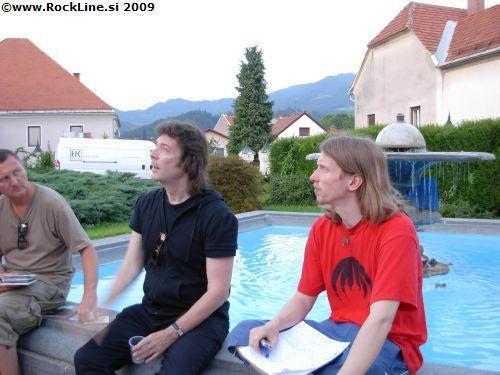
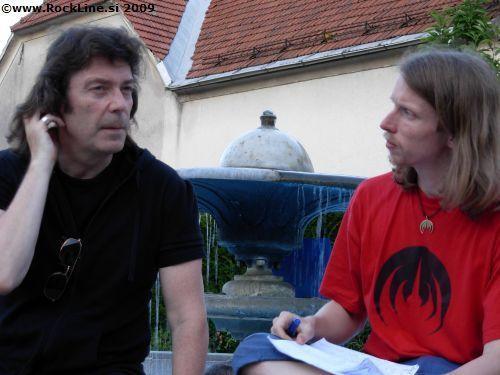
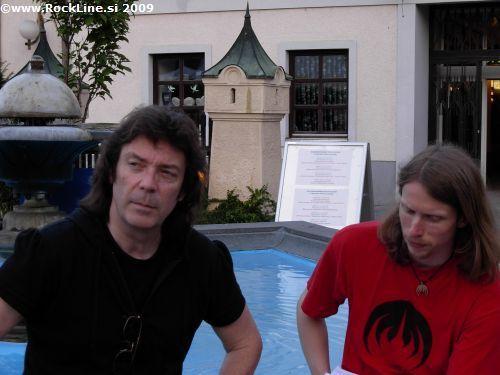
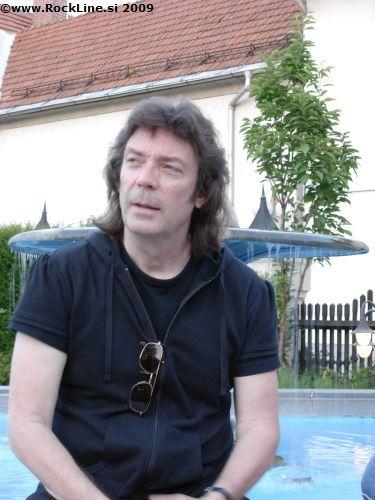
Location: Slovenj Gradec, Slovenia
Interview date: July 17, 2009
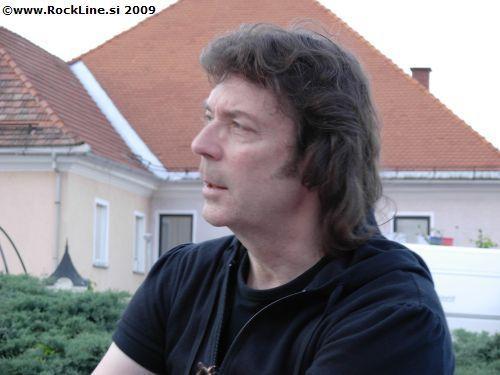
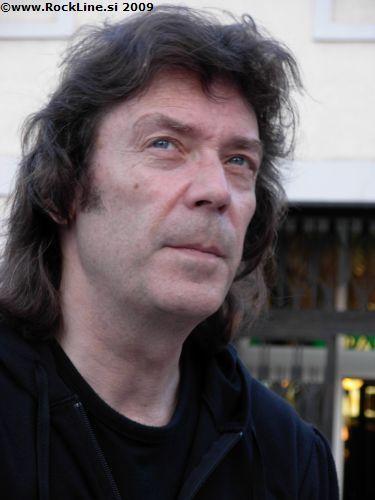
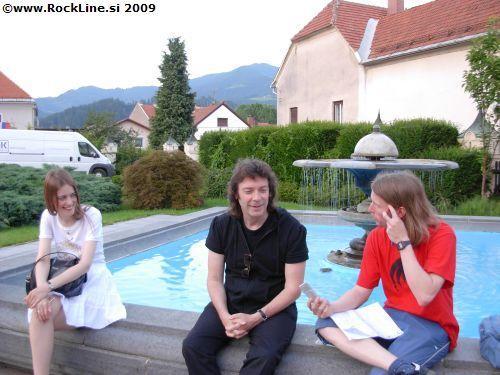
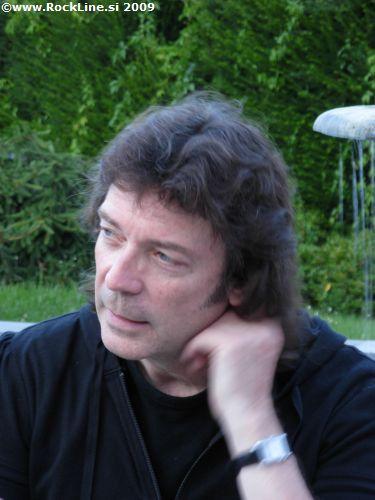
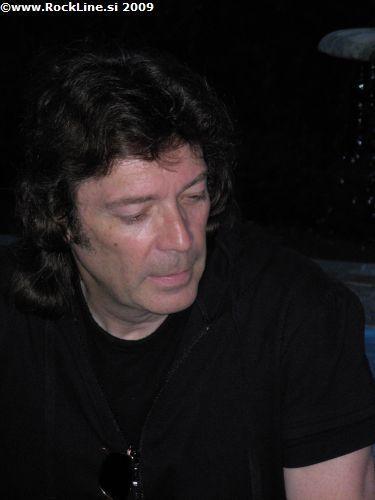
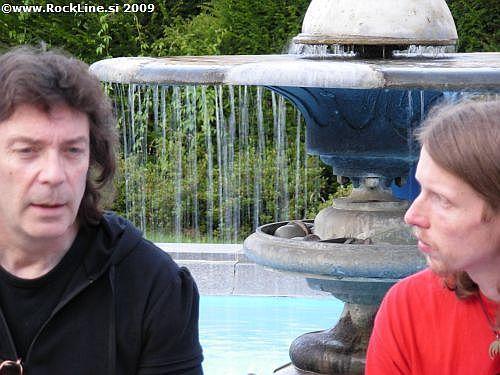
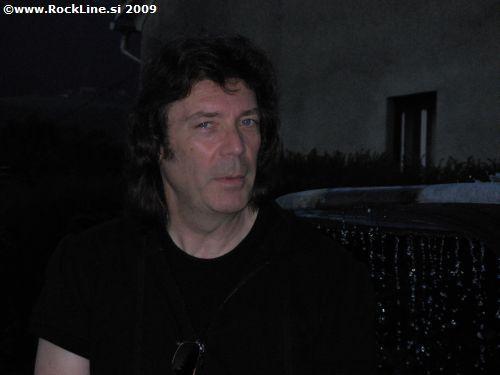
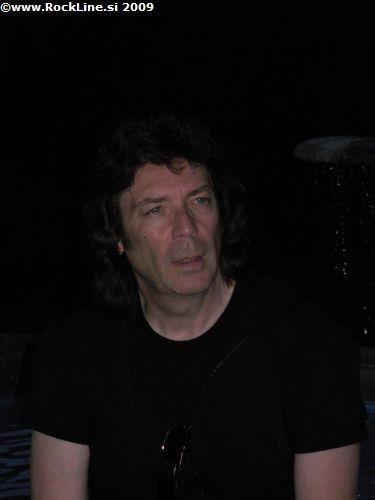
Steve Hackett first became famous as the guitarist of Genesis, who he joined in 1970 and recorded six studio albums with. After Wind and Wuthering he packed his bags and left the band, and what followed was a hugely varied solo career that’s still going strong. Along the way he also played in the supergroup GTR (with Steve Howe), and lately he’s been performing with the Hungarian band Djabe. There’s no doubt he’s one of the best and most influential guitarists ever. It was an honor to talk to him before his show with Djabe in Slovenj Gradec.
RockLine: How are you doing?
Steve Hackett: OK. Very good, thanks.
RockLine: Can you tell me something about Djabe? What drew you to their music?
Steve Hackett: Well, first I worked with Attila, who was the distributor of one of my solo albums in Hungary. Then when they came to play in London, I jammed with them. It was very easy, very free, and I loved the experience. I thought it’d be nice to do it again sometime. Later they called me because their percussionist (Sipos Andras) had died. There was a memorial concert for him in Budapest, and I played at that too. I played electric and classical guitar. There were loads of people on stage, constantly coming and going. It was a really good show. A great experience, and the atmosphere was incredibly emotional. I also like playing angklung with them. Every concert is different. Sometimes I’m playing and I have no idea what’s coming next. It’s totally unpredictable. We mostly improvise, so there’s a lot of freedom. In their music you can hear jazz, world music, fusion, a bit of prog. I think it’s jazz in spirit, but you can also hear Romani music and improvisation. We have all of that in common.
RockLine: So you enjoy playing with them?
Steve Hackett: Yes. We’ve been playing together for quite a while now. I’ve done quite a few shows with them. I recently toured with my own band and played those shows too. Next week I’m heading out on a tour of Italy with my band. We’ve still got a show with Djabe in Graz, Austria. We’ve already done Dubrovnik, which was lovely, since I’d never been there before.
RockLine: Have you ever been to Slovenia before?
Steve Hackett: No, this is my first time?
RockLine: Not even with Genesis?
Steve Hackett: No, not even with them.
RockLine: I noticed you play in Italy a lot. Does that mean you have a special bond with Italy?
Steve Hackett: I’m very attached to Italy, and I think Italians have enormous respect not just for what we play today, but also for the ideas we had in early Genesis. It was the first place that really responded to Genesis. They became famous there before anywhere else.
RockLine: Kind of like Van Der Graaf Generator.
Steve Hackett: I think so, yes.
RockLine: Does it ever bug you that people still call you the Genesis guitarist?
Steve Hackett: No, I’m happy with that. It was an important part of my development, and the music I played with Genesis is still very close to my heart. There were good ideas, good musicians, good songs, and good friends too.
RockLine: So you didn’t part on bad terms?
Steve Hackett: No, not at all. I think we all felt at the time that it was the right move. We all respect each other as musicians and as people.
RockLine: What about the Genesis reunion? Did you catch any of the shows?
Steve Hackett: No, I didn’t see it, but I hear it was very good. I’m glad it happened. We did talk with Peter Gabriel about maybe doing The Lamb Lies Down on Broadway. Maybe one day, but right now we’re too busy with other things.
RockLine: Do you think it’s a good idea to go back 35 years, or would you rather move forward and do something completely new?
Steve Hackett: That’s an interesting one, isn’t it? I think for musicians who have to prove themselves all over again, new is always best. A musician always looks forward, always tries to make something new. The audience always wants to be sixteen again, so the emphasis is always on the past, on enjoying the music you listened to when you were very young. I listened to certain artists when I was young, and that music means more to me than anything they could do today, because I want to go back to adolescence, with the hormones raging and the constant daydreaming.
RockLine: So did Genesis’s music have anything to do with hormones?
Steve Hackett: Well, everything we did with Genesis was completely asexual. It all came out of books, no passion.
RockLine: Peter Gabriel’s outfits were especially asexual.
Steve Hackett: Exactly.
RockLine: I know there was a lot of conflict back then over Peter’s costumes. Were you one of the ones against what he was doing?
Steve Hackett: I never complained about it. I thought it was necessary for him to do it, because we were playing very difficult music that almost nobody liked, until he started dressing up, and then suddenly people liked the music too. It’s very important to have a frontman who knows how to talk to the audience’s hormones, and how to scramble them.
RockLine: But Genesis were never as popular with Peter as the singer as they were later with Phil.
Steve Hackett: We weren’t as popular with Peter. With the four of us we did slightly better, and they did even bigger as a trio. But when people look at Genesis these days, they’re mostly interested in what we did when there were five of us. That’s the period that interests them, because of what the individuals could do. It’s appreciated more now than when it was current, which is often the case in all branches of creative art.
RockLine: Do you find it a bit ironic that you all had your biggest successes after you split? Peter was popular as a solo artist, you had a nice run with GTR, and Genesis scored big with albums like Invisible Touch.
Steve Hackett: If you want hits, you usually get the game that comes with them. That usually means compromises, but I don’t like compromising in music, because otherwise we’d all just be making things that corporations back. I think it’s important to stay open to new things. Interesting, isn’t it? It’s all mythologies the whole time. Sometimes the audience embraces an artist’s work, and sometimes they reject it. Sometimes the artists themselves say: “I made this album and it was rubbish. Nothing worked.” The audience might think it’s heavenly while the artist thinks it’s hellish. Live shows are the same, because nobody knows what people are thinking when they’re up on stage. Do you play yourself?
RockLine: I play now and then, but I’m pretty bad.
Steve Hackett: But do you enjoy it?
RockLine: I do, but I don’t think anyone else does.
Steve Hackett: Really? Well, I think the most important thing is that you enjoy what you do. I think I enjoyed playing guitar most when I could only play three chords. I had no technique, but just getting the basics down thrilled me. The more you can do, the more you want to be able to do. It’s an endless quest. You can never do everything you want. It’s impossible.
RockLine: You mentioned compromises earlier. Did you have to make a lot of them in the bands you were in, like Genesis and GTR?
Steve Hackett: I think so. I think compromises happen because you’re trying to work in situations where some personalities are more difficult than others. I always felt I had to be the glue and bring out the best in the other people. I’ve always been very uncompetitive about my own contributions to a band, because when I hear someone play something great, I tell them so. I think that’s really important, no matter how old the musicians are.
RockLine: So you’d never try to override something with your own part?
Steve Hackett: No. At least, I hope not. I think a band is only as strong as its individuals. Everyone has to leave everyone else enough room so we can all shine together.
RockLine: What about your solo career? You’ve played with so many musicians. How do you adapt to each one’s playing?
Steve Hackett: I think music is always about adapting. I recently recorded a classical guitar album called Tribute, where I play Bach pieces. They were the hardest things I’ve ever played, but it was worth the effort because the music is so spectacular. I’ve felt a passion for Bach my whole life, and what I try to achieve with my classical projects, he achieved many years ago. It’s wonderful music because you can use it anywhere. It doesn’t matter what instrument you play it on. It sounds fantastic on everything. I think all musicians aspire to write compositions like that.
RockLine: In Genesis you were first known as an electric guitarist. How did you discover your love for classical guitar?
Steve Hackett: I grew up on The Beatles, The Stones and r’n’b, and then when I was 15 I heard Segovia play Bach on classical guitar, so I always had two interests in music. One was a possible career – the electric stuff – but I didn’t think a band could take in classical influences, medieval stuff, even a bit of flamenco, which I’ve been doing more of lately, especially on the new album. With the bands that started appearing in the late 60s and early 70s, I noticed that those kinds of influences were possible. In a single band you could bring in classical, jazz, pop, rock, blues and even humor. I was lucky to be born at a time when music wasn’t trivialized. In the 50s, when I was growing up, mixing genres just didn’t exist. You had either opera or light music. Rock was only just being born out of the blues. I was lucky to be around when it didn’t seem wrong to cram the whole history of music into one song and still touch on the future as well. In a way it was both surreal and magical.
RockLine: Did Genesis satisfy both of those sides for you?
Steve Hackett: To be honest, I’m never completely satisfied, and I’ve never been completely satisfied with any one band. When you have musical dreams, you keep chasing them, and I can be proud of many of the albums I’ve made, with Genesis, solo and with other people, but my soul is restless and nomadic, so I always feel the urge to travel and experience different cultures in different places. I want to study the environment, the culture, the musical differences. I always feel pulled toward the East. There’s a bit of that with Djabe too, an undercurrent, especially with Feri, the violinist, who also plays trumpet.
RockLine: The Romani influences.
Steve Hackett: Yes, there’s definitely something Romani in his playing, and he makes really interesting albums of Romani music, where the violin is incredibly passionate and wild. It’s very interesting, and when I play with them, every concert is different. Sometimes I feel I played really well with them, and sometimes I feel like I couldn’t do anything right. I always judge it in a very human way. I’m always chasing musical perfection.
RockLine: You mentioned a solo album earlier. Two projects are on the way, right?
Steve Hackett: We’re going to record a rock album with lots of different styles. It’ll also come out as a special edition with some live material, but that’s with my own band. I’m sure I’ll keep working with Djabe too. There’ll be lots of different things on the album. I can’t think of another album right now.
RockLine: What about the Squackett project?
Steve Hackett: Oh right, the thing with Chris Squire (Yes). We’ve worked on a lot of stuff together. I hope we’ll be working together in August, when he comes over to England. He’s busy touring in the States right now too. We live in different countries, but we’ve already made some great music together. I’m looking forward to it.
RockLine: We’ve also had reissues of the Genesis albums lately. How happy are you with the ones you played on?
Steve Hackett: I think the production is much better and the mixes sound better, especially the drums. I always want to change everything. Those albums are the products of a very young band at a time when we were struggling to find a way to express ourselves. We made something very special, but not perfect. You shouldn’t expect perfection. I love The Beatles, for example. I’m not looking for perfection in them, I just want to be that age again. I hear them with the ears of back then. I forgive them everything, because that music was so rich and such an important part of my life, just like Genesis is for some people.
RockLine: Maybe the imperfections are what make the music interesting.
Steve Hackett: I think the imperfection lies in knowing that we were all struggling with this music. That lets other musicians say: “Hey, I could do that, and do it better than them.” There’s always an invitation, the baton is always being passed to younger musicians and singers.
RockLine: Did any band member influence the sound of the reissues, or was it all down to Nick Davis?
Steve Hackett: To be honest, I let Nick get on with it. I’d suggest something now and then, but mostly he did a good job, and I can hear more guitar than before. I think he likes the guitars up front, and I think it works well. But you’ve got both the old and the new editions. There are also new live reissues coming out soon.
RockLine: Have you heard Seconds Out yet?
Steve Hackett: I have, yes.
RockLine: Is your guitar any louder now? On the original it was pretty quiet.
Steve Hackett: Well, I haven’t compared the two side by side, but I think they sound pretty similar.
RockLine: Just one more question. Can you tell me about your inspirations in music? Is it sometimes poetry, literature?
Steve Hackett: All of that inspires me, since so many things can influence music. I think a lot of singers are known for their poetry. At the same time, I think there’s a kind of conspiracy trying to tell us what one person can do, and we have to change that idea. Take Bob Dylan. Everyone said he couldn’t sing, and then he made Nashville Skyline with a completely different voice. So part of what I’ve done in the past was tied to poetry. I think guitar heroics can be limiting. I don’t know how often I could sit and listen to a whole album of electric guitar. I’ll listen to it and try to pick something up, like a little glossary, but if you want a fully rounded piece of music, you need strong songs and superb arrangements, as if all the instruments were talking to each other and doing exactly the right thing at exactly the right time. That’s what I try to do with my music.
RockLine: Thanks.
Steve Hackett: Thank you.
Photos: Ivana Kisegi
———————————————————————————————
Steve Hackett first became famous as the guitarist of Genesis, the group he joined in 1970 and recorded six studio albums with. He left after Wind and Wuthering and this was followed by a highly versatile solo career, which is still going on. In between all this, he was also a member of the supergroup GTR (with Steve Howe) and he has recently been performing together with the Hungarian group Djabe. There’s no doubt that he is one of the best and most influential guitarists ever. It was an honour for me to talk to him before his show with Djabe in Slovenj Gradec.
RockLine: How are you doing?
Steve Hackett: OK. Very good, thank you.
RockLine: Can you tell me something about Djabe? What grabbed your attention in their music?
Steve Hackett: Well, first of all I worked with Attila, who was the distributer of a solo product in Hungary. And then, when they were playing in London, I jammed with them. It was very easy, very free and I enjoyed the experience. I thought it would be nice to do it again sometime. They later phoned because their percussionist (Sipos Andras) died. There was a memorial concert in Budapest and I played at that. I was doing some electric and some nylon guitar. They had many people on stage, coming and going all the time. It was a very good show. It was a very good experience and the atmosphere was very emotional. I also like playing these angklungs with them. Every concert is different. Sometimes I play and I wonder what’s going to happen next. It’s very unpredictable. It’s mainly improvised, so it’s very free. There are aspects of jazz, world music, fusion, some progressive. I think that it’s jazz in spirit, but there’s an aspect of gipsy and improvisation. So, we share all of those things.
RockLine: So you’ve been enjoying playing with them?
Steve Hackett: Yes. We’ve been playing for quite some time. I’ve done quite a few shows with them. I’ve recently been touring with my own band and doing those shows. We start a tour of Italy next week. We have one show here with Djabe and another in Graz, in Austria. We already did Dubrovnik. That was very nice. I’ve never been to Dubrovnik.
RockLine: Have you ever been to Slovenia before?
Steve Hackett: No, this is my first time?
RockLine: You’ve never been here with Genesis?
Steve Hackett: No, this is the first time.
RockLine: I notice you travel to Italy a lot. Does that mean you have a fondness for Italy?
Steve Hackett: I have a tremendous fondness for Italy and I think Italy has a fondness for not just the things we play today, but for the ideas we had with early Genesis. It was really the first territory to respond to Genesis in a very big sort of way. Genesis became a famous band there before it was famous anywhere else.
RockLine: The same as with Van Der Graaf Generator.
Steve Hackett: I think so, yes.
RockLine: Does it ever bother you that people still talk of you as the guitarist of Genesis?
Steve Hackett: No, I’m happy to be known as the guitarist of Genesis. It was an important part of my development and I’m still very fond of the music I did with Genesis. There were lots of good ideas, good players, good songs and good friends too.
RockLine: So you didn’t part on bad terms?
Steve Hackett: No, we didn’t part on bad terms. I think it was something we all felt was right. We all respect each other musically and as individuals.
RockLine: What about the reunion? Did you catch any of those shows?
Steve Hackett: I didn’t see that, but I hear it was very good. I’m very pleased that happened. At one point, we were all talking with Peter Gabriel to see if he would do something like The Lamb Lies Down on Broadway. Maybe one day, but at the moment we’re too busy doing other things.
RockLine: Do you think it’s a good idea to revisit stuff you did 35 years ago or would you rather look to the future and do something totally new?
Steve Hackett: It’s very interesting, isn’t it? I think that for musicians who have to reinvent themselves, new is always best. The musician always looks forward, tries to create something new each time. The audience always wants to be sixteen again, so there’s always an emphasis on the past, with the function of enjoying the music you listened to when you were very young. There are artists I listened to when I was very young and that music means more to me than anything they could possibly do today because you want to return to adolescence, where your hormones are raging and your dreams are coming thick and fast.
RockLine: So, did the music of Genesis have anything to do with hormones?
Steve Hackett: Well, everything with Genesis was completely asexual. Everything was learned from books, no passion.
RockLine: The costumes of Peter Gabriel were especially asexual.
Steve Hackett: Exactly.
RockLine: I know that there were many conflicts at the time, about Peter’s costumes. Were you one of the people against him doing that?
Steve Hackett: I never complained about it. I thought it was very necessary for Pete to do that because we were playing very difficult music that nobody really liked until he started dressing up and then suddenly everybody started to like the music. It’s very important to have a front man who is able to speak to people’s hormones, to confuse the hormones.
RockLine: But Genesis were never as popular with Peter as with Phil as the singer.
Steve Hackett: It wasn’t as popular with Peter. It was slightly more popular with the four of us. It was even more popular with the three of them. But now, when people look at Genesis, they’re mostly interested in what we did when there was five of us. The main interest is in that area because of what the individuals did. It’s appreciated more now then when it was current, as is often the case with things in all branches of creative art.
RockLine: Do you perhaps find it ironic that all of you had the most success when you broke up? Peter had a huge solo career, you had a successful album with GTR and Genesis were huge with stuff like Invisible Touch.
Steve Hackett: There’s something that goes with having hits. There’s a game that accompanies it and it’s partly to do with making compromises. But I prefer not to compromise music, otherwise we would always be doing things that are corporately viable. I think it’s important to be open to something that is new. It’s interesting, isn’t it? You’re dealing with mythologies the whole time. Sometimes the public embraces the work of an artist and sometimes they reject it. Sometimes the artists themselves say: “I did that album and it was terrible. Nothing worked.” The audience may think it’s heavenly, while the artist may think it’s hellish. That’s the same with a live concert as well because nobody knows what the people are thinking when they’re on stage. Do you play yourself?
RockLine: I play from time to time, but I’m pretty bad.
Steve Hackett: But you enjoy it?
RockLine: I enjoy it, but I don’t think anybody else enjoys it.
Steve Hackett: Really? Well, I think the most important thing is to enjoy what you do. I think I enjoyed guitar playing most of all when I was able to play just three chords. No technique, but just to be able to manage the basics was very exciting to me. The more you can do, the more you want to be able to do. It’s an endless quest. You can never do everything you really want to do. It’s impossible.
RockLine: You were talking about making compromises before. Did you have to make many compromises in the band projects you were involved with, like Genesis and GTR?
Steve Hackett: I think so, I think there were compromises because you’re trying to work in situations where some personalities are more volatile than others. I always felt my role was to be the glue and to try and bring out the best in other people. As far as my own contributions go, I’ve always been very uncompetitive in a group context because if someone is playing something that sounds great, I always tell them if they’ve played something really good. I think it’s very important, no matter how old musicians are.
RockLine: So you’d never try to replace something with your own part?
Steve Hackett: No. I hope not. I think that a band is only as strong as all the individuals. You all allow each other that space to be able to shine together.
RockLine: What about your solo career? You’ve played with so many different musicians over the years. How do you adjust to the playing of each musician?
Steve Hackett: I think that music is all about adjustment. I recorded an album of classical guitar music, called Tribute, with Bach pieces and I found those the most difficult of all the pieces I’ve done, but I thought it was worth it because the music is so spectacular. The music of Bach is a lifelong passion for me and the things that I try to do in a classical idiom always aspire to the same condition that his music already reached so many years ago. It’s wonderful music because you can transpose it. It is indifferent to the instrument it’s being played on. It sounds marvellous on everything. I think that all musicians aspire to write compositions like that.
RockLine: You were first known as an electric guitarist in Genesis. How did you discover your love for the classical guitar?
Steve Hackett: Many years ago, I grew up listening to The Beatles and The Stones and r’n’b, then when I was 15 I got to hear Segovia play Bach on the nylon guitar, so I always had two interests in music. One of them was a possible career move – which was all of the electric stuff, but I didn’t think a band would be able to incorporate the classical influences, the mediaeval stuff, even some of the Flamenco stuff, which I’ve been doing a bit more of, especially on this new album I’ve just done. What I discovered with bands that started to appear in the late 60s and early 70s, those kinds of influences were possible. It was possible within one band to include classical influences, jazz influences, pop, rock, blues and humour as well. I was very fortunate to be born in a time when music was not trivialised. In the 1950s, when I was growing up, there was no such thing as fusion in music. There was either opera or there was light music. Rock was just starting to be born out of blues. I was lucky to be involved in a time where it was not considered gauche, in the course of one song, to run the gambit of the whole of the history of music and touch on some of the future as well. So, in that way, it was both surreal and magical.
RockLine: So, did Genesis satisfy both of those aspects for you?
Steve Hackett: Well, to tell you the truth, I’ve never really been totally satisfied and I’ve never really been totally satisfied with any one band. When you keep having musical dreams, you’re always chasing them and I can be proud of many of the albums I’ve done, with Genesis, on my own and with other people, but I’m a restless nomadic spirit and I feel the need to travel and experience the different cultures of many places and to examine the terrain, the culture, the musical differences. I always feel I’m being drawn towards the East, in a way, the whole time. Even with Djabe, there’s an aspect, an undercurrent, especially with Feri, the violinist, who also plays the trumpet.
RockLine: The gipsy influences.
Steve Hackett: There’s something gipsy in there, yes and he makes very interesting gypsy albums with very passionate and wild violin. It’s very interesting and when I play with them, every concert is different. I sometimes feel like I played very well with them and at other times I feel like I couldn’t do anything right. I always have a very human assessment of it. I’m always chasing musical perfection.
RockLine: You talked about your solo album earlier. You have two projects coming up, right?
Steve Hackett: We have a rock album coming up, which has many different kinds of styles. We also have a special edition of that, which contains some live material as well, but this is with my own band. I’m sure I’ll continue to do stuff with Djabe. There will be many different things. I can’t think of another album.
RockLine: What about the Squackett thing?
Steve Hackett: Oh yeah, the thing with Chris Squire. He and I have a number of things that we’ve been working on. I hope I’m going to be working with him in August, when he’s over in England. He’s also busy touring in the States. So, we’re living in different countries, but we have some great music we’ve done together. I’m looking forward to that.
RockLine: We’ve had the rereleases of Genesis albums. How are you satisfied with the ones you played on?
Steve Hackett: I think the production sounds much better now and the mixes sound much better, the drums in particular. I always want to change everything. The albums are products of a very young band, in a time when we were struggling to express ourselves. We made something very special, but not perfect. You shouldn’t look for perfection. I like The Beatles, for example. I’m not looking for perfection in them, but I want to be that age again. I hear it with the ears of then. I forgive it everything because it was so rich and such an important part of my life, as I think Genesis is to many people.
RockLine: Perhaps the imperfections make it interesting.
Steve Hackett: I think the imperfection is in knowing that everyone was struggling to do it. It makes it possible for other musicians to say: “Hey, I could do that and I could do it better than them.” There’s always the invitation, the torch is always handed on to younger players and singers.
RockLine: Did any band member influence the mixes or was it Nick Davis alone?
Steve Hackett: To be honest, I let Nick get on with it. I’d sometimes suggest one or two things, but in the main, he does a very good mix and I can hear a lot more guitar than when I originally did it. I think he likes to have the guitars a little louder and it works very well. But you have both the old mixes and the new ones. There’s also a live box set coming out.
RockLine: Have you heard the Seconds Out yet?
Steve Hackett: Yes, I did.
RockLine: So, is your guitar any louder now because it was quite quiet on the original mix?
Steve Hackett: Well, I’m not playing it side by side, but I think it sounds quite similar to the mixes before.
RockLine: Just one more question. Can you tell me something about your inspirations in music? Is it sometimes poetry, literature?
Steve Hackett: It’s all of those things because there are so many ways to influence music. I think many singers are more known for their poetry. At the same time I think that there’s almost a sort of conspiracy which fixes everybody’s idea of what one person does and it’s really up to all of us to change the idea of that. Like Bob Dylan. Everyone was saying that he can’t sing and then he did National Skyline with a different voice entirely, so part of what I’ve done in the past has been involved with poetry. I think guitar heroics can be very limiting. I don’t know how often I would sit down and listen to a whole album of electric guitar. I’ll listen to it to take things from it, as a glossary of terms, but to have a fully rounded piece of music, you have to have powerful songs, exquisite arrangements, almost as if all the instruments are talking to each other and doing exactly the right thing at the right time. So, that’s what I work towards.
RockLine: Thanks.
Steve Hackett: Thank you.
Photos: Ivana Kisegi
Photo gallery