Author: Rok Klemše
Photos: Aleš Podbrežnik
Location: Kino Šiška, Ljubljana
Interview date: May 7, 2013
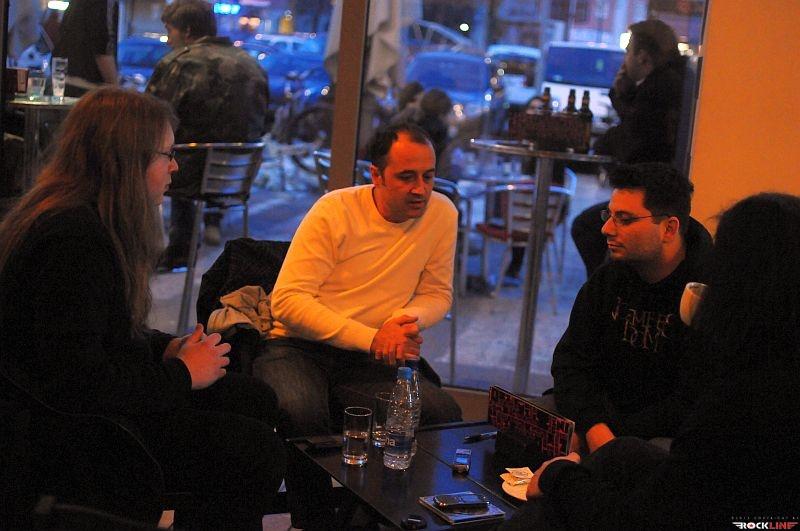
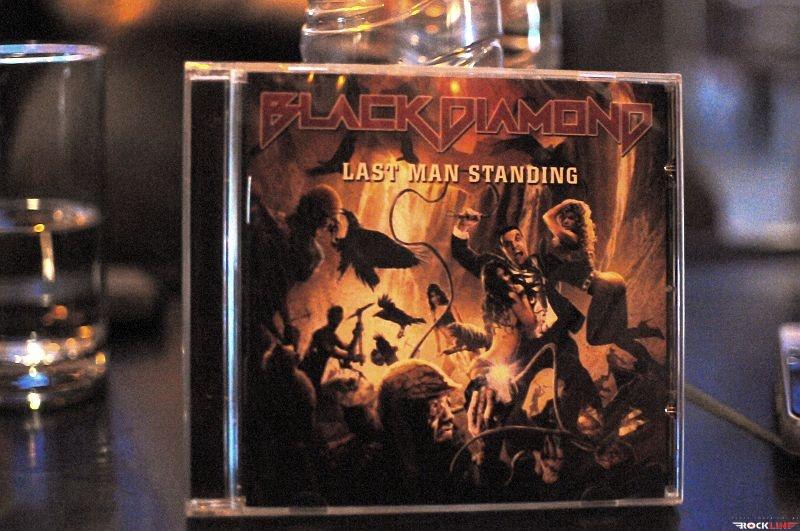
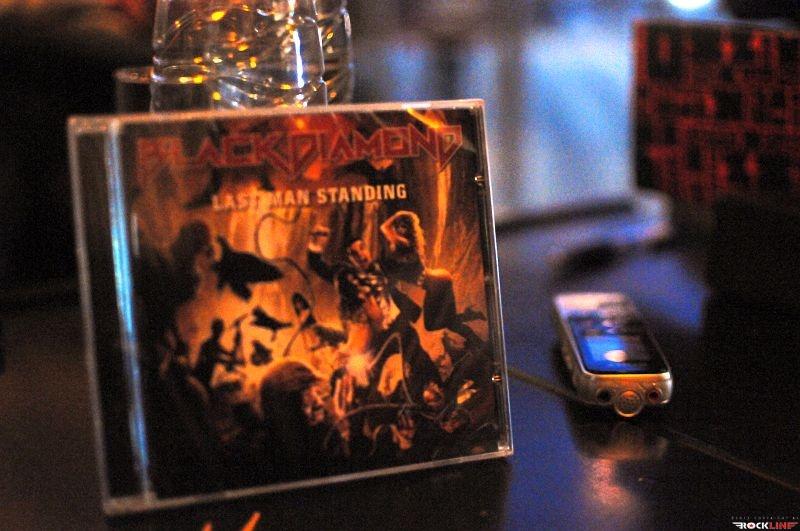
Summer 2005. Guitar duo Igor Manasijevič and Nejc Vidmar start writing original material, and the pair gives the newborn band a name too. Black Diamond. Extreme difficulty finding and landing extra members doesn’t faze the guitar duo. Igor and Nejc keep writing material nonstop and present it to the public via MySpace for the first time around 2008. Even the first demo recordings showed that this Novo Mesto gem had the potential to be a top-class heavy metal outfit. Because the search for the members they needed wasn’t going anywhere, Black Diamond turned to »session« musicians at the time. Among others, the band got help from Žanil Tataj Žak (Turbo, Mary Rose), who recorded vocals for a few tracks, and drummer Robert Kovačič (Scaffold). They caught people’s attention, while Igor and Nejc kept grinding away, cutting and polishing the music like a diamond until it gleamed. In all its brilliant blackness it finally shone on the debut Last Man Standing (you can read the review HERE), and at last live too, at the “release party” on May 16, 2013 at Ljubljana’s Orto Bar (report HERE)! The band’s founding fathers Igor and Nejc walked us through the band’s history and the story behind the making of the debut, and the “third member behind the scenes,” Samo Urbančič, who has been with the duo since their very first steps, chimed in as well.
RockLine: You two have come a long way from forming the band to releasing the debut Last Man Standing. The band’s beginnings go back to 2005, and you put the first demo recordings up on MySpace in 2008. That’s a pretty long stretch, especially when you factor in the trouble of finding members. How did you manage to hang in there for so long, and write strictly original music from the very start?
Nejc: It wasn’t even hard to keep going, because we don’t know how to do anything else anyway (laughs). We knew that what we were doing had potential, and we had no alternative but to persist. We knew that once we recorded the album, the lineup would settle too and we could move forward with a proper crew.
RockLine: You’ve certainly proven your persistence. Was there ever a point where you were close to calling it quits?
Nejc: No, never, not once.
RockLine: Samo, you’ve been helping Igor and Nejc from the very start with the creative side, but mostly with recording, production and so on?
Samo: Yeah, that’s right. I’ve worked with them since the very beginning, when they were still on their own and I believed in them. The sketches of the songs, the ideas, seemed so good to me that I backed them in everything. I helped them with microphones, and back when I still had my studio they recorded the first demos at my place. At the start I also taught them how to use certain programs, which they’re now experts in themselves. I believed in them from the start and stood by them through the years-long search for members too. That they stuck it out is a bit of a surprise, though it’s not really strange, since both of them are stubborn and huge perfectionists. They have broad musical knowledge, and they worked systematically, deliberately and slowly.
Nejc: You forgot that you also helped by contributing a song.
RockLine: Tears In Eyes, which you sang on the album too.
Samo: Yeah, that’s true. It was actually the first demo. In my opinion that one and all the other songs are now on a much higher level, because they’ve matured, and the guys approached everything very professionally, right down to the instruments they used. For Tears In Eyes the guys said it simply fits my vocals, and I have to say the song was already getting spins as a demo on some Finnish internet radio.
Nejc: On a site fighting child pornography and child abuse.
Samo: The song was still just a raw demo back then. It seems it had something, some kind of message, that got it noticed.
RockLine: There is a difference between the demo of that song and the final version on the album, which you gave a female vocal on top.
Nejc: That’s right, and the version on the album has an extra guitar solo as well.
RockLine: How did you come up with the idea? The song has a sort of dialogue form.
Igor: The story itself carries the idea of abuse, and the female vocal represents the abused girl »on the other side of the street.« We really tried to put ourselves into that story.
RockLine: How did the collaboration with vocalist Sandra Tomovič (ex-Moveknowledgement) come about?
Samo: She’s a longtime friend of ours, both from the music scene and otherwise. We wanted to lift the ballad feel of the song. While recording it we tried lots of things and combined them in the end, and this female vocal was one of them. It turned out it was done really well and the decision was right, because it elevates the song. It was already great at the recording session, when Sandra started singing and Igor and I just looked at each other (laughs). At the beginning I was a bit afraid that the tone of my voice wouldn’t match hers.
Igor: I wasn’t, because at the very first test I ran her vocal together with Samo’s and saw it was a winning combination. After that everything went smoothly, she rehearsed the song and recorded it pretty quickly too. She’s a proven vocalist, an excellent singer. She otherwise sings solo music with big technical demands, so I knew there wouldn’t be any major problem.
Samo: Her vocal lifted the whole spectrum of the song even more and gave it a certain atmosphere, and it’s sung that way too. I’m more of a rock singer myself, and sometimes I had a hard time following Igor’s demands for all sorts of triplets, rises and drops. Sometimes he had to explain the whole thing in really graphic detail. So the song has this constantly rising atmosphere, and it’s sung in a way that first and foremost reflects the message of the song.
Igor: It’s very realistic and points to something people close their eyes to, or find hard to admit: that abuse really happens, and in our own homes.
RockLine: Even the demo-stage songs were recorded with a strong crew: Žak sang one of the first tracks, Robi drummed on Opus. How did these collaborations actually come about?
Igor: Nejc suggested Žak.
Nejc: A while back I bought the Turbo CD…
RockLine: The Power of Metal or A Glimpse of Home?
Nejc: A Glimpse of Home, which was a phenomenal record to me even in my youth. Originally we had in mind that Simon Jovanovič would sing the other songs too, but he had no time, so we called Žak.
Igor: The first song was Tears In Eyes, which is now the last track on the album, because we didn’t want to mix up the songs. The first eight are sung by Žak, then Simon, and at the end Samo and Sandra. After the first Tears In Eyes came Mastermind, sung by Simon, former Prospect vocalist. We still wanted to work with him back then, but his schedule and other commitments didn’t allow it. I contacted Žak and we agreed he’d record one song, and he blew us away right then. We were thrilled, plus he’s a great guy, and we said, why not keep working with him.
RockLine: When did that moment come when you said the demos already up on MySpace were enough and it was time for a proper studio album?
Igor: True, the demos were out, but the staffing problem remained: we had no members to present the material live. So we’d rather finish this album, use that time, and look for the remaining members in the meantime. At the end of 2011 we met with Simon for the first time and agreed to start recording. In mid-January 2012 we started recording the first song, and it went on from there. At the start things got stuck quite a bit, because everyone pulled in their own direction, everyone wanted to realize their own vision. Simon had his own way of working, which we respected, but we also made it clear we’d stand our ground. There were some complications, but there was never any bickering. Simon is a good friend of ours, and we respect him. In time he also got a feel for what we wanted from the sound itself, and we agreed to give him a few references of bands and records with the sound we were after. That slowly got things unstuck. At the beginning we came to his studio in Ljubljana and there were too many demands from our side, to the point where it was barely clear who was the producer and who was the band. We might really have overdone it there, but we explained to Simon that we meant no harm, we just wanted what we felt. We had a clear vision of the sound we wanted, what we’d insist on and where we wouldn’t budge. He saw we had no intention of discrediting him, just of finding a compromise we’d all be happy with. Once we nailed the sound, we decided we’d stop going to his studio, that he’d mix on his own and send us the tracks, which we’d approve and then dampen, balance the levels and so on. By early August we were finally, slowly, nearing the finish line.
RockLine: Who did you two give Simon as references?
Igor: Definitely Metallica’s Black Album, which for me personally is the most top-notch thing when it comes to production, even by today’s standards. And Iron Maiden too, of course.
RockLine: That’s exactly what you hear on the album.
Igor: Yeah, true, those are our influences. That’s what Nejc and I have been striving for all these years.
RockLine: You had the album mastered abroad, in Finland with Mikka Jusila. How did that collaboration come about and why did you pick him?
Nejc: We weighed for quite a while which studio to send the album to for mastering. From the start we knew we wanted a better studio, and there aren’t any in Slovenia, unfortunately. Mikka was pretty affordable, he’s done plenty of records that are to my taste, and that made him the right choice.
Igor: If you look at the price-to-quality ratio, we decided right on that front too. The price was reasonable, projected at under 1,000 EUR, which is very good for world-class mastering. The price did climb a bit in the end because of our demands (laughs). Still, it’s acceptable given what we got in the end. Besides, with us price has never been a factor that stopped something we had in mind. And we definitely had a vision. When we recorded the first demos we had no clue what we were doing, and we were actually learning how to record. But our musical sense was already well developed, which helped us later on. If you’re a musician, especially when it’s your own music, you know every nuance, every detail, and that’s definitely a big advantage. What we lacked was knowledge of production and recording itself. Along the way we learned a huge amount and so had a lot of say in the final mix. To be honest, we were effectively the album’s co-producers. I’m sure we were a “pain in the ass” to somebody (laughs), but I still think everyone now knows what we wanted and why it went the way it did. I think we were already so confident because we’d spent four, five years doing production on our own, on a more amateur level, but we still had a well-developed ear and vision. That’s why we “dared” to meddle in the producer’s work, though of course the main producer is still the main producer, and that’s how it should be. Without him this final product wouldn’t exist, of course.
Samo: In the end game it was really only about minimal tweaks, but they completed the picture. Those are little things that may be unimportant to a listener, but for a finished whole they matter a lot. So they weren’t such a “pain in the ass” as they say.
Igor: Honestly, we were, but with a clear goal. Mostly because if you don’t have a high-quality recording at the start, it’s very hard, if not impossible, to compensate for it later in production and post-production. That was exactly our big problem, because our early recordings weren’t high quality, largely due to unsuitable equipment. We actually kept working even after mastering, and in the end we restored the “tracks” too, which was that very final “polishing” step. Mikka had told us beforehand that the recordings he usually gets for mastering are of far higher quality. World-class bands record with him and deliver top-quality recordings. So we decided to “polish” the whole thing at the end, remove minor noise and the like. Before printing, Simon got to see the whole thing and approved it. We left nothing to chance and I think we can be extremely happy with the result.
RockLine: How would you two describe the material itself and how it came together? Already when you were releasing the individual demo songs, I felt there was strong progress with each one, and the songs we can hear now are quite demanding and complex. When writing songs, do you start from a riff or do you approach it some other way?
Igor: Yeah, the starting point that we then build on is mostly a riff.
Nejc: Sometimes it’s a vocal melody too. But we never start with lyrics. A riff or a vocal melody, and then we draw from the pool of riffs we already have and piece something together. We don’t look at song lengths.
Igor: We didn’t want to burden ourselves with commercial trends about song length, like how long a song can be to make it on the radio. We wanted to use what we could use. We’re aware that we play a kind of music that doesn’t find its place on the radio very often, so why not go for broke and do it the way we want. Nejc and I think the songs are exactly as long as they need to be to be the best they can be. Stylistically too, I don’t know if there’s a band in Slovenia we can be fully compared to, we have our own distinctive style. Maybe the album is slightly conceptual, since there are lots of classical and acoustic guitars, and a violin shows up on Edge of Sanity. On Dreams of Tomorrow there’s a choir of girls, eight girls singing live into one, two microphones, and the recording was downright magnificent. We loved experimenting and I think we made very good use of the conditions we were working in.
RockLine: It’s easy to get the feeling the songs are pretty progressive, with complex structures, Dreams of Tomorrow for example, with its two different choruses.
Igor: I’d say the music is progressive in terms of arrangement, but the idea of the riff itself is pure heavy metal. We both come from heavy metal and rock, so I’d say that at its core we play classic heavy metal, sometimes accompanied by progressive and rock elements. You can definitely find several different influences in the songs, and they vary quite a bit. The interesting question is how far music can take you, since in my view it has no limits. That’s why, to the question of what the second album will be like, I’d answer that I have no idea. We’ll see when we get to that point of recording a new album and see what we feel then.
RockLine: One interesting side of the songs that I personally find fascinating is how well the lyrics match the music, even more so because the lyrics were written separately.
Igor: Yeah, the lyrics were always written in the final phase, while the vocal lines were shaped earlier. Most songs started from a riff, then came the structure, arrangement, the other instruments, the vocal melody and finally the lyrics. The exception is The Thing That Couldn’t Die, where the song grew out of the vocal melody, and only then came the riff foundation and everything else. That’s actually how most bands work, like Metallica, mentioned earlier, who’ve been writing songs that way for thirty years. We never really created songs strictly together, though. Usually one of us brought in a riff, and then we mostly worked on the arrangement together.
Samo: They always worked so that the lyrics and music breathe together, so that the story works. So that the listener, listening to the album, hears and feels the space and what the band wants to say. They really managed to blend lyrics and music in every song.
Igor: It’s not easy to hit the sphere of the music and the message at the same time. Edge of Sanity is a song where you feel that strongly, the darkness of the melody and the message of the lyrics at once.
RockLine: And Black Diamond, with its double father-son role. The lyrics also deal with dark, real-life themes and carry a deeper message.
Igor: Unfortunately that’s how we felt, and we can’t help it (laughs).
RockLine: You touched on war with Opus 91-96, madness with Edge of Sanity and abuse with Tears In Eyes. Heavy topics that wear you out a bit.
Nejc: True, but what’s the alternative? You can sing about women you failed to score with, you can sing about dragons and knights, or you can sing about the things you see around you. Genre-wise this music isn’t the kind where you could sing about abstract topics, so you’re not really left with any other subject matter.
RockLine: Maybe the listener can relate to these themes more easily too, and that’s why the music works better?
Nejc: Yeah, when we wrote the lyrics we wrote them so that a larger number of people can relate to them and find their own experience in them.
Igor: Exactly, you can’t sing about flowers and how everything’s just peachy in heavy metal. This is rebel music, so we wanted to be as concrete as possible, maybe sometimes sharp and cynical too, but we said what’s true, because we don’t mince words. The song Black Diamond actually foretold what’s happening in Slovenia today, with people going out on the streets and having had enough of everything. We wrote what we saw slowly starting to happen, when things began to simmer. This isn’t about any political option, it’s simply about people wanting a better future. Unfortunately, it was exactly the form of capitalism we feared the most that arrived. (At this point a ten-minute fiery debate flares up about current political and social events, author’s note).
RockLine: For years you two searched for suitable members for Black Diamond, and now you’ve finally managed to complete the lineup.
Igor: That’s right, the live lineup is complete. Žak decided to join the band as a full member, and we’ve also started working with drummer Klemen Markelj. What his status will be we’ll see, mostly it’s up to him whether he becomes a full member of the band. He’s a very high-quality musician and we’ll be very glad to have his contribution. On bass we currently have Urban Medič joining us.
Nejc: In this case it’ll definitely be much easier to record a new album too, since everyone can focus on their own part.
RockLine: And one last thing. Considering that Last Man Standing is a kind of cross-section of your work so far, maybe you’re already writing material for the follow-up, the second album?
Igor: For now we’ve said we won’t deal with that, even though we already have quite a lot of rough arrangements ready. There are definitely enough of these arrangements with basic riffs and vocal melodies for two albums, around twenty songs or so.
Nejc: They’re not finished songs yet, since the melodies and the rest are still missing. But it’s definitely a good start, because it’s much easier to continue from a good basic riff.
Igor: That’s right, because arranging the music always takes the most time.
Samo: At this stage the most important thing is to promote this album. Even though the guys already have a ton of material for what’s next, let that wait. The main thing is to promote this album with gigs and present it to a wider audience. It’s the end of one era, but only the beginning of another.
Igor: We decided that for a certain time we definitely won’t be working on making music, we’ll focus on promoting this album as well as we can. If it’s a serious project, you need to take at least a year or two for really thorough promotion. Metallica promoted the Black Album around the world for a whole four years! And judging by the reactions, there’s interest in the album from abroad too, along with positive responses, which makes us very happy.
Photo gallery