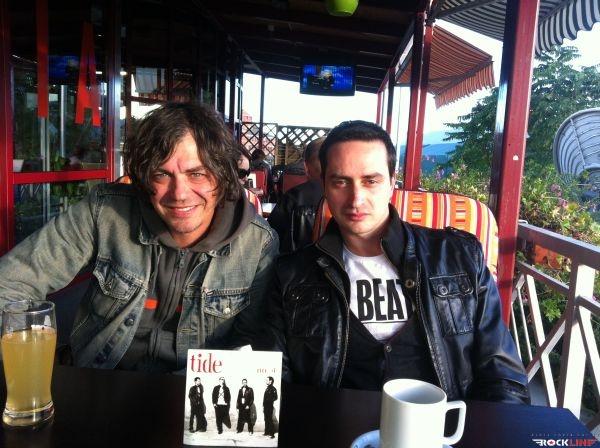
Location: Ljubljana / POP TV
Interview date: 08.10.2012
Hot Slovenian bad-boy rockers Tide are back with their fourth album »No. 4« – RockLine review HERE. Brimming with big plans and the hard-won lessons of all the miles behind them, they can proudly claim that »No. 4« is the most mature studio achievement of their career. On it, Tide wink back at the roots of their debut, while adding a mature outline of arrangement and mood, the fruit of the wisdom that simply comes with the years.
RockLine: The new Tide album is your fourth, and a whole new story! How does it feel, Kevin?
Kevin: To be straight with you, the new album is »Seven Days« plus that extra dimension we picked up from the experience of recording »Regeneration«. In other words, to get that dimension on »No. 4«, we had to go through »Regeneration«. Even though »Regeneration« was a bit of a commercial slip for us, in that we drifted away from the fan base we’d built with the first two albums, it gave the band a new dimension, a new maturity I’d say, and now that we’ve gone back to a more direct rock sound, it comes through along with it. It gave it a breadth that, say, »Seven Days« didn’t have. Plenty of journalists claimed Tide got lost after the first album, but if I listened to them, those same people would now say we’ve found ourselves again with the new one, »No. 4«. I wouldn’t say Tide got lost at all. I’d say we experimented on purpose. And that’s a big difference. You’re lost when you really don’t know what to do. At every step of our career we always knew what we were getting into with our artistic choices and moves. We paid the price with the fans, sure, but luckily the quality of a piece of music isn’t measured by the number of admirers. So I don’t regret the »Regeneration« story one bit. It’s a really good record, we put our souls into it and experimented with the sound very successfully. And »No. 4« puts Tide back on the scene as a band that’s gone back to its roots but presents them in a far more mature way.
RockLine: That »Regeneration« influence, carried over into the new era, shows especially in the more atmospheric, more sophisticated, mellower parts of the album…
Kevin: Yes. Especially on songs like Love Has Gone or Believe. Another difference between the new album and the earlier ones is that »No. 4« is a band album. It wasn’t made under my solo baton, which was the whole point of »Regeneration«, but is the work of the band as a team. That shuts up those who say Tide is just Kevin. No. Tide is a band. We work together. I can’t be on stage alone, I need a band. I need the other three members just like they need me. That’s why there’s no dictatorship with us. But since you often get pushed into the role of lyricist, and so you’re the one deciding how the message of the lyrics gets across, you have to win enough creative freedom to put it across the right way and, in the end, deliver it to the audience in a simple enough, understandable way. Whoever listens to »No. 4« will recognize the character of every member of the Tide quartet. The drums are grandiose and raw, the guitars massive, the bass digs deep, and each of us shines in what we do in the band. Similar to how it was on »Seven Days«. Maybe you couldn’t feel that factor as much on »Nothing To Loose« and »Regeneration«, but »No. 4« brings the point of the quartet, the band as a team, back to the front. No matter who was recording what in the studio at any given time, all of us were there the whole time.
RockLine: That’s why »No. 4« has such an authentic, live feel. Like Tide played a gig in the studio.
Kevin: True. There was no polish in the studio. We went at the recording in a very basic way. We recorded the old-school way. And if people used to make really good albums in a garage without any technology, why couldn’t you do it today, with all this technology at hand?
RockLine: You’ve matured as a vocalist too. You conjure up the desired emotions in songs of very different character on the new album. Riot Act and Love Has Gone perfectly sum up the two faces of your vocal approach, which you handle with more and more mastery.
Kevin: I’ve always seen the vocal as the fifth instrument of the band. I never accepted the rules by which singing schools, choir singing included, shape you into a singer. The vocal has to be woven into the band’s music. It shouldn’t stick out of it, but be an equal part of it. Many productions on many albums push the vocal forward in the mix and make the other instruments »sneak« around in the soundscape. And I don’t like that. For »No. 4« too, I wanted the vocal embedded in the musical framework and form of the songs, as is the rule in rock, metal, alternative, even punk bands, if you like. The vocal isn’t too quiet, it’s just blended with the other instruments the right way.
RockLine: Production-wise, »No. 4« is a decisive step forward for Tide. It captures all the up-to-date, modern worldwide trends in shaping the sound of any rock album.
Kevin: For the new sound we tried to capture the sound of our role models like Soundgarden, Smashing Pumpkins, Queens Of The Stone Age. Bands that sound massive and keep the rawness of the seventies. That retro sound. Without »effecting« the guitars and drums, you just aim to keep the natural sound….
RockLine: Now I’ve just been struck by the thought of your live version of the MC5 standard Kick Out The Jamms. Do you still play it at gigs?
Kevin: Still do. Again, actually.
RockLine: You’ve always been tied to the Netherlands when it comes to making music. You’ve probably answered this a thousand times on various occasions, but still. What connected you with the Netherlands in your music-making?
Kevin: »No. 4« was the first album recorded in Slovenia. As for the collaboration, I can say we’re very good friends and these are people who actually understand what you want. Of course it all rests on friendship. If I’d built that kind of relationship with some Slovenian producer in the past, I’d still be working with that person today. It just happened that the connection formed with the Netherlands. That bridge of trust based on friendship. But that collaboration has nothing to do with the sound of »No. 4«. We could have recorded it in India or anywhere. It would sound the same. Like I said, »No. 4« is the first album we recorded in Slovenia. And it’s the album with the best sound of all the Tide albums released so far. In this new story, the budget and the booking of available studio hours played no role. It was all about everyone in the studio, the producer included, wanting to make a good album. We got to the goal fairly quickly, but nobody on the team would have sweated it even if it turned out we needed two more months to polish the sound into shape.
RockLine: »No. 4« keeps a simple, easy-to-grasp rock form, but with plenty of catchy melody too.
Kevin: We were actually striving for that minimalism, for things to sound as simple and direct as possible. Better to strip arrangements back than to complicate the whole thing. It makes things simpler when you’re on stage, and it fires people up a lot more, wins them over, since that way you put the rock energy first. Above everything. The purpose of that energy is to suck in the crowd, satisfy it, the way it satisfies us at the most basic level. Already at Rock Music Fest in Ljubljana in mid-June this year (RockLine report HERE, ed. note), we tried out half of the new material to make sure the new tunes work live.
RockLine: That love for a retro vibe in rock also shows in your collection of Gibson guitars, from the »Explorer« to the »Flyin’ V«, the »Les Paul«…
Kevin: Recently I rounded out that classic Gibson set with an »SG«. Before, I played most gigs on the Explorer and the Les Paul, now I’ve widened the range of guitar models I use. Our live sound basically has to have loads of guitars in it. And every guitar has its own sound. When you swap guitars mid-show, you get a new sonic quality, a new vibe, a new mood, tied to the message and substance of the song you’re playing on stage at that moment. Our music is guitar music at its core, and we have to make sure our guitar language is as lively and colorful as possible.
RockLine: Your career has had some gigs that really stuck in the memory, like supporting the mighty Iron Maiden at the Bežigrad Stadium in June 2007, or Uriah Heep in December 2008 at Hala Tivoli…. How far do you in Tide reach abroad? Musically you operate in a way that foreign audiences should soak you up quickly and identify with your music.
Kevin: It’s much harder to break through abroad. There everyone favors their own first. What do I mean by that? For example, when you come to Italy, they’ll put some homegrown band in front of Foo Fighters instead of Tide. You can’t blame them for that. They took care of promoting a local band, even if it doesn’t meet the quality standards of some other. That’s how it should be. We should practice that approach here too. The shame is that big rock acts skip Slovenia. They pass us by on tour. Here it’s still a paradise for folk music from the Balkans, and everything rock that’s current goes to Zagreb or Belgrade. That’s a big shame. People got used to listening to whatever’s there. And that’s Balkan folk music. It would take a long time to get people in Slovenia used to listening to rock again. It would be really important to bring rock concerts back to Slovenia. I’m talking big events like Guns N’ Roses, Ozzy Osbourne, Slayer…
RockLine: The klapa groups have done us in.
Kevin: I’ve got nothing against those performers, but rock is part of the urban culture of every civilized society. Personally, I wouldn’t send my kid to the shows of some now-suave guy born in ’54, who built his career in the seventies on the soil of former Yugoslavia and who sings evergreens about unrequited love from when he was 17. Every year in a row, every year at the same venues in Slovenia. Slovenian teenagers aged 16 and/or 17 need to consume rebellious music in their phase of growing up, they need to go through that stage of developing a personality. It’s also about broadening your intellect and your horizons.
RockLine: What about a smaller club tour abroad for Tide?
Kevin: We tried that recently, to see if it would work out. But it stalled at the sponsors. Slovenian sponsors would rather back singing »misses« than bands that play original rock and write original music of their own. That’s the original tragedy repeating itself in Slovenia. Money isn’t the problem. There’s plenty of it. The problem is that the money doesn’t go to the right place. There’s enough money to turn the careers of many good, promising, committed Slovenian rock bands with ambitions around for the better. And those Slovenian bands could score a decent result abroad too. We in Tide want to carry our music abroad. One of our short-term projects is to land sponsorship that would let us pull off such a tour abroad next year. We’re aiming for a proper club tour abroad.
RockLine: My take on Tide right now is that everything’s clicking for you and you’ve got a »wild card« to finally get noticed abroad, starting with your excellent delivery of lyrics in English and so on…
Kevin: English has always been handier for me for delivering lyrics, and in English is where Tide work best. We always have. We tried Slovenian too, but it didn’t work out. Keep in mind I’m from the Littoral, so switching to the Ljubljana way of speaking is harder, and I find my footing better in English. Better to stick with what I master and what I’m good at than try things where I wouldn’t come off convincing enough.
RockLine: After Riot Act, a very rebellious song released as the first single from »No. 4«, it’s now the turn of the second single, Believe. That’s a calmer song.
Kevin: Many people asked us when we’d do another song in the style of our Waiting For The Rain. People told us they actually miss a song in the Waiting For The Rain style from us. With Believe, that was an excellent chance to give fans of our music such a song. And if memory serves, we haven’t released a single since Waiting For The Rain that was a ballad. Winter’s also coming, so maybe it’s an even better time to put out a ballad as a single again. Anyway, there are enough hard-hitting songs on »No. 4« that could be singles in the future, if we decide to release another. Past experience teaches us, though, that our punchy singles usually don’t make it onto the radio. So our fans will find their favorites on »No. 4« in the songs that won’t be released as singles.
RockLine: What’s the short-term vision for Tide?
Kevin: First priority is to promote our new album successfully. The main launch show was on 15.11.2012 at KUD France Prešeren in Ljubljana (RockLine report HERE, ed. note). We worked guest musicians into that show as a surprise. After that we want as many gigs as possible and, as I said, to find sponsors, which would let us pull off a batch of shows outside Slovenia.
Photo Gallery