

In mid-June 1970, Uriah Heep released their studio debut »Very ‘eavy … Very ‘umble« in the UK (RockLine review) and laid the groundwork for a musical artistry all their own. It didn’t take more albums than their contemporaries needed to find a recognizable sound and style: Deep Purple, Pink Floyd or David Bowie, even though Uriah Heep came along a bit later. The commercial breakthrough was another story, of course, since back then it was left up to complete artistic freedom. That’s how the ultimate bands of rock pioneering came to be, along with all their innovations. And with them, the classics of rock music, naturally. Music critics weren’t kind to the band’s debut, even though it’s an excellent achievement. The band didn’t let that stop them. Still that same year they wrote enough music to put out a new album as early as February 1971. And what an album! Packed to the brim with artistic daring.
In their early birth pangs, Uriah Heep struggled with the position of a permanent drummer. Nigel »Olie« Olsson, who played drums on the debut’s »Lucy Blues« and »Dreammare« from »Very ‘eavy … Very ‘umble«, quickly bolted back to his previous employer, Elton John. The band then recorded »Bird Of Prey »with new drummer Keith Baker, who had previously played with Bakerloo and Supertramp. »Bird Of Prey« was in fact only included on the American version of the debut, which came out in the US in August 1970.
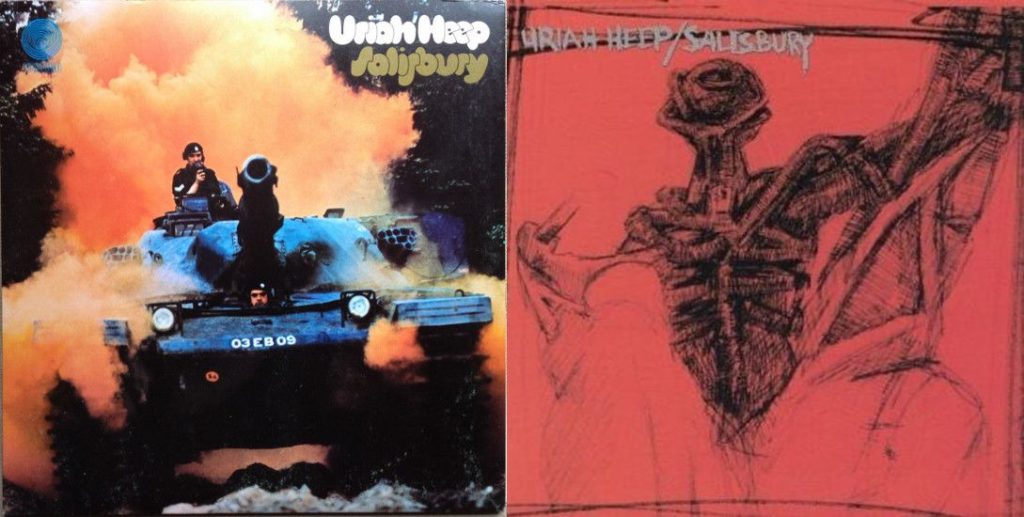
You can read RockLine’s review of the album “Salisbury” HERE.
Through the summer and the fall of that same year, the band shored up its position with a heap of live shows. That helped Uriah Heep further consolidate their musical vision. The band went back into Lansdowne studio, with Gerry Bron, who also managed the group, taking the producer’s baton again, while Hensley wrote half of the album himself and co-wrote the other half of the new material. The album was recorded through October and November 1970 with sound engineer Peter Gallen, who had »reel carriers« Ashley Howe and Les Cunningham at his side the whole time.
In 1970, the trend of chasing ever louder, studio-distorted noise was pretty much a constant. Hard rock was, in effect, firmly established for good that year. Thanks to Black Sabbath’s first two albums, and especially Deep Purple’s »In Rock« (RockLine piece on its 50th anniversary), which finally gave them their sound. The Uriah Heep debut certainly poured some of that oil on the fire too. But unlike that trend, »Salisbury« never forced its way into it. It’s an extremely well-balanced album that, on a track like »Bird of Prey«, does carry a hard-rock scowl, but on the other hand serves up an incredibly sophisticated, characterful musical personality, embodied by the gentler »The Park«, where David Byron delivered one of the most fascinating vocal performances of his musical career, and the famous »Lady In Black«, while the album’s special place belongs to the cult, over 16-minute epic, symphonic suite »Salisbury«. It clearly heralds the rapid rise and spread of progressive rock at the time, and with the integration of a 24-piece wind and string orchestra it confirms the great fondness among long-haired bands of the day for blending rock’n’roll with classical music. Besides Uriah Heep, Pink Floyd, Deep Purple, Yes, Barclay James Harvest and The Moody Blues all served up this principle on their records back then. The title track is probably still considered the most ambitious piece of Uriah Heep’s entire career. Because of its complexity, and the logistics it demanded, the band never played it on a concert stage. Many years later Ken Hensley did pull it off as a solo artist, backed of course by a band and a full orchestra.
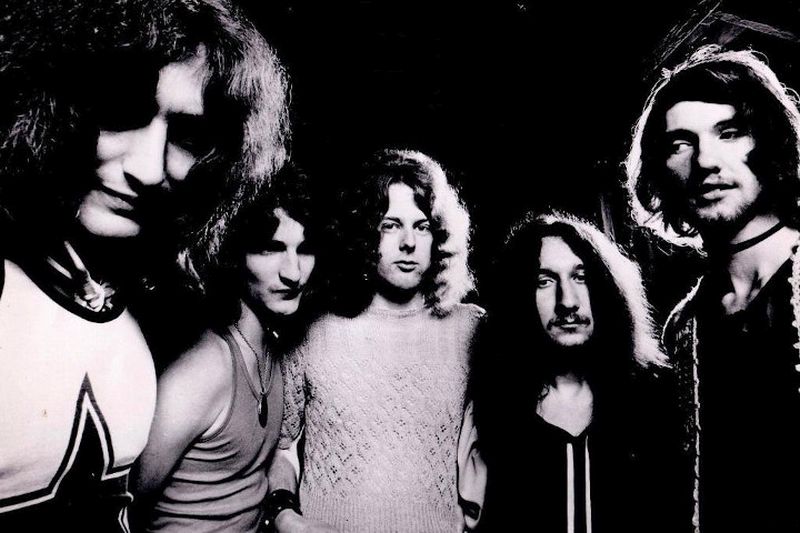
»Bird Of Prey« – a song with a killer lead phrase –, considered a true prototype of metal, was first played by the band in one of London’s pubs, and in it, according to Mick Box, they for the first time in their career really successfully worked out and arranged the vocal harmonies that were slowly becoming the trademark of the band’s sound and style. This menacing, crushing opening track of the album, which for the American market is replaced in the opening slot by »Simon the Bullet Freak« – »Bird of Prey« had already been used on the American version of the band’s debut –, has striking falsetto harmonies that, combined with bristling phrasing, give it a predatory stamp and crank up the gloomy atmosphere. Speaking of falsetto … Byron delivered in that manner one of the most moving performances of his singing career in the album’s next song, the fragile but deep »The Park«, which is the complete opposite of the raging opener. Hensley wrote this gorgeous ballad in August 1970 in Stanwell Village (Middlesex). He played a harmonium the band had found in a house while on holiday in Hamburg.
»Time to Live« also came out of one of the band’s rehearsals in Chiswick. Also in August 1970. It’s marked by the heavy swings of Box’s guitar phrasing, backed by chunky Hammond “boulders” and the heartfelt singing of the infectious, charismatic Byron, plus lyrics about a wrongly convicted prisoner, supposedly guilty of murder, coming home to his wife’s embrace. None of it comes from the life experiences of any band member. The lead guitar phrase is suspiciously similar to one Iron Maiden later wrote for their classic Revelation, which only confirms how strong a mark listening to Uriah Heep left on a teenager named Bruce Dickinson.
»Lady In Black«, which closes side one, was written by Hensley in Bradford in November 1970, after he’d been watching a snowstorm out the window and a woman in dark clothes, curls whipping in the icy wind, appeared to him like an apparition. Hensley never could explain how he managed to connect so deeply with this mystical figure in his poetry, but it makes sense that he never regretted it. The song became a huge hit in 1978, when it was released in Germany as a separate single and won Uriah Heep the Golden Lion award, a sort of European equivalent of the American Grammy. Although the song’s structure is built on just two chords, Hensley used four different acoustic guitars in the arrangement, and on top of it all his vocal delivery reigns supreme in an exceptionally strong and instantly memorable chorus, evoking a good dose of mysticism as well. Among rock’n’roll folks around the planet, even half a century later it remains one of Uriah Heep’s most recognizable songs.
The mystical yet cheerful »High Priestess«, opening side two, lays the runway for the outstanding title track to land. »High Priestess« tells of the happiness forged by people spending time together. How simple it is to find happiness, then. And how meaningful that is in the times we’re living through. This song was written in Germany in September 1970. Much like “The Park”, when the band took some time off between tours. Which of course leaves us with Hensley’s breathtaking title composition, which we already mentioned above. It’s a unique piece of music, a blend of everything in one place. Elements of awakening progressive rock, hard rock, still some psychedelic rock too, which as a trend was slowly leaving the music scene, as well as elements of jazz-rock fusion and of course neo-classical music. It’s also incredible to realize how well the contributions of all five members of the Uriah Heep lineup of the time are woven into this complex arrangement. Byron’s one-of-a-kind vocal, which with its commitment and passion shows off a whole range of faces, and Box’s perfectly placed wah-wah guitar solo somewhere in the middle of the twelfth minute … The composition is full of theatrical and dramatic twists. The predatory atmosphere swings dynamically and is full of peaks. In 1970, Hensley wrote about the song: »The composition is fantastically and unusually well seasoned with arrangements for woodwinds and pipes contributed by John Fiddy. There are tidal moments when the music pulls you straight into the beyond. The way the flute and cor anglais circle David’s vocal creates something close to baroque. The composition is opened by the orchestra and organ, which together lay the foundation of its context. Then come Byron’s first verses, followed by an organ solo driven by Paul’s resolute bass, and the orchestra gradually swells into it all with incredible intensity! A huge amount happens in the composition. Lots of different sounds are gathered in one place, and every time you listen, you can easily find something new in it.«
»This composition is an honest manifesto of our maturing and development, and we’re all eagerly waiting to see how you’ll judge it yourselves. Thanks to everyone who helped make this album happen. We’re already looking ahead to the next one,« Ken Hensley wrote in 1970.
Still missing is the story behind it. The band found the inspiration to create it after an incident at one of their gigs. It happened at Alex Disco, located in none other than the English town of Salisbury (Wiltshire). After the regular part of the show ended, two fans, in an unbridled burst of enthusiasm, accidentally switched off the main PA, so the band couldn’t play the obligatory encore. Uriah Heep had just ten minutes to completely clear the venue and haul out their gear. »So everybody from the venue helped the band carry the equipment out,« Ken Hensley recalls, adding: »We could’ve had a totally ruined evening and a botched gig, but the crowd saved the situation, so we decided to dedicate this song to them.«
The band was extremely happy with the result. The only thing that frustrated them was the choice of album covers. For the British and European market they used a command tank pushing through thick orange fog. The band was on tour at the time, and label reps described their choice over the phone. The label connected the word »Salisbury« with the chosen tank in a purely “label-guy” way: there was a military training ground near Salisbury. The band made no secret of their displeasure. The cover picked for the American market fared no better. It’s even creepier than that tank. According to Hensley, it’s not just totally unappealing but downright hideous. It’s a drawing of a man pulling the skin off himself. And of course the band had no say whatsoever in that choice either.
Luckily, the music press was kinder to »Salisbury« than to the debut, even if it seemed like the reviewers were too busy hunting for its hard-rock content and so lost sight of the record as a whole.
After the album was recorded, Keith Baker left the band. The reason was his discomfort on stage. With “Salisbury”, the band headed out on their first US tour, and when that offer came, Baker turned it down and had to leave the lineup. That didn’t endanger the tour, on which Uriah Heep kept company with Three Dog Night and Steppenwolf. The band recruited Iain Clark on drums, who came to Uriah Heep from the British progressive rock outfit Cressida. They too were on Vertigo Records. Still, Uriah Heep were far from commercial success. Though it wasn’t far off. Just two more albums stood between the band and it. A year and a half to go, then.
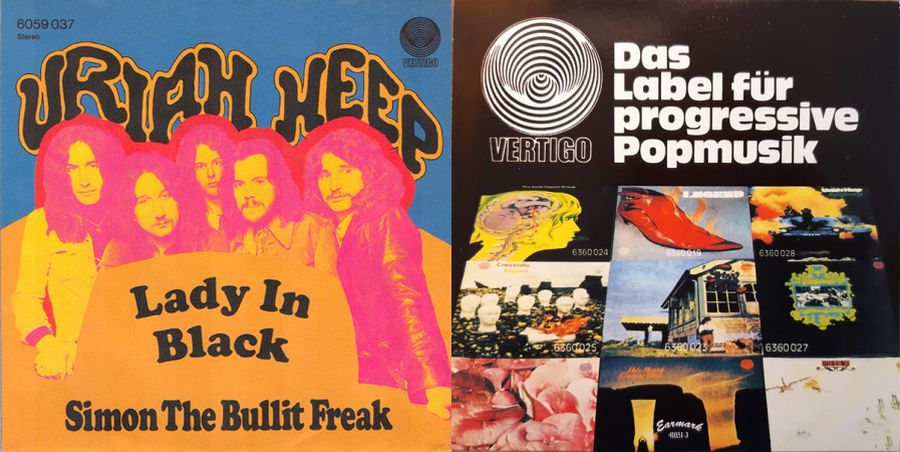
The album “Salisbury” came out in February 1971 and left no noteworthy mark on the charts. It didn’t make the UK albums chart, and on the Billboard chart it climbed to number 103. It did better in Australia (number 19), Italy (number 20), Germany (number 31) and Finland (number 3). In March 1971 the single for »Lady In Black« was released. It came out in several different versions, with either »Simon the Bullet Freak« or »Bird of Prey« on the B-side. Apart from the Finnish singles chart, where it hit number 16, it failed to chart anywhere else. In 1978, on its reissue, it managed to break into the German top 20 hits chart, where it stayed for a full nine weeks. Its peak position was number five. In Switzerland it did a notch worse.
For a band with just one year behind them, »Salisbury« is an album that similar bands would only put out as their fifth or sixth studio record, carefully building on their name and commercial success before that. But not Uriah Heep. »Salisbury« was a bold, decisively measured step up, and in an extremely short time the band confirmed exactly what the debut had hinted at. That they possess exceptional artistic talents, which were capitalized on in an excellent, mature peak of their artistry at the time. Thanks above all to the compositional gift of the brilliant Ken Hensley, who as the album’s songwriter stepped into the creative front line of the band.
Author: Aleš Podbrežnik
