Author: Rok Klemše
Location: Menza pri koritu, Ljubljana
Interview date: 13.09.2011
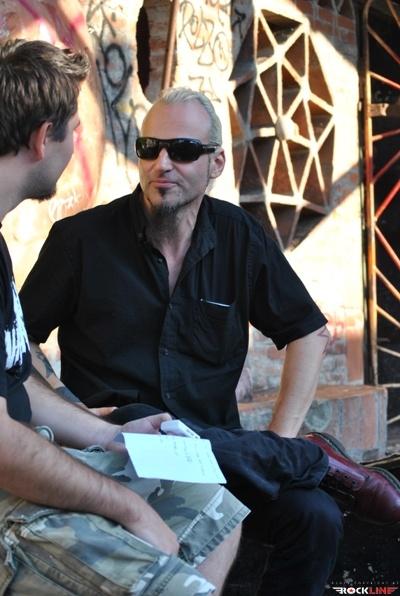
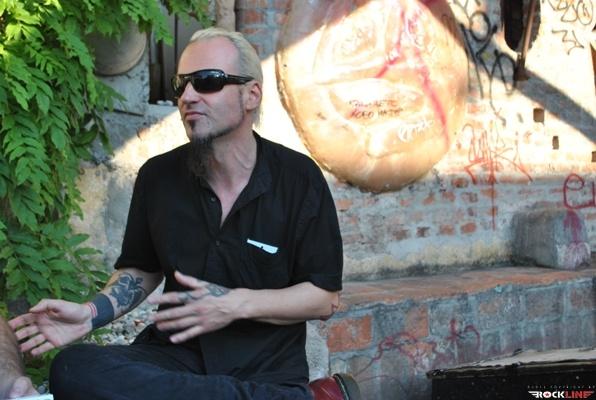
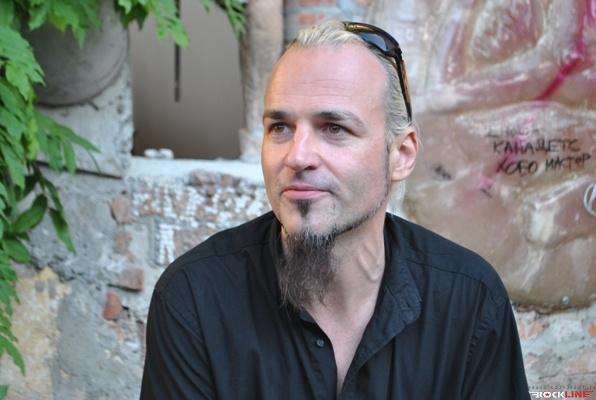
Swiss veterans Samael, who set the course for European black metal south of Norway with their first pioneering black metal releases, are no strangers to our stages. They last played here in September of last year, on the tour promoting their current album Lux Mundi. One of the last warm, sunny days of last September wasn’t exactly the thing to enrich the concept of a black metal night, but it sure hit the spot before the show, sipping a beer in the sun with the band’s mastermind, guitarist and vocalist Vorph, getting ready for the slow cooking in the Swiss sauna that followed. We talked with Vorph about the album’s themes, Samael’s evolution, the Swiss metal scene and Laibach.
RockLine: You recently released your new album Lux Mundi, and its title comes from the Bible.
Vorph: That’s right, the Bible says the Church is the Light of the World, and the title is in Latin for the obvious reason that it was the language of the time. But our feeling is that it’s exactly the opposite: the Church deceives people and blinds them. The light of the world is people, their decisions, the way they connect with each other. That’s kind of the shared idea behind the album, and a few song titles are directly tied to the album title, like Let My People Be and Lux Ferre. That one could have been the album title too, but we didn’t want a track with the same name as the album, since we didn’t want just one song to be the focus.
RockLine: You mentioned the title is a reference to the Church. What do you think about the Church doing exactly the opposite of what Jesus preached? I mean, that faith itself should be the light of the world for each individual, not an institution.
Vorph: Sure, I’m not denying there’s some positive philosophy in the Bible, but it’s also full of bullshit you have to filter out.
RockLine: It’s like a bedtime story.
Vorph: Exactly, they’re little stories with a moral you have to arrive at yourself. But we’re all grown individuals, we don’t need someone deciding and choosing for us. If there’s a book that’s supposed to steer the opinions of the masses, that’s a huge mistake from the get-go. It doesn’t matter which book. Even if it were the best book in the world, it would still be wrong, because it would be a dictatorship of thought. And of course there’s a big danger hiding in that. Communist countries went through it, Nazi Germany too. Granted, that wasn’t about religion, but it’s the same thing.
RockLine: For the sake of one man’s will, one man’s idea.
Vorph: Yeah, they built the whole philosophy of the state on the idea of one person, or on the idea of an elite. You can’t imagine the whole world being one big state, though that’s not an idea I’d be against.
RockLine: You mean one big utopian state?
Vorph: I wouldn’t call myself a utopian, but I think we shouldn’t be afraid if our dreams and ideas lean in that direction. It’s probably not a goal we’ll ever reach, but it’s a goal worth our wishes and aspirations.
RockLine: How would you place the new album within the whole discography, the concept, the bigger picture of Samael?
Vorph: I think it fits in really well. Our goal was to start over, start fresh, so we wouldn’t repeat the previous record. Before that we recorded the Above project, which we released as Samael. We knew it wouldn’t be the follow-up to that record, since it was a one-off thing. But we didn’t want this one to be the follow-up to Passage, Solar Soul or any album from the past either. Still, with this album we tried to keep elements of Passage and Ceremony of the Opposites, because we think they’re worth keeping. With this record we tried to remember what it would be like if it were our debut. We tried to spark that creative fire again, like we had at the beginning.
RockLine: So it’s kind of a mix of old and new Samael?
Vorph: Yeah, probably. We wanted more orchestral parts, which we had quite a lot of on Passage, whereas with the alternative elements on Eternal we drifted away from that.
RockLine: Like with Era One?
Vorph: Yeah, but that was a project again. Era One and Above are both part of the Samael discography, yet at the same time they don’t belong in it. Above was our decision, but with Era One the label made the call. We wanted to release that album under the project name, Era One, and the label decided to put it out as a Samael album.
RockLine: You mentioned Above. How did you come to the decision to release it?
Vorph: We’d had the songs for a while, but never brought the whole thing to a close. We’d just wrapped up a tour, we had time, there weren’t many festivals in the summer, and it was a chance to finish it. At that point it was still being made as a project separate from Samael, but once we finished it we noticed it had some really strong material on it, worthy of being released as Samael. So with Era One it represents both extremes of Samael, and the decision to release Above as Samael kind of balances out our discography.
RockLine: If we dig even deeper into the past. Did you realize your first two albums and then Passage would leave such a mark?
Vorph: No, that’s not something you can be aware of, but you can feel it. With Passage, for example, journalists would drop by the studio while we were recording, and from their reactions we could tell we had something good. They were really surprised, they didn’t think we’d go in that direction. But a lot of people were skeptical. Even the label told us to do whatever we wanted in the studio, but not to play it live, because the fans would turn their backs on us. And honestly, they were right, people still ask us today when we’re going to bring a drummer back. But I like that we do things our way and don’t bend to what others want.
RockLine: You started talking about the label’s skepticism. Did you personally, or the band as a whole, have doubts, fears…
Vorph: Of course, but you have doubts all the time. For us it was mostly a gut feeling about whether we dared to sacrifice everything we’d worked so hard for up to then, for something we believed in. It was mainly about risk, and yes, we were ready to take it. Even before our sound changed we had a keyboardist in the band, who ironically left right before that change. We wanted to experiment with different sounds, and I’m glad we took that step.
RockLine: Still, it wasn’t a sudden shift but an evolution of your sound.
Vorph: I’d put it that way. Between Ceremony and Passage we released the mini album Rebellion, on which we recorded two tracks: an Alice Cooper cover, and one song, Rebellion, with programmed drums. We didn’t realize it would be the new Samael sound, but if you listen to it today it’s crystal clear. Rebellion is a mini album that meant a kind of transition for us. It wasn’t planned, but it really is what it is. If you listen to our discography, it’s really a kind of “flow.” If that flow is natural you have to follow it, but of course you can also consciously change something in a moment.
RockLine: But in that case you don’t stay true to yourself.
Vorph: True. But if we hadn’t surrendered to that flow, we wouldn’t have released the Above record as Samael, for example. That album was a complete departure from our style at the time, and we knew it, but we still wanted to release it as Samael. We wanted to surprise both people and ourselves. When we listened back to the record, we realized we’d be playing a few of the songs as Samael, and it felt weird. On the American tour with Carcass we played to a crowd that’s way more extreme than our usual listeners, but when we premiered the track Black Hole we got really good reactions, and we knew we had something good.
RockLine: The musical change was followed by a change in themes too. After the first two albums you moved away from occult, satanic themes toward more cosmic ones, which also fit the new musical direction.
Vorph: I was always drawn to the dark side of metal: Venom, Bathory, Hellhammer, the pioneers of the style. I was a huge fan, and I think with the first two albums we tried to achieve something similar, but in our own way. The first two albums are definitely part of that movement. Back then we could easily have played with Venom and Bathory, if they’d been playing live. Once we reached that level, the question was what we’d do going forward. Repeat ourselves or take a step forward? Around that time we started working on Passage, and we didn’t know exactly what the music on it would even be like. We just knew we wanted something strong, something fresh and something different. Everything else was a mystery, we worked step by step, and even we didn’t know where exactly we were headed. Before recording the album I’d been to India, where I discovered a bunch of new sounds, the sound of the tabla for example, and I wanted to bring some of that into Samael. It was strange, since there weren’t many bands doing that back then, and a good example is the track Jupiterian Vibe. We wanted a nice rhythm, but a massive drum sound. There’s a similar tribal style on a track from the new album, In the Deep, and I really like that.
RockLine: What influenced you and the band most when it came to the change in sound from Ceremony of the Opposites onward?
Vorph: There wasn’t just one band I could single out, since we listened to all kinds of music, but I can definitely single out Laibach. They’re without a doubt one of Samael’s biggest influences, and I’m a huge fan. The funny thing is that when we put out Passage, they put out Jesus Christ Superstar, which has a ton of guitars on it. Of course it’s not that we influenced them, it just happened. We went more toward industrial, and they went more toward metal. By the way, it’s an excellent album.
RockLine: Agreed, though my personal favorite is Opus Dei.
Vorph: Yeah, another great record. When we were touring for Ceremony of Opposites we listened to NATO all the time. We even used it as the intro for our shows.
RockLine: It’s interesting that Laibach were such a huge influence on you, Morbid Angel, …
Vorph: And plenty of other bands, like Rammstein. When I first heard them they struck me as a bad Laibach copy, and the first album is really bad. Later they found a more distinctive direction, and I like them a lot more today.
RockLine: How do you remember the early Swiss metal scene? What’s interesting is that it never counted as a big metal scene, yet it produced a trio of cult bands – you, Hellhammer/Celtic Frost and Coroner.
Vorph: Yeah, Coroner recently got back together. I saw them in Switzerland, but I don’t think they’re a live band. They’re great musicians, they have great songs, but in my opinion the band is too focused on their instruments and you don’t get the real feel of a live show. But it’s a great band. To answer your question: back when all three bands were playing, there wasn’t any unified scene as such. I was always a huge Celtic Frost fan, but not because they were Swiss, because they were a great band. I never cared where a band came from, the music is what matters to me. Even though they’re Swiss, I never liked bands like Krokus, I even think they’re an embarrassment, but that’s a matter of taste.
RockLine: So what does the future hold for the band, or more fittingly, what’s next for the “lux mundi” Samael?
Vorph: We’re halfway through the tour right now, and we’re really enjoying playing the new stuff. Going forward I hope we get to play in the US, the UK and Scandinavia. It’s too early to write new material, we’ve got enough for a while. There are still tons of songs we never play live. I’d really love to play the closing track of Reign of Light live, Door of Celestial Peace. We wanted to play it on this tour, but somehow it never found the right spot.
Photo Gallery