

What is there left to say about an album that’s already had everything said about it? Did anyone ever even need to say anything about an album like this? A fast 40 years have gone by since it came out in early November 1980. Even a passing thought of this bottomless holy grail of rock’n’roll sets off thunder and lightning in your brain. Whenever Motörhead come up in conversation – no matter the context – the classic lineup instantly appears before your eyes. There’s that poker card, the ace of spades, the rolling gambler’s dice, the sound of revolver cylinders spinning,….
Let’s rewind for a moment to the waning seventies. In July 1978, Douglas Smith took Motörhead back under his management wing. He managed to talk Bronze Records, which at the time looked after Uriah Heep and Manfred Mann’s Earth Band, into signing Motörhead. But only for individual singles. It didn’t take long before the label renewed and expanded the deal. What convinced them was the success of the single “Louie Louie”, which crawled up to number 68 on the UK chart. 1979 was a breakthrough year for Motörhead. The band put out two studio albums. Actually three (but that’s another story).
By March 1979, Motörhead already had their first appearance on Top of the Pops behind them. Through the spring the band first promoted the single “Louie Louie” at gigs, and then of course the album “Overkill”, which landed at number 24 on the UK albums chart when it came out in April of that year. The boys were supposed to rest over the summer. The rest was interrupted by a show at the Reading festival. Like hell they rested. They were already recording a new album, which came out in the fall and was an even bigger success. That was “Bomber”, which dropped anchor at number 12 on the UK albums chart. The band set off on a new tour, supported by Saxon. That was also when the bomber first showed up on stage – an aluminum frame packed with lights, reminiscent of the German World War II aircraft Heinkel He-111.
You know the drill. A gang of three desperadoes who crawled out of the appendix of the back end of the sewers and storm drains, with busted elbows and knees poking out of their denim jackets,… Those three hellions who comb their hair with firecrackers, never take their boots off, and keep up their daily form on a special diet – the fuel of an unholy alliance of hectoliters of vodka and a generous helping of substances with, let’s say, questionable side effects. So in a single year the band built a reputation as the filthiest punk scoundrels the planet had ever seen, and also became synonymous with the loudest band in the rock universe. Thanks in part to Philthy’s use of two bass drums, which was revolutionary for the time. But back then, that was how only the British Isles saw the band. Two important factors that, on top of the band’s toxic and much-noticed reputation, really put Motörhead in the spotlight were the outbreak of punk and the rise of the N.W.O.B.H.M. So they were carried on shoulders both by worshippers of punk and by the emerging new wave of British heavy metal in the eighties. With their wrecking-ball dose of ultra-filthy rock’n’roll, Motörhead slowly became a proper little working-class deity. Everything was ready for the big bang.
Then came the new year. With it came February 1980, when the release of the EP “The Golden Years”, which hit number 8 on the UK charts, only confirmed that Motörhead were getting hotter and hotter. There was always something compelling about the idea that this was a band that could screw up absolutely everything at any moment. And that was a quarter of a century before The Darkness, who officially booked their one-way ticket to hell in 2005. Given their lifestyle, it had always seemed perfectly natural for this band’s career to head in just one direction. Wherever that might be. In a direction with no way back. The stamina of three studs with a reputation for knocking over girls at every turn, showering in cocaine and having speed for breakfast (Lemmy) – where the question was never when, where and how – was already starting to show its first cracks. On July 26, 1980, the band played Stafford, England (Bingley Hall). It was the third of four UK shows added after the fact. Before that, through February and March, the band had played exclusively on the old continent (mostly in France and Germany). Well, at Bingley Hall, with Saxon, Girlschool, Angel Witch and Vardis in support, about an hour into the Motörhead set, Lemmy suddenly staggered off to the backstage area in the middle of the show and collapsed. Up to that day, it was the biggest gig the band had ever played. A crazy crowd of 12,000 heads showed up.
Lemmy was no punker, and even less anything metalheads could claim as their own. If anyone teased him about who he belonged to, he liked to say that their music had more in common with The Damned than with Judas Priest. Supposedly, at Sid Vicious’s personal request, Lemmy tried to teach Sid to play bass, but according to Lemmy, Sid was simply a hopeless case. Deep down, though, Lemmy was a retired hippie who knew very well what it was like to be a roadie, going back to the days when he supplied Jimi Hendrix with the finest goods. He also knew what it looks like to get kicked out of a band if you’re too open about dealing drugs. Even if you wrote that very band its only hit in 1972. Motörhead, born in 1975, were already legends five years later – right at the outbreak of the N.W.O.B.H.M., which adopted them whether they liked it or not despite their different musical makeup (much like Judas Priest). Behind the seemingly rough reputation of Lemmy’s untamed nature hid a soft soul who loved to hang out and have fun with anyone. Of course, only until that company started throwing logs under his feet. Then he turned into a proper hellion.
So in 1980, things moved for Motörhead even faster than the year before. Even Lemmy himself got spooked by the fact that the band had suddenly become big and important and that more and more was expected of them, saying that was never the point of the band or why it was founded. “Eddie and I can’t be stuck together all the time writing music. We’re not fucking ABBA,” the Iron Chancellor explained back in the day. True, the band’s new music had no songwriting traces of either Björn or Benny, but Motörhead’s lineup of Phil “Philthy Animal” Taylor, Eddie “Fast” Clarke and of course Ian Fraser “Lemmy” Kilmister managed, while making “Ace of Spades”, to calibrate their chemistry to the point where their songwriting hit a winning musical formula. When we talk about classic Motörhead, “Ace of Spades” is the document where the trio rode up to the artistic peak of their classic days. Everything on it fell into place with fascinating precision.

The new producer, Vic Maile, played a very important part in that. At Jackson’s Studios in Rickmansworth, England, where the album was recorded, Vic Maile pulled off a real miracle. Vic Maile, whom the trio also called “the Tortoise” – he kept a terrarium with a tortoise at home – managed, as the first in the band’s history, to tame the three wild hooligans to the point where Lemmy started to (at least roughly) sing instead of shout, began playing bass the way a bass is played (until then he’d played it strictly like an electric guitar), and got Philthy to smash up his drum kit a little less and land the occasional, more accurate hit on the snare. The same went for the greater emphasis on keeping the rhythmic flow steadier within Philthy’s 4/4 drum mantra. Vic Maile was an extremely calm person. Even when something wasn’t to his liking, he came only as close to anger as it took to say, still politely and softly: “Is that really the best you can do?” With that diplomatic gentleness he actually soothed the roughness of three immature rogues everyone else ran from. And the trio hugely appreciated it.
Still, even Vic wasn’t all-powerful, and he couldn’t get rid of some of the band’s bad habits. At first the band invited him out, but Vic kept dodging the invitations. He was a diabetic. He didn’t drink, didn’t smoke, didn’t do drugs. At 6 p.m. every day he took a break to drink his tea, eat a croissant and take his medicine. That was his daily ritual. He was the complete opposite of the producer who, for survival’s sake, would have needed to keep up a superman’s form to match the antics and adventures of Lemmy, Eddie and Phil. Despite the breeze of self-discipline Vic instilled in the trio during the recording of the album, working with Lemmy became impossible, at least whenever the speed supply ran dry. Lemmy simply wouldn’t show up at the studio, or he’d turn up painfully late. Phil and Eddie got by fine without a dose of speed, but Lemmy didn’t, and he’d always start to ail.
So 12 tracks were written for an album whose title Lemmy had had in his head for quite a while. In fact, he had it tattooed on his left arm. Lemmy was a guy who always approached things head-on. No beating around the bush. He was never any good at poker, but he showed great affection for being near slot machines, where he worked his right hand as if smacking the trigger of a Colt .45 with the palm of his left. The title track became so huge that the whole world knows Lemmy and Motörhead by it. Like Deep Purple with “Smoke on the Water” or Led Zeppelin with “Stairway to Heaven”. Quite a few songs run under three minutes. Alongside the title track, skull-smashing and neck-snapping duty falls to the dedication to the crew of techs, (We Are) The Road Crew, as well as The Chase is Better Than the Catch, and the “extremely sticky” Love Me Like A Reptile. Shoot You in the Back is a story straight out of a typical Clint Eastwood western, and, judging by the band’s experience, there’s at most even more testosterone-fueled excitement when it comes to enjoying carnal pleasures with the female world (The Hammer, Jailbait, Fire, Fire). Eddie “Fast” Clarke once said that Lemmy made leaps in his lyric writing back then. The man would regularly “get lost” in the bathroom with a pencil and a scrap of paper. There he’d stick to forging verses for as long as it took, with only the song title in his head, around which he built the lyrics. The lyrics always came last in the whole process. Metaphorically, though, the title track is a real little bible, a lesson on how to live your life to the fullest, even if you don’t want to live forever.
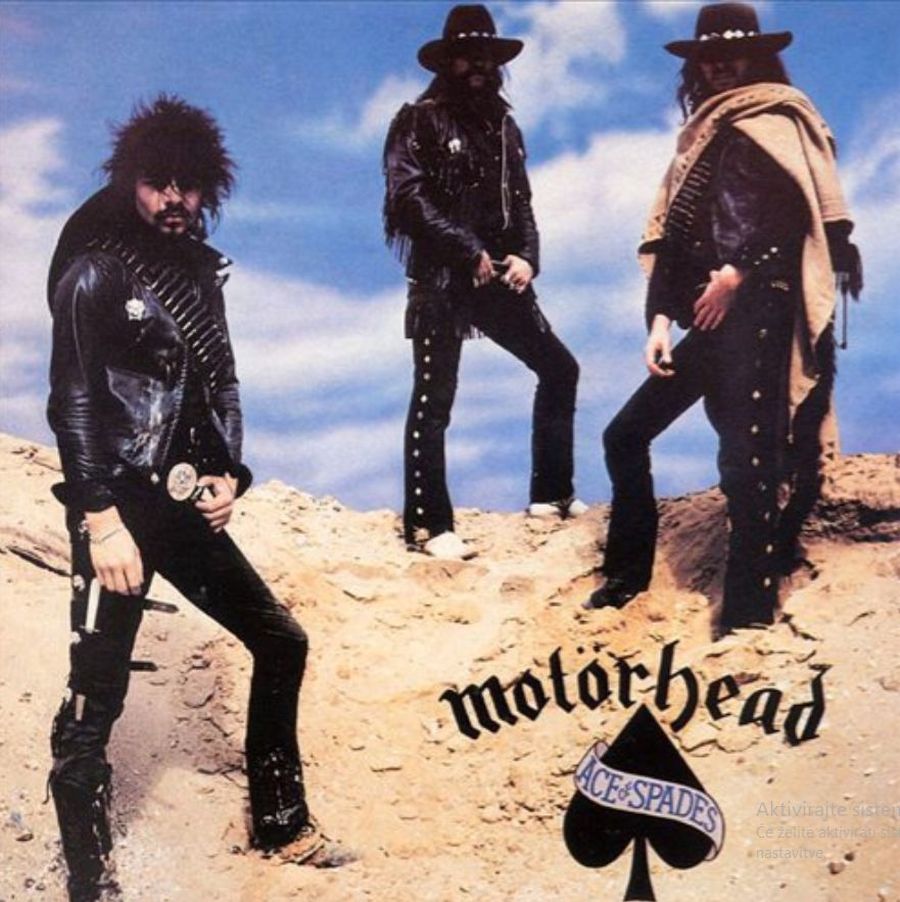
The album cover was shot on the sand dunes in Barnet, England. On the day the boys were photographed there, the weather was very overcast, and the photo was later retouched to emphasize the feeling that it shows three gunslinging outlaws in the middle of the Arizona desert.
Then came October 1980 and the single “Ace of Spades” came out, taking number 15 on the UK singles chart. The band appeared on Top of the Pops again, landed on even more music magazine covers, and it all culminated in November, when the album “Aces of Spades” came out and dropped anchor at number 4 on the UK albums chart.
But the fame, which caught the band completely unprepared, started to backfire. It got to Lemmy and Phil in particular, who were turning into ever bigger rascals of rock-star arrogance. And that was when exactly what was mentioned somewhere in the upper half of this piece started happening. The band slowly began reaching for things that undermined their hard-earned success. That point in their career was the start of the way down. On the eve of the “Ace Up Your Sleeve” tour, Douglas Smith told the guys they had to accept a lower offer than originally agreed, because the promoter wouldn’t pay. The band stayed committed to their mission regardless and didn’t sweat it too much. They simply couldn’t let their followers down. On the UK leg of the tour, Motörhead were supported by Girlschool and Vardis.
The tour that should have brought the band historic triumph was marked by an incident in which Phil cracked his head during a “headlong flight” down the stairs of one of the hotels. There are as many explanations for that fall today as there were witnesses. Did somebody push Phil, or did he launch himself? The unpadded landing ended with just damaged vertebrae. Still, the fall was so theatrically chilling that everyone thought Phil had broken his neck. He drummed the rest of the tour in a neck brace. Things got even tougher in April of the following year, when the band headed out on their first major tour of North America, playing a series of 42 shows. At some of them Motörhead played small clubs, and at others they opened for Ozzy Osbourne.
“Ace of Spades” was the first album to also come out in the US and Canada. If Motörhead had become truly huge in Great Britain, in the US they had to make peace with playing to sparsely attended clubs and rather lukewarm feedback and reactions from the crowds. Right from the start, American radio stations refused to back the band in promoting the album. So across the pond the album barely got played, if at all. Motörhead had hoped to repeat the success they’d had in Great Britain. The goals were high. It was also Lemmy’s first new North American visit since 1975, when he was caught at the US-Canada border with pockets full of drugs and got kicked out of Hawkwind. Lemmy already knew then that he’d one day live in Los Angeles, saying: “If I could choose, I’d only do a tour of Los Angeles that would never end.” Expectations were high from Eddie and Phil too, who had never been across the pond. But at the shows, the trio got booed by Ozzy’s drunken Neanderthal crowd more often than they got anything else. The club gigs were dismally attended too. Tension and disagreements grew in the camp. Especially between Phil and Eddie, who started to bicker fiercely. Even the band’s manager Douglas Smith mused out loud about cutting the tour short. One night Phil had to be rushed to the ER because of an overdose. You know how it is in the US? If you call the hospital, the police almost always show up with the ambulance. And Douglas had to carefully cover things up, claiming “Philthy” had simply succumbed to exhaustion. At another show in Canada, Lemmy nearly had a heart attack because there was no dose of speed at hand.
Anyway. The band, who were behaving like stars on the other side of the Atlantic – even though the local crowds wouldn’t have granted them that status in their wildest dreams – were further egged on toward such behavior by the February success of the EP “St. Valentine’s Day”, a three-track release Motörhead put out together with Girlschool. The EP landed at number five on the UK charts and, with 200,000 copies sold, became the band’s best-selling release. Even though a cold shower in North America was guaranteed, Motörhead had meanwhile grown into a real national pride on British soil. Suddenly they were regular guests on Top of the Pops and even on the children’s TV series Tiswas.
But the best news was only just coming. It caught Lemmy in the middle of Los Angeles, where the band was still on tour with Ozzy in June 1981. Douglas Smith threw Lemmy out of bed in the middle of the night with a phone call to say that the live album “No Sleep ’til Hammersmith” had hit number one on the UK albums chart. Lemmy remembers: “Doug woke me up with a call and the news that we were number one in Britain. Even though I was overflowing with arrogance at the time, this news shocked even me. I didn’t show it then. I told a hotel staff kid to have Doug call me again in the daytime!” The band’s insomnia all the way to Hammersmith is summed up in the choice of the live album’s title, which Lemmy explained like this: “The title comes from the fact that we did 25 shows on tour without a single day we could use as a break. All the way to Hammersmith. When we set off, we wrote the slogan ‘No Sleep ’til Hammersmith’ on a piece of paper and stuck it behind the bus windshield.”
When Lemmy tattooed his famous motto on his arm: “Born to lose. Live to win.”, he wasn’t wrong about a thing. With “Ace Of Spades,” Motörhead became immortal. At that moment not just the filthiest but the loudest band on the planet, they used this timeless achievement to finally chisel out the rulebook of the core teachings of the lifestyle called rock’n’roll. Walking the razor’s edge, they rode off into eternity. “Ace of Spades” is without doubt a gigantic monolithic block that built the legend of the most dangerous rock scoundrels in the galaxy. And what fueled it was sex, stimulants and snake eyes – the metaphor for the “two” roll, when a throw of two dice shows a one on each (“1 + 1”).
Author: Aleš Podbrežnik
