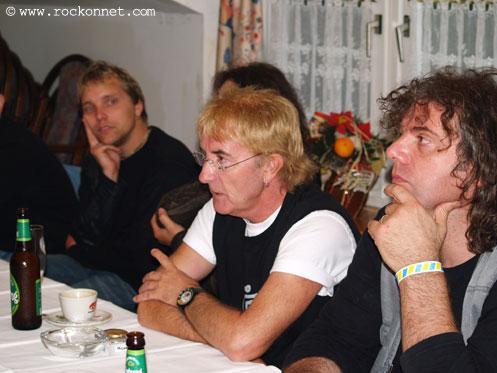
Interview date: 11.08.2006
Aleš: “Hi John! How does it feel to be playing in Slovenia for the second time?”
John: “Good. It’s good because it isn’t raining yet (laughs).”
Aleš: “How did you get in touch with Mary Rose, how did the collaboration come about?”
John: “Šoki offered me a gig at the festival and I thought, why not. He said he knew some really good musicians who could back me. And that’s no lie! They’re really good.”
Aleš: “Mary Rose are probably the best live rock band in Slovenia right now?”
John: “I think so, yes.”
Aleš: “You’ve got a new band, On The Rocks. What can you tell us about it?”
John: “On The Rocks is a project with a former Focus guitarist, and there are also musicians from Brazil involved. Basically we’ll be playing rock, but with South American influences. Not like Santana, but with somewhat similar musical influences. Going by the first recordings we made together, that’s about all I can say about our style for now. We’re planning the first live shows for the near future, first in the Netherlands, Belgium and Germany, and then we play on at a festival in Brazil.”
Aleš: “Which festival is that?”
John: “Not the one Uriah Heep are playing (laughs). It’s some festival outside Rio de Janeiro.”
Aleš: “Will Uriah Heep invite you to the Magician’s Birthday Party in London again this year?”
John: “They don’t organize it anymore!”
Aleš: “How come?”
John: “Because it’s too expensive. Putting a show like that together costs quite a bit of money, especially if you want all the special guests to play. I think the band doesn’t want to get into those kinds of costs anymore, and that’s fine. But the Magician’s Birthday Party was always a wonderful thing. It was packed with Uriah Heep fans from all over the world. The show usually ran over two days, Friday and Saturday. Not this year, though. I don’t think there are any plans for it at all in the future.”
Aleš: “How did the prep with Mary Rose go, how did you get tight together?”
John: “We only had one rehearsal yesterday. But the guys are good musicians and they did their homework.”
Aleš: “Did you send them homework?”
John: “Yes, I sent Šoki a CD with the songs I wanted to do for my set here in Postojna. He passed the CD on to Mary Rose. The idea was to play Uriah Heep songs. Of course I have other songs available too, we could play Lucifer’s Friend tunes, for instance, but I think at a festival like this one in Postojna, Uriah Heep simply belong, so tonight we’re playing nothing but Uriah Heep songs. Yesterday we rehearsed for the first time. I was nervous. Then we had a few beers and that helped (laughs)!”
Aleš: “Excellent therapy!”
John: “Absolutely!”
Aleš: “What happened to the John Lawton Band? Does it still exist?”
John: “The band is on hold at the moment. The bass player’s heart “blew out”. He had to have surgery, they did a “bypass”. Right now he has to rest to get back on his feet. The guitarist went back to Canada, to Vancouver…”
Aleš: “Erol Sora?”
John: “Yes!”
Aleš: “He just put out a great album!”
John: “Yes, he did. “Demented Honour” sounds very, very Erol Sora! That’s definitely his album!”
John (continuing his answer about the JLB): “We’ve officially wrapped up the collaboration. The band is on a temporary break and we’re each just doing other things right now.”
Aleš: “You’ve obviously got tons of energy, and now you’ve put together On The Rocks. Do you think that could be your new permanent band?”
John: “I don’t know yet. At this point I could just as well say: “John Lawton & Mary Rose”. That could be a project too. The guys sitting next to me here are such good musicians that we could repeat what we’re doing today any time.”
Aleš: “You could record something together.”
John: “Yes! Why not!? Why not, everything’s totally open. One of the really good things about being a musician is that you never know what’s waiting around the next corner. If you work in a factory or a shop, you know exactly in advance how your working days will go, but when you’re a musician, everything is a spontaneous arrangement. Something like: “Hi! Could you… I’ll see… maybe, actually… etc…” Pleasant surprises are always waiting for you. That’s why I say there’s no reason at all not to work together again at some point. It wouldn’t be nice to do just one gig and then say goodbye to each other. Sometimes that just isn’t right, it’s worth giving things another chance.”
Aleš: “You never know what kind of creative chemistry might develop between you?”
John: “Yes. You could put it that way.”
Aleš: “Here’s a question that goes way back. Who discovered you, brought you in, or introduced you to Uriah Heep?”
John: “I gave a tape to the guitarist of Mot. This was 1974 and he knew Uriah Heep were looking for a new singer.”
Aleš: “Already in 1974?”
John: “Yes! Well, and it happened in 1976. They liked my material and Ken Hensley called me up to ask if I’d join them. Wait, which songs did I have to learn for the audition? Stealin’, July Morning and…???”
Davor (Mary Rose keyboardist): “The Wizard.”
John: “Exactly! The Wizard, ha, ha, ha,…!” Back then I only knew the name Uriah Heep, not their songs. So I went out and bought a CD of their hits so I could learn them.”
Aleš: “Now let’s jump to something completely different. You also worked with the Germans ZAR, in the early nineties. What drew you to them, considering they played melodic hard rock, not to say heavy metal? You sang vocals for them. They put out a great album, what was it called again?
John: “Live Your Life Forever.”
Aleš: “A really interesting, excellent thing! How did you end up in ZAR?”
John: “At first they asked me to produce a record for them. I said fine. But then there was a problem in the studio, because the singer couldn’t get the songs out. When you’re a producer, you know how it goes. You wait. And if it doesn’t happen on the first day, you say okay. If it doesn’t work on the second day you say okay, that’s a bonus. And if it still doesn’t work on the third day, then you get frustrated. And when it didn’t work on the fourth day either, I said that’s enough, I’ll sing. The guys had a low budget. The longer they were in the studio, the more money went out. So I said: “I’ll sing the songs, then you do whatever you want with them.” So I went into the studio, sang the material and wrapped it up quickly.”
Aleš: “It’s incredible, because you sound very high and the vocals are strong even in the highest registers on this record. If you compare these recordings with songs by the other bands you’ve been a member of, your vocals on “Live Your Life Forever” are something completely special. Did you have a special day in the studio, or is that down to the production itself?”
John: “You know, there are little tricks in the studio. The guys recorded all the backing vocals in a key that was adapted to the singer. All you have to do in production is slow the backing vocals down in the studio, just by a tiny bit. Then you sing your vocals at that same pitch and put everything back to normal speed. That’s so you don’t sound like Mickey Mouse.”
John (turning to the members of Mary Rose): “Well, now I’ve said too much, now you all know the trick (laughs)!”
John: So, if you slow everything down by just a hair, in production that makes your vocals sound younger.”
Aleš: “Are you still in touch with your old buddies from Lucifer’s Friend?”
John: “Of course. Every now and then I come to Hamburg and meet up with them. We sit down together over a beer and chat. But not about music. These days the hot topics are, you know: “Oh my back, ah my joints… I’ve got this problem… oh my knee…” and only then do we start talking about music (laughs).”
John: “That’s how it is when you get old.”
Aleš: “But you’re not old. It may look that way, but at heart you surely aren’t?
John: You know, musicians never get old. Over the years musicians become like a good bottle of wine. The longer you let wine age, the better it gets. You let it age so long that in the end you can’t drink it anymore, ha, ha, ha,ha,…”
Aleš: “Who is John Lawton when he’s not on stage?”
John: “I’m one and the same person. No act. What you see is what you get. I’m the same guy on stage and off. I like to cook, and my kids are old enough to live completely on their own, so I don’t have to worry about them anymore. All my other friends will tell you the same thing, that there’s no pretending in me.”
John: You know, if you believed all the gossip…. Say the two of us are sitting here, you’re interviewing me. You’ve got a poster with my picture hanging at home and you say: “You must be a star!” And that’s not true. I was just the lucky one who turned up in the right place at the right time. If Ken Hensley hadn’t called me… well, let me tell you a story.”
John: It was when I moved out of a house in Hamburg. On the day of my move, I called my agent and told him: “I’m giving you my new phone number.” The very next day Ken Hensley called him and asked if he could give him my new phone number. My agent was the only person I’d given my new number to at that time. And if I hadn’t given my agent my new number exactly one day before I moved out, Ken Hensley would probably never have gotten to me. So there’s a touch of luck in there. You have to be in the right place at the right time. If Ken Hensley hadn’t called me, he’d probably have called somebody else, and in that case somebody else would be singing with Uriah Heep instead of me. That’s just how it happened. Other singers were in the running besides me when Uriah Heep were looking for a replacement, David Coverdale for instance, maybe I was cheaper for them, so they picked me, I don’t know…. But they offered me the job. Still, I’m not one bit different from the rest of the people sitting here. We’re all just messengers. You just have to be in the right place at the right time. Look, maybe Whitesnake will need a new guitarist tomorrow and maybe it’ll be Eki (glances toward Eki, Mary Rose’s guitarist), you just have to turn up in the right place. That’s why you should never believe the little stories, I sure don’t. If you start believing them your head gets bigger day by day and you no longer treat people, or communicate with them, in a natural way.”
Aleš: “How do you see what’s going on in the rock scene right now?”
John: “I think it’s not rosy at all. There are lots of bands that can’t play, they just look pretty and they’re 18 years old. Little girls fall for good-looking boys who can’t play. Maybe there are two bands right now. Mudfly, for instance, they’re very popular, especially in England and Europe.
Have you heard of them?” (We all shake our heads)
Davor: Maybe they’re from the seventies?
John: “Oh, no, no!”
Eki: If any of us would know, it’d probably only be Davor.”
John: “Jure! Jure is the youngest among us, he should know about Mudfly!”
Jure (Mary Rose drummer): “I don’t know!”
John (returning to the answer to the question): “I don’t see what’s going on in music in the brightest light. There’s too much pop and too much rap, too much dance music. And in England, radio stations only play music that’s popular. You have no choice. You can turn the dial and search through new stations as much as you like and every single one is playing the same music. And then you’re forced… You know, I don’t know how it is in Slovenia, but in England you’re forced to listen to this music, and in the end you just put on your own CD. There’s no in-between. When you go to, say, the USA, in every state there’ll be at least 20 if not 30, or at the very least 10 radio stations playing Aerosmith, Kansas, etc… But not in England and I think not elsewhere in Europe either. Or if you go to Japan. They play rock music there, but not in England and Europe. And the labels say: “If you’ve got a hit, then great!” They grab the money quick and then take the next candidate in line. So along comes a new female artist who knows how to shake her butt and looks good but can’t sing. The label makes quick money off her with one hit, quickly thanks her and says: “Good night. Next, please”. The current music scene is “crap”, horrible. There aren’t any proper TV programs either. They only play music videos everywhere. In England there’s just one, otherwise I switch to Dutch TV stations, where they play live music, where bands actually perform live and you can see Jeff Beck, David Gilmour and the big names playing live on TV, with brand new music on the market at the same time. There you get to choose, whereas radio only plays whatever suits it. So 15- or 16-year-old kids go to the store and buy music they hear on the radio. Rap artists like Eminem, for instance, have a fresh hit out and many people run to the store right away, because it’s something “modern”, a fad, you’re keeping up with the times. A 16-year-old brat will say: “Wooow!!! I’ve got the new Eminem CD!” That will sound very trendy. And you’ll say: “Ooooh, I have to buy that too!” Just to be trendy and keep up with the trends. And that’s bullshit, “crap”! That’s not how the media should be delivering music to listeners. Sorry, I sound awful, attacking the media, but it’s one of the things that really gets to me personally.”
Aleš: “No, no,… You don’t sound awful, that’s just the truth!”
John: You know, in England you’ll run into radio stations that play classics or, say, ABBA, and if you want to hear anything else, something more on “that side” like ZZ Top, Aerosmith or Bon Jovi, you’ll have a hard time. The only rock station that plays “rock music”, spinning “heavy metal”, “thrash metal”, “death metal”,… is Total Rock, and even that’s only on the internet. That station, which plays nothing but metal, once applied for its own radio frequency, but the British government didn’t approve it.
John: “You know what I personally think? The big labels Sony, BMG, EMI simply hand out money and bribe the media so rock music doesn’t get played on the radio. That’s my theory!”
Then John Lawton politely steered the conversation over to Mary Rose!
John: Go on, ask them something too, let them talk a bit as well!”
Aleš: “You’re back together again, running at full steam! How does it feel and how’s the band doing?”
Aleš: “You had a record in the can, what happened with the release?
Eki: “Yes. “Rocks Off”. The album “Rocks Off” came out only on cassette. And later we planned a new album on cassette, vinyl and CD. We financed it ourselves and paid 20,000 DEM (German marks), it all came out of our own pockets. Helidon sent us to the studio and said we’ll give you 20,000 DEM to cover the costs. We came with English lyrics, we had a singer from Italy. When we’d recorded our material, Helidon said: “Okay, now record the whole thing again in Slovenian.” And then the thing with Studio Tivoli went wrong too, it burned down with those recordings inside. Now we’re this new lineup gathered here tonight, and I have a feeling we’ll stay together.”
Aleš: “And the new record?”
Eki: “We recorded the third record in Postojna, it’s supposed to come out this September.”
Aleš: “What if, as John mentioned earlier, you get into some closer collaboration with John Lawton and a project with him in the future?”
Davor: “Step by step”
Eki: “Slowly, slowly,…”
Davor: “We’ll see first how it goes today. It’s like a soccer team saying it’s already in the UEFA Cup semifinal when you’ve hit a mine in the second qualifying round. So the concert, the “after party”, and then we’ll see how and what next.”
Davor: “As you know, we play today, and after our joint set with John we also play once more by ourselves as Mary Rose, and our concentration today is 100% on the gig.”
Aleš: “Aha! So you’ve got two shows back to back, what do you say to that?”
Davor: “Well, that’s how it worked out!”
Eki: “We play with John Lawton, then there’s a “striptease” in between, that’s when we have time to tune up and head back onto the stage. Today we’ll also be playing some brand new tracks from the record that’s about to come out. This is a very important gig for us, I’ve got a big old “lump” in my stomach.”
Aleš: “You’ve already had quite a few concerts behind you, you also played as the opening act for Whitesnake. It seems to me the scene in Slovenia has grown, but nobody supports it at all. There’s a whole bunch of promising young bands that just “rattle around” in garages.”
Eki: “Always the same old story. Labels! With our third record I went to all of our labels, nobody wanted it. And I’m not giving them the record for free. Look, I’d rather put it on the internet and let people “download” it. I’ll throw in the covers and that’s it. That way I’ll play more. You know, you go to a label and say they should at least cover your costs for the effort, that symbolic 50,000. People with fancy cars, weekend houses, various cameramen, you tell them: “Can we agree on a symbolic cover for our basic costs?” and then the guy says: “You’ll have to bring the cover art too!” Well, it’s no big deal, no need to make a mountain out of a molehill, you know, basically we all make music here so we can play it, nothing more. Otherwise I’m thrilled that we’re this lineup, Jure, Davor and Mitja together, and of course the fact that Šoki brought us together with Mr. Lawton, and if we quit tomorrow, we’d have this huge document that we played with Mr. Lawton, a pioneer of rock. He can tell you more about that.”
John: “I’m not a pioneer of rock! Others invented rock, we’re the second generation that carried rock music a step forward, a step further. The pioneers were people like Elvis Presley, Jerry Lee Lewis, Chuck Berry. Those people said: “We’re not going to play like Frank Sinatra anymore!”. Presley’s It’s All Right Mama, that’s real rock pioneering.”
Dragan: “Eki, the latest Mary Rose lineup is probably the strongest in your history, what do you think?”
Eki: We run rehearsals every which way. Different members can lead a Mary Rose rehearsal. I can learn from Jure, from Davor, from Mitja, we each lead rehearsals in turn. Knowledge and experience circulate, we get to know each other more and more, and the band works better day by day.”
Jure: And vice versa, I learn from Eki and the others, we complement each other in the band!”
Dragan: “Good vibes are what matter most.”
Eki: “Totally!”
Dragan: What do you say about your gig when you played before Whitesnake at Križanke in Ljubljana versus tonight, are there any differences?
Davor: “The Whitesnake show was the first in this current Mary Rose lineup. It was very important. This one now with John Lawton is again a different story, I had to learn all the material really fast.”
Dragan: “Doug Aldrich, Whitesnake’s guitarist, was also thrilled with you after the concert at Križanke. He said: “Good beer and good music, here in Slovenia!”
Eki: “After the concert the Whitesnake manager came over to us and asked us for contact details.”
Dragan: “What was it like with the Whitesnake flag with the lettering and emblem flying over your heads? Were you shaking at all before the show?
Davor: “It was a symbolic show for Mary Rose, like I said, the premiere in this lineup. We were simply so busy with all the preparations for the gig that we had no time to think about what was going on around us at that moment. The soundcheck was very good. In two hours we got well used to the ambience, the flag didn’t bother us.”
Dragan: “You’re the first band from Postojna that has ever played at Križanke.”
Eki: “No! Črna gradnja already played there before us.”
Dragan: “When?”
Eki: “In 1983 (Novi Rock).”
Aleš: “The general feeling is that real rock music is waking up again today! Take the Buldožer “reunion”, then in neighboring Austria the No Bros reunion after twenty years,…”
Eki: Yes, that’s very exciting, very important for us too. And No Bros. That was an excellent band, they were really good. I saw them in 1985. It was at Hala Tivoli, I was in the front row!”
Aleš: “John? Are you excited about Slovenia? Have you ever had a chance to take some time and visit an interesting place in our country?”
John: “I wanted to visit Postojna Cave today, but there wasn’t time. You’re always busy somewhere when you’re on tour, or right before a show, like you have to deal with the soundcheck or you’re just catching a plane, etc…. I think Slovenia must be very beautiful, they suggested I visit Bled! I’ll turn up at Lake Bled like some Japanese tourist with a big camera, or even two or three, ha, ha, ha,…”
John: “Last week I was in Latvia, in a place by a lake. Next to it there was a hill covered in crosses. Back when it was still the Soviet Union, people put crosses up on that hill and the Russians kept removing them. But people were stubborn and the Russians finally gave up and left all those crosses alone. They’re huge crosses made of thin branches, about 100,000 of them stand there, and when you walk among them and glance at the church on the hill on the other side through those crosses, the view simply takes your breath away. I think every country has something like that. Ayers Rock in Australia, for instance, and we English have our famous Buckingham Palace (laughs)!”
Aleš: “With all your years John, which you count, or let me ask it this way. Given all the experience you’ve gained in your rich career, how do you take care of your voice?”
John: “I don’t. My theory has always been Jack Daniels and a cigarette. I’ve been doing that for a long time and it obviously works. Otherwise the “soundcheck” is the way I warm up my voice. When I haven’t sung for a few weeks, I pick up my guitar and practice my singing a bit with guitar accompaniment. But that’s really the exception. At the end of my garden at home there’s a big shady spot, I go there with my guitar and run through a few exercises, but like I said, very rarely. But I’m lucky. You know, the older a voice gets, the more power it loses and along with that it loses range too. But when you get old, you learn to bluff, if you know what I mean? When you come to notes in a show that are very high, you tell yourself: “No! I’m not going to sing that!” And you go “around” them, so you skirt the high registers that don’t suit you, and that’s called bluffing. Right now I’m the best at bluffing, ha, ha, ha,…”
Aleš: “Maybe in that case we’d pick the nicer term “improvising”?”
John: “Yes, yes! But I always improvise anyway. I love that. In the studio you often have to stick to strict rules in how you perform a melody, but live not at all, in the sense that you’d have to repeat a melody so that something sounds exactly the way it sounds on the studio recording. And on stage you let loose. It’s the same with a guitar solo, for example. Well, except for very important melodies that, if you played them differently, could change the song so much that it’d practically become a new song. Like in the song Come Back To Me. You have to play the main melody on guitar the way it is in the original, but then when the solo comes, it doesn’t have to be the same as on the studio album.”
Aleš: “Where do your roots go, your singing roots, what kind of singer are you at the core?”
John: “My roots are in the blues.”
Aleš: “You brought a completely special vibe to Uriah Heep, one the band didn’t have in its sound until you joined.”
John: “That depends on the singer. Paul Rodgers, for example, who sings with Queen now. I saw them in London. Speaking for myself, I can say I like Queen with Paul Rodgers a lot more than Queen with Freddy Mercury. Paul just adds little things to the songs, some vibe that makes the songs a shade different. A lot of people say: “Oh, Freddy Mercury was a god!” He really was. He was Queen. Now that Paul is with Queen, people don’t just talk about Freddy Mercury anymore, they talk about Roger Taylor and Brian May too. Personally I like Queen much more, because Paul Rodgers gives them that delicacy, that bluesy dot on the “i” for the overall picture. Paul Rodgers is one of my personal heroes anyway!”
Aleš: “John, thank you so much for the precious time you gave us for this interview.”
John: “Thanks, it was a great pleasure.”
Aleš: I wish you, and Mary Rose, a great show tonight in Postojna at the Biker’s Festival, lots of fun and as little rain as possible!”
John: “Thanks. I’m looking forward to tonight’s show in front of a Slovenian audience.”
Photo Gallery