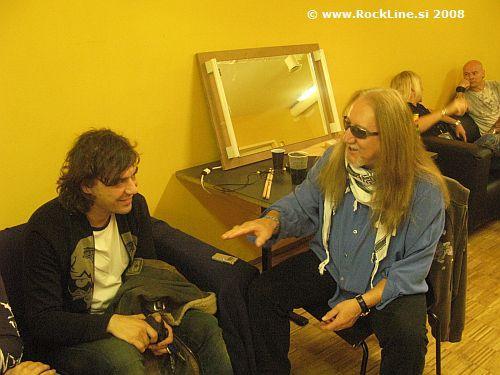
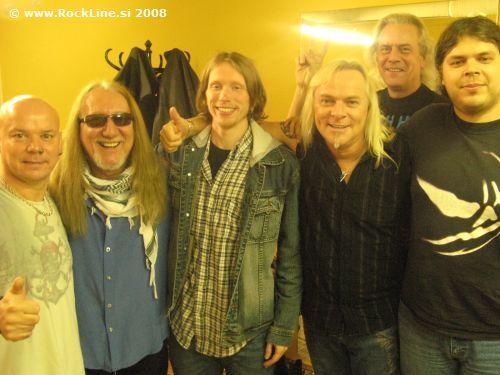
Location: Gasometer / Vienna / Austria
Interview date: 01.12.2008
Getting to this interview was a bit harder than we first imagined. Everything had been arranged, and then we managed to miss tour manager Ian. We were waiting for him at the entrance to Vienna’s Gasometer hall, while he was looking for us on the other side of the venue, where the backstage entrance is. On top of that, guitarist Mick Box had to be rushed off to the hospital, and to top it all off, Ian’s cell phone suddenly went dead. In this case, it was probably for the best. So we decided to pick up our passes and just focus on the gig. But our inner investigator wouldn’t give us any peace, so we walked up to the gentleman who was looking after the official Uriah Heep merchandise, told him who we were and what was bugging us. He said: “Wait for me here, I’ll be right back.”
After a few minutes he found us again and took us to catering, telling us to stay put there and help ourselves to some tea (the English way, of course) – which, naturally, wasn’t all we helped ourselves to – and that the band would join us as soon as Mick arrived.
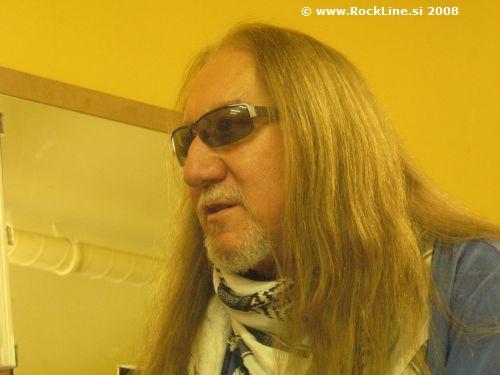
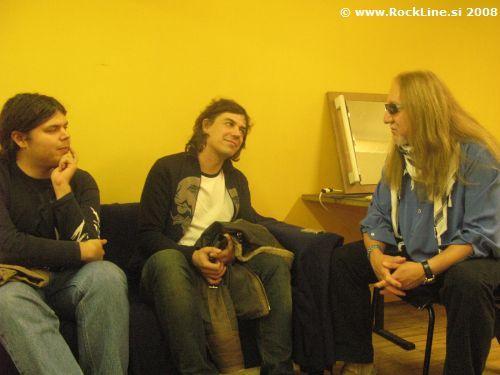
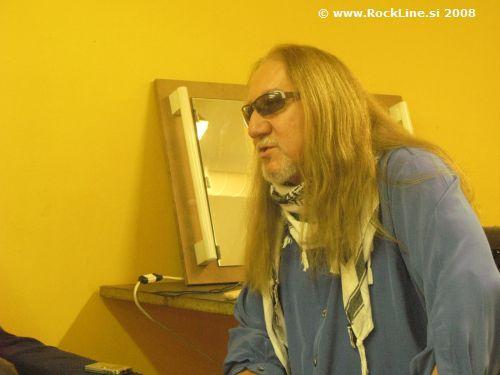
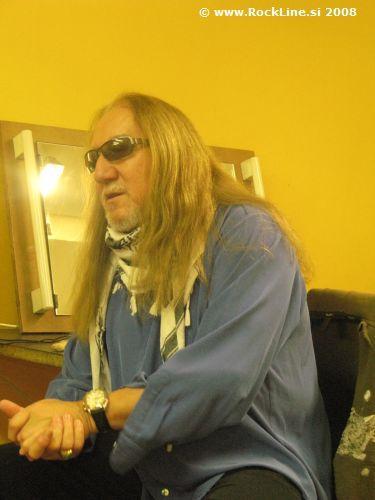
At 20:40 the legendary guitarist Mick Box, an original member of Uriah Heep, showed up at the venue and kindly asked: “Are you the ones waiting for an interview?” Mind you, there were only 50 minutes until showtime! We followed him straight backstage. We got a view of singer Bernie Shaw, who was carefully ironing his shirt, a must-have part of the wardrobe he wears at gigs; keyboardist Phil Lanzon was deep in conversation, surrounded by people; drummer Russell Gilbrook’s cell phone had just started ringing (read: “Hello honey!”), while bassist Trevor Bolder was in catering, grabbing a bite. We finally settled in and the chat began…
RockLine: How are you feeling, Mick? How’s the tour going?
Mick: Good. Rock n’ roll is literally running through my veins right now. We’re halfway through the tour. Everything’s going to plan.
RockLine: Before the interview, you were reportedly rushed to the hospital. Was it anything serious?
Mick: Ah, nothing special. Pretty routine stuff.
RockLine: Routine?
Mick: Yeah. Routine. My arm cramped up and they gave me an injection. Everything’s okay now. My arm still works, ha, ha, ha….
RockLine: You’ve just wrapped up the German leg of the tour, where the legendary Thin Lizzy opened for you. How was it hanging out with them?
Mick: It was a great tour. A lot of great songs got played, and there were a lot of excellent musicians in the mix. Every night of that tour was a night of excellent rock n’ roll music. Thin Lizzy have some phenomenal songs. We got along really well, as friends too. Overall, it was a very successful tour.
RockLine: Why did it take Uriah Heep a full 10 years to release a new studio album, “Wake The Sleeper”?
Mick: Because there’s total chaos in the album publishing business. The music industry as we knew it just a few years ago is gone. It simply doesn’t exist anymore. It vanished, it collapsed. The whole internet thing started ten years ago, too. At first the record industry attacked the internet and dragged Napster to court, but that didn’t help, because it later turned out there are millions of “Napsters” out there on the internet. So we couldn’t find our safe home. Then the labels started scaling back their operations, and many of them disappeared, went under. A lot of people lost their jobs. In a situation like that, it’s really hard for a band like Uriah Heep to find a home. Even today the labels themselves don’t know exactly what they’re doing, that’s how much of a mess it is. There’s actually a great deal of distrust inside the labels themselves. So this whole thing hasn’t settled yet, and I don’t think it’ll fully settle even in the next few years.
RockLine: During that ten-year stretch, more precisely between the studio albums “Sonic Origami” and Wake The Sleeper, your releases, mostly a bunch of different live albums, also came out on Classic Rock Legends. Was that your label?
Mick: No. Someone else ran that label. We weren’t connected to it in any other way, except that we released a few albums through it.
RockLine: Can you tell us about the stories hiding in the lyrics of “Wake The Sleeper”?
Mick: The lyrics for the songs on the new album come from different sources. From life experience, from the experience of an outside observer, theories about life… For example, the song Overload is about the era of computer domination, how people lose themselves behind computer monitors, how they swap out their own identity in the process. It’s fascinating what computers have brought and how they’ve turned the way people function in the real world upside down. Like many other things, computers definitely have their good sides, but also bad ones, even frightening ones. Tears Of The World is about how we look after the world. No matter how hard we try to protect it, we’re not protecting it well, and that’s why “the world weeps”. Even if we try as individuals, there are corporations out there literally killing this world that we’d like to keep and preserve. What Kind Of God came about while reading the book “Bury My Heart at Wounded Knee” by Dee Brown, which is about Native Americans. They lived a rich spiritual life, and then the white men come along and shoot them down with guns, steal their land, even tell them they have to accept another religion and so on. So if you were a Native American, none of this would make any sense to you, and you’d ask yourself: “What kind of god do these people worship?” Ghost of the Oceans is about women pirates. A lot of people had no idea, when they saw the ship sailing by, that it was actually full of women – female pirates. So the stories sort of capture the whole point of Uriah Heep. We’ve always picked themes like these.
RockLine: I noticed your new album sounds more organic. You’ve brought back that rich Hammond organ sound…
Mick: Yes. We went back to our roots. We got rid of all the synthesizers and that kind of thing. We wanted to record an album as a band. That’s why we invited producer Mike Paxman to work with us, who really listened to us while we were all in the studio. You know, most bands today record, say, only drums for 14 days, then the same for bass, guitar, vocals and so on… so you can’t “capture” a band on tape. You really only get some version of the band. If the band records together, you can catch it on tape whole, because a whole sound comes out of the speakers.
RockLine: So getting rid of the synthesizers was a completely conscious decision.
Mick: Definitely, yes.
RockLine: You recorded by playing at the same time, as a band together in the studio. So pretty much like playing live.
Mick: Yes. We recorded the tracks, listened to how they worked, and for each song we needed two or three takes. We were very happy with what we achieved. For us it’s the simplest way of recording. And on top of that, you capture the live “feel” of the album even better. If we’d recorded our instruments and vocals one by one, the effect would’ve been different, we’d never have caught that so-called magic. The good thing about this album is that it carries magic, it has magic. That’s a really important thing in all of this.
RockLine: I assume the band is really excited about the new album, since you decided to play it in its entirety on your current European tour?
Mick: Yeah, yeah… It started while we were recording the new album. Like with all bands. We were thinking quite generally about how we’d put together the set for the tour. So it would again be made up of our classics, with two or three songs from “Wake The Sleeper” slipped in between. And then it started happening that we didn’t know which song from the new album to choose for the live shows. We tried out the new tracks and they all worked great. Then we decided to just play the entire album live!
RockLine: Was it difficult for the band to get tight on the new songs?
Mick: That’s always a tricky thing, because each of us in the band has a different outlook and hears music differently. On that front we’ve been very successful, since we’re playing the whole new album live, which I think is fantastic. There are few bands today that go for moves like that at their shows. They simply didn’t record their new stuff in a “live” way, like we did. They usually only have bits of their new albums down, and just aren’t capable of that. Uriah Heep can boast the opposite, we’re “loud n’ proud” in what we do. I have to stress that this was a very brave move for us. Because in our case you’re facing the opposite wish from our audience, who always demands our classics at the shows. The current set of course includes the classics too, and they work very nicely mixed in with the new album. Our current set is really strong. People appreciate that, whatever they expected before the show. That courage is paying off for us.
RockLine: Why did you decide to put a Buddha on the cover of the new album?
Mick: The cover was designed by a guy named Ioannis, who’s from Greece and based in the US. He came to us with a concept for the cover and we all liked the idea. The cover shows a female Buddha waking up and holding a light in her hands. That captured our thoughts perfectly, since we’d been talking before about how we needed to awaken a sleeping giant, because we’d gone a full 10 years without releasing anything with new material. It all came together nicely.
RockLine: Is there any wish or idea to also release a new live album from this tour?
Mick: We’ve got a long tour ahead of us. We’ll see and decide whether to record a few shows.
RockLine: What keeps you together, what keeps you going as what you are, and what drives you after all these long years on the rock scene?
Mick: We simply enjoy what we do. As long as you enjoy what you do, or in other words, as long as you find some creative passion in yourself, that’s kind of the foundation that keeps pushing you forward, so you just carry on with your work. But if you lose that passion, that drive, then the joy goes too. We love making music together and playing it together, and also just being on the road together. Where we are right now with the band is a good place. It’s nice to be here today.
RockLine: Just a few years ago, you organized the “Magician’s Birthday Party” in London every year.
Mick: That event has run its course. It said what it had to say. So it lost its real purpose. That event was really good and successful for its time. When we felt that the “Magician’s Birthday Party” had served its purpose, we decided to record one last show of ours organized at that event, together with Ken (Ken Hensley – former Uriah Heep keyboardist, editor’s note) and John (John Lawton – former Uriah Heep singer, editor’s note). That way we gave it some lasting freshness, because if you want to see this event, you’ll have to buy the DVD, since you’ll never see us “live” at it again. We had to move on. The point is that you can’t cling to the old stuff. If you do, things in life start pulling you back, holding you back, and your enthusiasm for the same thing you’ve always done eventually dries up. What keeps us going on this road is simply the fact that we have new songs. That makes the old ones feel fresh now, too. If we played only old songs all the time, we’d start getting bored.
RockLine: When I saw you in October this year at your show in Munich, Germany, I noticed you play one of your biggest classics, the song Gypsy, with the completely original Hammond organ intro added back in, like it appears on your studio debut “Very ‘Eavy… Very ‘Umble”(1970).
Mick: Russell came up with that idea. It was his suggestion that we try it. It had a great final effect.
RockLine: Did integrating Russell into the band cause you any headaches?
Mick: Not at all. The transition was very easy. That’s because Russell is a very accomplished drummer. Once he’d polished up the backing vocals too, we were ready for the new live shows.
RockLine: Mick? Have you ever thought about releasing your own solo studio album?
Mick: I’ve never had enough time for something like that. I’ve always been responsible for looking after the band, organizing its tours, playing in the band, writing music in the band whenever I found the time. Now we’ve brought in a manager who looks after us. Maybe there’ll be some more time now that I’m relieved of the organizational worries and that free time will have to be filled with something else. One day I may actually take something like that on. The truth is, releasing a solo album has never particularly interested me. I’d rather feed my ego with total dedication to Uriah Heep and the work we do in the band. I’m fulfilled in everything when I’m on stage with Uriah Heep.
RockLine: You come out on stage with the drive of someone half your age.
Mick: Well, we can’t exactly hide our beards, ha, ha, ha… But it’s honestly a great feeling when you look out at the audience at a show, stare at the first rows and see people singing Gypsy who are younger than the song itself. That’s just proof the song has stood the test of time and that it’s a great song people always want to hear. In a situation like that, all I can do is smile on stage, because the feelings are truly one of a kind.
RockLine: That’s where you find your peace and personal pleasure.
Mick: Absolutely. It’s a kind of therapy. Like playing guitar completely alone in your room. In that moment you escape from the whole world, nobody’s angry at you and so on. It has a meditative effect too. That’s also why people come to our shows. To escape the normal mold of everyday life and join us at the party.
RockLine: How do you pick the songs before a show? Do your fans decide, or do you decide what you’ll play yourselves?
Mick: Depends on the situation. But one thing matters. You can’t just throw 15 or 24 songs onto a sheet of paper. You have to connect them to each other so they flow, to reach the climax you want at the show. So when putting together a set list, you have to be really on the ball and thoughtful about how you handle especially the endings and openings of songs and link them together.
RockLine: Your album appeals to older and younger listeners alike. Do you think the material on the new album also has the potential for its songs to become classics one day, like Gypsy, for example?
Mick: Judging by the reviews we’ve gotten, that’ll be the case. And we’re also happy to play older songs again now, in combination with the new material. We hope these will become classics someday too. Just a bit faster, please, ha, ha, ha… We don’t have much time left, we’ll have to hustle a bit more, ha, ha, ha… But we’re already noticing at the new shows which favorites people pick off the new album “Wake The Sleeper”. Those are What Kind Of God, Tears Of The World, Overload, and Shadow is also one of the strongest songs, or Angels Walk With You. We’d had the first four or five songs written just 14 days before we started recording. That was very fast. The process of making the album itself. New ideas for the “Wake the Sleeper” music generally came very quickly, so we had to keep “chasing” them with the right lyrics.
RockLine: Practically every “Wake the Sleeper” song.
Mick: For now we can count ourselves very lucky on that front. It happens to me more and more often these days, too: when I buy newly released CDs, I only find three or four interesting songs on them. So far, when we’ve talked to people, many of them say they don’t take the album out of the CD player until it’s played all the way through from start to finish.
RockLine: What are your plans for the future?
Mick: We’ll be on the road for 18 months. After Europe, the tour moves on to Canada, then the US, Australia, Japan, and next summer we’ll be playing all the major European festivals. During that time we’ll try to keep our professional level as a band high, and meanwhile start writing new songs for the next studio album.
photos: Rok Podgrajšek interview for RockLine conducted by: Peter Podbrežnik, Rok Podgrajšek, Aleš Podbrežnik text translated and edited by: Aleš PodbrežnikPhoto Gallery