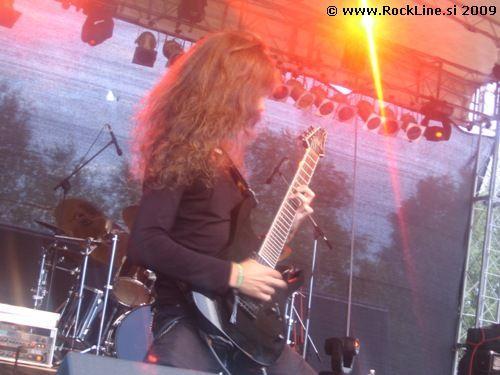
Author: Rok Klemše
Location: Paranoid Open Air 2009, Avtopoligon Ljubečna (Celje)
Interview date: 13.08.2009
Obscura are a German-Dutch technical death metal band who put out their debut Retribution in 2006. The album went unnoticed in the flood of other death metal releases, and over the next couple of years a good number of new members came and went, leaving guitarist and vocalist Steffen Kummerer as the core of the band and its only original member. This past February, though, Relapse released the band’s second album, Cosmogenesis, and Obscura became a brand-new tech death spectacle, with an album that calls to mind the best moments of the big four of progressive death metal – Death, Cynic, Atheist and Pestilence. Obscura made their Slovenian debut on the first day of Paranoid Open Air, and before the show I got the chance to talk to guitarist Christian Muenzner, who jumped ship to Obscura from another German giant, Necrophagist, and recently also became a permanent member of Germany’s Spawn of Possession.
RockLine: Let me start by welcoming Obscura on their first visit to Slovenia!
Christian: Thanks, this is really our first time here as a band, but I played this same festival last year, back when it was still called Metal Mania, with Stormwarrior.
RockLine: Right, I thought I’d seen you here before. You recently put out Cosmogenesis, which was received great by fans and critics alike. But it took quite a while for the debut Retribution to get a follow-up.
Christian: Not really, actually. After Retribution came out there were a lot of lineup problems, so Steffen is the only original member left. After the others left, it took him a good while to put a new crew together around him. We’ve been together in this lineup since the start of 2008. We got together in January, started recording the album in June, so it all didn’t take that long.
RockLine: Since the debut, a pretty large number of members have passed through the band, if I’m not mistaken as many as 14, 15?
Christian: Yeah, I think that’s right, but I wasn’t in the band back then, so I couldn’t tell you exactly.
RockLine: How did the recording of Cosmogenesis go?
Christian: We recorded at Woodshed Studio in Germany, which is owned by Victor Santura, the vocalist of German black metallers Dark Fortress. We prepared all the tracks beforehand in Guitar Pro, then Hannes tracked the drums first, after that we did the rhythm guitars, Jeroen did the bass lines, the guitar solos, and finally the vocals. We recorded everything in the studio except the guitar solos, which I recorded myself at home.
RockLine: Victor produced, mixed and recorded the album, and he also guests on it as a vocalist.
Christian: That’s right, Victor is a great musician with a great ear, and on top of that he’s incredibly creative. I think the album is even better because of him, since he had some great ideas for the vocal lines. The clean vocal lines especially were his idea. With a different producer the album would’ve sounded completely different.
RockLine: You can clearly hear the influence of the big four of progressive death metal on the album – Death, Atheist, Cynic and Pestilence. Do you think new tech death metal bands get “unfairly” compared to the veterans of the genre?
Christian: Yeah, no doubt. But at the same time, there are tons of new elements in music today, and after all, 13 years passed between those bands’ albums and the music itself has changed in that time. We love those bands, we grew up on them and they’re without a doubt a huge influence, but we’ve also been influenced by bands you wouldn’t expect. You can clearly hear black metal elements in Obscura from bands like Dissection and Emperor.
RockLine: Especially in the vocals.
Christian: Yeah, exactly. And in certain guitar parts too. You can definitely hear power metal influences and nineties death metal influences as well. But that’s just how it is, bands will always be compared to other bands and I’m totally at peace with that.
RockLine: Speaking of nineties death metal, the band’s name is borrowed from an album by veterans Gorguts, right?
Christian: Yeah, I think the guys borrowed the name from Gorguts when the band started. But I don’t think we sound anything like Gorguts, we sound completely different. People might expect to hear something similar because of the name, but the name is all that’s left.
RockLine: Listening to the album, at times I felt the Cynic influence was especially strong, mostly because of those occasional “spacy,” otherworldly synthetic vocal lines. In fact, the whole album has a unifying theme – space, right down to the album title. How did you land on those themes for the lyrics?
Christian: We’ve always been huge Cynic fans and we liked the idea of “vocoder” vocals. If you listen to a track like Choir of Spirits, those robotic vocal lines are used right in the chorus and they can easily remind you of Cynic. But if you listen to what the track is about, you quickly see we’re not trying to imitate Cynic. Some tracks have really obvious Cynic influences, like Noospheres, but we’ve always just liked the idea of a sci-fi concept with a modern sound. We were poking around Wikipedia and came across the theme of the genesis of the cosmos, and I think it fits the sound of our music perfectly. At first we wanted to call the album Noospheres, but Jeroen had already played on an album called Spheres (Pestilence – author’s note) and that probably wouldn’t have been a good idea. Anyway, I think the sci-fi theme represents our music really well.
RockLine: What would you say is the deeper idea behind Cosmogenesis, since it almost comes across as a concept album?
Christian: It’s not quite a concept album, I’d rather say the album is thematically linked. All the lyrics touch on the genesis of the universe in some way, but the heart of it is the question of the origin of humanity and the creation of the universe and all life. The idea is that there’s only a kind of collective consciousness, there are no individual thoughts, only one unified collective of consciousness. That collective of consciousness existed before life appeared, and life emerged from it.
RockLine: Cosmogenesis is quite a different record from the debut. Did you consciously go for more complex, technical death metal, or did it happen spontaneously because of the new members?
Christian: It definitely happened totally naturally. The first album really wasn’t as technical as this one, but the influences were already audible. The old members were big fans of Death, Cynic, Pestilence and Atheist, and the new guys in the band have been playing for a really long time. I’ve been playing guitar for 15 years, and obviously we’re more experienced, and that brought more complex, technically intricate music with it. Still, there’s a common thread between the two albums.
RockLine: I’d guess it’s Jeroen, who played on the last Pestilence record before they broke up, and the two of you who played in Necrophagist (Christian and drummer Hannes – author’s note) who brought a ton of tech death influences into the band?
Christian: Definitely. You learn a ton when you record albums with other bands and go on tours, and it all changes the way you play and think. The older you get the more experienced you are, and I hope that shows on the album.
RockLine: How do you write the songs, considering how insanely complex they are? Do you write the riffs first, then the drums…
Christian: No, it’s different. Mostly different members write entire songs. Steffen already had a few songs ready before we joined, Hannes had a few ready too since he plays guitar as well, and I wrote one. All the songs had the same influences and they came together quickly and, I think, well. We wrote two songs on the album all together. But mostly one member has the idea for a whole song, writes it all out, and the rest of us maybe add a little something here and there.
RockLine: You’ve also got some eminent guests on Cosmogenesis, like Tymon Kruidenier (Cynic) and Ron Jarzombek (Watchtower, Spastic Ink, Gordian Knot, Blotted Science, etc.). How did you get in touch with them?
Christian: Ron is one of my favorite musicians. Steffen already had the idea for the first album to have Paul Masvidal (Cynic) play a guest solo, but he was busy and it never happened. For Cosmogenesis we invited him again, but unfortunately the timing didn’t work out again, so we got in touch with Tymon. He and Jeroen are good friends, he got our demo, and he wrote and played a lovely solo on Choir of Spirits. That solo wasn’t even planned, actually, but it came out so well we kept it. On the title track, Cosmogenesis, it’s Ron playing. I was supposed to record the solos at first, but none of us had a particularly good idea for a solo, or all the attempts were on a much lower level than the other solos on the album. We just couldn’t manage to write a fitting solo, and the answer could only be a more experienced guitarist. Jeroen had Ron’s e-mail, we asked if he’d be up for playing a solo, he liked what he heard, and two days later he’d already sent us that insane solo.
RockLine: For an album as complex as Cosmogenesis, it’s pretty unusual that the songs are really “catchy,” they get in your ear quite fast. Did you intend from the start to write “catchy” songs?
Christian: Yeah. All the songs have technical parts that are demanding to play, but they also have parts that are easier to play and sound like 80s heavy metal. It’s all in the structure, the song has its complex individual parts, but the structure itself isn’t that convoluted. We try to keep everything as logical as possible instead of cramming 20 riffs into a song. The songs have 5, 6 riffs at most, and the structure is pretty traditional and easy to remember. When you play an instrument for years it’s only logical that you get more and more technically polished, you listen to more technical bands and play harder guitar parts. But the older you get, the less technicality and complexity matter, and you start playing the music you simply like.
RockLine: What do you think about this new prog death scene? Do you listen to any newer bands or do you still swear by the pioneers? Given that jazz and fusion influences are clearly audible too, you probably listen to other kinds of music as well?
Christian: Yeah, a huge amount of our influences come from jazz and fusion. Jeroen is a big jazz fan, and I listen to a ton of fusion. I try to bring more complex harmonic content into my solos, and Hannes is also a fan of lots of jazz and fusion drummers. The current tech death scene doesn’t inspire us, many of those bands don’t focus enough on the songwriting itself, their songs sound like technical exercises and I think the whole thing is a bit overblown right now. But a few bands are great anyway. I like Psycroptic and Spawn of Possession.
RockLine: Yeah, a lot of modern technical death metal bands really do sound too technical, but on Cosmogenesis you can clearly hear the emphasis is on songwriting.
Christian: Exactly! We don’t want a solo, for example, to take over the whole point of a song. In fact, we don’t even really consider ourselves a technical death metal band. We’re more influenced by older bands like Death, Dissection and even heavy metal à la Judas Priest. Bands like Priest and Megadeth are also incredibly technically accomplished, but they didn’t put those elements front and center. The song always came first, enriched with the occasional technical touch. I think that’s the right way to write songs, and maybe we don’t even want to be labeled as tech death.
RockLine: The weekend before Paranoid Open Air I saw you at Brutal Assault, where in the worst heat you still managed to draw a nice crowd in front of the stage and played a great show. If I’m not mistaken, a pretty grueling touring schedule awaits you.
Christian: Thanks! Right now we’re on tour with Atheist, we’re playing a few big European summer festivals and filling the dates in between with individual shows. When we get home we’ve got six weeks off, then a European tour with Cannibal Corpse starts, and there are a few more tours down the line that aren’t 100% confirmed yet. In January next year there’s another European tour (Obscura will also stop at Kino Šiška as part of the Bonecrusher tour), and we’d love to go to the US too. It’s not the right time for a headlining tour yet, right now the important thing is to get the album in front of as many people as possible.
RockLine: Is it uncomfortable for a band like Obscura, or for you personally as a guitarist, to be compared to big bands like Death? Or is it just an extra challenge to improve your playing?
Christian: No, absolutely not, it’s a huge honor. I grew up on those bands and I love them. All of them – Death, Cynic, Atheist and Pestilence – were ahead of their time. I think they weren’t understood back then, but they’re appreciated all the more today. We’re really honored to be mentioned alongside bands like that, and we’re honored to be touring with Atheist. It means a huge amount to us, and it’s real inspiration, those bands make you want to be better and better.
RockLine: Do you think it’s possible, not just in tech death but in metal as a whole, to still achieve something new, something that hasn’t been heard before?
Christian: I think the whole scene is stagnating right now, and I think it’s slowly dying out, there’s simply too much of everything and the scene has become oversaturated. All that’s left is writing really good, listenable songs. I don’t care about reinventing the wheel, I just want to write good songs.
RockLine: Who are your influences when it comes to guitar playing?
Christian: I started playing because of Angus Young, and he’s still a guitar hero to me (laughs). When I was 11 I wanted to be Angus, period (laughs). Later the Iron Maiden guitarists were hugely important to me, because of the twin harmonies and the way they split up the solos. Then I discovered more technical guitarists, Malmsteen, Dream Theater, Marty Friedman, Steve Vai, Paul Gilbert, Tony MacAlpine, Jason Becker, Michael Romeo. I quickly fell in love with jazz guitarists too, John McLaughlin for example. And of course guitarists who wrote great riffs, Chuck Schuldiner, Jeff Waters, Dave Mustaine, James Hetfield, Jon Schaffer. I could go on, but those guitarists left the biggest impression on me.
RockLine: One last classic question. What does the future hold for Obscura?
Christian: Right now the important thing is to keep touring and presenting Cosmogenesis. I hope we’ll get to play all over the world. We’re already writing material for a new record…
RockLine: Will it be in the style of Cosmogenesis?
Christian: Yeah, the common thread will be similar, but it’ll still be different. The melodicism and catchiness will definitely stay, and we’re trying to create an Obscura sound and somehow find our own niche. So that people don’t just compare us to other bands but also get to know the sound of Obscura. I think it’s already taking shape with the progressive structures, guitar solos, melodic riffs, fretless bass and acoustic guitars, but we’d like to broaden and deepen the sound.
RockLine: In the end, the most important thing is exactly that, a band having its own “trademark,” recognizable sound.
Christian: Exactly! Cosmogenesis was more of a record written by feel, we didn’t think too much about what we wanted to write.
Photo Gallery