Location: Mozart bar / Domžale / Slovenia
Interview date: December 10, 2009
Analena are total musical oddballs. Hard to compare to anyone, and genre-wise there’s no way to stuff them into a neat little box. Their sound works on the new album “Inconstantinopolis” (2009) too – RockLine review HERE – fresh, inspired and curious. It’s alternative rock with a punk backbone, but with unobtrusive yet enticing detours into hardcore, as well as twists toward post-punk. Still, Analena don’t settle on a clear genre definition, and that’s seriously exciting, because it means they’ve found their own field of recognizability and uniqueness. Analena is the real address for a mockingly rebellious attitude with avant-garde punk charm, dressed up in a cheeky dose of core trash on one side and the high-intellect delivery of verses of revolt on the other.
The Zagreb band has a Slovenian guitarist in its ranks, Miran Rusjan. Miran, who is also known as one of the founders of the independent label Moonlee Records, took time after a working day at the label’s headquarters in Domžale to sit down for a drink and have a proper chat about Analena, about the guitarist as a musician, and about the character and role of Moonlee Records itself, whose birth is actually tied to Analena.
RockLine: How would you describe the feeling of having just released the new Analena album “Inconstantinopolis”? Especially when you look back at its predecessor “Carbon Based” and the five years that passed between the two?
Miran: It’s a leap. Mostly because there’s one fewer member in the band now. Our bass player left soon after the last album came out. For a while that paralyzed us in a kind of status quo, until at some point our singer Ana just grabbed the bass guitar herself and we got down to work as a foursome. I think that’s the biggest difference between the new and the old Analena right now. Although the difference in the music itself and in how we express ourselves hasn’t been some massive jump. “Inconstantinopolis” is a normal continuation for us. Over these five years we’ve all grown a bit, matured, and that shows up to some extent in the new songs. Some people expected Analena to soften up. Okay, maybe some of the vocals have become more melodic. Personally, I feel that even with the new album Analena has stayed as sharp and uncompromising as before.
RockLine: The sharpness in Analena’s sound stirs up a special kind of feeling, one I honestly don’t know where to place. You’re a band with modern views, and I’m curious where you draw inspiration from, what everyone in the band listens to, and where the ideas come from that you then shape into the final songs that reflect the pulse of Analena.
Miran: We all listen to very different music. At the same time, none of us carries any subconscious wish for Analena to copy some particular band. We just show up to rehearsal, fire off a few riffs, a few rhythms, shout and sing along however feels best, and we know that whatever mix comes out of that is simply it. So we’re not hung up on whether something sounds too soft or whatever. We’re not burdened with following some trend, fitting into some genre, or pandering to the audience. We simply “play” at rehearsals, and if we like what comes out, that’s enough for us. All the songs we write, including on the new album, are born in an atmosphere of us feeling good. And listeners will just have to accept that. That’s the freedom we allow ourselves and keep, so we can create whatever feels best to us at that moment. If we weren’t happy with this approach, the whole thing would have no meaning. Everything we make, we make first and foremost for ourselves.
RockLine: What about audience reactions to your music? I’m especially curious about the responses at gigs, since you play abroad a lot.
Miran: From the very start Analena aimed for as many shows and tours as possible, so in these 12 years we’ve actually played all over the European map, from Spain to Finland and all the way to Istanbul, and everywhere in between, so we’ve racked up more than 300 shows in total, at least half of them outside the countries of the former Yugoslavia. As for audience reactions, I notice that Eastern Europe is much more receptive to our music than Western Europe. I don’t know why. Maybe they don’t like this more genuine approach, not so professional, more spontaneous, which is just part of who we are. In countries like Poland, Lithuania and the Czech Republic, for instance, we’re sometimes received way better than at gigs in Zagreb or Ljubljana. After all these years, we still like playing best in places we haven’t played before, where we can present our music to a new crowd and experience something new. That’s much better than getting anchored in our home clubs. For us it’s an adventure. And the point of an adventure is that it can last as long as you keep doing new things. If you repeat yourself, it’s not an adventure anymore and creating loses its meaning, its point.
RockLine: I think that’s the most important thing too. Ideas should drive a band forward. What are the relationships like between the members? Do you get along well?
Miran: We understand each other really well in the band. It seems to me that since we became a foursome, the energy inside the band is actually the best it’s ever been. That’s also why we didn’t strain ourselves too much looking for a fifth member to play bass. Mostly it’s a risk, because you never know how a new person coming into the team will work out energy-wise. Everything can be okay at first glance, but then you run a tour with them and realize it’s just not it. It’s a shame when you figure out after a year that this person doesn’t fit the puzzle. A band has to be one tight, compact thing. The four of us work great together, even though each of us comes from a completely different corner. Character-wise we’re very different too and everyone has their own quirks, but when we create together, it makes us really happy, and that’s the energy that keeps us going. Without that energy we’d probably stop playing. That’s what drives us.
RockLine: How did you end up in Analena, a band that’s actually based in Croatia?
Miran: There’s an interesting story behind that, going back to the spring of 2002. Analena was just about to release the record “It’s Never Too Late To Split Up (split with Sensual Love)”, a month before a European tour that was already completely booked. Back then Analena played with one guitar. And around that time the guitarist had health problems and had to have surgery. About a week before the tour, his doctor told him he couldn’t go. So the band was in a bind over whether to cancel the tour, meaning a tour that could bring a band plenty of good things, new things, and open new doors. First of all, a tour like that is hard to organize in the first place, and you’ve got a record out that you have to promote and present, and a chance like that might never come again. On the other hand, the question was how to get through the situation without the main figure of the band. So they decided to find a guitarist who’d be able to learn all the songs in one week and have time to go on a month-long tour with them. They contacted several guitarists from Zagreb and the area that they knew, and they remembered me too. We’d known each other for a few years already, since I’d been organizing their shows in Slovenia. Their urgent call caught me right in Belgrade, where I was on tour with a Swedish band called Children Of Fall. The band moved on, I stayed in Belgrade, and I was just thinking about going home and finishing some obligations for my studies, while I’d also spent 14 days with that band, watching them every day and seeing how great they had it on stage. And then a band calls me, one of my favorites, asking if I’m ready. I told them to give me until the evening to think about how I’d juggle everything. And I called them back after half an hour and said I was in. I got on a train and spent whole days at the guitarist’s place grinding through the songs. I did the first dates of the tour alone on guitar. In the last week the guitarist had recovered enough to travel from Zagreb to Prague, and we played the last shows together, so with two guitars on stage. We all clicked great, and in the end came the question: “Will you stay in the band?”, totally normal, and I said: “Yes!”.
RockLine: What’s the difference on stage between being the only guitarist and playing with another one? When was it harder on tour?
Miran: I don’t know… The people who knew Analena from before said that a second guitar fills out the sound and that Analena had always kind of been missing that…
RockLine: So two guitars?
Miran: Yes. Because with us the bass lines are fairly simple, and the specific thing about Analena is that the individual instruments are very simple, but when you put those pieces together, it gets more interesting and becomes a colorful mix. Maybe because each of us plays pretty different lines, and when you put it all together you get this really “colorful” effect at the end. The band agreed that two guitars enrich the sound, and that’s how I stayed with Analena.
RockLine: I feel like in the songs on the new Analena record you can hear how successfully both guitars fill the space. They don’t necessarily play the same patterns, but build an interweaving that fills out the sound. What’s your take on that?
Miran: Why complicate things if you don’t have to, ha, ha, ha,… There are plenty of bands that think they have to complicate things, they even mix a whole pile of genres, and in the end the whole thing comes across as some unrecognizable blob of everything. You can play totally simple patterns, lines, but when you put them together they sound colorful and exciting. So still hard-hitting enough, and colorful at the same time.
RockLine: Were you in a band before Analena, and where did you learn to play guitar?
Miran: I first picked up a guitar in the fourth year of high school. At first we had a band called Man Of A Shadow, which moved in underground hardcore circles. After that came membership in Hopes Of Choice. Around 2000 both bands fell apart. So in the period before Analena I was without a band, but I never lost contact with the guitar. I’ve never been considered some kind of virtuoso. We played punk, and for punk you don’t need much guitar-playing know-how. All that matters is the right “attitude”!
RockLine: Was it a handicap for Analena when Ana had to pick up the bass? It limited her movement on stage and maybe took some energy out of her performances, and consequently yours too.
Miran: Well, the first reaction of our fans who’d followed the band for at least 5 years or more was that they slightly doubted it, they figured it might not work out so well. Before, Ana was really a persona with her own charisma, her own energy, jumping around the stage as its focal point. The question was how that would work once Ana grabbed the bass. In the in-between phase we had a friend who started playing bass, but then he got a job on transoceanic ships. We agreed that while he was away Ana would play bass, and when he came back he’d be our bassist again. And then it turned out this buddy just stayed on those ships. Ana then suggested she could take over the bass completely, and to us that seemed like a great option. We were maybe skeptical for the first three shows, but not after that. We didn’t even think about it much, it was perfectly normal for us to become a quartet. Watching Analena shows in 2004 was definitely something different than it is today. Even the people who were skeptical at first eventually saw that a bass in Ana’s hands is a totally sexy thing.
RockLine: You picked a very interesting title for the new album, “Inconstantinopolis”. What’s hiding behind it?
Miran: Ana would be the best one to interpret that. The album title is also the title of one of the songs on the new record. It’s basically wordplay. So nothing is constant, and then “polis” as in a city. I actually really don’t like interpreting lyrics myself, but if you just skim through them on this new record, the lyrics revolve around an individual existing in this, often unjust, society. They basically point to disagreement with this system, and at the same time to a search for a position where you can survive as an individual within it, within this society. Even though our band’s background is punk, in our expression we’ve never spat out those primitive slogans along the lines of “Fuck the police!”, “Fuck the state!” and so on. That’s been said a million times and there’s no point in us repeating it. We’re also mature enough by now to know it’s stupid to blame the people around you for the injustices that happen to you. I mean, we live in a world that isn’t perfect. You have to accept it as it is and secure yourself a position in it, you have to create your own world, the kind you might want when you think about, if I can put it that way, a perfect world.
RockLine: That seems like the real point of Analena to me. Ana strikes me as an excellent performer. She gets into it totally and her anger is real.
Miran: Yes. Maybe that’s actually a kind of filter for us, and when people watch us from below the stage, they think: “Damn, these guys are really angry at the whole world!” But in fact. It’s really about experiencing a kind of catharsis on our side. We channel this rage, this anger. When we get it out during the show and cleanse ourselves in a way, we feel really great after the show. If you find that, that’s the best. That great feeling. For the length of the show you actually find that place of yours where you can fire these feelings out of yourself, but in everyday life we’re not angry at anyone at all, ha, ha, ha… We’re totally calm, normal people.
RockLine: I’d also like to ask you something about your label Moonlee Records. What was the purpose behind starting it?
Miran: The birth of Moonlee Records is tied to Analena. When we were recording “Carbon Based” five years ago, we asked ourselves, what do we do with the record now? Where will we release it? We could’ve put it out with some friends of ours who also run small independent labels. But deep down we knew that wasn’t what we expected. We wanted to do the whole thing a bit more responsibly and professionally. There was no concrete offer from bigger independent labels, from abroad of course, so only two options were left. Either release the record somewhere we knew it wouldn’t get the kind of promotion we wanted, or release it ourselves. We thought it over, and given our knowledge, experience, connections and energy, we decided to take all the responsibility on ourselves. When we got into self-releasing this album, nobody was even thinking about founding any kind of label. In the same period our friends from Zagreb, Lunar, who also have the studio where we recorded, made a great record and were in the same position as we were. Then the joint idea came up to start a label. Soon after, other bands with the same problem showed up, bands that didn’t know how to release an album. And then it all just kind of rolled on its own. We definitely never dreamed that today, five years after founding it, we’d have 18 releases.
RockLine: What’s fascinating is that among all these alt bands, you manage to pick out talents that turn out to be big artistic surprises.
Miran: The first and main thing is that we have to see a band live first. Those bands that “live” on stage, that shake out some energy… If that energy grabs you, you kind of know it’s the real deal. You can assume the album will work well too. That’s the main criterion. And of course the fact that all these bands think similarly to us. Rock-star behavior is not welcome. That means making unrealistic demands of us. That’s not interesting to us, and it doesn’t seem worth negotiating with such people and bands, or wasting time in any way. Re-educating them: “Okay, come down to earth,…” The bands that have made it with us are simply hard workers. They have no problem getting in a van, driving far, and honing themselves for little money. Bands that make high demands after just 10 shows have nothing to look for here. You need mileage to shape yourself into a real band, with the right character and attitude toward music. Another important factor in our decisions is that we’ve been knocking around gigs for fifteen years, so based on that experience we can quickly figure out which bands have potential. So it’s not about the sheet music, it’s about energy. If a band enjoys itself on stage, isn’t bored, then it radiates a certain charisma, an energy you can feel.
RockLine: Earlier you explained that Analena called you when they were looking for a guitarist, just as you were on tour in Belgrade with a Swedish band. Tell me, had you been doing management work in music before that?
Miran: I come from Nova Gorica. I used to organize a lot of shows in Ajdovščina and Nova Gorica. I was a concert promoter. We also organized a lot of those big bands. That’s where we collected contacts and connections. Even back then I was involved with a small independent label that supported smaller local bands. It was all pretty much a “trash”, “low budget” initiative, I even put out records for those Swedes Children Of Fall on cassette back then. They played in Slovenia a few times. It helped them a lot that I joined them on tour in the Balkans too, for those 14 days, since I knew the languages and was the real go-to for communicating with the locals, which made the band’s job much easier. Over time you build up a network. Of local clubs across Europe. Of course you also have to be the one who works both ways, who reciprocates and offers your own services. It’s about trust, the free flow of information. You organize some bands by enabling them to do a tour, and then you offer your own bands, who get supported by foreign and local promoters. The main thing is that bands go to shows too, to check each other out. That they support one another. Because they have local connections and contacts, and then it’s easier to recommend each other.
RockLine: You know what I find fascinating about Moonlee Records? You’re not EMI, you’re not Sony/BMG or any of the other music business moguls, and yet you approach things with incredible professionalism. For example, when we get a promo CD from you for review, it comes with such a concise band introduction on a single A4 sheet that you could consider it a review of the album before the review,…
Miran: Ha, ha, ha,…
RockLine: Seriously. We at RockLine get promo material from bigger labels, from Germany, Austria,… and none of them can brag about a band introduction as detailed as Moonlee Records’. Where and when did you develop this knack for presenting a particular band so well, right at the start of the promotion, to local promoters and to the media?
Miran: We’d done a lot of work before that, building up mileage. At some point we simply realized how important it is. It’s not only important to have a band with great music, but also to know how to present that band. You can’t overdo it, of course, you have to approach it fairly, highlight the most important and interesting things about the band, and of course not highlight the things that aren’t positive. When you mentioned that the whole thing is prepared like a review already…. Of course you try to serve the media something you quietly hope that outlet or its journalist will discover or write. Half of the reviews our bands get are superficial, for example. In that case it’s best if the journalist uses the information we hand to the media during the album promotion, rather than babbling some nonsense or not describing the album in enough detail. So it’s better if they lean on the info contained in the PR presentation of the CD for their article, if they don’t know what to write otherwise. Of course the outlet discredits itself in a way by doing that, but we don’t care, because our information reached its target in the promotion. The problem, of course, is that if everyone just made “copy-paste” articles out of this PR info, you yourself wouldn’t get any feedback on what’s not okay on the album or with the band and could be better in the future. Bands still want to hear where they need to level up, so critical album reviews are definitely sought after.
RockLine: One last question. More about Analena. Future plans. How long will this cycle of promoting “Inconstantinopolis” and playing shows last, before you lock yourselves in the studio again and start working on a new album?
Miran: For sure, intense promotion of the new album at shows and presenting it to the audience is ahead of us now. When we’ll start creating new material, I can’t tell you at the moment. In that respect we in Analena work pretty spontaneously. We never tell ourselves we have to record an album. Of course we’ll keep rehearsing as usual, and ideas for new songs are born at rehearsals. It’ll be the same this time. We’re in no rush, and we’ll take our time. That’s the freedom we talked about at the beginning. What binds us to the band is the joy of making music. Nothing more. So Analena must not enslave us, you know what I mean? If we need a year, we’ll write new songs for a year, if more, then more… We don’t care about that. The main thing is that we enjoy it. The most important thing is that we end up just as happy with our next album as we are with our new record “Inconstantinopolis”. We’re not tied to time.
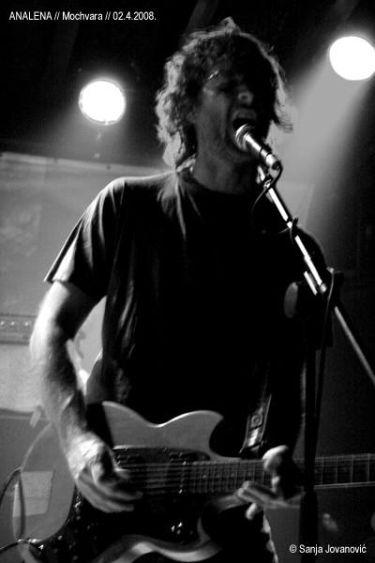
photos: source: official Analena MySpace page
Photo Gallery