Place: Schwabenhalle / Augsburg / Germany
Interview date: 22.06.2011
The arrival of classic AOR gems Journey in Europe to promote their second studio album since coming back renewed and reborn, fronted by new vocalist Arnel Pineda, is a real celebration for fans of melodic hard rock. Their 14th studio album overall, “Eclipse”, confirms the huge creative drive and inspiration surrounding the band, and they show absolutely no signs of rust or fatigue.
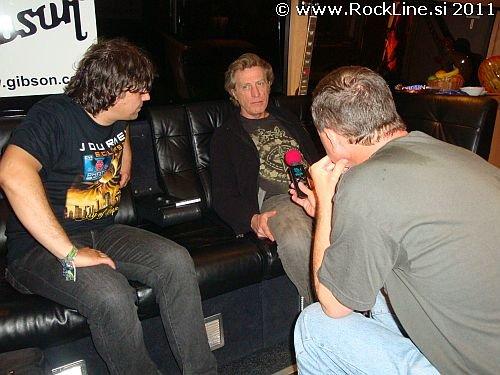
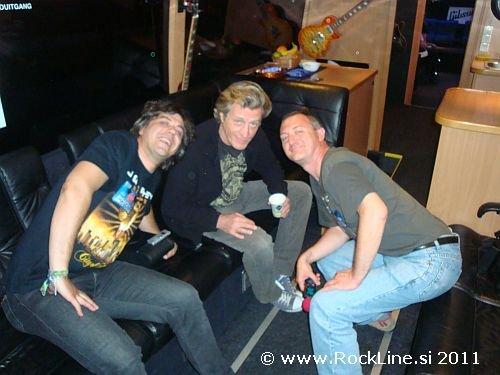
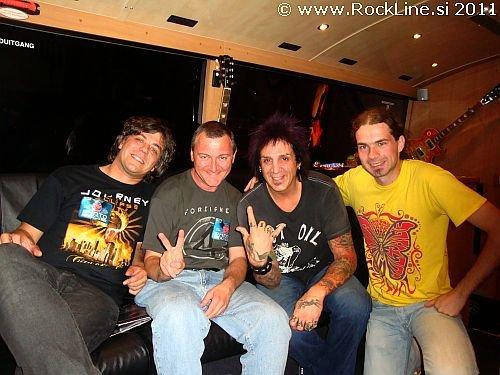
We did the interview before the band’s show in Augsburg, Germany, where Journey played in a dream “brotherly” lineup with Night Ranger, Kansas and Foreigner. It took place on a special bus, its body plastered with Gibson guitar ads and its interior converted into a space for promoting the bands, which includes doing interviews.
RockLine: How are you feeling a week after landing on the old continent and playing your first show in Berlin? How happy are you with the tour?
Ross: We’re relaxed. The whole thing is running like a well-oiled machine. We usually play with three or four bands, and on the bill we’re always last, which suits us just fine. The tour is excellently organized and everything runs very smoothly. At the shows we play a set with all our biggest hits, with some songs from our new album “Eclipse” mixed in. But we actually started the tour back in April, when we began playing in South America. Before that we rehearsed and got ourselves tight for about two weeks. Everything’s running great right now and the vibes are very positive.
RockLine: For Journey, Arnel Pineda’s arrival was a kind of rebirth?
Ross: Exactly. Even though Arnel’s been with us for almost four years, I can still say he’s the new guy. What can I say about Arnel? He’s “hot”. “Eclipse” is the second studio album he’s contributed his vocals to. Between the two albums we also put out the DVD “Live in Manilla” (2010), where you can see for yourself what the new look of our band is like.
RockLine: Did you need more time for your new album “Eclispe” to gather enough ideas and material, which then went through the next stage of studio work?
Ross: It took Neal (Neal Schon, translator’s note) and Jonathan (Jonathan Cain, translator’s note) about three months to go through all the ideas. And those ideas really took their final shape in the studio. Over the years, Journey have recorded albums in two ways. The first way was to write the material, rehearse it, go into the studio and play it. It was a kind of workshop in the studio. You come in, play, record. That’s the approach we took on the new album too.
RockLine: This time you didn’t have to focus on song length…
Ross: No, we didn’t. That’s a very good question…
RockLine: …. because I know your songs that get played on the radio are usually about three minutes long. Those are edited for radio airplay. So this time you had complete creative freedom.
Ross: Yes. And the reason is that the concept, or let’s say the purpose, of radio has changed completely in the digital age. Formats made for playback can be longer, offer more variations, sometimes they’re hard to recognize, like shortened snippets. They’re more about getting to know the music than listening to it. People can “download” those formats, so airplay on the radio doesn’t mean the same thing in the new era. Everything is slowly moving to the internet. From the songwriters’ point of view, over the last few years we’ve given ourselves complete freedom to write songs at whatever running time we like, and we keep full control over that. On top of that, we also prepared shortened, edited versions of the originals, in case we get a chance at wider radio airplay for the masses.
RockLine: So Journey prepare those edited radio versions of the songs yourselves.
Ross: Yes. We would never let anyone else do it for us. If I look at “Eclipse”, the album carries the originals, while the released singles are edited. Edited by us.
RockLine: How does Journey feel about the way rock radio stations work today?
Ross: To be honest, I don’t listen to many of those radio stations anymore. It’s hard to tell the two spheres apart these days. The first is the internet, where music lives in all sorts of edited formats. There are places on the internet where music is completely categorized. Besides satellite radio like Sirius XM, there’s a whole world of the internet, which is no smaller a market. Our music, edited for playing on the radio or the web, is categorized under Adult Oriented Rock, shortened to “A.O.R.”, and that category has nothing to do with pop.
RockLine: “Eclipse” is a guitar-cranked album, and at the same time refreshingly daring for Journey, since it doesn’t hide its musical variety.
Ross: Exactly. Journey are capable of playing many different genres of music. The musicians in the band come from different musical backgrounds, or rather developed in different musical environments. At heart, the guys in the band are very well versed in handling all kinds of musical styles. Even though at concerts we mostly play material from our biggest hits, the material on the new album “Eclipse” is somewhat different and hard to match against the image of our hits. Playing and recording the same music over and over, with the risk of achieving nothing tangible, is out of the question for us. “Eclipse” is a different album. If I compare it with our past work, the parallels make sense with “Frontiers”, which at the time of its release was seen as a completely experimental album. We went back to the approach we used for “Frontiers”. It has moments we’ve never tried before. At the same time, it doesn’t hide the musical influences that were typical especially of the band’s early career. I’m thinking of the period before Steve Perry joined Journey, or the early period right after he joined. “Eclipse” is once again a heavier, more rocking, more energetic album. To a degree, a heavy metal album. And since we’re on heavy metal, we find our way around those waters very well too, and tonight you’ll be able to study that in detail at the show (laughs).
RockLine: You mentioned the “Frontiers” album earlier. Was it hard for Journey to follow the success of “Escape”?
Ross: To a degree, yes. Really. We followed “Escape” in certain respects. That’s how we put together Separate Ways and Faithfully. But “Frontiers” also has some completely different moments on it. Those served as our reference for steering the ship this time too, when we were shaping “Eclipse”.
RockLine: Apparently there’s a slight concept behind the messages in the lyrics of the “Eclipse” songs?
Ross: Yes. In songs like Tantra and Human Feel there’s a concept in the background. Journey have always been a band that, lyrically, brought listeners messages of hope, defiance, encouragement. What shines through in the verses of Tantra carries no less weight in its message than what’s in Don’t Stop Believing.
RockLine: After that answer Ross Valory said his goodbyes, saying he’d love to visit Slovenia someday, since the band has never made it in Europe any further than Germany. Around then drummer Deen Castronovo joined our conversation. Ross diplomatically hinted that Deen knows a lot more about the concept behind the songs, and Deen didn’t forget to add…
Deen: I’ve been outside Germany too. When I played with Vasco Rossi. Three shows in a row in 1995. And Stef (Stef Burns, translator’s note) was on guitar back then.
Ross: Stef’s a good friend of mine too. We played together. And if you run into him, tell him he still owes me money. He should at least give me enough to buy a couple of new pairs of jeans (laughs).
RockLine: Deen, as a creative part of the Journey lineup on the new album “Eclipse”, can you tell us about your contribution to the album?
Deen: I’m really excited that I got to contribute my share to the songs. Neal and Jonathan prepared the material and presented it to us. We were in the studio. No rehearsals, no playing. We just listened to the music. Demo material. We discussed what could still be added to individual songs, small tweaks here and there. Once we agreed on everything, we went into the studio and played and recorded it in just two takes. That’s it. My contribution? What could it be, when your buddies hand you demos with computer-programmed drums as the backing? (laughs) In the studio it was me and producer Kevin Shirley. Kevin steered me. He’s a genius, an exceptional producer. I brought the idea and Kevin guided me through the details. As for songwriting, I didn’t get involved at all. I’m on a team with the best songwriters of all time, which is a huge honor for me personally.
RockLine: How do you decide which songs you’ll play in the set when you head out on tour?
Deen: We always have what we call the “dirty dozen” ready. That’s the collection of the biggest Journey hits that can’t be missing from any set. That leaves us about 80 songs to choose from to fill the rest of the set. We always make room for two or three songs from the new album we’re presenting on the tour. Mostly, though, the set list has the staples, like Open Arms, Faithfully, Don’t Stop Believin’. Of course, things can change from night to night. Sometimes we talk it over together before the show and say: “Tonight we need something more “rockin'”!”, and so we pick a fitting song and add it to that night’s set. We only try it out at soundcheck before the show, to see how it works and whether we still know how to play it after two or three years of not playing it, and that’s it.
RockLine: Journey have always been known for strong support from the ladies. Is that still true today?
Deen: Things stay the same. We’ve all gotten older, the only difference is that the girls who used to come to our shows now bring their kids along too. And that’s incredible. You meet kids who are 10, 15, 20 years old, and then the people in the audience who are 50, 60. It’s incredible how many generations come to our shows. I was a huge Journey fan myself before I actually joined the band. I’ve loved them since I was eleven. It’s great to see younger people at the shows who like your music.
RockLine: Even though young people today can choose from many more artists than they used to?
Deen: Yes. Bands like Journey grew on the back of radio airplay and live shows. We had nothing to do with MTV when it comes to the band’s success. Take artists like Lady Gaga, they’re great, they’re huge, but MTV built them. We were lucky enough to keep the stability and strength of our success all these years, right up to today.
RockLine: How do you decide in the band which songs you’ll sing at a Journey show, and how do you manage to drum so brilliantly and sing lead vocals at the same time?
Deen: When I was eleven I joined a band called The Enemy. The other members were older than me, quite a bit older. They were around 20. One day they played me the album “Infinity”. Of course I didn’t know it before, I had no idea who Journey were. When I listened to the album, I was fascinated by the extremely high, melodic vocals. My voice hadn’t even broken yet and I managed to follow the vocals on that Journey album. That album motivated me. That’s how I got used to singing and drumming at the same time. Of course I was listening to other stuff too, like Kiss and so on… The songs meant for me to sing are always the same ones. If we have time for them, of course. I always sing Mother Father, Keep On Runnin’ and Still They Ride. Of course, Arnel Pineda is so good he doesn’t need any help (laughs). Still, me singing a few numbers during the show is welcome for me and for him. In that time he can rest his vocal cords, catch his breath, relax, have a sip or two. Besides drumming, my basic role at the show is also to cover Arnel with backing vocals. Singing and drumming at once? It comes down to breathing technique. When I get the chance to take over the vocals, the lead vocals, the drums move to the background. The drumming runs on a kind of autopilot then. So I don’t have to worry about the drums, the drum work becomes totally automatic at that point. But I have to give special attention to the singing, so it’s really the best I can give, because the fans are in front of you expecting the best from you. If you can’t deliver, they crucify you.
RockLine: And you don’t get tired doing that night after night?
Deen: Luckily I always have energy to spare. Most people think it’s really hard, but it actually isn’t. I’ve been doing it for years. For me it’s a kind of fun, I really enjoy it. Sometimes I have trouble in places that are really hot, there I really have to work to find enough air to breathe.
RockLine: Where does your surname come from?
Deen: From Sicily. My dad’s Sicilian. There’s even a town there called Castronovo, and my dad comes from it. But I don’t speak a word of Italian. When I played with Vasco Rossi years ago, his guys only taught me the most “juicy” words and curses in Italian.
RockLine: Have you maybe heard the curious fact that on the day of Journey’s first show on the old European continent on the “Eclipse” tour, 15.06.2011, there was a lunar eclipse? The context of the new Journey album’s title is what gave me that association.
Deen: Yes. I heard that. Isn’t that incredible? What are the stars trying to tell us? Yeah, some people have already told us that. What’s also fascinating is that our new album came out in Europe the very same week the lunar eclipse happened. An incredible coincidence.
RockLine: The new album is also doing very well on the Billboard chart. It shot up to number 13.
Deen: Yes, and we’re very happy about that. You know what I find fascinating, and I’m really not making this up? In America the audience is organized in a very clichéd way. Metalheads listen only to metal, those who listen to pop listen only to pop, rappers listen only to rap and so on. In Europe we can play a show together with Korn and Slipknot on the same night. And the European audience stays excited about a bill like that. The audience in Europe is much more open-minded than in America. In Antwerp we played one night together with Scorpions, Korn, Voivod,…. By the way, I love Voivod and the way their drummer plays. I grew up on them. Getting to play in lineups like that here in Europe thrills us. That’s what I find really great about the European audience.
RockLine: Deen, thanks for your valuable time, see you later in the front row at the show.
Deen: Thank you too, and God bless you. That was a really good interview.
interview conducted by: Jernej Vene and Aleš Podbrežnik
interview translated and edited by: Aleš Podbrežnik
photos (with Ross Valory): Urban Bolta
Photo Gallery