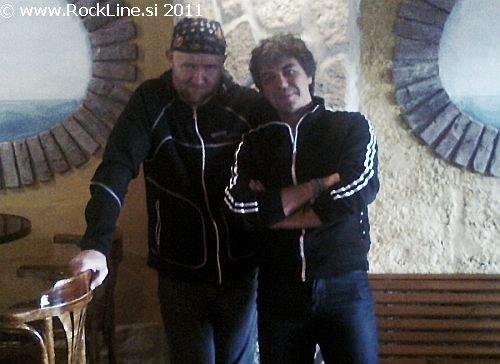
Location: Ljubljana / Slovenia
Interview date: 10.10.2011
Franci Zabukovec is, no beating around the bush, one of the most accomplished rock guitarists in Slovenia. Over a good many years he has worked his way through pretty much every corner of the Slovenian music scene, up, down and sideways. The man is a respected, widely acknowledged old fox of music, a kind of guru, a guitar wizard, a sort of catalyst who today (in the studio too) steers the eager stream of young guitarists in the right direction. He first got serious attention as a member of Rdeči Baron, later made his name in Robert Magnifico’s backing band Pismejkers, and then turned into a true studio fixture, shaping the sound of many “clients” as a producer and co-producer. He’s also known for hanging out with k.u.t. Gas and Botri.
All those miles on the clock led him to the point where it was time for a solo music project, one where his own creative musical vein would get absolute priority and full authorship. “K-Metal,” extended into “Kryptonite Metal,” which keeps all the vital functions of its supersonic colleague Superman, is thus the studio debut of the project Zabukowski. The very name of the project, like the quips the coinage “K-Metal” sets off, hints that the whole thing was made in a spirit of lucidity, in line with the demands of a mature and tasteful rock-jargon aesthetic, and it sits neatly in the set of 10 songs Zabukowski presents himself with.
Ljubljana. A lovely autumn October day. Not a cloud in the sky, crystal-clear air. The kind of moment when you forget for a second the daily euphoria and all the tension that gives you migraines. An afternoon hour in the middle of Zupančičeva jama. A round gets ordered, a chat gets going…
RockLine: After all these years of working with so many Slovenian musicians, both in the studio and on live stages, and after experiencing practically every sphere of existence in the Slovenian rock scene, and I’d even say the pop mainstream, you’ve decided to release an album that embodies strictly your own personal artistic touch. How did it come about?
Franci: Pretty much everything on “K-Metal” I already had in my head back in high school, when I was listening to Pomaranča, Šank Rock, and then also foreign bands like Iron Maiden and the rest, mostly heavy metal and eighties hard rock. All of that was smoldering inside me, and even though it was followed by the collapse of Slovenian rock with the arrival of the new punk wave in Slovenia, a period of “crisis” set in for hard rock and heavy metal bands in Slovenia. Back then I had a band called Ironija, I was in Odiseja 2000, in short I was swimming in hard rock and heavy metal waters. Well, things shook up so much here back then that most of those bands fell apart. To stay as connected to music as possible and somehow survive as a musician, I drifted a bit away from what I had always wanted to create. For many years I didn’t even listen to that kind of music anymore. After some 20 years of that distance, to be honest I can’t even calculate exactly anymore (laughs), that desire woke up in me again. The problem, though, is the vocals. Finding the right vocalist for this kind of music. In every production I do, the vocal is the most important thing. Except of course if I were making purely instrumental music, but that doesn’t really pull me in. I always imagine music with a vocal in it. The problem isn’t that it has to be a good vocalist, the problem is that it has to be the right vocalist. The subtleties get even bigger when you add lyrics written to be sung in Slovenian. So it’s an even tougher thing to get the right vocalist. My wish was for the lyrics to be in Slovenian, and a lucky turn of events led me to meet Sergej Škofljanec. I listened to his recordings on his MySpace profile, they were more like orthodox demo tapes. In him I found, heard, or let’s say recognized, that “eighties metal” vocal that tipped the scales in favor of recording an album. Then I “attacked” Sergej. Relentlessly. I jumped him and talked him into it. One way or another Sergej is involved in lots of bands, and now I’ve jumped on his back too. But from there on things ran smoothly! And what do they say? The rest is history (laughs). Anyway, once I had Sergej on board, I went back in my head to that music I used to listen to, but at the same time I updated my “personal memory” with newer stuff like Creed, Alter Bridge,… whatever, I went back to Judas Priest and similar old bands again,… The incredible thing is that I found that fascination with Judas Priest again, the one that gives me goosebumps when I listen, just like way back when,…
RockLine: So you were never tempted to make a completely instrumental guitar rock album, in the vein of what Satriani does, what Vai does, because let’s be honest, with the versatility your guitar arsenal offers, that wouldn’t be any kind of problem?
Franci: I have to admit something like that always scared me a little, even though I’ve tried playing all sorts of things. But I don’t feel comfortable enough in that sphere. On the other hand, I’ve listened to so many of these instrumental, guitar-centered albums in my life that I just can’t picture making another one like it myself. There’s a whole ocean of those albums and those guitarists today. I’m not saying no, if I had a completely distinctive style, really clearly recognizable, something that would feel revolutionary and truly unique. But as it is, song structure with a vocal is my priority. That’s also because of my role as a producer. Basically all the songs are made so that they come together with a vocal over an acoustic guitar. I’m also a keen believer in melody. Although in the future I’m already thinking about an even more orthodox record that I’ll develop out of “K-Metal.” “K-Metal” is my primal one and serves as the basic springboard going forward. But I never had it in my head to make a “guitar hero” album.
RockLine: Are the ideas for “K-Metal” old, did they develop over several years, or did they take shape in a shorter period before the album came together?
Franci: Mostly everything came about after Sergej and I started working together, though you can feel the influence of older rock bands, there are really, really few old ideas. So I really didn’t have stuff lying around ready and waiting to be used someday, but you can feel plenty of influences from other bands. In the end it’s the same thing, just packaged differently. Who knows how an album I’d release today would land if I’d written it 15 years ago? Good question. Over the years I also learned a kind of filtering, you could say, a kind of understanding or recognizing of the right phrases that go together and work best in a song’s musical structure. The question is whether time would have run over an album like that, I’m speaking hypothetically, if it had been made many years ago and only released today. Anyway, there are also two instrumentals on the album, which are meant to sound raw and loose and come across as pretty original.
RockLine: Personally I get the feeling, with a new album from Mary Rose and Requiem expected, then Cveto Polak put out a solo studio album, the hard rock band Jelen was formed, Lene kosti joined forces and are already recording their second album after the 2010 debut, Chateau got back together and released a new album, that this generation of yours, the true-believer rockers who were pushed out of the Slovenian public’s focus for many years, aside from the bright spots of Šank Rock and Martin Krpan releases, is making a comeback?
Franci: This year feels like one of those years when quite a few such projects came out, and plenty more are being announced, there’s really a sense of optimism in the air. I’m running into people in this scene I hadn’t seen or been in touch with for years, and I get the feeling it’s a kind of regeneration of this musical sphere, the one my generation belongs to, with the profile that belongs to hard rock and the roots of metal.
RockLine: We mentioned Sergej Škofljanec earlier, but your album “K-metal” has a whole bunch of other musical aces on it, one of them is drummer Roman Ratej, then there’s bassist Cveto Polak,… how did you get them all together? After all, it’s probably pretty hard to wield the conductor’s baton over such a colorful herd of strong musical egos?
Franci: Roman and I have been talking all our lives about how we’d play together, we talked about it even before he left for the US, back when Roman was still playing with Miladojka Youneed. Roman stood out even before he went to America. He wasn’t just a technically excellent drummer, Roman is actually “music.” That’s very important in drumming. You can have two technically excellent drummers, and one is “music” and the other isn’t so much “music.” You can tell on all sorts of levels of creating. What I’m trying to say is that if Roman hadn’t drummed on “K-metal,” the record would basically still sound fine, but it wouldn’t have that extra something that’s so important and guarantees a kind of excess in the best sense. I like to say the “K-metal” record has really a lot of music in it. And that music was played by people who understand this principle. It burst out of all of us. And Roman is like that too. After Sergej he was the immediate next pick for this album. Without Sergej I wouldn’t have started the album at all. I did approach the guys with some reservations though, because these days someone’s quick to serve it right back at you: “Nobody listens to that kind of music anymore anyway.” and so on (laughs)… Well, the next pick was Cveto. Cveto and I were in contact more often before, we met a lot at gigs, when he was playing with Šank Rock and I was with my bands. Again, I didn’t dither much over choosing a bassist. I knew I needed a solid support on the bass line, a firm two-legged stance, a firm pick hand, and for something like that on “K-metal” Cveto is the best fit. Even though I’ve worked with many acclaimed Slovenian bassists, like Jani Hace or Anže Langus, …. So that’s how I put together the core team for the album. At first it was basically just Sergej and me. I programmed the tracks, did the pre-production, then Sergej sang them so we could see how things worked, and once part of the repertoire was ready, Cveto and Roman added the rest. Then came the contributions of the so-called “guest stars.” There’s Miha Gorše, a top keyboardist who plays for Omar and Samuel Lukas, he helped me with a few arrangements and played everything brilliantly, then Gorazd Vidic on wind instruments, and Vojo Djuran as the only lead vocalist besides Sergej on the record. Djuran and I also worked together a lot in the past, and then there’s a whole lineup of backing vocalists I’ve known in one way or another for years. I can say the point of this record is some good karma and collaboration between people who enjoy their work and are having fun doing it. For this album I wanted to set up a completely new working environment, a different climate, and the lion’s share of that was thanks to sound engineer and recordist Drago Popovič . During recording we didn’t stress much, there were no questions like: “How do you want me to hit this cymbal? How do you want it to sound?”, we simply said everyone should do their job the way they feel it. It’s simply clear that the “macho style” of music this record has won’t get media support here, so we told ourselves we just wanted to get out a record that would please those who really love this music.
RockLine: There aren’t many records like “K-metal” in Slovenia. I often get the feeling that there’s a whole bunch of Slovenian musicians who are truly talented, yet they put a kind of principle of caution in front of their talent, in the sense that they subordinate their talent, literally trample it, just to please the Slovenian masses. Do you see that as a problem, or do you see it differently?
Franci: Yes. It’s a problem. That is a problem. When I talk to people who do their own solo projects, I often run into a huge amount of dissatisfaction. I think that dissatisfaction comes mainly from the fact that those musicians didn’t, first and foremost, listen to themselves. It’s different when you have a “commercial project” prepared and calculated in your head in advance! Then you know exactly where its market niche is. That’s another chapter, then you make compromises, with others and first of all with yourself. But if you’re doing a project for your soul, first and foremost for your soul, then the point is that you’re satisfied and you have to work in a way that’s right for you. And if it’s right for you but not for others, that doesn’t matter at all. It’s not even important. Because even if others don’t like it, you’ll know you stand behind it with your heart. From my own experience I can say that a circle of listeners and supporters always forms, people who are close to your music, the kind you make for your soul. I feel an extremely positive vibe in this, even though there are plenty of doubters who ask me: “Why, though? Now you’re here on your own. Just for yourself?” and yet I’m extremely happy with the result and I’d like to keep that positive vibe going in the future. Keep this team from the record for the concerts, keep this joy we have together, we won’t push our way into anything where we’d be used as some kind of “filler.” We know the audience that comes to our show won’t be a random passerby but an audience with a chosen taste, and we want to give them our stage maximum, just like we did in recording the record. Such a principle is worth that much more these days, because what matters to most people in society today is just how to scoop up some 100,00€ as easily as possible, wherever.
RockLine: You mentioned you’d like to keep this positive vibe going. Is a follow-up to “K-metal” on the horizon?
Franci: I really do want that, but making projects for your own soul is very hard to pull off these days, especially from a financial point of view. I’m very tempted to continue, though. I haven’t fully decided yet. In any case I won’t force anything. I’m also tempted by an even heavier sound. But right now I’d like to make the most of this “K-metal” moment! It’s the kind of album that will be as “out” half a year from now as it is “in,” or five years from now,… The audience that listens to this kind of music is very grateful and it’s worth building on.
RockLine: Which moment of your rich musical career would you single out? Let’s put it this way, which period before you made “K-metal” has stayed closest to your heart in terms of the fun side of rock n’ roll, and which do you especially like to remember?
Franci: The craziest parties are always with Rock Partyzani, no question. Everyone likes to look for some connection to Agropop here, since Aleš Klinar is in it too, and at the same time I can’t remember when I soloed as much as I do at Rock Partyzani gigs. They only have two sounds anyway. Sound “A” is distorted, sound “B” is clean, but I use the latter very little in this band. Working in this band left certain marks on me, I can say that among all the other factors it also had an effect on my deciding to do a solo project. Before Rock Partyzani, if I leave out all the bands I played in before being called up to the JLA (the former Yugoslav People’s Army, author’s note), those were Ironija and Odiseja 2000, the first such moment was Rdeči Baron, a moment that also had strong media backing. Saša Einsiedler and Tomaž Sršen were there, and it suddenly opened my eyes wide to the scene. All of a sudden there was a flood of gigs, recordings,… well, the biggest experience and turning point in my career was Magnifico. For me, a heavy metaller at heart, those seven years with Magnifico meant I found myself in an environment where I had to use the guitar in a somewhat different way, while still somehow keeping myself intact. It was a special kind of experience, working with truly quality musicians, working with good repertoire, in really good projects, on big stages, at big concerts. My time with Magnifico left me with a huge amount of experience and positive feelings, and helped me later decide more easily to work as a producer and arranger. During my time with Magnifico I gained a huge amount of breadth. That breadth gives me a more objective view of everything and lets me return to my own musical foundation, and lets me do things the way they should be done and make the right calls. Across different genre spheres, from dance and pop music to rock. That’s exactly why I count the experience with Magnifico as the most valuable in my career and I’m very grateful for it.
RockLine: When you look at the cover of “K-metal,” the effect is like you’ve poured over yourself some of Magnifico’s healthy sense of rock n’ roll lucidity, including the big letter “Z” on your chest?
Franci: With the letter “Z” I wanted to keep a touch of self-irony. It’s not good for a person to take themselves too seriously. To be too strict with yourself. When someone finds out you recorded your first metal record at 45, they’ll most likely first ask: “You? Are you alright?” But it’s true that I like joking around all the time, and the crowd around me is such that we all like to joke. “K” and “Metal” come from those situations when we were hanging out with various musicians. That goes especially for the ones you’d never expect to start digging into an AC/DC riff in the studio, the ones who make dance and pop music, followed by a sarcastic remark: “Don’t be such a hick, getting all fired up about that hick basic style!” So “Kmet” (hick) plus “al,” that flipped nicely into “K-metal.” What I feared most was a cover with just my head on it. Can you imagine? That would’ve been awful. I’m also a big comics fan and I remember the Marvel-style covers of Molly Hatchet. That was the starting point. Of course Superman couldn’t be on there, so the thing had to be done a little “wrong.” I think the cover turned out great, it combines a joke and self-irony and adds a touch of metal. Later I also found out that “K-metal” is an old name, no longer in use, for kryptonite, which again ties back to Superman. That’s especially handy for foreigners, who don’t quite get the coinage “K-metal,” which is why “kryptonite” is printed underneath, to catch their attention. Don’t take the foreigners thing too seriously, though. It’s aimed squarely at being an authentic Slovenian project. A lot of people told me you can’t do this kind of music in Slovenia. When I first heard Pomaranča, I knew that wasn’t true. That you can. You just have to get the expression right. I also struggled quite a bit with the lyrics, I wrote them myself. I’m not one of the established lyricists, I wanted to deliver them in an unpretentious, acceptable way, in a way that lets them be sung smoothly. They belong to the music of the “K-metal” album and carry a note of self-irony. This kind of music doesn’t need any special philosophy in the verses, I’d rather not even start on translating, say, Whitesnake lyrics into Slovenian (laughs).
RockLine: So your short-term plan is presenting the “K-metal” album on Slovenian stages.
Franci: Yes. I’d like to bring this album to the people who listen to this kind of music, and at the venues where those people hang out. We definitely won’t push for gigs. Even if we play only once every six months, that’s enough. That’s enough for me to get feedback from the audience, as a compass that fills me with energy and gives me that positive guiding sense of defiance and perseverance for the future.
Photo Gallery