Author: Rok Klemše
Photos: Nina Grad
Location: MetalDays, Tolmin
Interview date: 26.07.2013
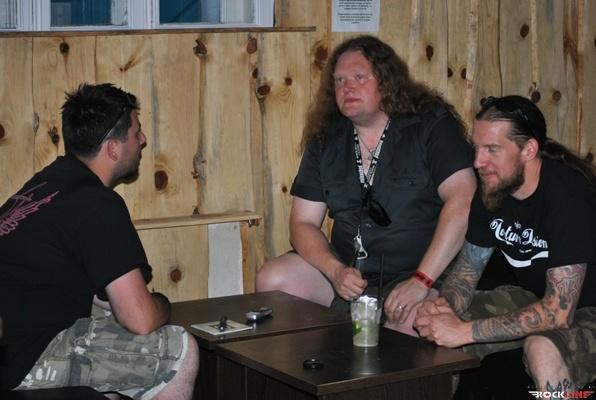
Swedish death metal outfit Unleashed are today, along with Grave, the name that spells Swedish death metal. They’re the only two of the big four who stayed loyal to the Swedish sound (Entombed swam into slightly different waters, and Dismember headed off into early retirement). Unleashed have just released their twelfth studio album Dawn of the Nine, and we sat down with founding members Johnny Hedlund (bass and vocals, who started out in Nihilist, the first proper Swedish death metal band) and Anders Schultz (drums) before their set at Metaldays 2013. A good year earlier, Unleashed put out the excellent concept album Odalheim, a post-apocalyptic story woven into Viking themes.
RockLine: You last played here a few years back as part of Heidenfest, and you were basically the black sheep of the tour as the only death metal band among the folk metallers. What’s your take on all those folk metal bands who sing the praises of Viking culture but, in most cases, have nothing to do with it?
Johnny: We had a great time on that tour you mention, those guys are our friends, even though our music probably did stick out. But that’s the point of that tour, on the other hand, because it’s really about the lyrics and not about a perfect musical fit between the bands.
RockLine: You released your eleventh studio album Odalheim a while back. Now that some time has passed since it came out, how do you see it compared to the older ones? Odalheim is actually your first fully conceptual record.
Johnny: The fact that Odalhaim is tied together by a concept is exactly the biggest difference. Even As Yggdrasil Trembles had a few tracks that linked up into a concept, but Odalheim is our first truly all-the-way conceptual album. That’s definitely the biggest difference, because musically we stay true to our roots. Otherwise you could move any song from Odalheim onto some other album and it would work, but anyone who knows the concept would know it’s just one part of the whole story.
RockLine: So what’s the concept of this album? True to your tradition, it’s rooted in Norse mythology, but its theme could also be mapped onto the present, right?
Johnny: Right, it’s actually a story from the future, but one that rests on Viking tradition rather than on the mythology itself that comes from the sagas. Of course we touch on that in the lyrics too, but it’s more of an influence. We’ll probably continue the story on the next album.
RockLine: And what do you reckon is waiting for us in the future?
Johnny: Odalheim (laughs). Really, the story of the album is my vision of the future that awaits us, but the story has no end, since we’ll continue it on the follow-up.
RockLine: Have you maybe already started working on it?
Johnny: Yeah, but not on writing the actual songs yet. Right now the main parts of the story are taking shape.
RockLine: How do Unleashed actually write new songs? The band as a whole, or each of you on your own?
Johnny: At the start, definitely each on our own. Now Fredrik is the one wielding the guitar and I’m on the lyrics, then we hand our ideas out to the band, who either accept them or not. That’s the whole art of it. From when we start writing songs to when we start recording, usually a year and a half goes by, pre-production takes half a year, and the recording itself about a month.
RockLine: And do you usually start with the music, or do you have the lyrics first?
Johnny: Usually both at once, but with Odalheim it was trickier because of the concept, since not every lyric can fit every song. First you have to go through all the songs and give each one an idea that suits it. A fair bit of the burden fell on Fredrik there, since he had to present me with more songs than usual, and from that pile you then pick out the ones that also work with the right theme.
RockLine: Unleashed have been a big and important part of Swedish death metal since the very beginning. How do you look back on those times today, on your early days and, Johnny, on Nihilist too?
Johnny: To be honest, I don’t like looking back too much, I’m not a nostalgic guy, I’d rather look at today and at what’s coming. But I have to say those times were wonderful, even before all the tours and festivals showed up we had a damn good time. Still, I’d rather live for today. I’ve got fond memories of those days, but I’d rather look ahead than in the rearview mirror.
Anders: Really, it was just a bunch of kids for whom drinking came first and being musicians only second. The scene itself was fun, but it was much harder than today, since you had to think about and take care of countless things that are basically taken for granted now. The funny thing is that a lot of people talk today about some kind of legendary scene, which I don’t even get, since we never saw it as such and still don’t. But those were good times and a nice way to grow up. It really did just start as a bunch of kids hanging out drinking, and then practically overnight everybody started playing death metal. And playing it well.
Johnny: It wasn’t any kind of plan, it just happened. Besides, we weren’t exactly great musicians (laughs).
RockLine: Still, you stood out from your contemporaries at least in that you didn’t write »gore« lyrics but approached things from the perspective of your Viking heritage. Did people look at you any differently because of that?
Johnny: Well, we had some disgust in us too (laughs). I still love bands like early Death and Autopsy, I like their lyrics, but we can’t deny that we come from the Viking tradition. If I came from Slovenia, I’d probably come from the Slavic tradition. That was the path we chose. And it all originally grew out of our interest in Sweden’s Viking legacy.
RockLine: As the elder statesmen of Swedish death metal, how do you see the modern Swedish death metal scene and, at the same time, the American, Florida death metal?
Anders: As for Swedish and American death metal… Back then we didn’t see these two scenes as something different, it was simply death metal. Nobody saw it as two different schools, it was just death metal. We never looked at ourselves like, “right, now we’re going to play Swedish death metal” either, though of course there were bands before us who were role models. It’s the same musical genre and there’s no point making artificial divisions. Even though they’re different bands, it’s all the same to me whether I’m listening to Terrorizer, Autopsy or Carcass. I feel the same about newer bands, although their number today is of course incomparably bigger.
RockLine: How have you managed to stay together this long, while being such an active band in the studio and on the road?
Johnny: I think it comes down mainly to two things. First, we love doing what we do, and second, everybody in the band contributes their share to the whole. It’s also important that we’re all striving for the same genre. I don’t know how long we’d stay in this lineup if someone wanted to bring keyboards or nu metal into the music just because it’s popular. You have to stay true to yourself. Look at AC/DC or Motörhead, for example. They always stayed true to themselves, and even when they tried something new, they didn’t drastically change their sound. I think that’s where their success comes from. And they’re still good.
Anders: Like Johnny said. The most important thing is that we’ve got a shared goal and absolutely no clashing views on it. We’re just four guys playing death metal. Outside of that we hate each other to death (laughs).
Johnny: I think I’ll have to talk to your mum about this hatred of yours (laughs).
RockLine: Given everything you’ve said so far, retirement is out of the question for you, unlike Dismember?
Johnny: No, no, no way. They drink too much (laughs). I don’t see any kind of ending right now, this is our lives. To look at it another way – I’ve had several cars and they all broke down. I’ve had several girlfriends… who aren’t anymore, and the one constant in life is the band.
Anders: Terrible, but true (laughs).
Photo gallery