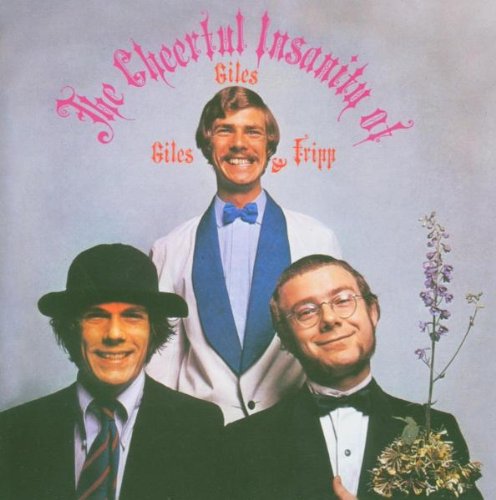
Label: Eclectic Records
Release date: 1968
Production: Wayne Bickerton
Album length: 59:28
Genre: Proto-Progressive Rock/Psychadelic Rock/Avant-Garde
Rating: 7.5/10
If the Topalovići were the strangest undertakers in the former Yugoslavia, and Laki’s distant cousin Paul Bearer stood out in the professional “sport” with his urn, then in the music world, or more precisely on the British psychedelic rock scene of the late ’60s, that honor surely went to three jokers calling themselves Giles, Giles & Fripp. A trio with a name better suited to a funeral home or, at best, a law office were, believe it or not, some of the finest musicians on the British psychedelic/pop rock scene of the day, even though until the band formed they weren’t really rock musicians in any real sense, being far more at home in classical music and jazz.
The roots of this short-lived and commercially totally unsuccessful project (which, I think, is hardly surprising) lie in the meeting of two brothers, Peter Giles on vocals and bass and Michael Giles on drums, with guitarist Robert Fripp, who until then had played as a casual musician with assorted local jazz outfits and with a band called The League of Gentlemen. Believe it or not, progressive rock legends King Crimson grew out of this bunch of unusual gentlemen. And that’s exactly what makes this album, which is pretty hard to track down, so interesting for fans of that band and for anyone digging into the roots of prog rock. Although this psychedelic outing (or proto-prog, if you prefer) barely hints that King Crimson would ever come out of it, and there’s precious little on it you could already call progressive rock, it’s a fascinating document of its era, marked by authentic British black humor and two tracks that at least give a hint of the future. I doubt, though, that anyone beyond the fanatical devotees of Pink Floyd’s classic “The Piper At the Gates of Dawn”, Monty Python and everything that smells of the golden age of psychedelia will find any special revelation in it. Interestingly, most of the compositions on “The Cheerful Insanity…” were written between 1965 and 1968. You can tell from the considerable sonic variety of some of the pieces. While psychedelic pop with the odd orchestral arrangement and a noticeable Beatles influence mostly dominates, here and there you can pick up elements of folk, jazz and even avant-garde with a more than obvious Frank Zappa influence.
One of the album’s hallmarks is that it’s split into two parts, with the individual songs tied together by Fripp’s offbeat narrations. The first part is held together by the quasi-conceptual burlesque “Saga Of Rodney Toady”, about an ugly, fat loser everybody laughed at. Poor Rodney (I can’t help thinking of that Rodney from “Only Fools and Horses”, even though the two are totally different) ends up secretly flipping through a magazine of “dirty” pictures rather than picking the fat, ugly girl his equally fat and ugly mother recommended. The second part, meanwhile, is tied together by “Just George” (with a deliberate Cockney accent), another dysfunctional character who radiates intelligence on a par with President “Little Bush”. Both stories reflect that typically British black humor, which, with a few honorable exceptions, most prog rock bands would sorely lack later on. Fripp managed to keep some of it alive in King Crimson too (Cat Food, Happy Family), while among the better-known bands Genesis (Harold the Barrel, Willow Farm) and ELP with their “honky tonk” burlesques had their moments too.
The influence of the Beatles, the only rock band Fripp admits ever influenced his music, is more than obvious throughout, while with its circus-like avant-garde motifs, which could easily sit in some Benny Hill sketch, it’s more reminiscent of a cultivated version of Zappa’s Mothers Of Invention. There’s also a whiff of Barrett’s Pink Floyd, though I suspect that’s purely coincidental. That King Crimson would one day emerge from this mix of pop, psychedelia and folk wouldn’t have been imaginable even in the wildest dreams, so don’t bother hunting for pieces where you can sense that something “big” is coming, because you’ll be disappointed. “North Meadows” and “Newly-weeds”, where Fripp already shows off some of his trademark jazzy guitar lines and you can even hear a bit of Mellotron, are typical examples of psychedelic folk, very much in the style of what Pink Floyd did on their debut, only on a noticeably lower artistic level. “One In a Million”, a typical piece of British psychedelic pop, shows that it’s the oldest-sounding track on the album. Interestingly, the color of Peter’s voice here occasionally veers toward his successor Greg Lake in the chorus. “Call Tomorrow” is another psychedelic daydream with organ and piano that surely owes some of its sound to The Moody Blues. A string of pretty average numbers follows. “Digging My Lawn” is almost a psychedelic cliché, something the Beatles had already been doing for a while by then. “Little Children”, with its symphonic arrangements and female backing vocals from the trio The Breakaways, is yet another perfect psych/pop ’60s nostalgia trip.
Things get a bit more complicated for the first time on “The Cruckster”, a genuine slice of avant-garde where Fripp first shows his urge to improvise while Peter recites something rather bizarre in the background. Despite being pretty unoriginal, some of the pieces had good commercial potential; the only problem, I’d say, was that they showed up maybe a year too late. The folk rocker “Thursday Morning”, marked by a lovely melody on Fripp’s acoustic guitar, subtle symphonic arrangements and romantic vocal harmonies, could have been a hit back then with more publicity and a different image and band name. “How Do They Know” is psychedelic pop in all its glory, incredibly reminiscent of Sgt. Pepper-era Beatles. Even Peter’s vocal in the chorus leans heavily toward Lennon’s.
“Elephants” (Fripp has always adored elephants, and they’d get their place in one of King Crimson’s later pieces too) is a fun avant-garde burlesque with elements of the absurd and folk, which, thanks to its quirky motif played by guitar and trombone, offers a partial answer to what a meeting between Zappa (vocals, absurd lyrics, grotesque wind arrangements) and Fripp might have looked like in the ’60s. “The Sun Is Shining” is another very average, stereotypical pop ditty with piano, wind arrangements and female backing vocals, and it’s more parody than anything. The end of the album, though, is where the two best moments sit, offering at least a tiny glimpse of what was to come. The excellent classical instrumental “Suite No. 1” gives insight into Fripp’s guitar genius and a peek at his future. In the first part we get to enjoy Bob’s nimble-fingered playing against a piano backdrop (some Mellotron can be heard in the background too) before he gets carried off into full-on flamenco/jazz waters. Here you can see the foundation, and where the master later spread his influence to future projects and his musical disciples, like The League Of Crafty Guitarists and the California Guitar Trio that came out of them. The closing “Erudite Eyes”, with its elements of folk and jazz, is another standout, and the one that comes closest to a seed of King Crimson. In the first part the melody even slightly recalls what Caravan did in their early days, right up until Fripp’s guitar takes the initiative and leads the piece into an atmospheric jazz improvisation, where he and Peter on bass really shine together. The latter shows here why he was later good enough for King Crimson too. Michael would later reuse this piece in a modified version for his project “McDonald And Giles” (1970), which he released after leaving King Crimson.
The 1992 CD edition also has two noteworthy extras. “She Is Loaded” is nothing earth-shattering, a pretty Beatles-esque psych/pop number, while “Under The Sky”, which in a modified version also found its way onto “Still”, the first and so far only solo album by Peter Sinfield, the original King Crimson lyricist who also wrote its words, is a far more noticeable piece. This psychedelic folk rocker boasts lovely symphonic arrangements, a good vocal melody, and use of Mellotron and flute while Fripp weaves delicate acoustic guitar passages. Had it come out on the regular album, it would surely have been the best thing on it.
“The Cheerful Insanity” is first and foremost a historical document, and it’ll be most interesting to King Crimson fans and anyone digging into the early roots of prog rock, while I doubt it’ll draw any raves even from the biggest fans of British psychedelic rock. If nothing else, despite a considerable lack of originality (and with it, a recognizable identity), Giles, Giles & Fripp left their mark with a likable black humor, and in places they already showed there was something special and unpredictable about them, which the following year, with the release of the famous crimson-faced debut, led to a new musical revolution within rock. The inevitable breakup of the group, which nobody took seriously (which was of course the whole point), even though poor promotion was the main cause, was heralded by Peter’s departure. Fripp and Michael later managed to find fresh strength in singer Judy Dyble (ex-Fairport Convention) and multi-instrumentalist Ian McDonald. Just as a new British folk rock powerhouse seemed to be looming on the horizon, Dyble left after a few demo recordings (among them “I Talk To the Wind”, which later found its way in a polished version onto King Crimson’s debut). Singer/bassist/guitarist Greg Lake and lyricist/stage technician/roadie Peter Sinfield joined the group, and King Crimson were born.
So what became of the immortal trio of cheerful undertakers after that? Peter Giles stayed in touch with his former comrades for a while and even took the bass role on King Crimson’s second album “In the Wake Of Poseidon” (1970). Then for years nothing was heard of him until he formed 21st Century Schizoid Band with former King Crimson members, a group that plays early King Crimson material. Michael, thanks to his low profile, forever remained one of the most overlooked drummers in rock history, one that Stewart Copeland (The Police) once named as one of his role models. After leaving King Crimson in 1969 he also guested as a casual musician on “In The Wake Of Poseidon”, after which he and McDonald released the short-lived project McDonald and Giles (1970). That same year he also recorded his first solo album “Progress”, which only came out in the ’90s. After that he worked as a casual musician with various names, including guitarist Anthony Phillips (ex-Genesis). In the new century he briefly joined Peter in 21st Century Schizoid Band, then handed his seat over to the late Ian Wallace. Fripp, as anyone who hasn’t spent the last couple of decades under a rock knows, became the undisputed boss of King Crimson, and turned from jokey Bob, the group’s resident comedian, into one of the most fear-inspiring yet remarkably effective dictators in the music world.
Author: Peter Podbrežnik
Tracklist:
The Saga of Rodney Toady
1. North Meadow (2:29)
2. Newly-Weds (2:07)
3. One in a Million (2:25)
4. Call Tomorrow (2:31)
5. Digging My Lawn (1:50)
6. Little Children (2:48)
7. The Crukster (1:35)
8. Thursday Morning (2:50)
Just George
9. How Do They Know (2:14)
10. Elephant Song (3:15)
11. The Sun Is Shining (3:06)
12. Suite No. 1 (5:33)
13. Erudite Eyes (5:05)
Bonus tracks on the 1992 CD edition:
14. She Is Loaded (3:11)
15. Under the Sky (4:01)
16. One in a Million (mono single) (2:25)
17. Newly-Weds (mono single) (2:44)
18. Thursday Morning (mono single) (2:57)
19. Thursday Morning (stereo single) (2:57)
Lineup:
Robert Fripp – guitar
Peter Giles – vocals, bass guitar
Michael Giles – drums
GUEST MUSICIANS:
R. Cohen, W. Reid, K. Isaacs, G. Salisbury, B. Pecker & G. Fields – violin
J. Coulling & R. Patten – viola
Nicky Hopkins & Mike Hill – keyboards
C. Tunnell & A. Ford – cello
C. Hardie & T. Barker – trombone
The Breakaways – backing vocals