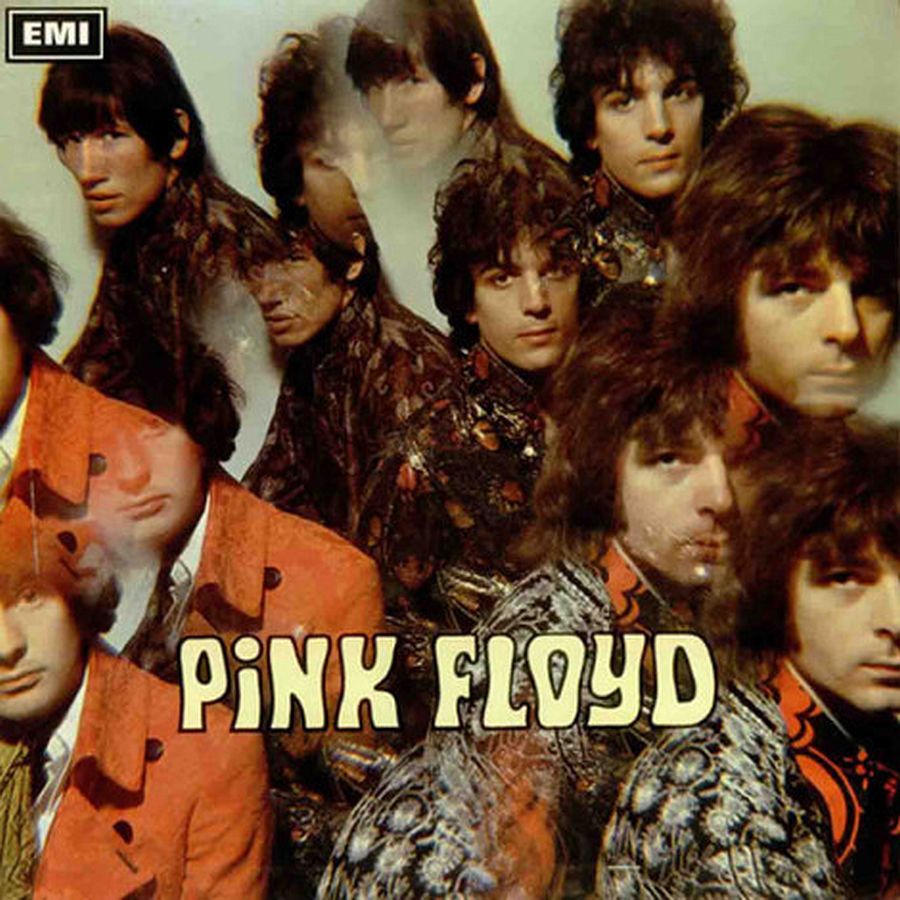
Label: EMI Records
Release date: August 4, 1967
Produced by: Norman Smith
Album length: 41.54 min
Genre: Psychedelic Rock/Space Rock
Rating: 7.5/10
Pink Floyd went through a seriously fascinating evolution. They started out as a small rhythm and blues band, grew into pioneers of psychedelic rock, and gradually became one of the biggest and most respected groups in rock history (especially in its progressive forms). By then they had traveled a long, almost unimaginable road, one that could have gone in a completely different direction even in their early years if it weren’t for the mental breakdown of their original guitarist and singer Syd Barrett (1946-2006). He remains an enigmatic oddball to this day, and the legends around him will keep piling up for a long time. Back then Syd, especially with his poetry, was the central musician and creative mastermind of the band, the one who laid the cornerstone of their identity as musical “spacemen”. Who knows what musical paths Pink Floyd would have taken if this exceptionally gifted musician hadn’t wrapped up his creative output far too soon, saying goodbye just a year after the release of their debut “The Piper At The Gates Of Dawn”, which, through both its music and its poetry, is in many ways his “baby”. Despite Syd’s short creative run, his ideas, groundbreaking for the time, earned him forever the status of an uncut diamond and the first rock “star” swallowed by drugs into a self-destructive vortex that choked off his unimaginable potential.
But “The Piper At The Gates Of Dawn” isn’t just Syd’s album. It’s a first-rate document of the band’s early days and one of the foundational albums in the development of progressive rock. Pink Floyd were experimenting like crazy back then with obscure psychedelic sounds, unusual time structures, sprawling, branching improvisations and, for those times, unconventional lyrics. Through their music they wanted to put listeners into altered states of consciousness, which were often fueled by various psychoactive substances. In the second half of the 60s that was a widespread social and cultural phenomenon that thoroughly shook up the British psychedelic scene, which really took off after Jimi Hendrix arrived from America. The negative consequences of that lifestyle were still a (well-guarded) secret, and most musicians of the day openly took drugs as one of their main creative wellsprings. For most of them it even paid off handsomely, since their music became far more artistically demanding and layered, even though the story usually ended with the collapse of the band (The Beatles being a nice example).
The London club scene of the time became an important hangout for psychedelic musicians. By midsummer 1967, plenty of new bands had popped up and made sure rock became much more than a collection of dance numbers for rowdy teenagers. Pink Floyd built their cult status as psychedelic innovators mainly through countless gigs at clubs like UFO and Marquee, and through the release of their first singles “Arnold Layne” and “See Emily Play”. Their live shows were already a special audiovisual experience, where they mixed psychedelic sounds with special lighting effects, especially elaborate light shows. Since the band’s beginnings, their compositions had steadily evolved from simple rhythm and blues into sprawling, expansive instrumental improvisations full of all sorts of sounds, often obscure ones.
Thanks to Syd, “The Piper At The Gates Of Dawn” is a half-conceptual album, named after his favorite children’s book, “The Wind In The Willows”. His love of fantasy stories shows in the poetry, which is often inspired by British folklore and mostly humorous little tales. They give the album a sincere touch of naivety and innocence, and it’s also a downright ode to madness, often lacking rhyme or reason, and that very combination is the key to its magic. Syd’s psychoactively fueled psychedelic songs are basically pop songs, built up with longer instrumental improvisations full of strange sounds, especially on guitar and keyboards, and they also use the theme of space travel (“Astronomy Domine” and “Interstellar Overdrive” are among the first examples of space rock) as a metaphor for hallucinogenic experiences. Even though almost all of Syd’s lyrics on the album are light and fun, they often clash with most of the music, which is full of dissonant sounds and odd vocal harmonies that give an impression of chaos and madness. That way they perfectly capture a cross-section of Syd’s state of mind at the time.
The album opens with the space-tinged “Astronomy Domine”. It’s one of the best and most advanced pieces on the record, a real pioneering experiment for its time, and with its unusual chord structure and strange sounds it stands in sharp contrast to most pop songs of the era. Its exceptional psychedelic charge comes mainly from the many effects on Syd’s guitar and Nick Mason’s simple but effective drums. Syd and keyboardist Rick Wright build the vocal harmonies together, smoothly and effectively. “Astronomy Domine” is still one of their most beloved pieces today. They played it live until 1971 and, after a long gap, even on their last tour. A true psychedelic masterpiece that reflects their early fascination with outer space. I’d even call it the symbolic birth of space rock. “Lucifer Sam”, dedicated to Syd’s cat, is another energetic psychedelic creation, with Syd’s electric guitar run through a special echo effect and built on an inventive central riff, while Roger Waters shows off some interesting twists on bass. The psychedelic atmosphere is reinforced by Rick’s sprawling organ and loads of effects on Nick’s drums. “Matilda Mother” is another song inspired by childhood fantasy and drenched in psychedelic sounds. It has an interesting switch on lead vocals, with Rick in the starring role this time, and Syd only joining him on the last verse. The intro also features some then-unusual harmonies between bass and organ, plus a Wright organ solo that must have sounded revolutionary at the time.
“Flaming” is also basically a simple children’s tale, with an optimistic, cheerful vibe running through it. “Pow R. Toc H.” is a perfect psychedelic trip, full of weird “jungle” sounds over a light piano. The song title makes no sense whatsoever this time. It’s one of the most out-there pieces on the album, and it would be totally chaotic if Wright’s piano didn’t “bring it back down to Earth” at the end. “Take Up Thy Stethoscope And Walk” is Roger’s debut as a songwriter, and his first time on lead vocals too, already hinting at his future role, when he’d gradually take the reins of the band into his own hands. It’s driven mainly by frenzied sounds from Syd’s guitar and obscure noises. Roger’s rather morbid lyrics, inspired by a verse from the Bible, are in sharp contrast with the other lyrics on the album, which are Syd’s creations, and already reflect his later lyrical style. “Interstellar Overdrive”, one of the very first psychedelic instrumental jams ever, is, alongside “Astronomy Domine”, another peak of the album and one of the most important pieces from their early period. This improvisation-soaked space instrumental, which they liked to stretch past 20 minutes at gigs back then, is in my opinion the most innovative piece on the album and an overture to the long, complex compositions on their later albums. Free avant-garde forms full of extended improvisations dominate it, tied together at the start and the end by an intriguing, spaced-out guitar riff.
“The Gnome” is a fun, cheeky little tune on acoustic guitar and vocals that tells the story of a gnome named Grimble Gromble, most likely inspired by Tolkien’s Hobbit. With its holy simplicity, childlike naivety and playfulness, it’s probably also a demonstration of the author’s visions, when meetings with gnomes and fairies appeared to him during LSD trips. “Chapter 24” is another of Syd’s psychedelic switch-offs, with a solemn mood, inspired by a passage from the Chinese book “The Book Of Changes”. The song is full of inarticulate sounds, Syd’s dreamy vocals and Rick’s church organ. “The Scarecrow”, originally released on the flip side of the “See Emily Play” single, has a pastoral vibe (mainly through the percussion) that conjures up the image of a scarecrow in the middle of a field. That’s Syd’s existentialist metaphor for his own life, which, when he’s sad, is “like a scarecrow left at the mercy of fate”. Metaphors like this would later become an integral part of most of their lyrics. The album closes with the playfully mischievous “Bike”, the only “love” song on the record, since it’s dedicated to Syd’s crush at the time. Besides his girl on a bike, the lyrics feature a few hallucinatory characters, among them a cloak, a homeless mouse named Gerald, and a crowd of gingerbread people. After the final verse comes a longer, spaced-out instrumental section that I’d call musique concrete in the style of someone like Frank Zappa. It’s a sound collage made of oscillators, gongs, bells, violin and a few other sounds. And the whole thing wraps up with manic, hastily recorded laughter.
“The Piper At The Gates Of Dawn” is an excellent demonstration of their early psychedelic experimenting, managing to capture various states of human consciousness with a menacing undertone of mental collapse and madness lurking beneath them all the time, a theme they’d return to again and again throughout their entire career. As we know, this was Syd’s only real album with the band (on the second album his contributions are merely a sample), and his death only deepened the mystique that had surrounded him ever since his departure. Even though they would later make far more advanced, sonically refined albums and completely change their sound, “Piper” is a unique record and a perfect psychedelic rock masterpiece, not an easy one to grasp for those of us who didn’t live through the excess-spiced 60s. Naivety and flaws notwithstanding, the “mad piper” heralded the dawn of a new musical era, when rock too became one of the artistic genres of music, and laid the cornerstone for the development of one of the most innovative bands in the history of progressive rock.
Author: Peter “Dr. ProgRock” Podbrežnik
Tracklist:
1. Astronomy Domine (4:12)
2. Lucifer Sam (3:07)
3. Matilda Mother (3:08)
4. Flaming (2:46)
5. Pow R. Toc H. (4:26)
6. Take Up Thy Stethoscope And Walk (3:05)
7. Interstellar Overdrive (9:41)
8. The Gnome (2:13)
9. Chapter 24 (3:42)
10. Scarecrow (2:11)
11. Bike (3:21)
Line-up:
Syd Barrett – guitar, vocals
Roger Waters – bass guitar, vocals
Richard Wright – organ, piano
Nick Mason – drums