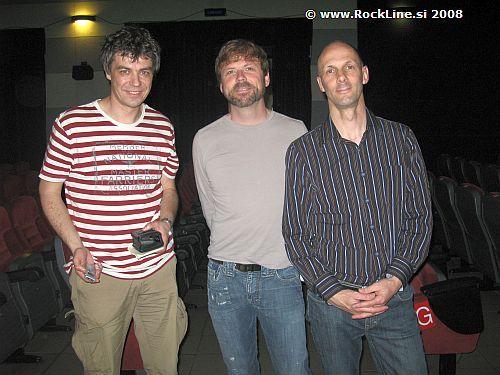
Interview date: 14.05.2008
Before one of just three spring shows California Guitar Trio were playing in Europe, ahead of a bigger North American tour, I got the chance to interview the acoustic three-guitar outfit California Guitar Trio in Milan. I showed up at the Teatro Leonardo Da Vinci, where the band had a gig announced (RockLine report HERE), really early, half an hour before the agreed time, around 6 p.m. The friendly promoter still walked me straight into the hall, right down to the stalls. California Guitar Trio had just wrapped up their soundcheck. Band member Paul Richards was strolling around the stalls, remembered my pleas from the emails and welcomed me enthusiastically. A few meters away, on one of the seats in the still totally empty hall, sat the other band member, Hideyo Moriya, busily working away on his laptop and not paying much attention to the chat between Paul and RockLine. A little later the third member of the band, Belgian Bert Lams, joined the conversation…
RockLine: Given that the current tour is focused on the US, it’s interesting that you’ve squeezed in three dates in Europe as well. How come?
Paul: We play a lot in the US, every year we do somewhere between 100 and 200 shows. For years we’ve wanted to play Europe more often too. That’s how we got in touch with a promoter here in Italy. At first it was only supposed to be Milan and Rome, then we agreed on one more show in Paris. It’s really important for us to make the most of every opportunity like this that comes up in Europe. It’s also how we grow our audience, because with these shows we bring our music closer to people. Maybe one day we’ll get to play Slovenia that way too.
RockLine: You’ve got a new album out, “Echoes”. It’s a whole different story from its predecessor “White Water” from 2005. Tell us about it. How did it come together, where did you get the ideas, what new things did you try out musically?
Paul: The “Echoes” CD is actually a compilation of songs written by other people. We named the album after the song Echoes by Pink Floyd, which is on the album and which we’ll also play tonight at the show. We wanted to serve up a selection of songs that you normally wouldn’t find together on a regular compilation. So we picked as “unusual” a combination of songs for the CD as we could. Among the artists you’ll find bands like Pink Floyd, then the English band Penguin Caffe Orchestra, then there’s a song by the Swiss progressive rock band Krokodil, there’s a piece by Ludwig Van Beethoven… there are a few odd tricks we pulled together to make an out-of-the-ordinary compilation. We all had the same wish in our heads: to arrange songs that are close to our hearts and rework them into something completely different. My personal favorite on the album is Pink Floyd’s Echoes. That song is especially close to my heart. I remember hearing it for the first time in the seventies, when my brother brought “The Meddle” home. Of course, as a kid I didn’t understand it then, the music just touched me. Arranging that song the California Guitar Trio way was a special challenge for me.
Bert Lams joined the conversation at this point…
RockLine: Did you invite any special guests to work with you on the new album “Echoes”? How was it working with them?
Bert: Of course. Quite a bunch of them. Davide Rossi, who contributed violectra and is otherwise a member of Goldfrapp, Pamelia Kurstin from Vienna, who played theremin, that special “don’t touch” instrument that fires off radio waves, then of course our buddy Tony Levin is back again, and Tom Griesgraber, who played bass guitar and Chapman stick, and Bonnie “Prince” Billy contributed vocals on the songs And I Know and Freebird.
RockLine: Are there any noticeable differences when you look back on your career in the nineties and compare it to where California Guitar Trio stand today?
Bert: The turning point for us was the tour with King Crimson in 1996. Before that we’d played Italy a few times, in smaller clubs, but being guests on the King Crimson tour opened the door to bigger venues, bigger audiences, theaters… And we’ve moved forward in that way year after year. It also helped us a lot that Tony Levin was playing with us as a special guest.
RockLine: Did you ever expect California Guitar Trio to become such a popular and respected band?
Bert: It just happened by itself. We started playing as a trio purely for the music. Over time we noticed from the increasingly loud reactions of the crowd that people really like our music. None of us ever thought about or deliberately planned some kind of commercial breakthrough, if that’s what you had in mind. Even now, when we play for bigger crowds, the music has the same effect on me as it did more than 10 years ago. Music is the first reason I end up on stage. All this popularity happened completely without any expectations on our part.
RockLine: How does your music come together? What’s the process in the studio? Who brings the main ideas? How do things grow and how do your songs develop? How do you compose your music?
Paul: Lately we’ve been composing our songs right in hotel rooms on tour. Sure, our album “Echoes” has only just come out, but we’re already writing new songs, our own original material. We’ve got six new songs written. That’s mostly happening on tours in the US, so one song came together in Kansas City, the next in Portland, Oregon, the third in New Jersey… Between tours everyone works on their own. So each of us jots down ideas, and then we meet up about three days before the tour starts and each of us presents the new ideas and motifs. Sometimes it’s pretty tough work, it’s a challenge.
Bert: Yeah, sometimes things can drag out when it comes to arrangements…
RockLine: You need the right moment, the right inspiration, right?
Paul: Oh, it’s great when that happens, it’s the best, but it doesn’t happen every day. When the moment of inspiration hits, you put a song together fast, otherwise a song can take quite a while to come together from various little pieces that only click when inspiration, an idea, strikes again… You can wait for that for a month or two.
RockLine: What’s it like being a student at Robert Fripp’s school?
Bert: A really positive experience in every way. The first courses were especially exciting for me. They took place in the US, and I’d never been there before because I’m from Belgium. Having to go to the US was a real culture shock for me. Before that I’d studied classical music. The courses took place on a big estate, with a big pool, a big house out in the countryside, like some kind of villa. We lived there as a kind of community. We all cooked, cleaned,… The courses were very intense and inspired, the participants played constantly, day and night. The classes were set up more like groups, where the members work together. So there wasn’t so much focus on individuals. For me it was a special experience and a special honor. A special honor that Robert Fripp shares his experience with other people too. The courses were very hands-on. One of them was all about learning to perform. There was no theory. In that course we got on a bus for six weeks, drove around and played gigs.
Paul: In practice that meant Robert demanded that we show him in action what he’d been teaching us. He’d tell a couple of students, say, to write a piece and come back, each with their own piece, and present it.
Bert: And he’d just order them to play their piece at dinner.
Paul: Robert Fripp is a special persona. He often goes about things in a pretty unusual way. He’s very good at presenting and passing on his own experience to others. During meals we had lots of discussions about sharing those experiences. About getting to know your own experiences and sharing them. For example, when we played in front of people, he’d ask us what was good and what was bad. Basically he taught you to look for the answers to your questions inside yourself.
RockLine: Personally I think it’s really important that musicians look inside themselves. These days it seems to me there are too many guitarists who’d like to be, say, the next Malmsteen…
Bert: Yeah, but that’s how it all starts. You need someone who inspires you, who wakes up some enthusiasm in you. In the beginning it’s always about imitating someone.
Paul: Say there’s a teenage kid who’s just learning guitar,…maybe Malmsteen is exactly the thing that gets him fired up, and that’s what drives you forward at first. Later it just comes down to whether that musician goes on to create something of their own or not.
RockLine: How and where did the three of you meet, what were the circumstances?
Paul: At Robert Fripp’s course. And in Europe, at that. At the courses in England, Switzerland and France. That was in 1987.
Bert: Paul and I met at the course in Switzerland.
Paul: Around the time Bert and I met, I was staying for a week at Robert Fripp’s place in England. Back then Robert was running courses in various parts of Europe.
Bert: You finished the first level really fast. In five or six days. Many of the students who took the courses wanted to come back and continue. Robert invited those people to carry on and they reached different levels. You could stick around for two or three months. We two took the courses for two years.
Paul: A year and a half. We were at Robert’s house, playing guitar together with Robert all the time, hanging out over meals. There were mandatory household chores too, like cleaning the toilets.
RockLine: That was a heavy responsibility….
Paul: Yes, a heavy responsibility, ha, ha, ha,…
RockLine: Oh, right. Tomorrow’s Robert’s birthday.
Paul: Really? Tomorrow? Then we have to send him an email. You two just keep talking in the meantime, and I’ll fire off a “happy birthday” to Robert!
RockLine: In your music you use a lot of interesting sonic tricks and effects, and even though the backbone of your music is acoustic, you experiment a lot with sound. Who’s the main driving force there, and is it hard when a song is coming together?
Paul: Basically all three of us were playing long before we met at Robert Fripp’s courses, each of us blending lots of musical influences. Robert’s technique was definitely inspiring. Those things have always attracted us. We use effects pedals on the floor during shows, and at the gig today you’ll hear plenty of sounds that are nowhere near acoustic. It’s totally normal for all three of us to build different kinds of sound into our basic acoustic guitar sound. Of course there are other acoustic guitar quartets or trios that don’t use any special effects. For them it’s a big challenge too, having to create and coax different sounds out of an acoustic guitar without effects.
Bert: The acoustic sound is still really inspiring for us too, and we’re constantly exploring how to upgrade our playing technique. We put a lot of emphasis on how we use the pick, on playing basic single lines, interwoven multi-voice melodies, counterpoint. We also have different tunings on each of the three guitars.
Paul: The way we play together is basically layering, one thing on top of another, which creates multi-voice harmonies.
RockLine: Where is California Guitar Trio aiming in the future?
Bert: We’d like to push our musical boundaries even further, we’d like to invite even more different musicians to collaborate, singers too. Personally I’d like to level up at writing music for film.
Paul: We’re also working on a new CD with our own original material. We’ll present a few bits of it at tonight’s show. We’ll invite other musicians to collaborate as well. Tony Levin will be there again, and next to him a friend who’ll contribute the African drum, the “djembe”.
RockLine: You switched labels. Your previous album “White Water” was still released on Inside Out Records.
Paul: Some changes are going on at Inside Out right now, so we decided to release the new album “Echoes” independently, self-released.
RockLine: How do you perceive the different reactions of the crowds in Europe and, say, in the US?
Bert: The reactions are pretty similar everywhere, I mean in terms of the feeling itself when you’re in contact with the audience.
Paul: People react in a similar way. A few days ago in Paris, for instance, they were more reserved than we’re used to when we play further up, in the more northern parts of Europe.
Bert: In Japan people are very reserved. They love our music, but at shows they’re an incredibly quiet audience.
Paul: You know, what’s interesting is that it’s always very similar, yet different at the same time. Take the people who’ll come to our show tonight. We don’t know if they’re in a good mood or sad. Maybe they need something in our music that’ll help them in life. Or maybe they just showed up for no particular reason. That alone makes tonight’s show totally unique, precisely because of the unique combination of people gathering at the gig tonight. In that sense every show is unique. Every person contributes to it. Everyone who ends up at the show. Say, you drove to Milan all day, we flew in, this morning we were still in Paris. All those details matter. Every state of mind that comes in with each person in the audience. Maybe nobody even realizes it, but it adds to the specialness of every show.
Bert: It’s also happened that we recorded one of our shows. We had a great feeling, and then when we listened back to the recording, that feeling was gone, but the opposite has happened too. Where the live recording came out more intense than what we experienced during the performance.
Paul: Sometimes you walk into a place where you’re going to play and you don’t have great feelings about it, and then this interaction, this one-of-a-kind union with the people, lifts you up to a whole other level and that feeling just vanishes.
Bert: I was at a Peter Gabriel show once. It was such an intense gig that I felt like he was playing the songs just for me.
RockLine: Do you change up the set lists a lot on tour?
Paul: There are usually at least small changes. As long as the songs work in sequence, we usually stick to the set list pretty faithfully during a tour, the tweaks are small.
Bert: Since lots of new ideas keep popping up in our heads between tours, we’re constantly trying out new stuff on stage too, adding these brand-new ideas to the set list, which are a challenge for us, and also a way to spice things up, to see how they’ll turn out live. The other day in Paris, for example, there was a break announced during the show, and just for that we had to adjust our set list a bit.
RockLine: What’s the collaboration like between the trio and Tony Levin? I know this question is meant for him too, but unfortunately he isn’t here…
Paul: Ha, ha, ha.. he’d no doubt answer this better. My take is that Tony enjoys himself while playing with us on stage. He joins us every year. Actually every time we invite him. We’ve been playing on stage together since 2000. Clearly the combination works. The feeling on stage is really good, the whole thing works very positively. Tony’s also full of great experience. He’s played with the best musicians in the world, and his experience and advice are hugely important for us.
Bert: We’ve learned a lot from him. He comes from the other side of the world, with different experiences,…
RockLine: We’ve reached the end. I’d honestly like to thank you both for this in-depth chat. I wish you a killer gig tonight in Milan.
Bert: Thanks to you too.
Paul: Thanks, I hope you enjoy the show tonight.
Photo gallery