Author: Sandi Sadar Šoba
Location: Menza pri koritu / AKC Metelkova / Ljubljana / Slovenia
Interview date: December 1, 2012
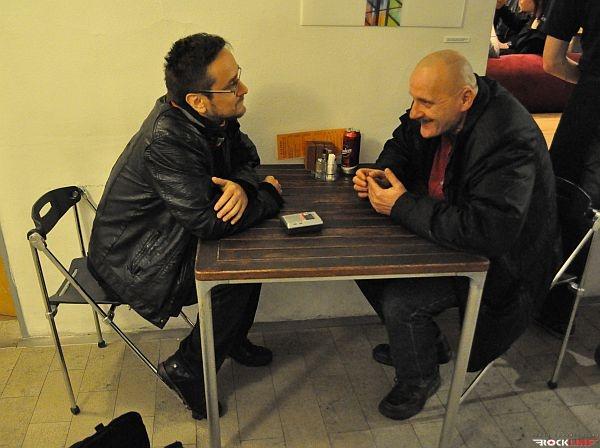
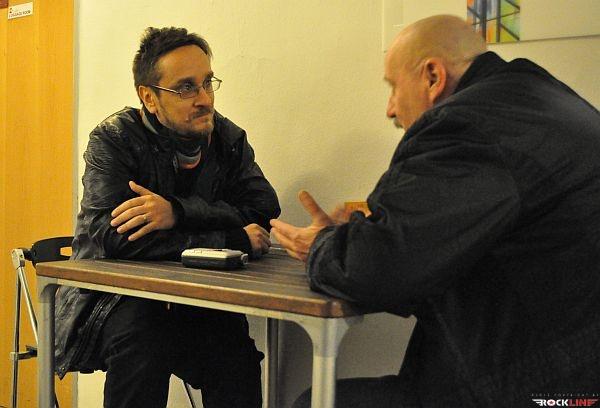
Saturday. The streets of Ljubljana are pulsing at a strange tempo, and there’s a feeling of charged tension in the air. The day before, clashes between rioters and the police had flared up in the streets again, and the crowd that had come peacefully, carnations in hand, to voice their disagreement with the state of the national spirit and the politics of the self-appointed oligarchs ruling our ever grayer homeland, had been drowned out by the whistling of rockets, firecrackers and tear gas, and the thunder of armored police cordons. As the counterpoint to the tyranny of the moment, a concert was going down on the other side of town, in the heart of the alternative temple of culture and revolt, Ljubljana’s Metelkova: the elder statesmen of Slovenian alternative rock, Brežice’s own Demolition Group. They’re a living demonstration of the full power and unifying force of rock’n’roll and, years be damned, still a vital generator of stirred-up consciousness for the young and the young at heart, and after a year of being out there, every single moment of the record Planet starcev has lodged itself deep in the hearts of countless people by way of their ears. It’s a reckoning with the negativities of our time, and about the message, mission and meaning of Demolition Group, the charismatic vocalist, poet and wordsmith of the band’s beating heart – the exceptional Goran Šalamon, known to friends and acquaintances as Friški – opened up to us in Celica before the show.
Rockline: Tonight’s interview hardly needs any big introduction, but it’s a real honor and pleasure to see you again, a good year after Planet starcev was first presented at Kino Šiška in Ljubljana. The launch tour is slowly winding down. After a 16-year wait, Planet starcev has broken new ground and stirred up feelings in people once again, along with an insight into what the reborn Demolition Group stands for today. Tell me, what was this past year actually like, and what are the retrospective feelings running through you and the crew? What’s been going on in that time?
Goran Šalamon – Friški: I can’t say anything other than that the feelings are good, and they’ve been good in principle from the very start of work on Planet starcev. The whole time we had this sense that it was good, quality material that could be done and presented well, and musically it sits in exactly that segment of music that completely satisfies the members of Demolition Group. That’s one of our sides: from the first note that was laid down all the way to the end, the vibe in the band was distinctly positive, and I think that shows in the final product. We’re happy with the final studio product, and with what Ajax did on the design side with the sleeve and everything (well, we did chip in a bit on the graphics too, but we were there the whole time for the talks, the chats and the philosophizing about the concept and the message of the sleeve itself. And the cherry on top was left to Ajax …). With everything under one roof, the feelings were even better, and after the promotion and the live unveiling at Kino Šiška they got a whole lot better still. The quality and goodness of those feelings just kept growing steadily with those promo shows. The record was breathing better and better and improving the climate at the gigs, so in the end we decided to catch that climate on tape and record a live album, Na živo. That’s kind of the final stage of confirmation and, let’s put it this way, the wrap-up of the work on Planet starcev.
Rockline: Demolition Group have been a live band since day one – a band that poured the lion’s share of its energy into the live work, which is why people fall in love with the DG sound and the idea you stand for. How come it took 30 years of thinking it over, and a record that would’ve been something “natural” back in the eighties or nineties of the last century, when everybody was doing it, whereas today this format, which suits you down to the ground, is quite a risk and an experiment? People buy records even less often these days …
Friški: All of that’s true, but for us, and for this kind of music, gigs are the essence and the soul of rock’n’roll. Rock’n’roll doesn’t live or exist because of records – OK, let’s set aside the commercial angle, since some records really do sell music. It’s precisely because we always had a very strong and deep respect for gigs, and we didn’t want to desecrate the sacredness of it by recording it. A sound recording, or even a video recording, does carry a dose of information, but what gives a concert its feeling is physical presence, and those physical, organic sensations can’t be captured in full by any medium. Maybe that’ll be possible one day, but it isn’t yet … And precisely because of that – speaking for myself – what stays with you in your memory after a gig, those sensations, compared to listening to a recording, are far richer than what you carry inside you from the experiences you know. So after all that artificial chasing of concert dreams you can end up disappointed and unhappy. Out of a big dose of respect for gigs, and for everything that comes with them, we avoided live recordings as much as we possibly could.
Rockline: The record Na živo is a sound document of the concert that took place at ŠTUK in Maribor. ŠTUK is a spot where many musicians who end up on its stage either shine and really prove themselves, thanks to the crowd’s response, or, under the huge pressure of expectations (their own and the audience’s), some of them also crash and burn. Sound degradation and disappointment could have happened on the day you decided to record the show too, so did you have any backup plan in case the Maribor plan for D-Day didn’t turn out satisfying?
Friški: Look – I wouldn’t make a huge deal out of ŠTUK, but it’s true that everything came together for us, since ŠTUK was the closing show of that tour. Far from it: all due respect to Štuk and Maribor, but Štuk isn’t the essence of the live record Na živo – the essence of the live record is really that we captured the last step, the last act and the finale of the promotion of Planet starcev. As for whether too many expectations or disappointment could have hurt us as a band – by the way, the show at ŠTUK wasn’t sold out and the place wasn’t exactly packed … What hit us right there on the spot – and I’m speaking in the first person plural because I think we were all participants, the audience and the band – was that we were all there just to take this last step together and for DG to close out the promotion of a record that’s dear to us, properly and with total commitment. After so many years of experience – I don’t know whether, exceptions aside, there can be longer experience in the rock’n’roll business, or whether solid work is even still possible after that long …; that’s a kind of maximum you can reach in this business – expectations can’t knock us off the rails anymore.
Rockline: Time shapes people, and you’ve been part of the DG story from the very first seeds and first steps. In Demolition Group’s early days there were plenty of expectations, and they were followed by action too – for example, your application to and appearance at the San Remo festival …
Friški: We didn’t apply to the festival. Our appearance there was just the result of the efforts of the Italian label we were working with at the time, and the deal came together through their channels …
Rockline: I’ve always held a certain awe for you guys, because with the level of quality you brought to Slovenia you raised the standards of alternative music a lot, and thank God you’re keeping that up in the new, reborn lineup too. Now 2012 is slowly drawing to a close, and with it comes a recap of all the Planet starcev shows. Is new material already in the works, and will we soon get a follow-up to Planet starcev? Is a launch to another galaxy next?
Friški: That the next album will be some kind of continuation of Planet starcev – I wouldn’t frame it that way, and what we’re doing right now proves it. After all these years we’ve actually come to realize that terrible planning and huge expectations don’t result in the best outcomes. We work, not exactly haphazardly, and we let ourselves be guided by the moments that influence us. We look for, and patiently wait for, the right moments that lead to the best result. What we’re preparing won’t be a continuation of what we’ve done so far, but something fresh.
Rockline: I’ve been told some outlines are already there – as Joco said, there are already eight songs slowly taking shape on paper. Are new lyrics, bits of text and ideas for the new narration already weaving together in your mind?
Friški: Not yet, we haven’t got to that moment or that shift. I think that what runs like a thread through the concept and lyrics of Planet starcev is a kind of hinting at and painting of everything that neoliberalism carries with it, this lifestyle, principle and doctrine that’s being forced on us with a heavy hand and, I’m afraid, a great deal of force. What’s going on now, we feel, is more or less clear to all of us. If it isn’t, that’s sad, because it’s crystal clear what it all looks like, where it’s all heading and what’s happening … Demolition Group transposing that onto the current situation through some slogans, onto the concrete state of things that’s clear to everyone – that was never really interesting to us. So the new record could well go in a different direction – whether it’ll lean more toward romance and love songs or whatever … – who knows what tomorrow brings? Maybe things in society will turn again in a direction where it’ll be possible to sense something that isn’t plainly visible, and that will be interesting to us too.
Rockline: You’ve always been a band that put a lot of stock in staying in touch with current events. You were the first to lend your support and weight to the Occupy movement in front of the Ljubljana stock exchange, with your performance for the protesters. With your presence and energy you added extra value to the revolt of the masses …
Friški: I wouldn’t put that in the context of some great importance of our act. The people in front of the stock exchange were the only ones who mattered and the only ones who deserve credit for everything they did and achieved. With the gig we just wanted to say that we’re with them, and that we think what they’re doing is the right thing and the right response.
Rockline: After Maribor, Ljubljana and Celje, a rally against the rot of politics and the system is on the way in Brežice too. People from Brežice will be able to voice their own disagreement with the situation in our little country, which has found itself in a dead end …
Friški: I have a feeling that this whole thing with the protests isn’t what it should be. The first wave of protests in Maribor, that first shock for the system, that was the real deal, and not because it was Maribor or because people from Maribor are so different from everyone else. I think the authorities were much better prepared for what’s coming, for the future, than the rest of us, the people. And so after the first protest in Maribor, politicians, our national rulers, started steering the water to their own mill. Friday’s riots in Ljubljana are just proof of that. Their real aim is to stage and portray these protests, which were peaceful at first, as a channel for violent hooligan outbursts of rage. They do that with the help of their provocateurs. Things are heading in a direction like this – the authorities have so far managed to set all these social organizations and movements against each other – where the union and factory workers no longer tolerate public-sector workers. So that’s yet another success for the ruling politics, since it’s easier to rule over people who are divided and at odds. Pit against each other and turn into quarreling those who could together be the engine of change. These protests are totally fragmented too, and they’ve managed to turn the protest force around so that we’ll each protest in our own towns against our own little mayors, but we won’t stand up against the doctrine of neoliberalism that this government is forcing on us, which is really the heart of what’s happening today. I’m not saying it isn’t wrong when some mayor steals, cheats and pockets the loot – of course it’s wrong! But we have to know and see that much bigger things are going on and hiding behind it.
Rockline: What would healthy alternatives look like – from your creative standpoint too, from your standpoint as an artist, as a citizen and as an active member of the society we live in?
Friški: That’s hard for me to say, because this neoliberal doctrine, with its total annulment of solidarity, cooperation and understanding among people, this goading of individuals into believing that everyone is special on their own and has to stand up only for themselves and against everyone else – that was never even remotely in my soul! How do you get rid of that feeling? I simply don’t know, and I couldn’t give you an answer, and at the same time I just can’t grasp how the majority, the mass of people, can be the sort that feels no solidarity, no sense of belonging and no compassion. Even bacteria live in colonies in order to survive – people won’t survive if they don’t stick together and don’t cooperate with each other at least on some tribal level, with everyone fighting battles for themselves against everyone around them. If that’s really how it goes, it’s a catastrophe!
Rockline: In hard moments like these, people need a kind of balm for the soul, and DG are that balm. Last night you played a two-and-a-half-hour show, and today there’s already a repeat, writing its own story. What do you expect from tonight’s gig?
Friški: I hope – and there’s no difference here between tonight’s, last night’s or any other gig – that this music we make in Demolition Group is a kind of mass, a kind of dough, a kind of glue that can give birth to and awaken in people a solidary, uniting spirit of belonging, a feeling that we’re all one big family or one big tribe, and that we’re one together – us on stage and the people below it – so that every person individually and all of us together feel some belonging, solidarity and connection. What matters is the feeling of being good and kind to your fellow human beings: that’s the most important thing and the only thing worth highlighting and putting into practice in everyday life.
Rockline: Let’s wrap up tonight’s conversation with a thought of your own, to address our readers. You’ve already highlighted plenty of positive guiding principles, and I agree that we need to find some common ground we can gravitate toward together and build a better tomorrow on. What’s your mental haiku for us?
Friški: I’m not an orator who can react hypnotically on demand, so I’d have to take my own time for a weighty thought and a dedication, and breathe before saying a word. In these hard times we (DG) are a kind of soothing substance for the soul. Music is a part of it, but I think there’s something else here, something bigger. As I read recently in a column by Tanja Lesničar Pučko, there’s something more important: when the muses die, it means we’re at war. As long as we play and as long as rock’n’roll exists, there’s a chance that we live in harmony and that a compassionate attitude toward our fellow human beings is possible. When we stop listening to music, reading books and going to the cinema, then we’re in total war with each other.
Rockline: I’d just borrow a piece of your lyrics: »Zucco is not dead!« and I hope it stays that way for many years to come!
Friški: That’s right. Thanks, and best wishes to everyone.
Photo gallery