Location: email
Interview date: October 29, 2012
No need to waste words on Steve Vai! Probably the greatest guitar freak the galaxy has ever produced. He can play everything possible and impossible. This year Steve Vai released his new solo studio album, “The Story Of Light”. He’s backing it up with a new tour that’s brought him back to the old continent of Europe, too! Even better, on November 13, 2012, Steve Vai stops in Ljubljana, where he’ll be playing for the fourth time. He first played Ljubljana on April 13, 2000 (Hala Tivoli), then on July 9, 2004 with G3 (Joe Satriani, Steve Vai, Robert Fripp), again at Hala Tivoli, and a third time on September 22, 2005 (Cvetličarna). All three shows were packed to the rafters!
The guitar wizard and great musical visionary took the time to answer a few questions we sent him ahead of his return to the Slovenian capital on November 13, 2012!
RockLine: You recently released »The Story of Light«. The album is an artistic step forward from its predecessor, »Real Illusions: Reflections«, and it also works as the second part of a conceptual story that began with the previous record. Can you walk us through the whole creative process behind the new album? What inspired you most while forging the new ideas? What message does the album carry?
Steve: At the start, it’s basically just an appealing idea for a song. It can come from a really simple riff, a single line of lyrics, a vague concept, and so on. Once it’s compelling enough in my head, and at least somewhat coherent, I try to make it real. That’s where the actual physical work comes in. I build songs in my studio, where I put together all the necessary foundations, then I hire musicians and keep expanding on that original idea around them. After that I listen to everything closely and check whether I’m still as excited about the whole idea as I was at the beginning. If the answer’s yes, the song makes it onto the album. If not, I set it aside for a while.
The biggest source of inspiration on »The Story of Light« is the story I started with »Real Illusions: Reflections«. It’s about a man who went mad from overwhelming grief. He returns to his hometown and finds a holy man there who has founded a renovation church (a religious movement, translator’s note), which absolutely everyone in town attends. When they arrive, they look at themselves in the mirror-like surface of a nearby pond. They see how their identity is built on past events and experiences. When they look more closely at those events, they see that it’s really their mind that translates them into their own identity, and with that identity they’re building their future at the same time.
As they examine the building blocks of their identities, they also look at the events they create – above all, how their actions have affected their fellow townspeople. So a whole bunch of fantastic individual stories unfolds before us. Each of us has our own story. The longer people look into their mirror images, the deeper they see. They see into their past lives, and watch how their skills, abilities, natural gifts, interests, traits, and even the people in their lives made their way into the present. And when they look deepest, they see how behind it all lies a kind of pure, all-encompassing consciousness that never changes, knows no time, feels nothing, and is the source of all creativity. The townspeople see that this infinite stream they see and feel is part of their whole awareness, that it flows through every single thing and hides behind every ego. They realize it’s an infinity that shows itself, in its own way, in the finite physical universe. They discover that humanity’s greatest mistake is thinking we’re separate from one another. So if you stare into the mirror long enough, you can start to see these things.
When the main character, Captain Drake Mason, looks at himself in the mirror pond, nothing happens. Or so it seems. After that, Mason writes a book. The story ends with Mason appearing before the townspeople with his book. It’s called »Under It All« (»Revealed«, translator’s note) and its first chapter is called »The Story of Light«. That’s where the four-part »Real Illusions« ends. That’s how I come up with ideas and concepts for new releases.
RockLine: On your new album you brilliantly blend your typical-yet-still-one-of-a-kind Steve Vai guitar language with traditional gospel sounds – you can hear it in »John the Revelator«. It feels like a still-undiscovered treasure of your musical expression, which makes the song very unique and instantly recognizable at the same time. Can you tell us more about your idea behind that kind of musical expression?
Steve: In my collection I have a set called »The Anthology of American Folk Music«. It’s got those really early folk recordings you could call Americana, and one of the songs is by Blind Willie Johnson – »John the Revelator«. It lodged itself in my heart, and I immediately heard it with heavier guitar sounds and a huge choir. It fit so beautifully with the concept of the story I had in my head that I built it out with musical ideas for the concept itself.
RockLine: For the European tour you’ve invited American singer Beverly McClellan as your opener this time. She’s also on your new album, lending her voice. How did you find out about Beverly?
Steve: The moment I first saw Beverly perform, I was totally blown away. I knew right away she was a deeply inspired and accomplished artist. In my head I could already picture how Beverly’s voice would fit the concept of »John the Revelator« perfectly. I was lucky that Beverly accepted my invitation to guest on my new album. She did an incredible job. I also felt she’d work great opening for me on tour, even though her music is very different from mine. But when you see her play… every one of her performances is so captivating and uplifting. That’s why she’s out on tour with me, playing about 20 to 30 minutes every night. At some shows she also does »John the Revelator« with me, but performing it live is extremely hard on Beverly, so she only sings it about every fourth show.
RockLine: What’s your take on innovation in guitar rock? Has the state of guitar-based instrumental music changed over the last five or ten years? What role do you think it will play in the future?
Steve: In my experience, which can be extremely limited, guitar-based instrumental rock hasn’t changed all that much since Jeff Beck and Joe Satriani. But I believe that sooner or later someone will come along with completely their own influences and ideas and change this music. The universe is always expanding, even if it doesn’t seem that way to us.
RockLine: What’s your opinion of music shows like X Factor and other similar programs?
Steve: In part I see them as great opportunities for discovering new talent that might otherwise never have gotten the chance to be heard. Beverly McClellan was discovered on the hugely popular American TV show »The Voice«. At the same time, I feel there’s still a huge amount of undiscovered musical talent outside that kind of format that people would find just as interesting – something that isn’t just sugar-coated pop culture shoved down their throats. But the music-industry bosses have figured out that these shows are great at selling music to the mass audience.
RockLine: You recently teamed up with 2Cellos on their cover of AC/DC’s »Highway to Hell«. Can you tell us about that experience?
Steve: My friend Bob Ezrin produced it and asked me if I wanted to play on the track. I was doubtful at first, because when classical musicians decide to try their hand at rock or metal, they mostly have no clue what that music is actually about. So I watched a few 2Cellos videos and was blown away. That’s when I decided to join the project. It was a ton of fun and I really liked the final video.
RockLine: A few years back you worked with a classical orchestra. That must have been a huge challenge for you. Do you feel classical music gets neglected in today’s consumer world?
Steve: There’s still a group of people who love various kinds of orchestral music that’s still being performed today, but that group is shrinking. Most modern orchestras play old music by dead people, so younger folks just aren’t interested. The current era of classical music is labeled »contemporary«. It’s extremely experimental and mostly extremely loud – it blends into noise territory. There’s some wildly creative, brilliant stuff in this contemporary classical, but for most of the audience the noise factor is a turn-off. The classical music community needs a revolution and an evolution to grow into a new era. I’m convinced it’ll happen.
I enjoy writing compositions for orchestras that combine my rocker’s voice with various classical influences like Stravinsky, Ligeti, Varese, Beriot, and so on. But those musicians only influence me, I’m not trying to imitate them, so my orchestral music is different from your typical classical.
RockLine: Music is something you listen to. Do you feel, then, that music videos cheapen the music itself, since the visual side pulls the listener’s attention away from it a bit?
Steve: I think there are tons of different ways to take in and process music. Some people prefer melody, some lyrics, some rhythm, others the visual side, and so on. And everyone likes a slightly different balance between those elements. I don’t think there’s a wrong way to approach it, and every listener will take in what they see and hear according to their own taste. There are no right or wrong ways, there’s just your way. And if that way is right for you, then it’s the right one.
RockLine: Has any of the newer, contemporary artists blown you away recently?
Steve: Yeah, I still come across stuff that’s honest, creative, and good. The new albums from Tom Waits, Devin Townsend, Skrillex, Kimbra. But lately I haven’t run into anything revolutionary.
RockLine: Let’s go back a couple of decades. While you were studying at Berklee College of Music, you met one of the most creative guitarists, Nenad Krsmanovič, who played in a well-known Slovenian avant-garde rock band from the ’90s called Miladojka Youneed. Can you tell us something about your friendship?
Steve: Ah, of course, Nenad! He was my roommate. An incredibly, incredibly hard-working musician, devoted purely to playing. He truly loved the guitar. He was very funny, witty, with an outstanding sense of humor. We got along great. I liked him a lot. And of course he was a great guitarist, too.
RockLine: Can you tell us what inspired you most during your years of learning from the great Frank Zappa, and what had the biggest impact on your artistic development?
Steve: The most important thing for me was seeing how independent Frank was. He made music that mattered to him, with no excuses and no reliance on other people. I remember that when he got excited about an idea, he’d simply carry it out. He pushed past conventional boundaries in everything he took on. That was incredibly inspiring.
RockLine: Steve, we wish you a hugely successful world tour ahead. Thanks for your valuable time and for answering our questions.
Steve: Thank you, really.
questions: Jernej Vene & Aleš Podbrežnik
text translated and edited by: Tine Kolenik
photos: Bojan Horvat
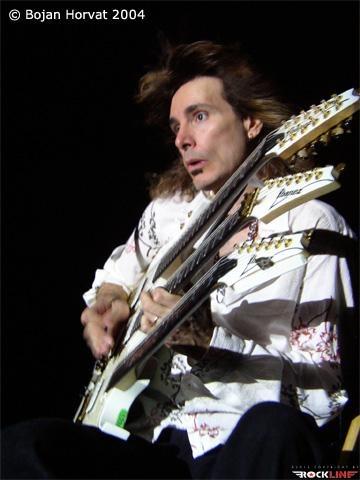
in the photos: Steve Vai onstage on July 9, 2004, as part of the G3 tour (J. Satriani / S. Vai / R. Fripp), in Ljubljana (Hala Tivoli) – RockLine photo archive 2006-2012, all rights reserved.
You can read RockLine’s report from the G3 show in Ljubljana (July 9, 2004, Hala Tivoli) HERE.
Photo gallery