location: Vienna / Wiener Stadthalle, Halle F / Austria
date: Monday, December 10, 2018
Ask the average well-read Earthling what comes to mind at the words Jethro Tull and you’ll get “flute,” “rock’n’roll,” and right after that, of course, the classic legendary English folk prog rock band. Few can also tell you that the name comes from an English pioneer of the seed drill who lived in the eighteenth century. Well, these brave agro-prog-folk rock artists, creators of an unforgettable and unique synthesis of flute, Celtic (folk, pastoral, medieval) and classical elements, and of course rock, the eternal and unshakable Jethro Tull, led by the no less unique and downright gigantic charismatic wit of the phenomenal Ian Anderson, are marking a hefty 50 years of activity this year! And those years flew by no less virtuously (quickly and quietly) since the release of their cult debut “This Was” (1968). So why 50 years, if the band formed a year earlier? After early trouble picking a name for the group, they only actually started using the name Jethro Tull in 1968.
Right now Jethro Tull have stretched their world tour celebrating “five decades of activity” deep into next year. If you missed them in Zagreb this October, you can catch their show on April 1, 2019 in Trieste. I’ll say it right away: you won’t regret it. This time RockLine was in Vienna, where, in a completely sold-out Wienner Stadthalle Halle F packed to the last corner, we got in with a photo pass one step closer to the band than in Zagreb. In a venue filled with 2,000 visitors, where we devotees of old prog rock culture enjoyed King Crimson this June and where a visit from Steven Wilson is expected in February 2019, a real mini super sensation unfolded, full of nostalgic Jethro Tull treats.
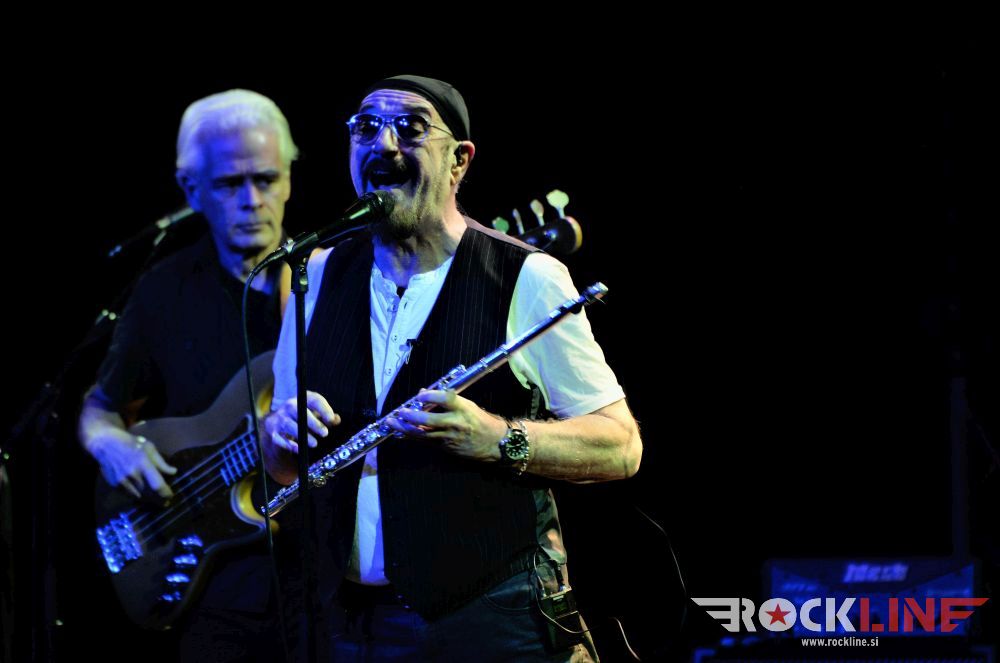
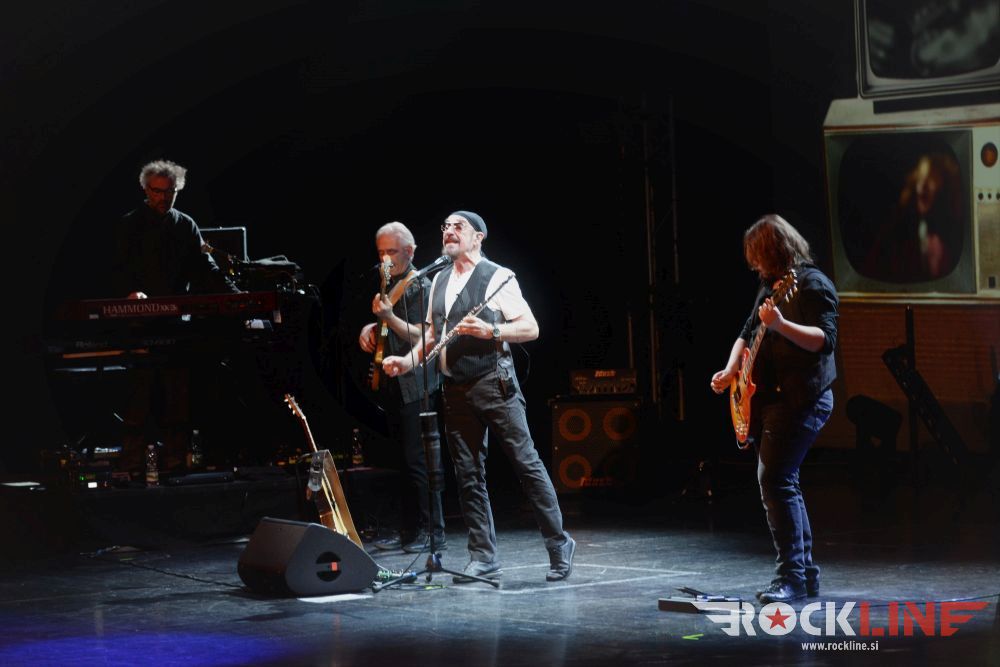
The concert started at exactly 8:00 PM. After an intro recording, four musicians first step onto the festive stage, the ones who used to make up Ian’s backing band. Two of them, bassist David Goodier and keyboardist John O’Hara, are actually former and new Jethro Tull members who were in the group back when the famous Martin Barre played guitar in it, while drummer and percussionist Scott Hammond and German guitarist Florian Opahle are relatively new faces in the lineup. Not long after, an unforgettable silhouette with a flute in hand sneaks in from the left and skips straight up to the microphone. Ian in person! The hall erupts. The repertoire unfolded in a completely historical, retro-nostalgic way. From the very beginnings, when the band still melted blues elements into its music, and so on the strong footing of the debut “This Was,” right up to the breakthrough among the cult rock acts (1971-72). A repertoire full of pleasant surprises that are rarely included in the live set. In that respect, Some Day the Sun Won’t Shine For You and, right in second place on the setlist, Love Story (“Living in the Past”) were particularly captivating. Both are extremely rarely played at the band’s concerts. The punchy opener My Sunday Feeling, along with Some Day the Sun Won’t Shine For You from the album “This Was,” was joined by Dharma for One and A Song For Jeffrey.
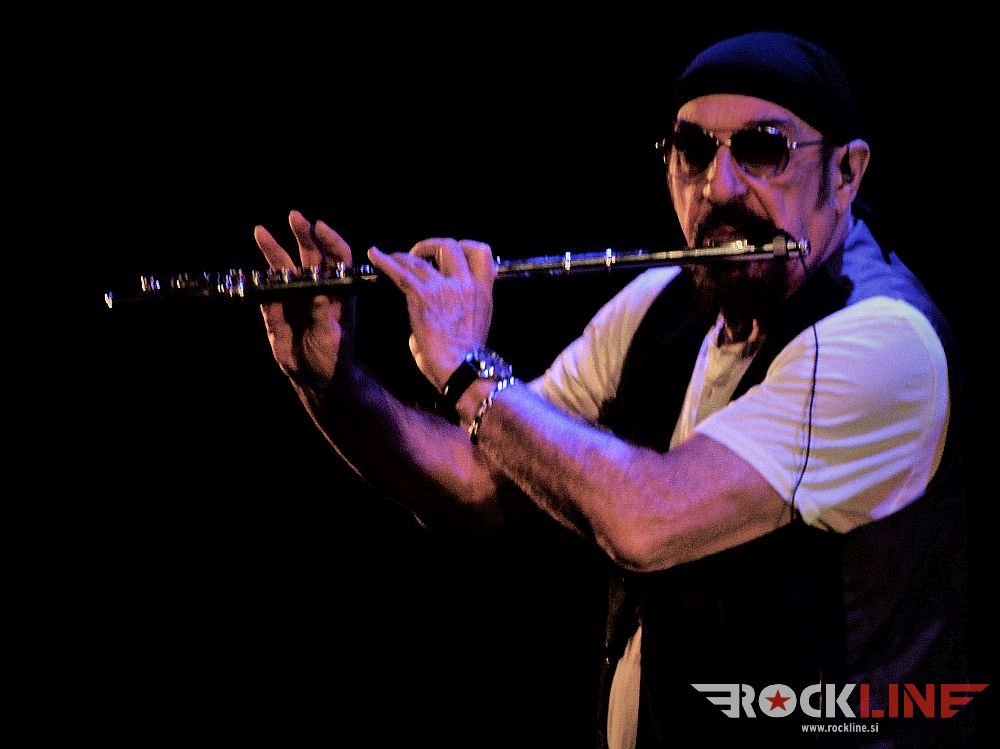
The first part of the concert lasted just 45 minutes, but it was “jam-packed” with truly lovely gems from the Tull career, which over the next twenty minutes turned into classics of the iron repertoire. That was heralded by A New Day Yesterday (with its famous dark and heavy rock phrasing), followed in contrast by a light, playful adaptation of Bach’s Bourrée, where Ian once again drew attention to his instrumental uniqueness. The band took a jab at the follies of the Catholic Church with the “Aqualung” gem My God, and closed the first part with the final excerpt of the cult prog rock adventure Thick As A Brick. In the first part Ian made it clear that he remains a mischievous, whirlwind little imp who, at a solid seventy-odd years of age, still keeps a boiling passion and drive, stage joy and undiminished heart inside him as he hops about on one leg and weaves a unique expressiveness, full of charismatic punch and insight, into his flute solo excursions. He’s still incredibly infectious with his witty humorous remarks and comments. Sparkling and sharp. Like always. The exceptional quartet backs him up. Tight and downright brilliant in the reinterpretation of Tull classics. Opahle’s guitar came incredibly close to Barre’s elemental feel. In the soloing, of course, there are concrete differences. Opahle is technically far more polished than his famous predecessor, but Barre’s “soft touch” nonetheless remains unique and irreplaceable.
After a fifteen-minute break the stage screen lights up again. Steve Harris (Iron Maiden) appears on it and says that his favorite Jethro Tull album is “Passion Play.” The band opens the second part with an excerpt from this excellent but unjustly overlooked and somewhat forgotten prog rock brilliance, gradually entering the (historical) middle and artistically most insightful stretch of their career. The instrumental counterweight in the second part came with the performance of Pastime in Good Company, which once again confirmed the incredible tightness of the quintet. It’s an adaptation of a piece whose creator was, incidentally, the notorious English collector of women’s trophies. Sadly, the French invented the guillotine two hundred years later, that is, after his death, otherwise he’d surely have become a fervent champion of French culture, which evidently thrives on revolutions. We’re talking, of course, about King Henry VIII, and Jethro Tull have been tied to this composition of his ever since the era of the album “Stormwatch” (1979). The performance highlights the quintet’s exceptional instrumental excellence and polish. In this part, the integration of the classics Too Old To Rock ‘N’ Roll, Too Young To Die (with an incredibly entertaining film in the background), Songs From The Wood and Heavy Horses felt completely natural, even necessary. A surprise on the setlist in this part of the concert came with the performance of Ring Out Solstice Bells (“Songs Form The Wood,” 1977), which was “ordered” from the movie screen in the background by Def Leppard vocalist Joe Elliot. For this song the band had to rely on pre-recorded backdrops.
It’s NO longer news that Ian’s vocal power has been fading over the years, that his vocal output in his later years is simply worn and weak. There was quite a bit of knowing glancing around in the crowd whenever his voice suddenly “dried up” or he improvised his way hunting for the right pitch (a few semitone clashes between the accompaniment lines and the vocal didn’t go unnoticed, after all). The man has been all too aware of this for years, and in a not-so-distant period, when he was still performing as the Ian Anderson Band, Ryan O’Donnel sang on stage for him. This man is an exceptionally fitting younger vocal clone of Ian, who brought extra spaß theater to the stage at those shows (Ian knew how to make use of his acting skills too). We met him in the summer of 2014 at the concert in Pordenone, and we’ll come back to him a little later. To get through the troubles with the vocal delivery, Ian adapted the vocal arrangements of the songs. This time he combined his own well-preserved vocals as much as possible with the vocal services of the other four who represent the name Jethro Tull in 2018. Above all he leaned on bassist David Goodier and occasionally on keyboardist John O’ Hara. He shared vocal lines (verses) with Goodier, e.g. in Songs From the Wood, Ring Out Solstice Bells and Farm On A Freeway, while O’Hara joined in mainly to build multi-part vocal harmonies. All evening the stage was furnished with a giant screen on which various historical clips of the band played. At two points Anderson also “borrowed” pre-recorded vocal services. First in Heavy Horses, where Icelandic singer and violinist Unnur Birna Björnsdóttir appeared on the screen dressed as an English farm lady. After so many brunettes who’ve worked with Ian as violinists, finally a redhead at last. She sang the first verse in the chorus of the song and contributed the obligatory violin solo. And then in the expected finale with Aqualung, when Ian drew on the recorded vocal of Ryan O’Donnel.
A proper Jethro Tull concert wouldn’t be complete without Locomotive Breath. It was played as part of the obligatory repertoire, and the shorter break before it did Ian a world of good, because it’s in this very song that he decently got through his vocal duties, similar to the first part, which is represented by vocally less demanding classics. In Aqualung and Locomotive Breath Florian Ophale also theatrically “exploded,” showing off his exceptional guitar “edge” and polish.
For all the devoted Jethro Tull followers, catching this tour is a (repeat) obligation. For those of you who haven’t seen them yet, no less so. At least once in your life you can “lose your Jethro Tull virginity.” Direction, set design, backdrops, energy, atmosphere, all together with the performance. It all works. Despite the painful split with Martin Barre. Everything is there as it should be. Even the adaptation of the vocal arrangements holds up and keeps its composure. This conclusion holds, of course, with some leniency toward the current vocal form of the iconic rock flutist. At the end the Vienna crowd rewarded this whole Jethro Tull theater with long applause and loud demands (everyone stomping their feet on the floor) for another encore, which sadly we didn’t get. So see you in Trieste, on April Fools’ Day next year. Ticket prices in the various categories for the announced Trieste concert are quite decent.
One more very important piece of info for everyone planning to see one of the upcoming Jethro Tull concerts. Don’t bring cameras. Using such gear, including mobile phones, is strictly forbidden. Ian is merciless here, and if he spots anyone taking photos from the audience during the concert, he immediately sics security on them from the stage. This happened three times during the Vienna concert, and already after the first such incident Ian seriously warned the audience that the band would be forced to stop the show if it happened again.
author: Aleš Podbrežnik
photos: Aleš Podbrežnik
Setlist:
Set 1:
1. My Sunday Feeling
2. Love Story
3. A Song for Jeffrey
4. Some Day the Sun Won’t Shine for You
5. Dharma for One
6. A New Day Yesterday
7. Bourrée in E minor (orig. Johann Sebastian Bach)
8. My God
9. Thick as a Brick (part)
Set 2:
10. A Passion Play (part)
11. Too Old to Rock ‘n’ Roll, Too Young to Die
12. Songs From the Wood
13. Ring Out, Solstice Bells
14. Heavy Horses
15. Pastime With Good Company (orig. King Henry VIII of England)
16. Farm on the Freeway
17. Aqualung
—encore—
18. Locomotive Breath