location: Cerkno / Stari plac / Slovenia
date: 18.05.2018
And then came day two of this year’s 23rd edition of the traditional Jazz Cerkno festival. Once again with three seriously interesting acts on the bill. And once again the clock hit half past seven in the evening, which is when the jazz starts in Cerkno. Before that, though, we got through a rainy, muggy (but by no means dull) day in thrilling fashion. Among other things, we made an adrenaline-fueled climb up Kojca (1301 m a.s.l.) in the Cerkno Hills, in the company of a streetwise crew member who headed up there with no hiking gear whatsoever. Afterwards came a “cleansing” program of thoroughly testing the beer selection at Bar Gabrijel.
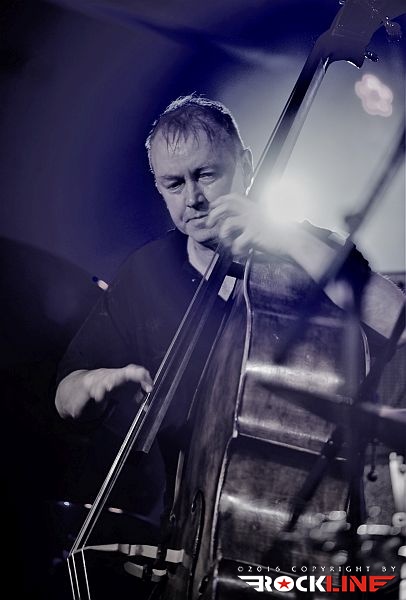
First on the bill were Japan’s Kaze, but at half past seven, when the program kicked off, they were still catching their breath after a “rocket” expedition from Vienna (more on that below). Luckily, four musicians were already on site and at the organizer’s disposal: Slovenia’s Zlatko Kaučič (drums, percussion), Britain’s Evan Parker (reeds), France’s Joëlle Léandre (double bass) and Spain’s Agustí Fernández (piano), “shortened” to Kaučič / Parker / Léandre / Fernández. Cerkno holds no secrets from Zlatko. This exceptional musical visionary earned his own inventory number in Cerkno a long time ago, and the growth of jazz here is tied to him one way or another. Judging by his past work, he’s one of those musicians who practically define the festival itself, the very jazz pulse of Cerkno. We saw the man in early May this year in a solo show at Bar Gabrijel, but this time the situation was completely new. The quartet knows each other very well, since the members had worked together before. Léandre played the festival once before (in 2009) and even gave a solo recital at the music school in Cerkno.
The four of them quickly delivered first-class proof of why they ended up on stage together. The chemistry between them is outstanding. Free jazz principles, experimentalism and avant-garde adventurism at every step of their playing. Mandatory eye contact, and at times a strongly pronounced, instinctive reaction to what the others were doing. Seriously demanding stuff, yet loosened up into witty, experimental exploration. This time Kaučič left aside the sonic manipulation he likes to throw in when he’s up there alone, but he certainly didn’t have any less on his plate, using all kinds of beaters to coax sound not just from the drum heads but from the entire frame of his kit. At times he put the sticks aside and pounded the drums with his bare hands. Light but incredibly compatible lines from all four building blocks, which at first listen sail off each in their own direction, completely independent of one another. In reality it’s an unbelievably in-tune, harmonious chemistry that barely keeps pace with the rational, logistical empiricism of music, though of course it does that too. Above all, it was the rhythm section, with the highly polished and musically intuitive Joëlle skillfully filling out Kaučič’s lively rhythms, that set the right platform for a dialogue between reeds and piano. Léandre’s presence is incredible. In her right hand she keeps the bow the whole time, using it on the double bass to accompany individual motifs and giving those tones almost the feel of a musical mantra. Exceptional charisma in musical free-spiritedness. A brilliant, thoroughly inspiring show by four extremely compatible musicians who, with their boundless musical oddness, only confirm that puzzling compatibility and mutual harmony. All the building blocks coexist in interplay and expression, folding into a beautiful balance and a real sonic contrast within the soundscape they create. Even in the sections where the lines get tense and, say, Fernández explodes like a storm with an almost blasphemously fast barrage of notes from the piano, the other three keep a rock-solid red thread and focus on this musical strangeness. An incredible reconciliation of provocative musical sweetness, the kind only jazz flirting with avant-garde approaches can deliver.
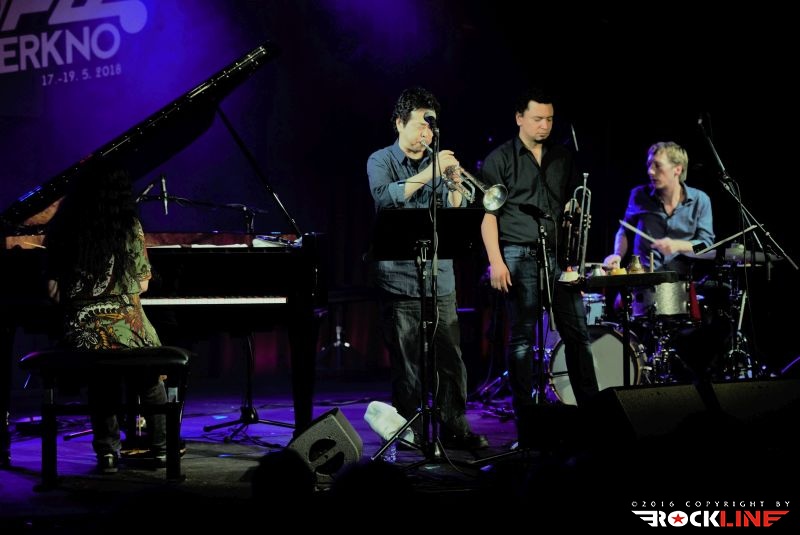
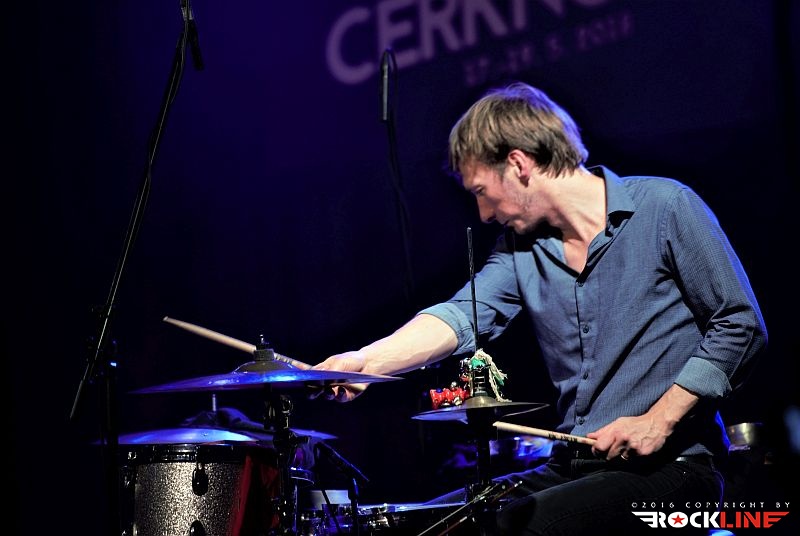
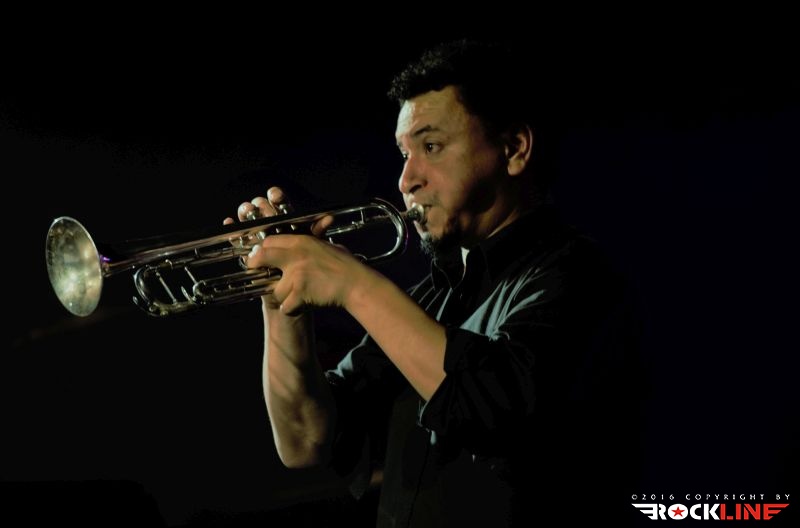
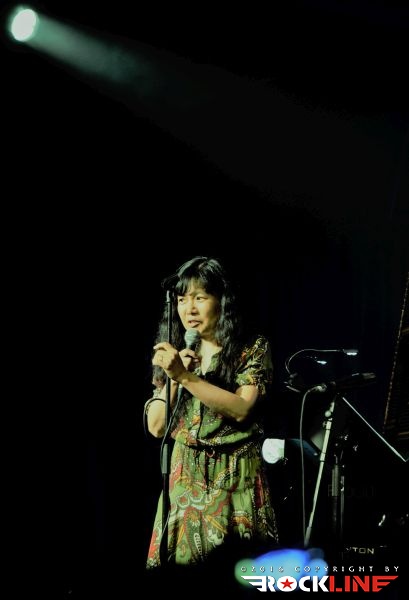
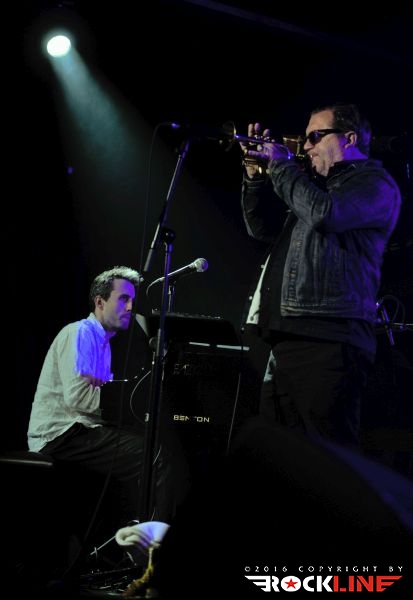
We also caught the Japanese-French quartet Kaze, led by the charismatic and tremendously prolific sixty-year-old jazz musician and pianist Satoko Fujii. Keeping her company in the lineup are her partner in good times and bad, Natsuki Tamura on trumpet, plus two French musicians: Peter Orins on drums and trumpeter Christian Pruvost, both of them comrades from the bands Impressions and Muzzix. So that’s two trumpets, piano and drums. A completely unusual combination, just as unusual as the band’s music itself. Unlike the opening group, Kaze bet more on tangible motivic substance, though there are noticeable detours into free jazz, since Kaze too sometimes drift right to the edge of smashing the motivic templates completely, into a free-spinning interweave of unfettered improvisations from the building blocks of the sound. The motifs may be more tangible, but in the long compositions they develop in such a way that you can never predict where the quartet will swim off to next within a given motif. The moment of spontaneity was present throughout. At the same time, Kaze can be very musical. The piano holds the motif, the drums keep the rhythm, and the dynamics over the top are driven by the often harmonized trumpets. Satoko Fujii’s improvising and experimenting is rounded out by an incredible stylistic vividness. From neoclassicism to world music. Her immersion in the moods at hand is amazing, constantly rippling now in unbridled scatteredness, now in serene, tender softness and brightness, which completely calms the churning waves of improvisational escapades. And she does this nonstop. Satoko comes across as an entity unto herself within the quartet and, with her expressive musical punch, practically dictates on her own how a given composition develops and how the tools and levers of improvisation get used. Even if you can’t tell right away, there’s a pile of filigree work and touches of fine aesthetics in Kaze’s music. The trio of men follow her lead extremely skillfully, and so Kaze as a whole present themselves as an entity of incredibly colorful musical tomfoolery, woven from the blend and interplay of several genre palettes. They head toward the edge of avant-garde adventurism, but never hit the listener with extreme strangeness or outbursts of “musical weirdness”. Outstanding, in other words. The omnipresence of the trumpets and the lightness of the compositions do summon, from somewhere far away, the restless spirit of Miles Davis’s pioneering, but it’s just a kindred energetic vibration, especially as you watch how the musicians step into solo spots and how they prepare the right space for one another beforehand for a perfect improvisational maneuver. There was also a heap of unusual tonal coloring on the trumpets, which kept surprising us and thoroughly, lucidly entertaining us. Satoko Fujii also works the piano strings themselves, using all sorts of props to coax out a whole load of unusual sounds that a lay listener usually doesn’t expect from piano playing. Satoko Fujii took the time to tell the audience about their trip from Kraków to Cerkno, when Kaze almost got stuck in Poland because their booked flight fell through. So they rented a car to Vienna, and to Vienna, from the other end of Europe, came the caring and self-sacrificing festival boss Simon, who is becoming more and more the legitimate successor to Boštjan Cvek, and who delivered the band happily to Cerkno. The Japanese musician said the band was extremely honored to play in Slovenia and to enjoy the beauty of a little corner of our country. The next day, the festival’s third, Satoko Fujii also gave a solo recital at the music school, and here’s one more curiosity. While we were idly sitting in front of Gabrijel around half past six in the afternoon, drummer Peter Orins turned up at our table from out of nowhere. Not to buy a round, mind you, but to borrow an umbrella, because all Friday it really did keep pouring on and off.
Rob Mazurek, a Chicago musician who loves to commune with the word “underground”, gives the second half of his band’s name, the word Underground, a different prefix depending on where the lineup comes from. Normally Underground comes with the label Chicago, but in 2014 the musician played Cerkno with two Brazilian musicians, and Underground got, for example, the prefix Sao Paolo. For a couple of years now, though, Mazurek has been working with a crew split between the USA and England, so he renamed the formation Chicago / London Underground.
The Chicago Underground crew (Mazurek and drummer Chad Taylor), plus Briton John Edwards on double bass and pianist Alexander Hawkins, make up the formation Chicago / London Underground. Last year this quartet put out an excellent record called “A Night Walking Through Mirrors”, played in one piece at a concert and later released as an album. And their musical meeting point? An incredibly special blend and a unique musical experience. In Cerkno, for part of the show they were joined on stage by another Briton, Evan Parker, who had earlier played in the stirring quartet mentioned above, Kaučič / Parker / Léandre / Fernández. That created a unique musical body and with it a new formation, naturally one that’s extremely skilled and has its eyes firmly on free jazz rhetoric. The album “A Night Walking Through Mirrors” itself, which the band mostly played at this gig, took on entirely new musical dimensions too. Mazurek and Parker kept stopping to trade lines between piccolo trumpet and tenor sax. Hilarious contrasts, at times like two totally different voices bickering, but playful and fun the whole way. That evening Mazurek’s samples weren’t as pronounced, and the band had a more classic sound, driven by the strong kinetics of the new situation and the new challenges that such a situation opens up in improvisational play. Partly thanks to guest Evan, too. Toward a new dimension.
How strong these musicians are, how layered, and how limitlessly they grasp the magic of music is proven by the fact that they can perform in a given combination of live, on-the-spot networking with full-blooded credibility, even though they’d never played together on stage before. That’s how the record “A Night Walking Through Mirrors” came about, recorded at a concert in London, and nobody would be surprised, let alone bothered, if Chicago / London Underground also released an album from the Cerkno show.
Mazurek didn’t forget a dash of glam either, which he brought with funny percussion props, a few stage excesses topped off with yelling into the mic, and not least his tinted glasses, which he’d already worn on stage the day before, when he played as a special guest at Cene Resnik’s trio show. A proper musical bone to gnaw on to close out day two of Jazz Cerkno.
author: Aleš Podbrežnik
photos: Aleš Podbrežnik