Author: Aleš Podbrežnik
Photos: Aleš Podbrežnik
Location: phone call Ljubljana – Paris
Interview date: January 31, 2014
Jordan Charles Rudes, born November 4, 1956 and better known to everyone as Jordan Rudess, is the keyboardist of Dream Theater. He joined the band for good way back in 1999, during the recording of the album »Scenes From A Memory: Metropolis pt. II« – RockLine review HERE. Dream Theater had already invited Rudess to join back in 1994, when they were looking for a keyboard replacement for the first time after Kevin Moore left. But after careful thought, Jordan chose to take a job with The Dixie Dregs instead, since joining Dream Theater would have eaten up too much of the time he owed to his newly started family. In 1997, then-Dream Theater drummer Mike Portnoy invited him to join the super progressive rock lineup Liquid Tension Experiment, which also featured bassist Tony Levin and Dream Theater guitarist John Petrucci alongside Portnoy and Rudess. That’s when it became clear that Jordan Rudess was exactly what Dream Theater’s music was missing. And the next time the invitation came, Jordan didn’t say no.
Jordan took a few minutes out for a phone call on January 31, 2014, right in the middle of Paris, where the band had a sold-out show, to walk us through how the new European tour is going and the band’s new album »Dream Theater« (2013) – RockLine review HERE – and of course to open up about himself as a musician too.
RockLine: The usual question to kick things off! How happy are you with the way the European leg of the new Dream Theater tour is going?
Jordan: We’re all super pumped. We’re putting on an especially spectacular show, the kind we’ve never had the chance to experience before. Every night it’s three hours of music, backed up by well-thought-out visuals on huge screens, which gives everyone at our shows, and the band itself, a special kind of experience, a journey into our musical world. Even if you’re not a fan of our music, I’d recommend coming to check out one of the shows on our current European tour, because you’ll simply be blown away by the staging and the sets that go along with our material. A show that knocks you off your feet! The setlist has material from the new record, which we play in the first half (the show is split in two by an intermission), and in the second half a few songs from the album »Awake«, since this year marks 20 years since we released that studio album.
RockLine: It feels like on the new album Dream Theater once again put more energy into finding concise melodic forms, at the expense of the experimental stretches that its predecessor »A Dramatic Turn Of Events« (2011) already hinted at – RockLine review HERE. How would you compare the new album’s compositions with those on »Black Clouds & Silver Linings« (2009) – RockLine review HERE?
Jordan: Yes, that’s true. With this album we wanted to get back to our roots and again put more focus on defining the melody, nailing down the melodic forms. That’s why the arrangements on most of the songs are shorter than they were on the last few albums, and at the same time it was a big test for us: could we keep the stylistic integrity that’s typical of Dream Theater’s music while shortening the arrangements? Of course, there’s still one epic piece on the new album. That’s the closer, a nearly half-hour composition called Illumination Theory, made up of several musical acts. We didn’t want to cut that one down at all, and it’s actually long on purpose. I think this song will be tailor-made especially for those Dream Theater fans, and there are quite a few of them, who’ve always been drawn to the experimental side of our music.
RockLine: You’re constantly involved in other musical projects too. How did all that activity, like the release of your new solo album »All That Is Now« and the album with Tony Levin and Marco Minnemann, affect your creative charge when making the »Dream Theater« album?
Jordan: The »Dream Theater« album was recorded before »Minnemann Levin Rudess« came out. As for that album, it’s well known that the Dream Theater story has been stylistically defined for years now, so the way we express ourselves doesn’t change much at the core of the songwriting. We definitely blend lots of musical genres anyway, but outside of Dream Theater I personally push to try things that I can’t do with Dream Theater, or can only do partly. One of those projects is the collaboration with Marco Minnemann and Tony Levin. There’s a ton of jazz on that album, for instance, and it gave all three of us incredibly positive energy and excitement during the creative process. As for my new solo studio album »All that Is Now«, it’s really about facing my musical roots. I went back to the basics. To an instrument I’ve always especially admired, respected and valued. The piano. All my original pieces on that album are arranged and played entirely on piano. I can say I was rediscovering a kind of little kid inside me. It’s a work that takes me back to my musical past, to times long before Dream Theater. At heart I’m considered a classically trained musician, and right around this time the idea of a set of original pieces on a solo album felt ripe enough for me to make it happen. Otherwise, I don’t really have any other hobbies in life. Every day of mine is completely filled with music. In lots of different variations, which keeps me fulfilled and gives my lifestyle its real meaning.
RockLine: How does Dream Theater find the right balance between a solid musical form, which you build with defined melodies, and that state, if you’ll allow me the term, where you push the whole story to the edge of musical chaos? How do you know where the right measure of each lies? Where do you have to stop to stay in the right balance between the two principles?
Jordan: I really like this question. Dream Theater has always aimed to hit the right mix of both approaches. Music is emotions, it’s passions, and we want to reflect those in different ways through our compositions when we aim to bring them to life on stage. We’ve definitely created some top-notch melodies in the past too, and our live audience always reacts to them emotionally every time we play them live. Whether it’s a vocal melody or a guitar melody. And of course we always include spots where we cut loose and go through a series of furious madness, through chains of excesses of musical improvisation on stage. Not just because we simply enjoy it, but also because that’s how we want to keep a sense of fun, of playfulness, if you will, in our shows. We like to watch during the shows whether our actions get joy and fun out of the faces in the crowd. We love seeing our audience throw laughter back at us on stage. And that’s right. Dream Theater is a combination of these two principles. That’s really the key to understanding who we are as Dream Theater. The starting point of our creativity and musical expression. What matters, of course, is that all of this is based on an honest expression of our emotions, which our audience connects with in all sorts of situations at our shows.
RockLine: Even though Mike Mangini has now been drumming with Dream Theater for more than three years, I’m still curious, if you can answer this, what are the basic differences between the musical personalities of Mike Portnoy and Mike Mangini, and what was the process of integrating Mike Mangini into Dream Theater after Mike Portnoy left the band?
Jordan: Both drummers are exceptional. Both Mike Portnoy and Mike Mangini. Everybody knows that. The people who follow our music adored Mike Portnoy, there’s no doubt about that. Mike Mangini, meanwhile, is seriously well versed in a “mathematical” sense. He can actually pull off some things on the drums that nobody else can. When Mike Mangini joined us, he brought a fresh creative wind, a freshness, and we tried some new things in our ideas that we couldn’t have before. He also brought new laughter, and the chemistry and camaraderie in the band got even stronger. Of course, it was a real pleasure working with Mike Portnoy all those years. He’s an organic drummer who follows his inner instincts like few others. Mike Portnoy is a drummer with a recognizable “groove,” a recognizable passion, a recognizable technique. He spent years developing a playing technique that demands especially careful focus on the work of all the limbs. Every combination of his movements belongs to a precisely defined form of drumming that he draws on. It’s a kind of fusion of limbs with the instrument. Mike Portnoy is considered a thoroughly physical drummer. He gets his groove purely by playing with his whole body every time he’s behind the kit.
RockLine: As a musician, are there any unfulfilled goals you’d still like to make happen in the future, both within Dream Theater and in other musical challenges?
Jordan: Of course, and that’s a very good question. I’m just now working out a new album that will be made with a large orchestra. The creative engine behind this idea is the inspiration embodied by the album »All That Is Now«. The idea was actually born while I was making that album and went back to exploring my roots as a classically trained musician. In the future I’d also like to expand my knowledge of electronic music and try my hand in those musical spheres too. But of course I’ll stay true to progressive rock in the future as well! I’m also working on upgrading the visual effects in our concert staging. You’ll be able to see these novelties for yourself soon.
RockLine: And finally, the classic question. Do you have a special message for our readers, and what can we expect from the new Dream Theater show in the middle of the Slovenian capital, happening on Tuesday, February 4, 2014?
Jordan: I remember that the first time we played in Slovenia, I woke up in the hotel room in the morning, got out of bed and looked out the window, and it felt like I’d ended up in the middle of a fairy tale. I told myself: »This town looks like something out of a dream!« So I’m incredibly looking forward to playing in Slovenia again. We at Dream Theater are proud that we’ll be able to deliver the best we’ve got to our music fans in Slovenia. Maybe it’ll be our best show. I also hope we’ll get a chance to take a walk around your city when we arrive and meet some new faces. So I’m looking forward to all these new experiences on our new road trip through Europe!
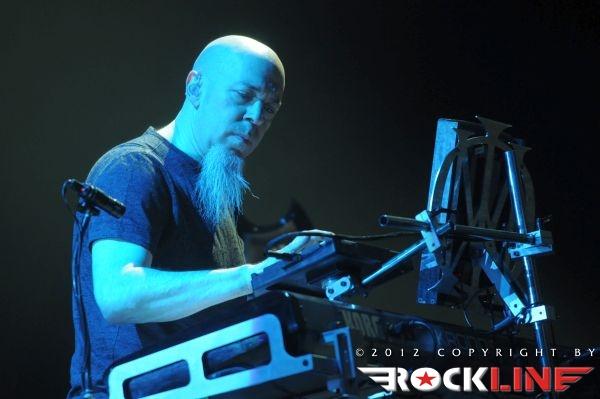
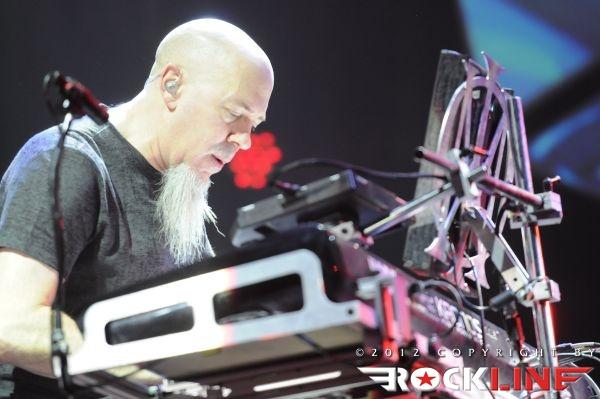
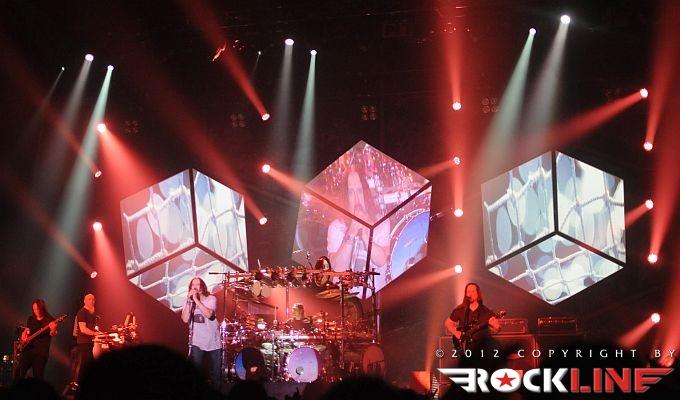
In the photos: Jordan Rudess performing with Dream Theater on February 20, 2012, in the Italian city of Pordenone at the Palasport hall (RockLine photo archive 2006-2014, all rights reserved) – you can read the full RockLine live report from that show HERE.
Photo Gallery