Author: Rok Klemše
Interview date: 12.03.2007
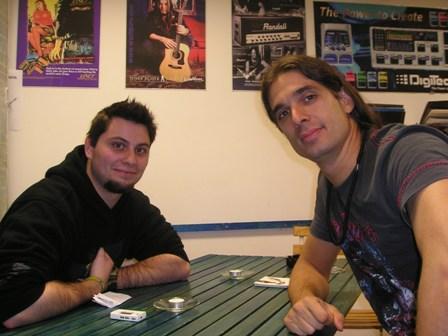
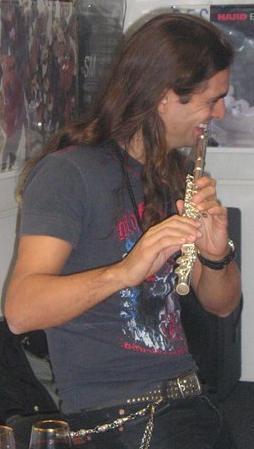
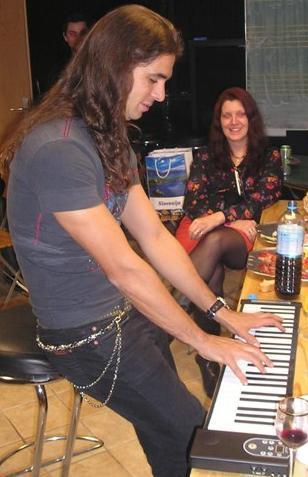
After the guitar clinic at Orto bar wrapped up, they kindly invited us over to the music school’s headquarters, where we got the chance to sit down for an interview with the excellent guitarist Kiko Loureiro. Not only is Kiko a fantastic guitarist, it turned out he’s also a totally regular guy who’s incredibly friendly and open. The interview went off without a hitch, and afterwards the friendly staff at Muzika Viva treated us to a glass or two, and the casual hangout with Kiko dragged on until the early morning hours. Once the “barricades” were down, Kiko proved he’s an outstanding multi-instrumentalist too and treated us to a short impromptu on flute and “piano”. Why piano in quotation marks? Because it wasn’t a piano in the true sense of the word, but some kind of plastic contraption from none other than the tech-crazy Japanese.
Rockline: Hey Kiko! This is your first time in Slovenia. How are you feeling?
Kiko: Yeah, I got here last night. We went to Orto bar so I could see what it looks like. And this morning I went for a walk along the river so I could check out the city a bit more – the Dragon Bridge and the market. Tomorrow I’ll see the castle.
Rockline: So you’re staying in Ljubljana tomorrow too?
Kiko: Yeah, I’m leaving at two in the afternoon and heading to Trieste for another clinic. Whenever I’m in a city for the first time, I like to look around and meet new people. That’s really the fantastic side of this job.
Rockline: Last year you put out your second record, Universo Inverso, which is completely different from your solo debut No Gravity. When I first listened to it I was really surprised, because I was expecting metal shredding and sawing, but it’s an excellent jazz fusion record with Brazilian elements…
Kiko: Yeah, that’s true. People who know me personally knew what to expect. If you were at the clinic, you could hear plenty of Brazilian sounds. Actually, a friend was encouraging me to record something like that, and I always wanted to show people my “non-metal” side too. When you decide to become a musician it’s really hard at the start, because of your parents, money and so on. So why, once you’re finally a musician, would you give up the music you want to make yourself and only record what the masses expect from you?
Rockline: Did you consciously decide on a solo project where you can play something totally different from Angra, or did it just happen naturally?
Kiko: Yeah, while we were recording the new Angra album, I was also writing music for my solo record. Some of the tracks sounded very jazzy, others had the Angra sound. I’m not some frustrated jazzman hiding his metal side, I’m trying to play both. I’d love to record a blues or flamenco album someday too. I think musicians have to be very open-minded.
Rockline: On your first record you played all the instruments yourself, with Mike Terrana joining you on drums. On Universo Inverso you’ve got a full band.
Kiko: Yeah, it’s a different concept. Playing jazz or Brazilian music is a completely different thing. That’s also why the album is called Universo Inverso – the world of metal is such that everyone’s in black and so on. Brazilian musicians behave totally differently and listen to different music. The concept of playing and writing is completely different – we play together, we don’t rehearse much, feel matters more. In rock you practice and practice, so with music like the latest record it’s important to have really good musicians around you who can nail it on the first take. The musicians I have on the record are very well-respected in Brazil. We barely rehearsed at all, and we recorded the record in the studio really fast.
Rockline: How come you picked Mike Terrana for drums on the first record?
Kiko: Because he’s a very versatile drummer. With No Gravity I wanted to make a guitar record, but at the same time a really heavy metal one. There aren’t many solo metal guitarists today, maybe Malmsteen, but he has a vocalist too. In the ’80s there was Marty Friedman, for example. I knew Mike was a great metal drummer who can also play fusion stuff. He’s a real pro, he recorded the album in one day. And he’s also a wonderful, super friendly guy.
Rockline: You can hear exactly that on the record, it’s almost improvisation, not something rehearsed endlessly and recorded over a really long time…
Kiko: Yeah, exactly. It’s really live music, actually.
Rockline: The record actually sounds like one big whole, a project built on joint efforts. I’m guessing the pianist from Cuba (Yaniel Matos, ed. note) contributed a big chunk to that, too?
Kiko: Oh yeah, of course. Actually, he and I started on the ideas for this project on our own and wrote a few tracks together. Whenever we had time, we played and created. He’s very busy though, because he also works with the drummer who played with Sepultura on Roots. He’s super famous in Brazil and tours a ton. He was one of the people who encouraged me to record Universo Inverso, too. And we said we’d record a Latin album, which is very different music from Caribbean. Our drummer comes from the school of Brazilian music, but it’s true that we mix styles. Yaniel brought the Caribbean music, I’m the rock guy, the bass player comes from the samba tradition, and the drummer is a jazzman. If you look at the Universo Inverso artwork, you’ll also notice a recycling symbol, only made up of four arrows, which represent us and the exchange of our ideas.
Rockline: You started playing guitar at eleven. Did you carry on by yourself or did you go to music school?
Kiko: At the start I had a teacher who came to my house and taught me little things. Then I went to music school, where I focused on electric guitar, since I was already listening to rock by then. After that, a very well-known Brazilian guitarist taught me for five years. When I started university, where I studied biology, I put the guitar on the back burner a bit. I soon dropped out because I wasn’t into it, and that’s also when the road with Angra began. These days I don’t take guitar lessons anymore, but I do have piano lessons.
Rockline: Can you describe your gear a bit?
Kiko: I use Italian Brunetti amps, the Mercury model. A really good handmade amp! The guitars are Tagima and ESP, and Takamine acoustics. Tagimas are excellent handmade Brazilian guitars. In Brazil they actually sell more of them than Fenders or Ibanezes. D’Addario supplies my strings. For Universo Inverso I also used a Tagima Telecaster, and I use seven-string guitars and various acoustic guitars too.
Rockline: Are you maybe already planning to record the next solo album?
Kiko: Yeah, but not anytime soon. I’m on tour with Angra until June, there’ll be a few solo gigs in between, and in the second half of the year I’ll be home more and can start writing new material. It’s really hard to create between tours, I only get little ideas, and for composing I need to be at home. Maybe next year, but nothing’s set in stone yet.
Rockline: And a new Angra record?
Kiko: It’s the same with Angra. We don’t want to force ourselves to create and record new albums. Last year was really stressful: I put out an Angra record and a solo record, and the singer put out his own record too.
Rockline: Who influenced your playing the most, both bands and individual guitarists?
Kiko: They’re always changing… When I started I listened to a ton of metal, Black Sabbath, Deep Purple, Iron Maiden and Metallica, who I still love. Guitarists – American ones, Brazilian acoustic guitarists, Spanish guitarists, like Paco DeLucia. I like classical and piano music, like Keith Jarrett. I also listened to a ton of Malmsteen and Jeff Beck. I listen to really diverse music, from blues through Cuban music to metal.
Rockline: Do you do a lot of guitar clinics?
Kiko: Yeah, quite a few. It’s something I really enjoy doing. It’s a chance to play my own tracks, talk with young people and have a great time. I think the exchange is super important. Both for the people watching and for me. If someone asked me to play some Angra, I’d be happy to. And if there are no requests, I play my solo stuff.
Rockline: What do you do in your free time, if you even have any?
Kiko: Yeah, not much of it (laughs). I’m completely devoted to music, so even when I’m not on tour or recording, I’m playing. I don’t do kung fu or surfing, although lately I’ve been trying windsurfing. When I’m home I play a lot of piano.
(Kiko gets a glass of Slovenian wine)
Kiko: Thanks. You’re not having any?
Rockline: No, thanks.
Kiko: You’re working? (laughs)
Rockline: (laughs) Yeah. Do you like Slovenian wine?
Kiko: Yeah, it’s excellent. The beer’s not bad either.
Rockline: What would you say to your Slovenian fans and Rockline readers to finish off?
Kiko: I’m really happy to be here for the first time. I got a really good feeling. Thanks to everyone for the wonderful time I’ve had here. And check out my record, of course… a little advertising. When you listen to music, don’t limit yourself to just one genre, be as open as you can.
Rockline: Kiko, thank you so much for coming here and taking the time for this interview too.
Kiko: Thank you! I hope I can come back soon. Either with Angra or on my own.
Photo Gallery