

Klemen Markelj has put his masterful chops on no fewer than three foreign albums this year. The first is the second album from Irish progressive metal project The Vicious Head Society, titled Extinction Level Event. The second is the new record from American gothic and doom metal project Drift Into Black, titled Patterns of Light. He played drums on every track of both. On the third album from British progressive rock project Crashed Astro, led by guitar virtuoso, composer, multi-instrumentalist and producer Oliver O’Shea, he contributed drums to three of the eight tracks.
“It’s incredible how much creative flexibility, wit and insight Klemen Markelj brings to this album, from where he places his fills to the fascinating shifts in the rhythm itself and the time signatures,” wrote Aleš Podbrežnik in his review of Extinction Level Event on RockLine (the full review is available HERE).
It’s not easy for Slovenian musicians to break through on the international scene, so those who really pull it off through hard work and persistence deserve admiration. Graham Keane, the Irish musical genius and above all guitar virtuoso, knew exactly why he kept Klemen on board after he played on two tracks on the debut.
“Markelj is in the right place at the right time, all the time. Nothing gets past him. Whether it’s time to stay soft or to go all-out and cut loose. We’re talking about a very demanding album that requires real flexibility from the musicians, and a wide-open mind for the vision behind it, which is Graham Keane’s,” Podbrežnik wrote, trying to get inside Keane’s head.
Klemen honed his skills at the College of Music in Los Angeles, under world-renowned teachers such as Joe Porcaro, Tony Inzalaco, Ralph Humphrey, Gary Ferguson, Dave Beyer, Mike Packer and Richie Gajate Garcia.
What it’s like to be ‘your own drummer’ is covered in the lines below.
They say your namesake from your former band Bad Law, where you actually played guitar, is the one ‘to blame’ for you ending up behind the drum kit. What happened to the guitar, and how come you stuck with pounding the drums?
That’s right. In ’94 Klemen Krmelj decided he was done playing in a band, and he sold me his drums for a spritzer. Even back then, while I was still playing guitar, I’d show up an hour early to rehearsals so I could practice on the drums. So I decided to take over the drums myself, and instead of a guitarist we invited my cousin, keyboardist Gregor Lipušček, into the band. I sold the guitar soon after and gave myself over completely to the drums. Well, I’d actually built my first drums back in primary school, out of Jupol paint buckets.
After Bad Law you played in quite a few bands. Which ones, and what stands out from working with them?
We played with Bad Law from 1989 to 1999, and during that time I also played in a brass band and in the group Oko, with whom we recorded the album Live Oko 2000. Playing with a guitar virtuoso like Pavel Kavec and a bassist like Ernie Mendillo was an incredible experience for me. Ernie and I practiced on our own three times a week on top of the full-band rehearsals. The energy at our live shows was unreal, it was great.
I played in the trio Oko for 3 years, and then my partner Katarina Globočnik and I founded the progressive metal band Obidil. We invited the guitarist and bassist from Bad Law (Tomaž Jelenc and Andrej Čufer) and keyboardist Gašper Kačar to join us. With Obidil we released two albums, The Magic Word (2003) and Stardust (2008), and played regularly until 2011. The lineup shifted a bit along the way, with Matej Sušnik taking over on bass and Rok Tomšič becoming the guitarist. Obidil finally made a long-held wish come true for me: creating my own music, which was a real joy. We’re on standby at the moment, but the story isn’t over yet.
Then from 2007 to 2014 I played with The Drinkers. We recorded the album Recidiv (2014) and the DVD Od Pira do Školjke (2009). In 2010 I joined the ethno trio Antorino, and we recorded the album Antorino – Medieval Crossover – 2011. The big challenge was how to combine violin, lute and a drum kit. I adapted the kit so that instead of a snare I had a djembe and instead of hi-hat cymbals a tambourine. I kept the two bass drums and 5 toms, and added three rototoms, bongos and a jam block. A really unique and wonderful album.
In 2016 I joined the rock and roll band Sam’s Fever, and we recorded the album Fever (2018). That same year we played as Darlene Love’s backing band in Germany, and she put out a live album in two versions – Darlene Love – Welcome to Germany and Darlene Sings Elvis and other Favorites.
It’s maybe not widely known that you ‘won’ the audition for drummer of Demolition Group, but you never became their drummer. What happened?
In 1999 or 2000, I don’t remember exactly, I went to the Demolition Group audition in Brežice. There were 21 of us drummers, I was the last to arrive and I got accepted, but when they asked where I was from, they changed their minds, because Železniki is too far away. On the drive home, Katarina and I decided to start a band where we’d play our own music, the kind we liked.

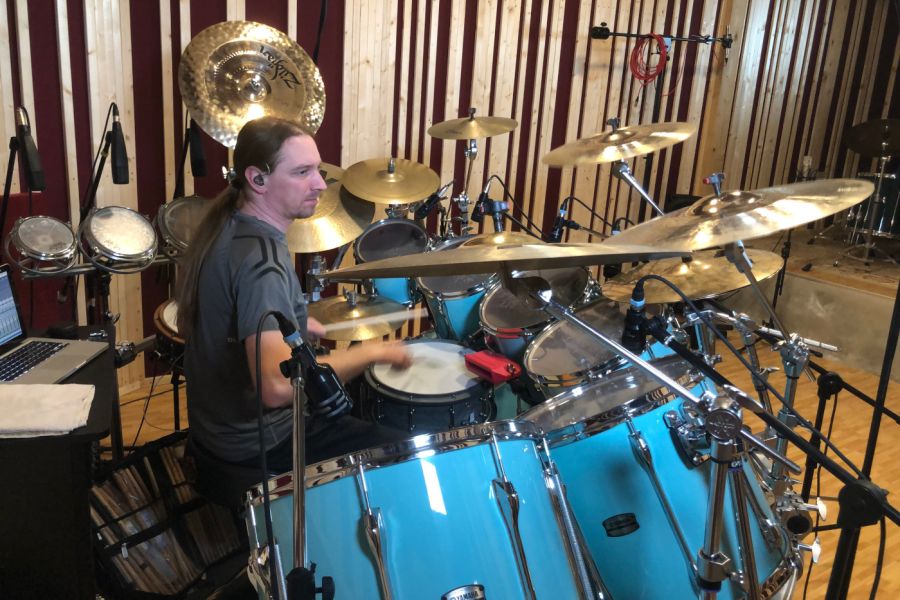
How did you get into the whole ’your own drummer’ thing in the first place? Abroad it’s pretty common, but here … Was there anyone else doing it back then? And what does your drumming work actually look like? Most people picture a drummer in a band, but you do everything on your own in your own studio.
At first I recorded at Ork studio in Jevnica, for various artists – Avven, Metalsteel, Out of Plumb, Big Nina, Salome, Interceptor, Nessy, Maja Prašnikar, Boris Brvar, Jaka Vižintin, Liam, The Fallen Idea -, and later I started building my own studio. I worked a lot with producer Damjan Pančur, who was a huge help with that process.
Once I got to the point where I could record everything in my own studio, I built a website and made a few promo videos. Over time clients started getting in touch from all over, Europe, America, Africa …
First they email me the details about the music, then a demo recording and instructions. Some only send an instrumental and give me completely free rein, while others already have it all worked out, how they want the drums for certain parts of the song. I listen through the demo and imagine how I’ll play certain parts. Sometimes I make notes, sometimes I just remember it.
Most of the time I get ideas when I’m not behind the kit, on my bike, out for a walk or in the car. Before I start recording, I always check the mics and the tuning, and sometimes I change the snare or swap it out, and I’ll tweak something on the bass drum too. There are a lot of elements you have to pay attention to.
I record the drums, send an info mix, and once the take is approved, I send all the tracks over WeTransfer. Over the years I’ve developed my own sound, so it’s always getting easier. In principle I record every genre, but prog metal and jazz/rock are closest to my heart.
What about the so-called energy that builds between band members? How do you make up for that, and do you coordinate with the others involved in a project, and how?
We definitely communicate, by email, Messenger or Skype, and sometimes I suggest something, ask something … I talk more with some people, less with others. When I was recording for a client from Denmark, the guy was so happy that to thank me for my patience, since I’d recorded three revisions of one song, he sent me six bottles of top-notch wine.
You also studied in Los Angeles at LACM – Los Angeles College of Music. How did you get there, who taught you, and what was the study like?
I first went to LACM in Los Angeles in 2016, when I did the summer program. In 2009 I passed the entrance exams, got a bit of a scholarship and finished the first semester, then I continued in 2012. That time Katarina and our son Vasja came with me.
I chose LACM mainly because of the teachers, well, and the sun too. (laughs) Right after the summer program I came home buzzing and full of new ideas. Just hanging out every day with people from all over the world who care about music is inspiring. During my studies I was at school from 8 a.m. to 10 p.m., living on almonds, raisins and coffee in between, and in the evening I’d cook dinner to unwind and treat myself to a beer. I took Saturdays off, and on Sundays I was already getting ready for the new week. It was truly great, stressful and exhausting of course, but great.
I was lucky to have the best teachers. Joe Porcaro, whom we called Jopo, sadly he’s no longer with us, was incredible, very inspiring, kind, friendly and curious. He always had a twinkle in his eye when he played the drums or told a story. Unforgettable and priceless. When somebody played so well that Joe would break into a smile, he’d say: ’You are gonna be a bitch.’ Joe Porcaro worked with names like Lao Schifrin, Toto, Paul Anka, Nancy Sinatra, Madona, Barbra Streisand, Pink Floyd, Diana Krall.
Ralph Humphrey was just as inspiring, a passionate musician and a perfectionist. He’s one of the few drummers who had the chance, and enough chops, to play with Frank Zappa and the Don Ellis Big Band. Today, besides teaching and recording, he works with the prog jazz band The Odd Dogs.
Then there’s Gary Ferguson, who worked with names like Ray Charles, Gary Moore, Glenn Hughes, Lana Del Ray, Dave Beyer, who worked with Mellisso Etheridge and Christopher Cross, Richie Gajate Garcia, who worked with Phil Collins, Tito Puente and Sting, and Tony Inzalaco, who worked with names like Oscar Peterson, Maynard Ferguson, Ben Webster, Dizzy Gillespie, Dexter Gordon. Tony got me hooked on jazz and I’m sincerely grateful to him for everything. We laughed a lot, talked a lot, and we’re still very good friends. I got along really well with all my teachers and I’m still in touch with some of them.
Could you say you’d be a worse drummer/musician without this ‘American experience’? What would you point to if someone asked how that study shaped you the most?
Definitely. Besides the musical knowledge itself, it’s the stories of the masters who made the musical history of blues, jazz, rock and funk. It’s an unforgettable experience that opens up your whole outlook on life.
Two albums have come out this year that bear your mark. The first is Extinction Level Event by the progressive metal project The Vicious Head Society, the brainchild of Irish musical visionary and guitar virtuoso Graham Keane. On the debut you played drums on two tracks, and on the new one on all of them. How did this collaboration come about, and how did the project go?
That’s right. The Vicious Head Society (Ireland) kind of coincides with when I started recording in my own studio. Graham Keane noticed my promo video (2016) and wrote to me. When I heard the demo, I hit the ceiling. (laughs) I wrote back right away that this was absolutely my territory, and I’m very grateful to him for that. On the first album “Abject Tomorrow” I played drums on two tracks, and on the reissue on one more, an instrumental – Xylematic Disembovelent. This year the new album “Extinction Level Event” came out, and I played on all the tracks. We started recording in 2018 and the album was finished in 2020, and it came out on May 28, 2021 on CD and as a time capsule edition that includes both CDs. Graham and I communicate really well and the process itself runs smoothly.
The other is the project Drift into black, which is very different in genre from VHS. Does that matter? Are you currently recording drums for a new album from that project too?
Craig Rossi first wrote to me in 2018 and since then we’ve recorded 4 albums. I finished the latest one just recently. The first, “Dead Suns Under The Forever Moon”, came out in 2018 on CD, the second, “Anthems From The Darkest Winter”, in 2019 on CD, and the third, Patterns Of Light, in 2021 on vinyl, which I’m really proud of. I’ve always wanted to hear my drums on a vinyl record. The album I recorded recently comes out next year. Craig Rossi even announced that bassist Paul La’Placa and I are now official members of the band.
This year the Crashed Astro (U.K.) album Fossil Megacosm also came out. The three albums differ in genre, ranging from prog metal and doom/death metal to experimental prog rock/metal, but that doesn’t really matter, since I love playing different styles.
We’re seeing live music events slowly come back. Are you playing any gigs? Do you miss the stage?
My last gig was with Sam’s Fever in January 2020, which is also when I decided to leave the band, so I don’t play with them anymore. I absolutely miss concerts, both on stage and in the crowd, but as long as these senseless restrictions are in place, you won’t find me on stage or in the crowd. But I’m sure that next year we’ll definitely be playing and going to shows.
To wrap up, let’s jump over to the future drummers you’re teaching percussion skills. How’s the ‘crop’ of Slovenian drummers looking for the future?
True, I run a drum school and I can say I’m not worried about the future of drummers, male and female, in Slovenia. I’m very proud of my students. Every year I organize a concert where everyone plays one song with a band. We all miss that a lot, the last one was in May 2019. I hope we can have it again as soon as possible, as normal, free people.
Author: Nataša Fajon
You can also read the interview on the web portal Opazovalec.si:
