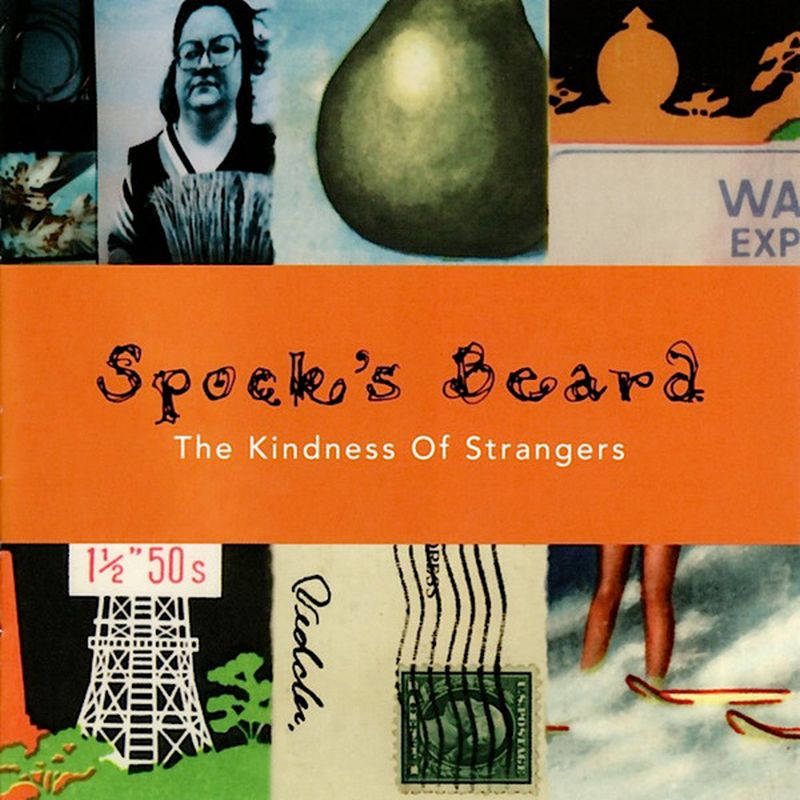
Label: Giant Electric Pea
Release date: May 19, 1998
Production: Spock’s Beard
Album length: 56.22 min
Genre: Progressive Rock
Rating: 9.0/10
“The Kindness of Strangers” was the third studio outing from the American prog revivalists Spock’s Beard, who, alongside Sweden’s The Flower Kings, were the leading lights of the so-called third wave of progressive rock in the second half of the nineties. This ambitious quintet, led by the brilliant singer and multi-instrumentalist Neal Morse, never ran short of interesting ideas while breathing new life into symphonic prog from its golden age.
After two very strong studio albums that cemented their reputation as a prog powerhouse, “The Kindness of Strangers,” released in 1998, was the logical next step in the songwriting and arranging bloom the Beardsmen had hit on its predecessor, “Beware of Darkness” (1996). At least half of the tracks on this splendid album are now essential live staples and among the band’s most beloved creations. One of Spock’s Beard’s main weapons has always been their mighty vocal harmonies, since Neal wasn’t the only talented singer in the band. He had an equal vocal partner in drummer Nick D’Virgilio, who later proved himself a gifted multi-instrumentalist too. When Neal left in 2002, Nick took over as lead vocalist very successfully.
The opening “The Good Don’t Last,” the first of three epics on “The Kindness of Strangers,” captivates the listener with an almost perfect, wonderfully harmonious blend of eclecticism, complexity and melody. Spock’s Beard never hid their many influences from prog legends, led by Genesis, Yes, Gentle Giant, Kansas and King Crimson, as well as some classic rock bands like Deep Purple and the Beatles, but they always added their own artistic touches on top.
“In The Mouth of Madness,” a genuine carousel of different styles, is another one that has become a fan favorite among the Beardsmen. Besides Neal’s chameleonic vocal performance, the real wow factor is the keyboard wizardry courtesy of the brilliantly mad Ryo Okumoto. The intro of “Cakewalk On Easy Street” also packs a pinch of jazz rock fusion, which has always been close to the heart of guitar master Alan Morse, Neal’s younger brother and today the only remaining founding member.
The romantic ballad “June” quickly established itself as a kind of unofficial anthem for the band. For the Beardsmen it holds a status similar to what “Lady In Black” has for Uriah Heep or “Dust in the Wind” for Kansas, with the important difference that Neal’s lyrics and the overall mood are far more upbeat than in either of those rock classics. In the uplifting vocal harmonies, you can’t miss the Yes influence. “Strange World,” where Neal’s vocal chameleon act once again shines, hits a bit harder, and you can pick up some hard rock influences in it too.
Few Spock’s Beard creations have reached such an iconic status among their followers as the wonderful epic adventure “Harm’s Way.” Neal kept playing it live many times even long after he was no longer a member of his original band. The majestic instrumental opening is a little reminiscent of Kansas, while the rousing, triumphant chorus is one of Neal’s best feats of its kind. And the brilliance on “The Kindness of Strangers” doesn’t stop there.
Closing out the album is “Flow,” another splendid epic adventure split into three sections. Here Tony Ray helped Neal with the lyrics, in which many will already spot early seeds of the multi-instrumentalist’s later Christian fervor. Working with outside lyricists and songwriters did become standard practice for Spock’s Beard after 2003, when Neal was no longer in the band. The opening section “True Believer” at times sounds like a close encounter between Gentle Giant and Genesis, but in a way where the band spices up those influences with completely original arranging ideas. “A Constant Flow of Sound” is the central section, packed with contrapuntal rhythmic variations from the D’Virgilio/Meros duo, brilliant symphonic arrangements, eclectic guitar passages and brilliant vocal harmonies. The latter have always been the trademark of this perpetually ambitious band. Thanks to Neal’s vocals and Alan’s subtle guitar passages, the solemn yet nostalgic closing section “Into the Source” is full of triumphant verve, a tried-and-true formula that the older and more notorious of the Morse brothers has repeated quite a few times in his career.
“The Kidness of Strangers” further cemented Spock’s Beard’s reputation as one of the two main pillars in popularizing third-wave progressive rock, which was no surprise under the baton of a composer and musician like Neal Morse. “The Kidness of Strangers” isn’t the most ambitious achievement of the Beardsmen from the Neal era, but it’s certainly one of the most balanced, and a great entry point for anyone not yet familiar with their life and work.
Author: Peter “Dr. ProgRock” Podbrežnik
Track list:
1. The Good Don’t Last (10:02) :
– a) Introduction
– b) The Good Don’t Last
– c) The Radian Is
2. In the Mouth of Madness (4:44)
3. Cakewalk on Easy Street (5:01)
4. June (5:26)
5. Strange World (4:18)
6. Harm’s Way (11:03)
7. Flow (15:48) :
– a) True Believer
– b) A Constant Flow of Sound
– c) Into the Source
Line-up:
Neal Morse – vocals, piano, synthesizers, acoustic & electric guitar
Alan Morse – guitar, cello, Mellotron, backing vocals
Ryo Okumoto – Hammond, Mellotron
Dave Meros – bass guitar, backing vocals
Nick D’Virgilio – drums, percussion, backing vocals
Guest musicians:
Eric Brenton – violin on track 1
Jackie Suzuki – violin on track 1
Melissa Hasin – cello on track 1
Tom Tally – viola on track 1