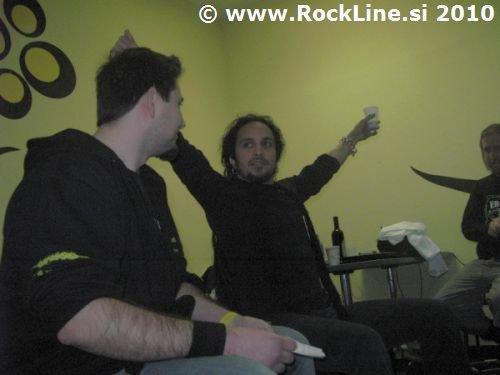
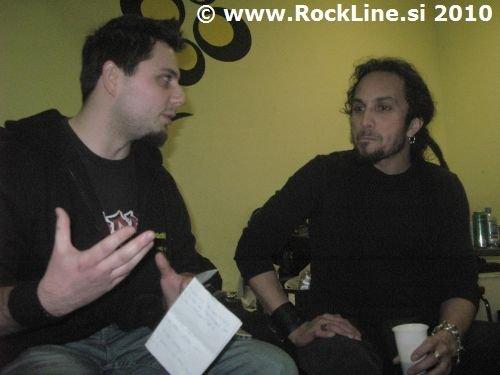
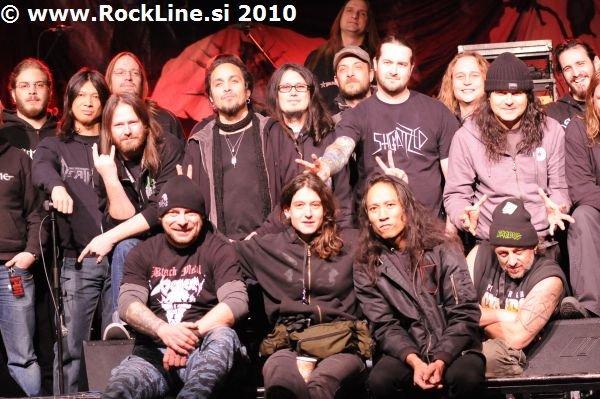
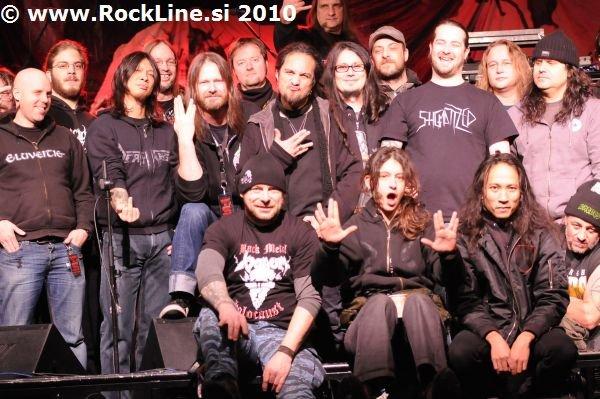
Location: Cvetličarna MediaPark / Ljubljana / Slovenia
Interview date: December 16, 2010
Death Angel are yet another legendary Bay Area thrash metal outfit, who blew the thrash scene of the eighties wide open with their debut The Ultra Violence. That debut got them written into the annals of metal forever, and their later releases only cemented their status. In 1991 they were supposed to play the legendary Clash of the Titans tour (the first one to bring together thrash giants Megadeth, Slayer and Anthrax), but a year earlier they were in a terrible van crash that kept former drummer Andy Galeon recovering for more than a year. That accident ended up being one of the main reasons the band fell apart. But even that break didn’t last long: Death Angel reformed in 2001 for a performance at Thrash of the Titans (a show organized in support of Chuck Billy and Chuck Schuldiner, who were both battling cancer). Death Angel history started getting written all over again, and it peaked last year with the release of one of the best records in the Death Angel discography, Relentless Retribution. We talked about all of this and more at Thrashfest 2010 in Ljubljana with the band’s charismatic vocalist and fantastic conversation partner, Mark Osegueda.
RockLine/Rock Hard: You just played another killer show on Slovenian stages, a total “sonic beatdown”. Throughout the tour you’ve been posting tour diaries and you’ve said more than once that Thrashfest 2010 is one of the best tours you’ve ever been part of.
Mark: That’s right. For us it’s without a doubt one of the best tours we’ve ever been part of, and for me personally it’s the best tour I can remember, period. I’ve never had this much fun. Not from the eighties until now. It’s the perfect package for any thrash fan of any generation.
RL/RH: Let’s start at the beginning. How do you remember the eighties Bay Area thrash scene today? Death Angel were a big part of that thrash community too.
Mark: That’s something I’m incredibly proud of and happy about, that I got to be part of that scene, which I left and then came back to. That way I can appreciate those times even more. Even when I wasn’t part of the scene, I was extremely proud to have been part of it, and today even more so. Really few people are lucky enough to live their dreams. We broke up… nobody gets the chance to live out their dreams twice. After the reunion we managed to do it, and that’s why we enjoy every single moment since our comeback. In the eighties everything moved so fast that you didn’t even have to be aware of anything like that. Now I can actually take a breather and think about what I’m doing. Like when I’m standing on stage with my back to the crowd, looking into the lights, looking at Will, all I can think is that what’s happening to me is just insane and unbelievable.
Rob: (from the background) You look at me too, right?
Mark: Yeah, sometimes I look at Rob too (laughter).
RL/RH: (laughter) Not in a homoerotic way?
Mark: Haha, no no. More in a familial way. When it’s family, it can’t be gay (cackling).
RL/RH: You’re one of the few bands where all the members, at least at the start, were related. Did that make it easier or harder to write music?
Mark: I wouldn’t say it helped us write music alone…
RL/RH: But it probably helped you work as a team?
Mark: I definitely wouldn’t go so far as to call it teamwork (laughter).
Rob: It forced us to be in the same room together.
Mark: Yeah, that’s true (laughter). No, seriously, to a certain degree it helped us create, because we’d known each other since we were kids, so we had a certain connection on stage and our own distinct style in writing. But when you’ve been in a band with certain people for a while, and you play as many shows as we do now… we didn’t play this many shows even in the eighties… you build your own kind of unity anyway. At the start being family worked in our favor, but toward the end I’d say it was more the opposite.
RL/RH: You had quite a bit of bad luck in the nineties, I’m mainly thinking of that terrible van crash that made you pull out of the Clash of the Titans tour. Do you think the future of Death Angel would have looked different if you’d played those shows?
Mark: It would have been different, but I doubt it would have lasted any longer. Even if we’d played those shows, Death Angel would have had two years left at most. I think we’d have split up eventually either way, and that tour probably wouldn’t have inspired us enough to stay together. By then our musical views were already so far apart that we were lucky Act III turned out to be a complete, consistent record musically. Given how diverse our tastes were at the time, I think the next record would have been thrown together from a bunch of different genres and definitely wouldn’t have been as tight and concise. To tell you the truth, the band definitely wouldn’t have been around much longer.
RL/RH: Death Angel have always been a band that wasn’t afraid to experiment, you brought elements of funk and the like into thrash. Were you ever worried about a negative reaction from the metal crowd back then?
Mark: Hard to say. By the time Act III came out, people definitely already had an opinion of us, since Frolic Through the Park was quite a different record compared to The Ultra Violence. That one was pure thrash, while Frolic Through the Park was far more varied and diverse. I think it was only with Act III that we found our real groove, and by then we weren’t scared of the reaction anymore, because we already had the opinions of the die-hard fans. By the time we got back together, enough time had passed that those fans had grown up too, and had finally figured out what the hell we were even trying to say. When we started playing again they were happy to see us again, and as for the young purists who’d only listened to The Ultra Violence, we wiped away their doubts with the very first show they saw. They were like, damn, this is a fucking good live band. And we’re extremely proud of our shows.
RL/RH: It’s pretty ironic that someone’s illness was the reason so many thrash bands came together….
Mark: I see it as the most pivotal moment in the resurgence of thrash metal. Thrash of the Titans happened in 2001, now it’s 2011 and that show was the seed of everything going on today. Luckily Chuck is cured, and music keeps you young and helps you through all the hard moments in life, whether you’re a musician or a fan. Or it carries you into the best moments of your life. That’s the beauty of art, and thrash is certainly one of the rawer forms of it (laughter).
RL/RH: That’s a great cue for my next question. Your albums keep getting more aggressive and raw, and you keep getting older and crazier (laughter). How do you pull that off?
Mark: I think it’s a result of playing live and touring. The fans and the conversations with them inspire us. We’re a very sociable band, after a show we always go out among the people and hang with them, and that’s how we see what they like. We also notice how people react to the songs we play, which songs bring the most energy. Then we try to write new songs in that style, and I can guarantee you there’ll be even more thrashy songs coming out of this tour. This tour is so inspiring, it’s unbelievable to play with Exodus, who were our idols when we were teenagers, then we became their contemporaries, then our paths completely split, and now we’re back at the same point as before. It’s the first time Death Angel are on tour with Exodus, and it’s phenomenal, because we’ve known each other for many, many years. Exodus kick ass every night with their set and that’s a huge inspiration for us. But I can guarantee you we’re their inspiration too, when we kick our share of ass (laughter).
RL/RH: You mentioned the lineup changes in Death Angel on stage. Was it hard when your bandmates, your cousins, left the band?
Mark: I’d be lying if I said it wasn’t hard. Emotionally, though, it wasn’t even that hard. When first Dennis and then Andy left the band, honestly, I was angry. They were trying to balance family life with music life and it just wasn’t working for them. They were still sort of pushing the music life forward, but at the same time they were setting rules and limits for everyone else, and for their families too, like, sure, I can go on tour, but only for two weeks. That’s not fair to the rest of us, and it hit me especially hard, since I live only for music. That’s what I want to do! These days it’s not enough to put out albums, you have to be a live band and play tours. When they started putting those limits on things, I just told them to fuck off. It’s hard to find the right people afterward and get used to them, but in the end it pays off. The triumph at the end outweighs all the hard work.
RL/RH: Your fourth record The Art of Dying came out a full 14 years after Act III. After such a long gap, was it hard to get back into writing material as Death Angel?
Mark: It was interesting. In the nineties we all had our side projects, we all grew musically, and our mutual respect grew too, along with respect for the material each of us brought in. Because of that, that album has a similar feel to me as Frolic Through the Park, there are simply too many different ideas on it and too many personal visions of how Death Angel should sound. To me The Art of Dying has some phenomenal songs that will always be part of a Death Angel set, but at the same time it’s a record that just isn’t consistent. I feel the same about Frolic Through the Park. And yet I meet people who say Frolic Through the Park is their favorite record, or ask when we’re going to make a new The Art of Dying. Seriously? (laughter). But we’re all different, and that’s the beauty of art. You can’t always make everyone happy, but if you’re proud of the work you do, you can only get better at it in the future.
RL/RH: Moving on to the new album. For me, picking Jason Suecof as producer was quite surprising, since Jason is known for mostly producing and playing in more modern metal bands. I see Death Angel as a band that isn’t necessarily purely old school, but is definitely in touch with its roots…
Mark: Absolutely! I actually heard about Jason through Rob, back when he was teaching guitar. His students would often bring him CDs from different bands and of course Rob had to learn that material first too. Most of those bands were awful, though a few of them you actually had to respect for the playing. Some of them had names that were just plain dumb, and one of them was August Burns Red, who caught our attention with great guitar parts, phenomenal drumming and above all fantastic production. In time we started thinking about producers, and we’ve always gone against what the majority told us. Even in the eighties everybody worked with the same three or four thrash producers, which we never wanted ourselves. So we simply contacted Jason, and it turned out he’s a huge Death Angel fan and had never produced a pure thrash record. When we talked to him we realized he’s nuts, but at the same time seriously hungry for this kind of production. And when both the producer and the band are that excited, the result can only be something special. Then when we listened to the albums he’d produced and his production of our album… Damn, our album is definitely his best production (laughter). And he was fun to work with, he’s fucking crazy and out of his mind, but he pulls the maximum out of you and the instruments.
RL/RH: You recently shot a video for the song Truce from the new record. Why did you pick that song, and how did that brutal, bloody clip come about?
Mark: That song somehow stuck in everyone’s brain, not just ours, but our friends’ and families’ too. As for the video… From the start we knew we’d shoot two, and we already had a plan worked out for the second one. The Truce video, just like the one for Dethroned, was directed by Robert Sexton, who’s a bit nuts. For instance, he got married in front of the Bates Hotel at Universal’s studios and he’s a huge horror fan. He pitched this concept, it seemed right to us because metal and horror complement each other perfectly. When I saw the finished product it didn’t seem all that scary to me, and then I soon started hearing from my parents about how we could possibly make a clip like that (laughter). I didn’t think we’d get that kind of reaction, gore and violence don’t get to me that much, for example. But rock ‘n’ roll has always had a shocking edge, ever since Elvis Presley and the Beatles. If you’re pissing off your parents, you’re doing something right, you know what I mean.
RL/RH: Jason Suecof also plays a guest solo on the record…
Mark: Yeah, that’s right, and that guy can really play guitar!
RL/RH: … but for me personally even better and more interesting is your collaboration with the duo Rodrigo y Gabriela on the song Claws in so Deep. How did that collaboration actually come about?
Mark: Oooooooooo, look at that! Nice (laughter). Actually, Rob is a huge fan of theirs, and when we were playing with Testament he talked a lot with Alex Skolnick. Alex played quite a bit with them in his Alex Skolnick Trio and told us they’re metal fans. He gave Rob Rodrigo’s contact, and when Rob sent him an e-mail he answered right away that he and Gabriela are big Death Angel fans. Even before we picked a producer, Rodrigo suggested we go with Colin Richardson, who produced their record. At first the idea was that Jason would produce the album and Colin would mix it, but because of scheduling conflicts that didn’t happen. Anyway, Rodrigo was so excited about the idea of working together that the two of them recorded a piece of music for the album that links two songs. And it’s their original composition, which we’re extremely proud of! That part is unbelievable, and it’s flattering that it was written specially for Death Angel.
RL/RH: The first song on the new album is Relentless Revolution. Given what’s going on around the world right now, do you think it’s truly time for a relentless revolution?
Mark: Yes! (laughter). With all my heart! I’m a revolutionary and I will be until the day I die. I always say what I think, I offend people when I talk, but I try to do it in a funny way. That’s my parents’ fault, they always taught me to believe in myself and speak openly, and to be a leader, not a follower. I stick to that principle in every area of my life, as a frontman and as a person. I truly think it’s time for a revolution like that, and we always try to be ambitious with our lyrics. The lyrics really are about the theme of revolution, but everyone can interpret them in their own way. With this song Rob and I are cleaning house of our past, of the people who dragged us down, and I think it’s a great start to the album. I appreciate the past, but I’m not going to live in it, I’m going to attack the future like something I want to conquer.
RL/RH: Good news for your Slovenian fans is that you’re coming back to Ljubljana in March on a headlining tour! The last time you played Ljubljana as headliners was in 2004, and that show is still etched in our memories as one of the best “indoor” shows we’ve had here.
Mark: Thanks, really, thank you. We remember that show fondly too, and I promise the March show will be even better and even more aggressive!
RL/RH: So my last question is what’s your message for your Slovenian fans, between this show and the one in March?
Mark: Thanks for your patience, thanks for all the support, thanks for the inspiration. This is a city I fell in love with. The architecture is gorgeous and I got the chance to walk around it when we had a few days off after Metalcamp. Ljubljana completely won me over in two days. I keep telling my friends back home in the US to visit Ljubljana and Slovenia too.
photos: Aleš Podbrežnik
This feature was put together in collaboration between RockLine and Rock Hard Slovenija.

Photo Gallery