Author: Sandi Sadar Šoba
Location: Kino Šiška / Ljubljana / Slovenia
Interview date: June 17, 2011
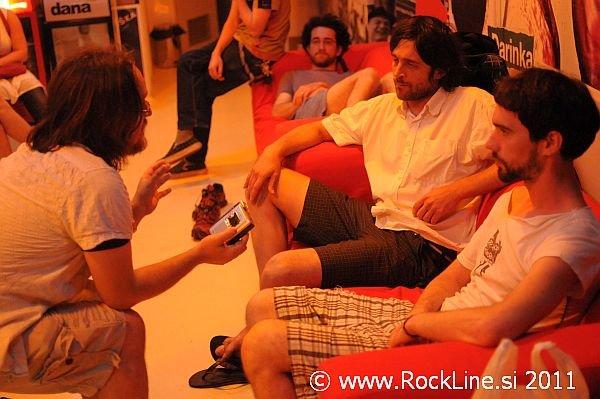
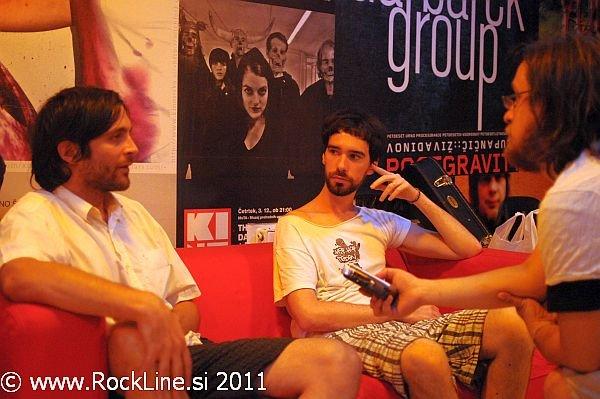
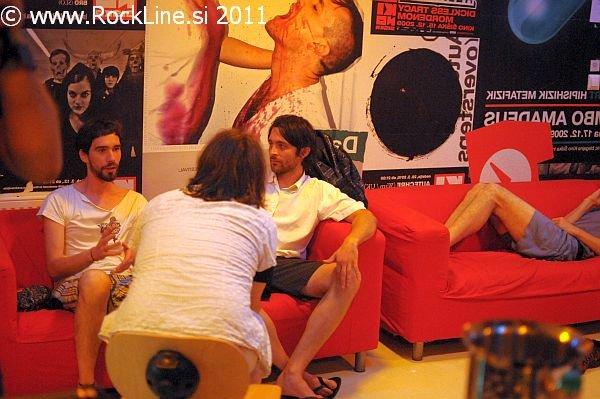
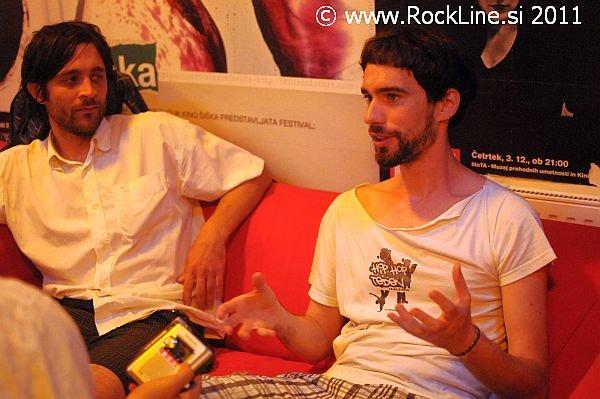
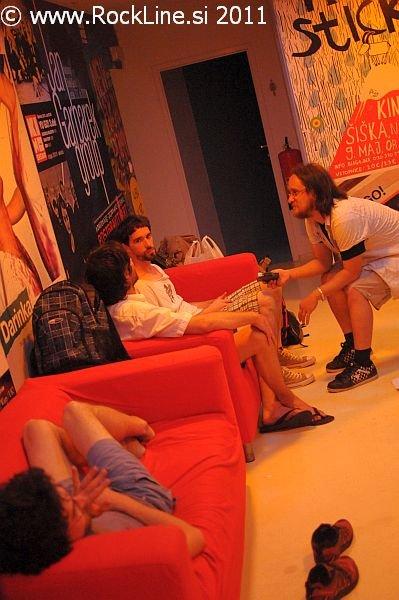
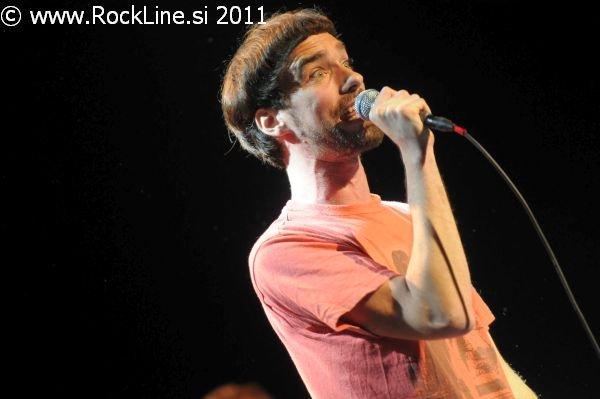
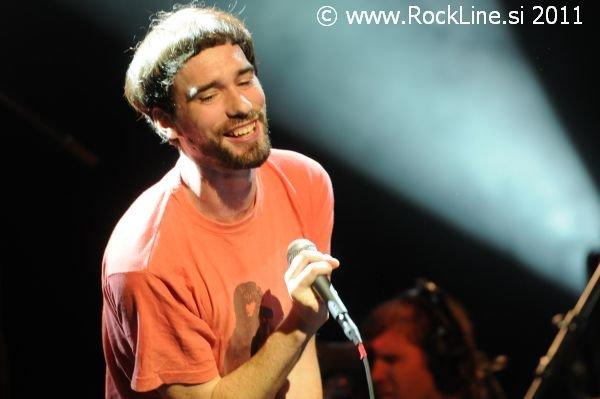
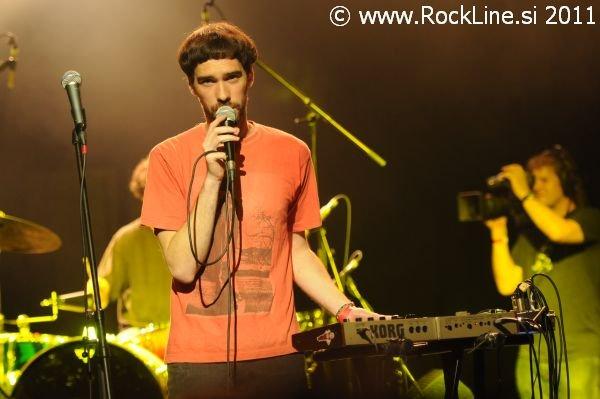
Statistics don’t lie: a band with plenty of talent, quality ideas and a creative core can survive ten years, record four albums and cement its position on the home scene as one of the main pillars of the alternative scene. We’re talking about Moveknowledgement and the fiery glow they’ve carried in an ever-changing, ever-fresh form from the first album Sun Sun, through Ant People and Listen To Nebukadnezar, all the way to the barely recognizable freshness of Pump Down!!! The fourth album was also the reason for a June gathering of old and new generations of fans of rock-based dub in Ljubljana’s temple of alternative urban culture, Kino Šiška. Before the baptism by fire and the on-stage launch of their fourth studio baby, we caught Miha Šajina and the guttural orator and wordsmith, vocalist N’Toko, backstage, one floor below the stage, in front of the mic. For you, the readers of RockLine, they revealed the state of mind and the reborn being of a band of a thousand faces and characters, yet with a single soul, hard as granite: Moveknowledgement.
It’s an honor and a pleasure that we get to see the story of Moveknowledgement continue live after 2007, this time at Kino Šiška. What have you been up to in the meantime? You’ve had some very turbulent times: you, N’Toko, were on the road in Japan the whole time. What was going on with the band as a whole, and how did communication flow between you during that period?
Miha Blažič – N’Toko: Pretty well, actually. The last stretch went like this: we recorded everything just before I set off on my trip. In the meantime, Miha Šajina mixed the material. We stayed in touch the whole time on the purely technical stuff, swapping files that I then recorded additional parts for in Japan. So we were actually in contact quite a lot.
The digital age makes it easy anyway: you hop on Skype and sort things out over the internet instantly. The difference, at least going by the interview you did for Polet, was in the actual working principle. How does writing the material for Pumpdown differ from what came before?
Miha Šajina: For the previous album, Listen To Nebukdanezar, I can say the songs came together a bit more spontaneously, from jams we cooked up, and then we picked a few bright spots from the pile and polished them. This time, half the album was already sitting in the computer as fragments, rough ideas, and then we took those rough sketches to rehearsals, where we really finished the whole thing. Still, this time the computer played a pretty important role in how the album came about.
How much time did it take for the album to go from the first idea to its final form?
N’Toko: Some songs were already finished back in the Nebukadnezar days, so since 2007, and we were already playing a few new songs on that tour. Now, after the tour, they’ve finally made it onto the record. Those are more than four years old.
Those are the songs we could already hear at the Metelkova summer stage and at Kapa festival?
N’Toko: Definitely, yeah! So then, basically… Maybe I’d say that about half of them actually came together in the last couple of months. Over the last two years, mostly. The guys wrote some while I was away, and some we still worked out together in the final phase before the studio. The songs came about while we were wrapping up the Nebukadnezar story and starting a new chapter with a new record. So the break for some creative rethinking was more than necessary for something new to come out.
So Moveknowledgement has gone through numerous phases of metamorphosis in this time. From the first record Sun Sun and the experimental forging of a common voice, Ant People hinted at what might come next, Nebukadnezar was the full bloom and renaissance of your sound, while Pump Down simply turns it on its head and deliberately drifts away from the path you set out on. Why did you decide on brighter contours and a sound that’s a bit friendlier to listeners?
Miha: I think it’s because Nebukadnezar was basically this dark, murky stew with few choruses. We kept part of the working principle going forward, but we set out to try something new and face new challenges. The challenge was really to write a few three-minute songs with killer choruses that would be a bit more accessible to a wider audience too. We didn’t want to make music just for critics to get off on, we wanted to get closer to the masses. And then we figured out that it’s not that easy. We actually enriched these songs a lot more, even though they look a lot simpler and more pop. So Miran Rudan is a real champ for getting so much across to so many people in such a short time…
N’Toko: It took us ten years to learn how to write a three-minute song. (laughs)
So stripping back those rich layers and coats of music was a real struggle for you as a band.
N’Toko: Definitely! Especially in a band that works on the principle of democracy, where all five members have a say and contribute their ideas, it’s really hard to pull together something compact and well arranged! Maybe also because we’ve known each other and made music together for quite a long time, we’re better at compromising now than back in our early days and first steps.
How does that democratic principle actually work in a band? With that many creative people, is consensus always needed, or does one of you sometimes win out?
Miha: Every now and then someone definitely wins out, but we’ve known each other so long and we’re such good friends that we know when we’re all heading toward something good. If someone comes up with something good, we don’t even think about butting heads over some ego thing. Like I said, the computer probably helped a lot here. Two members get together and record something, and the computer obeys and lays down whatever’s needed on some kind of grid. You don’t have a drummer nagging “not this, not that,” the computer just obeys nicely and does everything the way it should… (laughs)
David Cvelbar: They shut the drummer up… (laughs)
Miha: Yeah, of course! (laughs)
But the drummer is the only one with a color photo on the record…
Miha: Absolutely! (laughs)
So what’s the idea behind Pump Down as the name and concept of the album? I’m really into the little story you worked into the sleeve as an article, but tell it in your own words, live…
N’Toko: It turned out pretty randomly, since we didn’t have any overarching concept before the recording. But we did have the feeling the whole time that we were making a proper dance record, with lots of electronics. The previous one was more dubby, but this time we fed on electronics, and that gave us the inspiration that maybe it’s a bit of the nineties and techno meeting hip-hop at the core of the new record. That aesthetic is sort of in the background. But when we listened back to what we’d recorded, we realized it doesn’t sound anything like electronic music, rock’n’roll actually won out from start to finish! (laughs) The idea did stick, though: to hold on to some kind of naive dance music aesthetic, hence the title Pump Down. And the story the band put together draws on the song titles, which is where the content sneaks in. We have this sci-fi feeling in the songs the whole time, and you find a guiding line in both the sound and the lyrics. Put all the elements together and what comes out is something like Pump Down…
Miha: And then all you can say is “Pump Down! There’s no other way!”
So with those three exclamation marks, are you calling on people to pull the record off the net, to “pump” it off the net?
N’Toko: Oh, for sure! (laughs)
Miha: Exactly, let them pump it, and if they abuse it too much, we’ll pump them too… (laughs)
The record is brand new and the audience at Kino Šiška will hear it for the first time. So what can we expect from the live sequel to what you sow today?
N’Toko: We’ve basically hit zero now, right? Until now, whenever we recorded one album, we already had the next one in stock, because we progressed slowly with writing during production. But now we’ve recorded everything we wrote over these years and we don’t have a single song in the drawer. Everything we do from tomorrow on is a brave new world, so we’re open to any new ideas. Maybe we’re even leaning toward throwing ourselves into the Moveknowledgement Freepop Orchestra project…
That’s exactly what I wanted to pick up on. The bright contours of Pump Down are more reminiscent of the bright contours of Freepop Orchestra. How much has the bright beat of Freepop Orchestra overpowered the old dark matter of Moveknowledgement? Does that mean the next logical step is scrapping Moveknowledgement as such and keeping only Freepop Orchestra?
Miha: No. It’s really just a more extreme dance element that we all need, and once a year we let it out at Klub Gromki, and we all get a kick out of it and have fun. We’re all kind of hooked on dance, and that’s just how it is. The next thing about this record is that a few Slovenian electronic artists will take on a remix of it, since that idea was always there. We all DJ a little at night, and the idea was always that we could spin all these rock songs in some kind of dance form. In the fall, if all goes well, it might see the light of day and come out. Rocktex, Novia, Nataša Muševič, Poll A Rock and New Wave Syria are supposed to do the remixes, so an interesting re-issue of the songs in a new guise is on the way.
You’ve also been DJing a lot around the place yourself in this time. Will you have a hand in the remixes too?
Miha: I think we’ll all give it a try! We’ll try to find our own expression and a new connection with music through the knobs, and then we’ll see…
At the same time, we can’t ignore the fact that you, N’Toko, are a very prolific solo artist. Your new solo record came out recently. How do your solo path and the Moveknowledgement path coexist, in terms of the time you can give to your different musical personalities?
N’Toko: For now I can say time wouldn’t even be that much of a problem, the problem is more my physical presence. This is the second time in a row I’ve kind of screwed over the band with a long absence, since the band couldn’t play live during that time. That seems like the main downside to me. It has nothing to do with liking to do solo stuff, more with the fact that I just love to travel and that’s a big part of my life.
Did you manage to introduce Japanese audiences to Moveknowledgement in this form, the idea and the music of the band, during that time? Maybe a band adventure across the land of the rising sun is coming soon? Maybe a leap into an ocean of unimagined possibilities and a dive into a completely different mental current?
N’Toko: One unexpected thing that can happen to you in Japan is realizing that making it can be way more screwed up everywhere else than it is here, in the music world. Alternative bands there have much less in the way of resources and money than we have here, even though our situation isn’t exactly rosy… I’ve often wondered, because even when I go there solo with no costs other than myself, I barely scrape by and a concert tour in Japan doesn’t pay for itself, how amazing it would be to have Moveknowledgement play there. We’d undoubtedly tear it up in that scene! But then I stop and start adding up the numbers for five plane tickets and five bullet train tickets to some part of the country… There’s no math or money in it, it’s nothing but expenses, and then you subtract the cost of renting venues where we could play… Even that realization can be a good thing, because I’ve seen bands that are maybe better than us, and are undoubtedly more established and more experienced, and they can only dream of playing venues like Kino Šiška and of the conditions we have here. They play in dives of a kind we almost don’t have anywhere in Slovenia… That gave me a ton of motivation, and I think we shouldn’t be spoiled. When you see guys over there who are two ranks or more above us and don’t have even half the options we do, so… When I go up on stage today, the happiness and awareness that come with that realization can only be that much bigger, and the enjoyment to match, and hopefully the payoff too…
So what comes after you tour Slovenia with four shows on this Pump Down tour? After Kino Šiška, Kranj, Lent and Mostovna, what’s next… Do you have plans for festival gigs or even places beyond our borders?
Miha: We’ve already covered quite a bit of our common European homeland: France, Hungary, Germany, the Czech Republic, Slovakia… Now we’re going back to our roots and we plan to visit places we’ve kind of neglected so far. In our whole live career I don’t know if we’ve had more than three shows in ex-Yugoslavia. Given that we wanted to make a dance record, but to my mind it came out very punk, we think this music is great and suitable for presenting in the Balkans too, since Yugoslavia was full of punk and it flourished back then. I think that’s awesome, rather than going out into Europe, to England or France. Let’s head to Serbia, Macedonia, Bosnia… So I can confirm that some arrangements are in the works, and things are opening up more concretely for Serbia, where we’re supposed to play a few shows and do a small tour, and we’re honestly and wholeheartedly looking forward to these gigs and to places we haven’t been yet!
What about video promotion? Average Bear is already out there with a pretty rudimentary video that presents you as aesthetic minimalists. Do you have more videos planned, and if so, which (un)established directors do you have in mind for that kind of collaboration?
Miha: Actually, it’s all more or less sorted already. The video will be shot here at Kino Šiška, where they offered us the space, and the shoot is planned for the end of August. The ideas are already there, everything is more or less worked out, so there’ll be animation involved too, and we’ll probably be shooting a video for the song Hands, in a shortened form. The song is six and a half minutes long, and a video that long would be pointless and expensive. We got ourselves a kind of guerrilla crew that will do it on a small budget and still at a high level. We’ll only set a bit of money aside for the editor, and we’re excited again to pull off something fresh. The point of the video, and I won’t give too much away, is that once again we’ll make fun of ourselves and present ourselves as fools.
And have a blast doing it…
Miha: Have a blast, absolutely!
One last question. Short-term and long-term plans, and a message to our readers.
N’Toko: What are our long-term and short-term plans? Short-term, survive the show (laughs), have one quality, awesome party, and then celebrate that the baptism by fire is behind us and that we put together one quality record. Then a few more summer gigs, make the video, record and release the remixes, and then work the Slovenian club circuit a bit more.
And let’s meet again in ten years and celebrate the band’s 20th anniversary together…
Miha: That would be phenomenal. Let’s hope so!
Dejan Slak: After we get back from America… (laughs)
photos: Aleš Podbrežnik
Photo Gallery