Author: Rok Klemše
Location: Ljubljana
Interview date: 19.02.2011
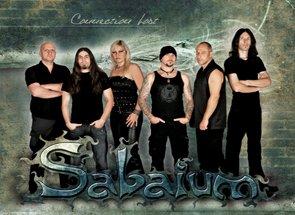
Styrian outfit Sabaium can boast being one of the longest continuously active metal bands in Slovenia, going strong since 1994 (back then still under the name Catacomb). Over their career they’ve put out four studio albums mixing (melodic) death metal with gothic metal influences, and the latest one, Connection Lost, just came out. After a long absence, longtime founding member Milko Kraner has also returned to the fold. We talked to David Kupčič (guitar) and Milko (vocals) about how the new record came together and a few other things.
RockLine: You recently released a new album, Connection Lost, and Milko came back to the band after a long break, bringing a lot of creative energy with him.
Milko: Yeah, we kind of found each other again, while I was playing in another band in the meantime. We stayed on friendly terms, and it just so happened that the urge came up to give Sabaium’s music a fresh jolt of energy with a different approach and clean vocals. All it took was one drink and that was that.
RockLine: So were the songs on the album already written before you came back?
Milko: Yeah, basically yes, apart from maybe a couple of tracks. The rough foundation for two songs already existed earlier, and they’re on the album now in an updated form.
David: While we were apart, some song seeds came about. The album needed filling out, so we said, why not use the old material we’d worked on together. We tried playing it to see if we could update it, freshen it up, add a new riff here and there, and that’s how it came together.
Milko: David wrote the lyrics, and I put the vocal lines over the instrumental parts.
RockLine: How does this record fit into Sabaium’s discography compared to your earlier releases?
Milko: It’s a bit different.
David: If you look at all four albums, the first two are similar in style, they follow the same thread. Then Milko and I parted ways and the third record went more in a death metal direction. We always wrote material for all of them, Milko-less ones included, and now that he’s back, what came out is a kind of hybrid of the first three records.
Milko: Instrumentally this album is faster, probably more so than if I’d been involved from the start. I contributed more on the melody side. You can tell from the first two records that I’m more into catchy, melodic stuff.
RockLine: More gothic waters?
Milko: Yeah, more, yeah.
RockLine: Your vocals also give the melodic death metal base a certain gothic flavor. They remind me of mid-period Paradise Lost, for example.
Milko: Yeah, we’ve been listening to them forever, and they’re definitely an influence on our music.
David: They’re one of our favorite bands and one of our biggest role models. We’ve never copied bands, but you can definitely hear the influence of the music we listen to.
RockLine: Design-wise, sound-wise and production-wise, the new record is a huge leap in quality compared to your earlier stuff. Especially the production, which was handled by Dalija at dB Recordings studios.
Milko: Yeah, I’d agree.
David: Yeah, that was the point. To be completely honest, we’ve been at this for a while, as hobbyists, sure, but that’s just the fate of our scene. Still, I think that after so many years of existence we couldn’t even afford to put out a half-baked product. We do know a thing or two by now, and if we’d gone at it half-heartedly, we could’ve spoiled the whole picture.
RockLine: I guess Jure (Vandur, guitar, ed.) also brought some influence and freshness to the band?
David: Yeah, absolutely. Age-wise he’s the youngest member, and being his age he listens to that kind of music too, he’s a fan of the Gothenburg melodic death metal scene. He definitely contributed something.
RockLine: How do you write songs? Do you start from riffs, from lyrics?
Milko: More from the instrumental side, yeah. Then David takes over the lyrics.
David: Yeah, so far it’s worked like this: we wrote the instrumental parts first. But we’re thinking of changing the concept in the future, so we don’t wait so long for the whole instrumental picture to be built, and instead try adding riff by riff and vocal lines earlier. We’ve already ended up in a situation, for example, where we instrumentalists wrote parts we thought were excellent, and then the vocals just wouldn’t fit them no matter what.
Milko: Clean vocals need a more dynamic instrumental backing anyway, so we’ll have to do quite a bit of coordinating on that front in the future.
RockLine: You can already tell on this record that you’ve found the right balance between growls, clean vocals and the instrumental backing.
Milko: Yeah, the starting point was that I said I’m not going to just stand around on stage for nothing, I’m going to sing on every song (laughs). Then I looked for parts where good clean vocals could work.
David: Honestly, it turned out really well. We had most of the songs roughly done instrumentally and had no idea what would happen with the vocals. We started talking about how Milko would come back so it wouldn’t be just growls, since those can get really bland. Most of the time, even once we were in the studio, the rest of us didn’t know everything. Time was pushing us a bit, and Jure and Milko did a lot of work on their own, so the rest of us only heard the final shape of the album in the studio during mixing.
RockLine: How much influence did Dali have on the sound and the overall feel of the record, considering he’s one of the best metal producers in Slovenia?
David: He’s definitely responsible for a lot of the finesse, and there are definitely some of his ideas on the album, and we changed a few things too. We reworked a lot of the guitar stuff together. I also had to drop some of my parts because he suggested something different, and on his suggestion they were written from scratch. I’m really happy with the result and with working with Dali.
RockLine: So you’ll stick with him in the future?
David: Yeah, if we record anything else, definitely. I think there’s pretty much no alternative for metal music here.
RockLine: A big part of the album’s atmosphere and ambience comes from the keyboards, which I think are woven into the music much better than before.
David: Yeah, you could say that. But that feeling comes from the combination of vocals, I think it would be different with growls only. The synths fit clean vocals much better, in my opinion. Dali also dropped a couple of ideas, especially when it comes to harmonies and that kind of thing.
RockLine: The lyrics are your domain, David?
David: Yeah, I mostly have to write the lyrics, and I’m doomed to it (laughs).
RockLine: On Connection Lost there’s a kind of common lyrical theme, that humanity has lost touch with itself?
David: Yeah, you can see it every day on the news. Greed, killing, everything for money and material gain. Fellow human beings don’t matter, friendship doesn’t matter, everything gets sold for money. Watch the news for a bit and you’ve got your topic. Stylistically I’m more drawn to darker themes, things that weigh on my soul. We won’t be singing about love… well, maybe, but in a dark way.
RockLine: Your lyrics have been entirely in English for a while now. Can we expect another attempt in Slovenian like Tiha pesem?
David: I think so, yeah.
Milko: Back then it seemed interesting to us, since there was almost nothing like it in metal.
David: Definitely, the point isn’t that we’d be ashamed of the Slovenian language. But I have to admit that personally it’s harder for me to write a good lyric in Slovenian.
Milko: Although, if you listen to Jan right now (laughs) (a track by Latin lover Jan Plestenjak had just come on the radio, ed.)
RockLine: Your lineup has also changed a bit on stage. Jure took over a big chunk of the growls, and you, Milko, now do the clean parts. Have you played in this lineup yet?
Milko: Yeah yeah, we have. It works, it works. The older, angrier parts are still handled by David, but otherwise I think it works really well.
RockLine: Is there another tour as extensive as the one with Interceptor on the horizon?
David: Yeah, we hope so. We ran out of steam a bit, since we put a lot of energy into getting the album out and designing the cover, and with all that coordination we had nothing left to line up more gigs. But I think we’ll get there slowly.
RockLine: If I’m not mistaken, you’re also planning to shoot a music video?
David: Yeah, we’ve already shot it, and we’re talking about adding some extras. We’re working on that at the moment.
RockLine: Who directed it?
David: Basically we filmed it with a buddy.
Milko: Totally low-budget. We’ll see what comes out. The footage still needs polishing.
David: I think we’ll go the totally classic route, YouTube, Facebook, which is the best way to promote these days. If a TV station picks up the video, great, if not, no big deal.
RockLine: What are the plans for the near future?
Milko: A few gigs this year for sure, but again not so many that we’d be playing non-stop.
David: We have day jobs, so that doesn’t work either. We’re not spring chickens anymore who can go to school and skip class. We have serious jobs and some of us have families too. This is still our hobby, and we enjoy it purely as amateurs.
Milko: We just want a gig or two a month.
David: For us it’s also about hanging out. We don’t sit around in the pub, we meet up at rehearsals.
Milko: And going forward I hope the ideas keep coming and a new cycle kicks off.
David: Yeah, after all, we’ve been held together for quite a while now, since 1993, 1994.
RockLine: It’ll be interesting to hear material written from scratch with Milko on board?
David: Yeah, definitely. That’s why I mentioned earlier that the concept needs to change. So that we’re all involved from the start, so there isn’t already a finished guitar part, for example.
Milko: Yeah, so the vocals get easier to work out too.
David: I think we need to take advantage of that, the potential is there.
Milko: It’ll be a bit more melodic going forward, but still energetic.
David: And we’ll stick with it. It means a lot that we’re also friends, since we hang out in our free time too. We’re not some professional musicians who see each other for an hour of rehearsal and punch the clock.
Photo gallery