Author: Peter Podbrežnik
Photos: Aleš Podbrežnik
Location: Prague / Forum Karlin / Czech Republic
Concert date: 15.09.2016
Attendance: 2500
Ticket price: 52,00€
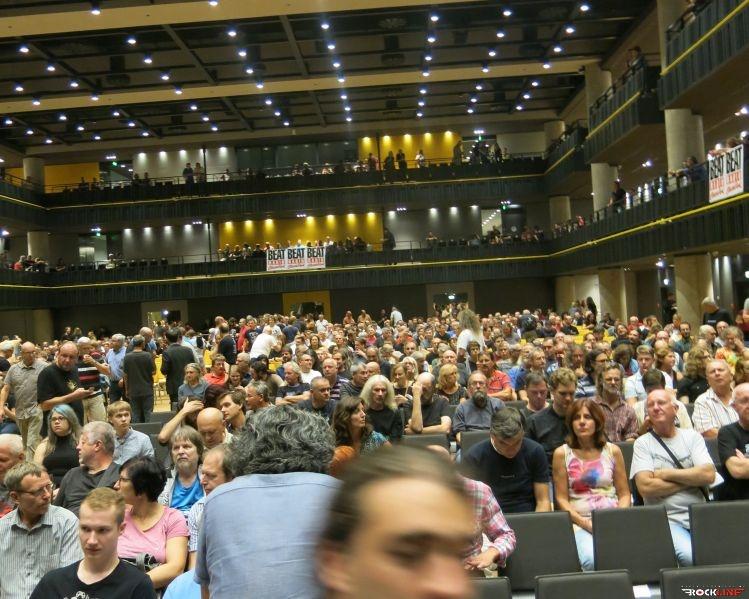
A daring four-man Rockline expedition was sent into the heart of the Czech capital, Prague, a picturesque city with an incredibly rich architectural and cultural heritage, with one special mission: to see the British music legends and progressive rock pioneers King Crimson live for the first time. The band has recently risen from the dead after their chieftain, the cult guitarist, composer and sonic innovator Robert Fripp, realized by his own account that »his life had become far too comfortable, so he needed a sharpened stick to rouse him from his sleep«. And so the latest, seven-piece incarnation of King Crimson was born, with not one, not two, but three drummers, and it hit the road first in America, then in Japan, and finally on the long-awaited European tour. Their show at the gorgeous Prague hall Forum Karlin was sold out, just like the night before, and the merch stand was swarmed with fired-up fans who, for the first time in more than twenty years, were getting the chance to finally see one of the most important bands in progressive rock history, if not the most important one, live.
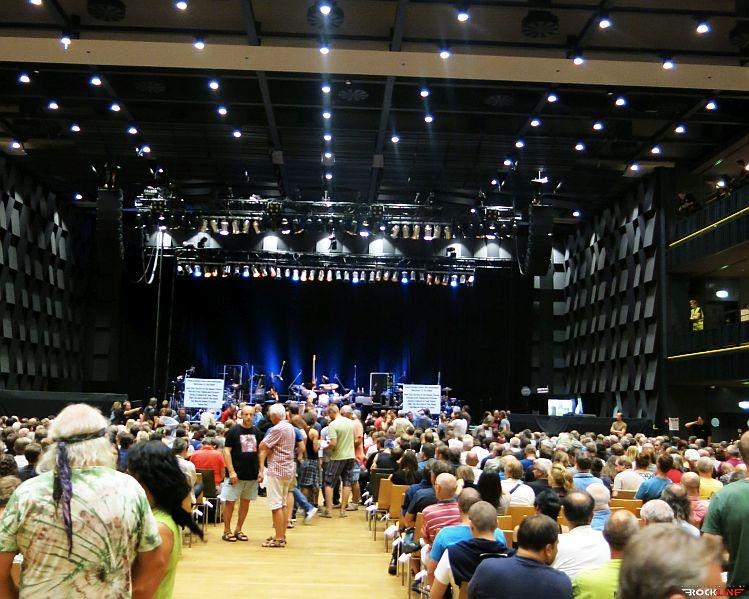
A King Crimson concert has been considered something special since their beginnings in the late sixties, and not just because of the musical performance itself, the experimental nature of their music and the band members’ enviable technical chops, but also because of the stage choreography, which largely reflects Fripp’s ‘somewhat’ eccentric nature and rather unusual attitude toward the audience, which is in many ways, justifiably and unjustifiably, tied to his long-standing resistance to the music industry. A lot has already been said in the past about Fripp’s controversial disdain for the very concept of a ‘typical’ rock concert and all the clichés that come with it, but it’s still worth mentioning that the view of the stage, right before the masters of sonic experiments and unbridled improvisation walked on, was a rather special sight for frequent concertgoers (not just rock ones).
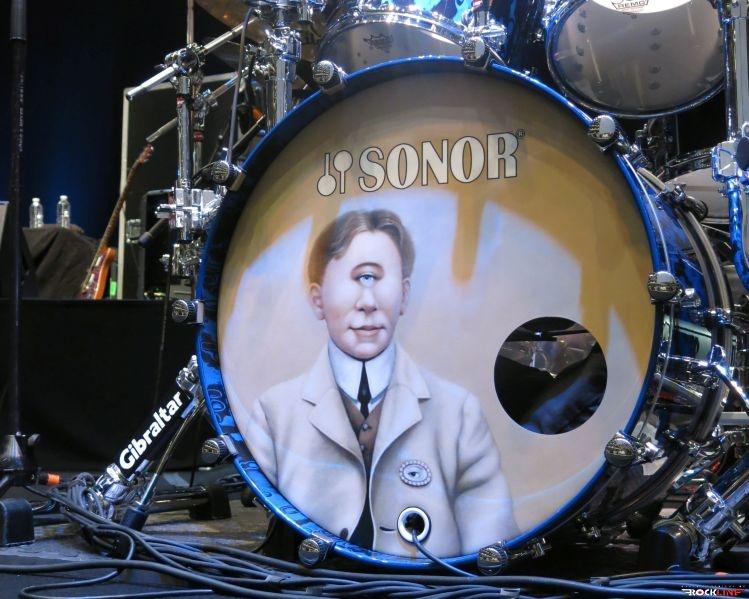
In the left and right corners of the stage hung posters with some rather dictatorial warnings (straight out of Fripp’s head) that any photography during the show is strictly forbidden. You can only take pictures once the band finishes its set and longtime bassist Tony Levin starts photographing the audience, as is his habit. Otherwise sanctions follow: anyone who breaks the rule gets escorted out of the hall and has to wait there until the show is over. We had no choice but to take a few shots of the impressive drum setup, made up of three drum kits, the most impressive of which belonged to the grandmaster Gavin Harrison, whom fans of Porcupine Tree know very well, although the drums of longtime drummer Pat Mastelotto were also bristling with all sorts of unusual percussion ‘gadgets’.
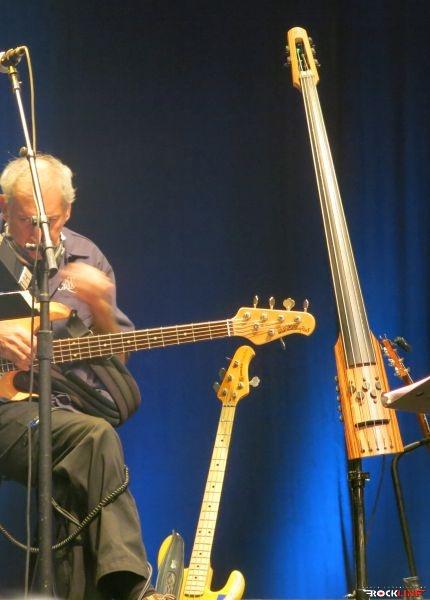
The drum setup of newcomer Jeremy Stacey, who replaced Bill Rieflin right before the European tour and thus made sure King Crimson are, for the first time in ages, more English than American when it comes to the members’ citizenship, looked a bit more modest, but the guy had a whole pile of pedals and gadgets set up on the floor, which he used to create all kinds of sound effects and occasionally stand in for actual keyboards. The keyboard duties, though, were mostly handled by the ‘pater familias’ Fripp himself, whose famous stool was planted high above all the other members so that he could watch them, or rather, supervise them, with his stern gaze throughout the show. Not the tiniest detail escaped his eye, even while the master of ‘soundscapes’ was playing the most demanding guitar solos. Levin, who switched between electric upright bass, Chapman Stick and bass guitar as needed, was positioned between Fripp’s ‘old buddy’, the woodwind player Mel Collins (with whom the genius-eccentric guitarist last performed live back in 1972) and the new singer / guitarist Jakko Jakszyk. With his excellent singing, the latter proved live to be a virtually ideal replacement for the legendary Greg Lake and John Wetton.
That night King Crimson delivered a downright fantastic selection of performances from almost all chapters of their incredibly rich history, with an emphasis on the classic era (1969-1974), which, thanks to its influence on the development of progressive rock, was certainly their most important and, in the opinion of many fans, also their best. Fripp and his disciplined buddies also played three instrumentals from the era with former singer / guitarist Adrian Belew and a few completely new pieces that bode well for a possible studio future, while the only key phase of the legendary band they skipped was the eighties, mainly because Jakko’s and Adrian’s voices are quite different from each other. That’s exactly why performing eighties evergreens such as »Elephant Talk«, »Waiting Man«, »Sleepless« and »Three of a Perfect Pair« wouldn’t have had the right effect or made much sense.
Because Fripp had (way too) long ignored playing material from the classic King Crimson era on tours over the past three decades, we were especially happy that he played numerous classics that night that he hadn’t played live since the mid-seventies, while two songs from the ‘ancient’ period were played for the very first time in their history on the current tour. The first of them was a real treat, »The Battle of Glass Tears – Part I: Dawn Song«, which is part of the epic, more than twenty-three-minute suite »Lizard« from the album of the same name. It was probably the biggest surprise of the whole evening, right at the start of the show, which opened with the new, improvisation-driven instrumental »Hell Hounds of Krim«. The vocal section from that all-too-often overlooked record, originally sung by Gordon Haskell, is quite short, yet it was one of the most pleasant surprises of the night, since Fripp and company started playing material from the album »Lizard« (1970) only on this European tour. Should their paths ever cross again with former Yes singer Jon Anderson, they absolutely have to invite him to guest, this time live, on the opening »Lizard« section titled »Prince Rupert Awakes«.
At least one song was played from every King Crimson album except the three records released in the eighties, which was certainly a commendable and impressive feat. With »In The Wake of Poseidon« (1970) we got the jazz-rock-fusion rouser »Pictures of a City«, once known under the working title »A Man, A City«, which, with its eco-awakening message, once again reminded us how far ahead of their time King Crimson, those incredible sonic and conceptual visionaries, were right at the start of their career. Too bad they didn’t play anything else from that album, say the title track, given that Fripp, Collins and Stacey covered all the orchestral arrangements, led by the Mellotron, so successfully. »The Court of the Crimson King«, one of their most recognizable evergreens, is usually played as an encore, so it was a big surprise that they played it already in the first half of the show, which was split into two parts with a fifteen-minute break so that ‘daddy’ Fripp could gather some fresh atoms of energy for the ‘second round’.
Jakszyk sang the »Lizard« classic »Cirkus« beautifully, while us improvisation lovers got our fill with »Fracture«, the fan-favorite improvised instrumental armageddon from »Starless And Bible Black« (1974). »Fracture« got its title from the injury and departure of former drummer / percussionist Jamie Muir, whose ideal successor that night was actually Stacey, and partly Mastelotto with his unusual percussive ‘danglers’. Jakko’s wonderful vocal abilities shone again on the always hugely entertaining critique of capitalism, »Easy Money« (»Larks’ Tongues in Aspic«, 1973), while the drummer trio came fully alive again on the new instrumental »Radical Action (To Unseat the Hold of Moneky Mind)«. Among the new pieces, »Meltdown«, whose structure strongly recalls some evergreens from the classic era, impressed us almost the most. »The Talking Drum« was, as expected, one of the central drum moments of the night, with Harrison especially coming alive, and he ‘ground up’ everything in front of him that evening, overshadowing even a drummer as technically gifted as Mastelotto. Because of his relatively youthful look next to the other two drum buddies, most people tend to forget that Gavin also has an extremely rich résumé behind him and that his professional career goes all the way back to 1979.
All three drummers complemented each other very well, even though Stacey often ‘rested’ a bit and handled sound samples in the meantime, while Harrison and Mastelotto got tangled up in duels several times, with Gavin coming out as the winner. With his technique and incredible sense of precision, combinatorics and improvisation, he may well be the most distinguished drummer on the entire progressive rock scene right now. Fripp and company closed the first part of the show with a bravura version of the evergreen instrumental »Larks’ Tongues in Aspic – Part II«, which, along with »Red«, sadly not heard that night, is one of the very few songs from the classic era that King Crimson also played during the Belew period.
After the fifteen-minute break came the second part of the show, which likewise featured numerous long-time treats, not just ones from the sixties and seventies but also three instrumentals created between 1994 and 2003. The first of those instrumentals was »VROOOM« (»Thrak«, 1995), which successfully stood in for the kindred classic »Red«, with Collins’ saxophone parts especially delighting, as they cleverly rearranged the original sonic look of this dark energy catalyst. The newly rearranged »The ConstruKction of Light«, from the album of the same name, and »Level Five« (»The Power to Believe«, 2003), reworked into complete instrumentals, also came off very convincingly, and with their wind additions and somewhat less dirty guitar lines than on the original versions, they lost none of their punch.
Worshippers of the original King Crimson, which in the opinion of many fans is still their best, were especially delighted by the wonderful performance of the masterpiece »Epitaph« from »In the Court of the Crimson King« (1969). It was a vocally extremely demanding piece, but Jakko once again wowed us with his brilliant singing talent, so we didn’t miss the young Greg Lake from the original at all. The ‘Crimson kings’ didn’t forget the album »Islands« (1971) either, from which they played the phantasmagorical »The Letters«, which was another vocal challenge Jakszyk passed with flying colors, as he sang the whole thing better than the singer on the original version, the sadly late Boz Burrell. »One Red Nightmare« (»Red«, 1974) was among the bigger surprises of the night, since it’s one of the few classic songs King Crimson had never played live before, so all the longtime fans were especially thrilled that, after so many decades, they finally remembered it. The perfect masterful finale to the main set was the epic masterpiece »Starless«, which came off more than fantastic and left us with our jaws on the floor.
King Crimson opened the encore with a ‘warm-up’ in the form of the new instrumental »Banshee Legs Bell Hassle«, followed by the third big surprise of the night – a cover of »Heroes«, the unforgettable hit from the treasury of the legendary and sadly late David Bowie. It’s worth noting that King Crimson haven’t played many covers in their long and turbulent career; in fact, only three cases are known. The original lineup played The Beatles evergreen »Lucy in the Sky With Diamonds« in rehearsals between 1968 and 1969, while they played Donovan’s »Get Thy Bearings« live several times. The third cover, not counting their special adaptation of »Mars«, the classical piece by the composer Gustav Holst, was Bowie’s »Heroes«, which they first played live back when Belew was in the lineup. There were at least two reasons for bringing »Heroes« back to the setlist after so long: Bowie’s recent death, and the fact that Fripp played on the original 1977 version, which means next year will already be the fortieth anniversary of this cult song. This lovely and, for Fripp, rather unusual gesture certainly deserves praise, as do the flawless performance and Jakko’s excellent vocal interpretation.
For the big finale, King Crimson played »21st Century Schizoid Man«, their most recognized masterpiece, with which Fripp said everything he had to say about his contribution to the roots of heavy metal back in 1969, after which, having co-created it, he got bored with it pretty quickly. So he preferred to dedicate himself to far more exciting sonic adventures, although metal elements still crept back into his music from time to time. Around the middle of the performance, Harrison was given plenty of room for a breathtaking drum solo, after which the whole band joined him and drove everything to a triumphant finale.
The show by the crimson kings of progressive rock in Prague, despite the respectable length of the concert, flew by ‘in a blink’ for most of us, which says the most about how great this unforgettable evening was, one we’ll remember in every respect for a long time, in the most positive way. The sound, not to mention the atmosphere that took us back to the golden years of progressive rock, was fantastic, which surprised only those who don’t know the sonic perfectionism of the master Fripp and his comrades-in-arms. The band members, who didn’t say a single word between songs all night, did come out to greet the audience after the show, while Levin, in his usual manner, took a few photos of the faithful fans. It was almost funny watching Fripp, who slowly rose from his stool with robotic movements and joined his bandmates, then very slowly and extremely carefully looked toward the audience without uttering a word or showing a trace of any emotion. Right before the robotic exit from the stage, he even took a selfie, and many in the crowd were once again struck by how thin the line between genius and madman really is.
The eccentric elder statesman of progressive rock did absolutely everything to keep his band’s show from coming off as an ordinary rock concert, whatever he imagines that to be, but his silence, with not a single word to the audience or even a brief thank-you, not counting his tasteless, pre-recorded, dictatorial instructions on what you can and can’t do before the show even starts, went a bit too far, even for fans who’ve seen it all and had to wait decades to hear their favorite songs live again (or for the first time). That’s also the only criticism of what was, in every other respect, one of the best concerts the Rockline crew has ever attended, including the author of these lines, for whom King Crimson are even the favorite band. We waited long, way too long, but the chance for a close encounter with King Crimson finally came, and they rewarded us with a spectacular show that glided between hell and heaven with utterly convincing ambient mastery, all while casually unleashing a good number of drum cataclysms.
In two years it will be fifty years since the band’s formation, and if Fripp manages to hold out until then without being gripped again by that fever of hatred for the music industry that has usually been behind his (un)considered decisions to break up the band, they might even manage to release a new studio album for the occasion, especially since the new material shows great promise. If not, they’ll still be bowing out in more than fitting fashion, having more than successfully closed their circle. Right now, along with Van Der Graaf Generator, Hawkwind, Camel and Caravan, they’re one of the last ‘old-school’ progressive rock bands still active and relevant (on stage and in the studio), since Yes have been little more than a tribute band for a while now, while the chances of a Genesis reunion, even though they officially haven’t split since their revival in 2006, get slimmer with every passing year.
Setlist
first set:
1. Hell Hounds of Krim
2. Lizard (“The Battle of Glass Tears – Part I: Dawn Song”)
3. Radical Action II
4. Pictures of a City
5. The Court of the Crimson King
6. Cirkus
7. Fracture
8. Interlude
9. Easy Money
10. Radical Action (To Unseat the Hold of Monkey Mind)
11. Meltdown
12. The Talking Drum
13. Larks’ Tongues in Aspic, Part Two
second set:
14. Devil Dogs of Tessellation Row
15. VROOOM
16. Epitaph
17. The ConstruKction of Light
18. Level Five
19. The Letters
20. One More Red Nightmare
21. Starless
—encore—:
22. Banshee Legs Bell Hassle
23. Heroes
24. 21st Century Schizoid Man
Photo Gallery