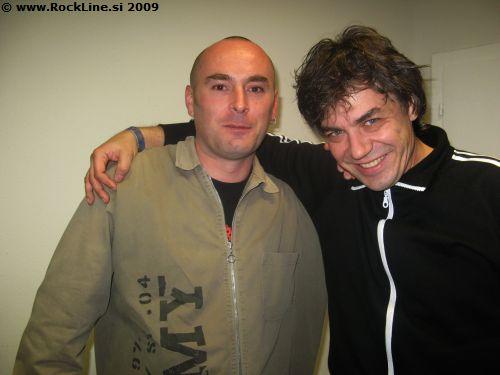
Location: Orto bar / Ljubljana / Slovenia
Interview date: 09.12.2009
Vatrene ulice are a band with a colorful history. Formed back in 1990, they caught a whiff of the eighties, when Yu rock was raging, a breath of post-punk, and picked up the nineties grunge boom, but when you listen to them, they define a musical figure all their own, with a recognizable sound and character that you just can’t pin to any genre. Why did they die out for a few years and then get born again? One of the reasons was certainly the Homeland War that raged on Croatian soil in the previous decade. Vatrene ulice can only be rock. And on top of that, really good rock. This year the band put out only their second studio album, which they like to describe as really their first proper studio album. Why that is comes through in the interesting conversation we had with the band right before their gig at Orto bar on 09.12.2009, when they got the chance to promote their fresh studio release titled “9 po Richteru” (2009) – RockLine review HERE.
In the backstage area of Ljubljana’s Orto bar, I was first joined by drummer Marijo Barić and guitarist Marin Jovanovac. Later in the conversation the guys swapped roles, and the interview was wrapped up by Vatrene ulice’s bandleader, singer and lyricist Goran Filipančić – Fila.
RockLine: How come it took you a full twenty years to get to your second album?
Marijo: Well, this is actually our first real studio album. The main reason for that is first and foremost the Homeland War that raged across Croatia. Our singer Fila took an active part in it, and so did I…
Marin: I was six years old back then…
Marijo: Marin was watching Professor Balthazar and Pink Panther cartoons at the time, ha, ha… The first album was recorded by Fila alone. He lived in Slovenia for quite a while. With the help of our dear friends Dance Mamblita from Slovenia, I don’t know if you’ve heard of them?
RockLine: Sadly, no.
Marijo: They’re five guys from Koper, and we’re still on very good terms with them today. I’ve been with Vatrene ulice since the beginning, but in between there was the war, then university, Fila went off to Slovenia, then marriages, kids,…. So we really only came back to the scene in 1998. The old Vatrene ulice again, we recorded that first album, played at the Kulušić club (an old rock club in Zagreb that’s no longer running, editor’s note), and a couple of great gigs followed. Then we got back to work, and here’s the new album, which we ourselves call the first real Vatrene ulice album. Even though it’s the second.
Marin: In the sense that the whole quartet actually took part in it, as a band.
Marijo: We pooled some money and went into the studio of the guy who produced Švigija’s album for us. He’s a very well-respected producer in Croatia, a top-notch one. The label Dallas really liked the final product.
Marin: Yeah, they really liked it. And we ran into the same old story. They couldn’t place us anywhere, genre-wise.
Marijo: And we’re basically a bunch of kids, except for Marin, who grew up on the new wave. Meaning bands like EKV, Partibrejkers, Haustor, the old Zabranjeno pušenje and so on. So you can hear that in our music too. Fila writes the lyrics, but he’s not an arranger. That means he comes in with a song and plays it to us on guitar. Then each of us goes at it in our own way, and that’s how the song comes together.
Marin: The reason you can’t pin our musical style down is that each of us listens to different music. Three of the guys in the band are “new wavers”, I’m quite a bit younger, and I listen to everything from Pink Floyd to Crosby Stills & Nash, Neil Young, mostly all those older bands, though I belong to the “grunge” generation.
RockLine: The songs on “9 po Richteru” were written over a period of ten years, right? Are some of them really old and their arrangements changed a lot from the originals, or not?
Marijo: Yes, they were written over a span of ten years. We can say that. But the songs aren’t really that old. A few of them were made completely “from scratch”. Ten songs on the album are totally new.
Fila: This album is really our “best of”. After waiting so many years for a proper label to put out an album, that’s hardly surprising.
Marijo: So only two songs on this album are older and newly arranged. Those are Dok padaju glave and Moja generacija. They’re done much better now. The rest are our joint product, written recently.
Fila: When we showed up at Jugoton in 1991 (the former Yugoslav record label, editor’s note) and brought our demo, they promised we might be able to put out an album with them. Then Škarica (Siniša Škarica, Jugoton’s editor-in-chief at the time, editor’s note) told us later: “Guys, there’s a war on! You’re the last thing we need!” But in the period before the war the climate was great. We were packing every club in Zagreb.
RockLine: You probably have a ton of unused ideas left for a new album. Will a new album follow the current one soon?
Marijo: Well, actually even this first album hasn’t yet given everything it has to give. Right now we’re about to release the album’s second single, Kreni. Music video shoots are on the way. We have to promote the album as well as we can.
RockLine: Are you happy with Dallas’s promotion?
Marijo: Fila? Are there any people in the club in front of the stage?
Fila: Yeah, a few.
Marijo: Well then, we’re very happy.
Fila: Did you see any posters for tonight’s gig?
RockLine: No.
Fila: See,… Dallas works harder for the big stars.
RockLine: If I can provoke a little and compare Slovenia with Croatia musically. What I notice is that Croatian rock bands usually have the rhythm all figured out, while Slovenian ones often don’t. On the flip side, Slovenian metal is a lot stronger than Croatian…
Fila: I wouldn’t exactly agree with that. Do you know Dance Mamblita?
RockLine: No.
Marijo: He doesn’t. I already asked him that myself.
Fila: Really? You don’t know them? They’ve toured all over Slovenia in the last two years. The band is led by Boris and Andrej, who used to play in Valter brani Sarajevo. Bass player and drummer. At the end of this month Dance Mamblita are putting out their second album on Radio Študent.
Marijo: They’re our good friends. When they opened for us at the “Jabuka” club in Zagreb, it turned out to be a great idea. They were made to warm up the crowd. A great band. You’ve got to check them out.
RockLine: So how does the crowd in Croatia get fired up for Vatrene ulice?
Marijo: See, we’re a mixed bunch. Guitarist Marin comes from Velika Gorica, I’m from Zagreb, Ferenščica to be exact, bass player Daniel comes from Slavonia, Fila is from Zagreb. But we all live in Zagreb. The first lineup of Vatrene ulice was all Zagreb natives. And lots of people have passed through the band, now the lineup has crystallized. And many people don’t get that. Fila picks sociological themes for his lyrics. He weaves in experiences from love affairs…
RockLine: The lyrics on “9 po Richteru” are really excellent.
Marijo: They are excellent. And get this. Everything Fila sings about, he actually lived through. Take the song Huligan gradskih ulica, the lyrics go like this: Amsterdam, Vukovar,… You know, he lived through all of it. That song is also our first single, and we shot a video for it too.
RockLine: The vocals really shine in the more sophisticated moments of the record.
Marijo: True. Fila comes to us with the lyrics. The melody is already worked out vocally. He plays it on guitar chords. It’s all lived, all the stories. War stories, love stories, sociological ones… Then we shape the whole thing together. That’s how we’ll shape our next album too.
Fila: For the current album, Mars Music and the label Dallas played an important role at the start of this story. So gigs are coming up in Belgrade in February 2010, then Novi Sad in March of the same year. So right now everything looks good for Vatrene ulice.
RockLine: Fila, how would you comment on your lyrics?
Fila: Well, you know how it is? It’s my rebellious stance toward everyday life, toward the injustice we’re part of in this society. So tonight too, when we play here in Ljubljana, I know exactly how, why, when and where these lines were written. That’s why I can always easily identify with them and squeeze the maximum out of them when I perform them on stage. That’s our strength, and with that ace we always win people over at our live shows. Those who see us for the first time will definitely come to our next gig too. It burns, and I’m convinced of that. You can’t think any other way if you grew up on bands like EKV and Azra. Anyway, this is our entry point and we want our place on the scene.
RockLine: I’d like to ask you too whether you have plenty of ideas left for the next album?
Fila: The songs for the third album are actually ready. The third album will be rebellious through and through, loaded with the explosiveness of our rock message. You know, as a teenager at 14 I went to my first concert. Azra were playing. In 1982. So you can imagine Yugo rock touched me very deeply. Partibrejkers, EKV, Zabranjeno pušenje, especially their first two albums, and New Primitives. The latter were strong in Zagreb and Sarajevo. They were incredible when they stepped on stage in football boots, ties and robes. Times are different today. This album should have come out two years ago, but things dragged on a bit for us. But in that respect it was actually very good for us that we had to wait a little longer. The former Yugoslav space has opened up to the max in the last two years when it comes to concert venues. Festivals especially. In Bosnia and Herzegovina alone there are some 15 festivals a year. We’re jumping on that train with a fresh album too, as a new Zagreb band that has a lot of concrete things to say musically. They’re very interested in us in Bosnia and Serbia, which is really interesting, ever since our music started getting played again. But the most important thing in all of it is heart. If you can give that, you’ve achieved the most. Of course I’m staying here within the “mainstream”, which Vatrene ulice still are, after all. We have the smell of a band that can follow today in the footsteps of the strongest albums by Riblja čorba or Azra.
RockLine: So you’re really in the running for festivals, clubs and biker gatherings.
Fila: Yes. We’ve already played here in Slovenia a few times, but tonight’s gig at Orto bar has a special meaning for us. And it doesn’t matter to us even if we end up playing for just ten people.
RockLine: You mentioned earlier the reopening of the former Yugoslav space for concerts. How do you see the bunch of new, younger, extremely talented bands popping up in that same area today? Exactly a year ago I interviewed, just like I’m doing with Vatrene ulice now, here at Orto Bar, the bands Morso and Vatra…
Fila: Yeah, that’s an interesting story. If you’d talked to Vatra and us three years ago, the story would have been completely different. Now that this space has opened up again, both of us look ahead with hugely positive expectations, mainly because of the explosion of concert venues, especially festivals. We have to “drive” Slovenia as well as we can too and leave a good impression, win as much sympathy as possible. We’ll see. We signed a three-album deal with Dallas, so we’ll definitely meet again in Ljubljana at some point. Otherwise, next year there’s a whole load of gigs around Zagreb. Tons of clubs have opened, it’s an explosion. Now all that counts is live shows, where you have to prove yourself in front of an audience, and there’s no more room for musical frauds who hide away in the studio.
* You can read how the Vatrene ulice gig went after this interview, at Ljubljana’s Orto Bar on 09.12.2009, HERE.
* Thanks to Primož Kranjec from the band Flu Flu and the bass player of the band Grrizli Madams (sadly I didn’t manage to catch his name, given the terribly poor promotion of the reactivated lineup – I hope they get their own MySpace up and running as soon as possible), who contributed the photos for this interview.
Photo Gallery