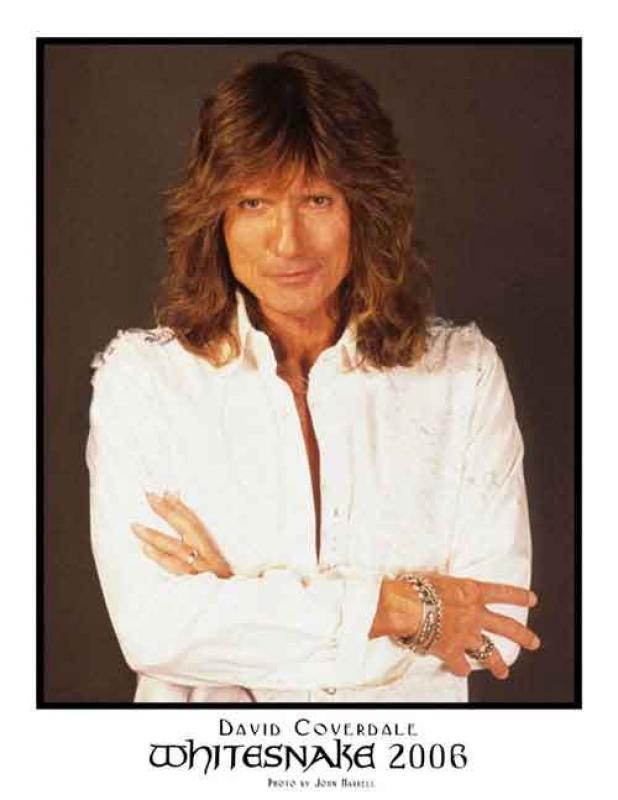
Whitesnake frontman and bandleader David Coverdale gave us his answers over the phone to the following questions

Author: Jernej Vene
Interview date: 06/27/2006
Vene: You’ve been on the road, with short breaks, since 2003. How are things out there right now?
Coverdale: The tour’s been going for quite a while now. Today we’ve got a day off, which we usually use to rest. But I’m actually in the area where I was born, so I’ve been visiting family. Visits like that are pretty exhausting, I’m sure you’d agree.
Vene: Whitesnake have been around for almost thirty years. What keeps you going?
Coverdale: To be honest, I don’t think about it, I leave that to you journalists. I enjoy what I do, I have fun, and I’m happy with it. At the same time I get to see the world and meet and entertain millions of people.
Vene: Last year you released the CD and DVD Live: In the still of the night. How do you pick songs for the shows, given that Whitesnake have a blues rock era and a heavy metal era?
Coverdale: I don’t have any trouble with that. Actually, I don’t like the term heavy metal. The only heavy metal song on that record is Burn, and all the other themes I write about come from physical, bodily feelings. There’s not much metal in there.
Vene: You’ve been touring since 2003, but without a new studio album. Does a band like Whitesnake even need a new record, or are the old hits enough for a successful tour?
Coverdale: Times are such, as Mick Jagger once confided to me, that the Rolling Stones make a new record to promote the tour. The situation is completely reversed from how it used to be. I run our website www.whitesnake.com very actively, and it’s a hit. I keep a close eye on what people still want from me as a musician. First they wanted a live DVD, so that’s done, they’ve got it. The fans’ next wish is a double live CD with the hits on it. I hope to pull that off this year. And third is new studio material. Just to make your mouth water: that double live CD will have four new studio tracks – three hard-hitting hard rock songs and one really strong ballad. Shortly before Christmas, or once we wrap up the tour, we’ll start preparing for a new studio album, which will come out next year. It’s pretty busy in Whitesnake land.
Vene: How does inspiration “find” you when you’re writing? Where do your ideas come from?
Coverdale: I have to tell you… I meditate, and in the end I grab a guitar and start raising hell… (laughs). Well, it’s a funny thing, I don’t do things after meditation anymore. The four new songs are very direct and natural, I wrote and sang them without any effort. I hope the album goes the same way. Oh, and before I forget, I’m still inspired by the physical and emotional sides of love.
Vene: Ten years ago you said: I’ve had enough of playing Tarzan, I want to sing! What did you mean by that?
Coverdale: The constant screaming. When I said that, I was dead serious, it was probably at the end of a tour. Still, I’m still doing my Tarzan impression, which I really enjoy, and I haven’t gotten tired of it yet. It’d be the same for you if someone had told you ten years ago that today you’d be doing an interview for Radio Slovenija. You probably couldn’t have pictured it back then. I meant that statement seriously, but they say if you make plans, God laughs at you.
Vene: Among the new countries you’ll be visiting is Slovenia. Do you think someone who travels a lot and sees a lot of the world and different cultures has an advantage over someone who prefers to stay home?
Coverdale: I love traveling. Where I live now, it’s very beautiful and peaceful. But on tour I’ll have the pleasure of bringing my music to places I haven’t been before, like Istanbul. It’s all very exciting. Going somewhere for the first time refreshes me.
Vene: Let me mention four guitarists you’ve worked with: Ritchie Blackmore, Jimmy Page, John Sykes and Steve Vai. What was it like working with them?
Coverdale: Well, of course they all play differently. I brought John Sykes into Whitesnake to help me make the transition from the band’s more traditional hard rock blues to a much heavier, electric hard rock blues. Working with Jimmy Page: that was a project that came out of nowhere and it was very exciting. I was just about to retire from music when a mutual friend of ours called me and asked if I’d be interested in working with him. Page and I met in New York and clicked right away. As you know, Jimmy wrote some of the most recognizable guitar songs in history. I was completely honored. Ritchie Blackmore was an exceptional teacher, a mentor and an astonishing musician. And Steve Vai is the Paganini of the guitar, he’s incredible, like Izak Perlman or some other great violinist. They’re all very different, both as musicians and as people.
Vene: The lineup Whitesnake are bringing to Ljubljana is road-tested. How is it different from previous ones?
Coverdale: I’m having a lot more fun, and it’s lasted longer than most of the earlier ones. The two guitarists are great, drummer Tommy Aldridge is at the peak of his expressiveness. It’s excellent, they’re proper good guys and great musicians. I think nobody’s going to be disappointed with this lineup.
Vene: In the video for Here I go again there are two Jaguar cars and a beauty. Were all three yours?
Coverdale: No, just the white Jaguar and the beauty (laughs).
Vene: What do you think about the digital information age?
Coverdale: I’ve fallen in love with computers, but if you’re talking about downloading music, that’s something we have to get past. If you’re a real music fan, you’ll support the musicians. For many of them, the current situation is very hard economically.
Vene: Is it true that when you applied for the audition with Deep Purple, you sent them a photo of yourself dressed as a boy scout?
Coverdale: Exactly. I borrowed the photo from my mom, because the band’s managers insisted I send one and I didn’t have any other. I asked them to give it back because my mom wanted it. If you’d like to see it, it’s on our website.
Vene: Do you think it’s important in the studio for a musician to have a free hand, or is it better to have someone outside the band do the producing?
Coverdale: As far as I’m concerned, it’s better if the musician does it. Usually it’s the record labels who make those calls.
Vene: Do people still ask you why you fired John Sykes?
Coverdale: No, and I’m not interested. If you want to talk about that, you’ll have to ask somebody else.
Vene: The first three Whitesnake albums recently came out as remasters. When can we expect the next three?
Coverdale: When EMI gets off their backsides and promotes the first three. I’ve got the next two ready, but they won’t come out until I see them actively getting behind the promotion of the first three. Really they’re doing the same thing as with Deep Purple, they want to scrape out whatever’s left in the bowl. I’m proud of Whitesnake and I won’t let anything come out that isn’t good quality.
Vene: Almost every Whitesnake tour in history has had a different lineup. Do you think you’re hard to work with, or is it the other way around?
Coverdale: That’s a question for other people. I find me easy to work with (laughs).
Vene: What do you make of the renewed interest in classic rock?
Coverdale: I have to say, in recent weeks I’ve played for 400, 500 thousand people from Sweden to Portugal. The festivals are packed with crowds, and they were playing classic rock everywhere. The labels and most of the music press are very wrong, because they’re not making business out of our kind of music. But they’ve always been slow. By the time they sign someone, they’re already late, because music fashion has moved on.
Vene: The nineties weren’t the right time for hard rock of your kind. For a while it even looked like Whitesnake were history. Are the good times coming back?
Coverdale: The good times never left me. I sold records non-stop through the nineties. Jimmy Page and I sold four million records, Whitesnake sold fifteen million, so it was good. I decided I wouldn’t make new stuff. I’d become a father again and I wanted to be there for my son, so he’d know he had a dad and not someone who’s always away from home. In 2003 I came back for just one reason: to celebrate Whitesnake’s 25th anniversary. The comeback was so successful that, with my wife’s blessing, I decided I’d work six months a year and spend the other half at home.
Vene: Your new bass player is Uriah Duffy. How has he fit into the band?
Coverdale: Perfectly, you’ll see him, the guy’s great, the girls love him because he’s good-looking, and the guys respect him because he can play.
Vene: Is it true that you named the band after your penis?
Coverdale: Yes, I named it after my penis. In fact, I’ve got a new name for it now: Roger. But I won’t be changing the band’s name (laughs).
Photo gallery