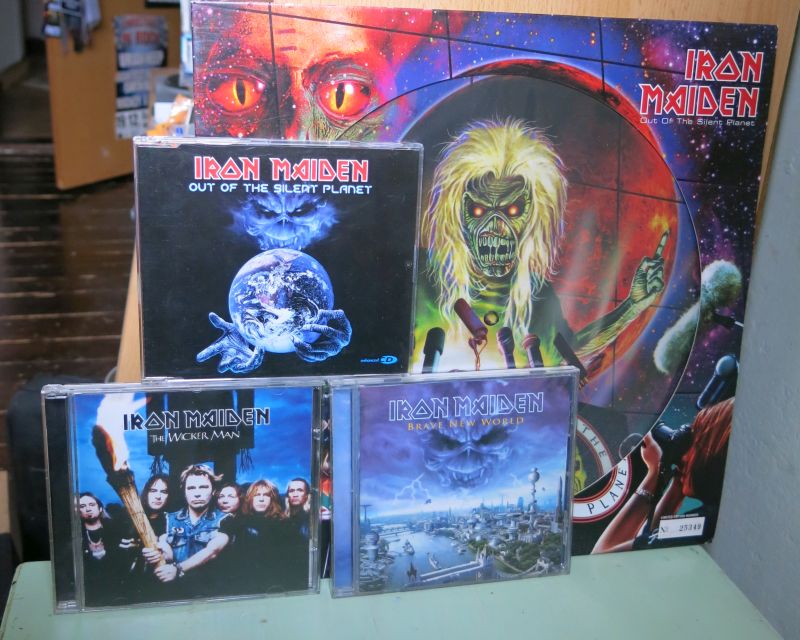
It’s hard to picture it today, but after the tour supporting “The Virtual XI”, times were anything but rosy for Iron Maiden. Empty halls greeted the band on the road promoting the “softest” studio album of their career, a sign that without Bruce Dickinson in the lineup they just couldn’t stir up real mass euphoria or genuine interest anymore. On top of that, everything felt like the band was slowly losing its focus. Eddie and the covers of both “Blaze Bayley era” albums were melting into ever uglier smears of the digital-editing trends of the day, and Harris was starting to turn into a stage footballer.
The ship of hard-won credibility carrying the rulers of metal was heading fast for stormy weather. Anyone who was at the Iron Maiden show in Trieste way back on May 6, 1998 can tell you that after a short but high-voltage set from Helloween – the openers, with the excellent “Better Than Raw” in their pocket – plenty of people started filing out of the hall, crestfallen, because Iron Maiden, with a not-so-great album and without their beloved singer, simply didn’t motivate them enough anymore. Even more telling: that show was supposed to take place at the Pino Grezar city stadium (the smaller of Trieste’s two football grounds), but because of poor ticket sales it was later moved to the Palazzo dello Sport Giorgio Calza basketball arena.
Unlike their former bandmates, whose ground was shaking beneath them, things were going swimmingly for Bruce Dickinson at the time. Dickinson had finally found peace and artistic freedom, with plenty of spare time to devote to family and other hobbies. In short, Dickinson was enjoying life. Alongside was an outstanding musical crew, led by both guitarists – former Iron Maiden comrade Adrian Smith, whom Dickinson lured in for the album “Accident Of Birth”, and producer Roy Z. In 1998 this crew not only held on to all the artistic brilliance of the previous record and carried it over to the new album “The Chemical Wedding“, they actually topped it. “The Chemical Wedding” is still considered the best studio album of Dickinson’s solo career, and that’s how it will stay. Unless Dickinson decides to release another one, which has been hinted at in passing in quite a few recent statements.
After the “Virtual XI” tour wrapped up, Iron Maiden showed Blaze Bayley the door. Sources say the band was unhappy with Bayley’s vocal output, since some songs in the live set were beyond what could be sung at the required level. Janick Gers later said that part of the blame lies with the band too, who pushed Bayley into singing songs that were outside the natural vocal range.
Right after the new year in 1999, when the band parted ways with Bayley, Harris at first didn’t even consider turning to Dickinson among the possible options for bringing in a new singer. But with some nudging from Rod Smallwood, Harris chewed it all over: “Who’s up to this task, and who should we invite if we’ve decided on a change? We all knew Bruce well and knew what he was capable of. Professionally we got along very well, and when I thought it all through once more, I honestly no longer saw why we shouldn’t invite him back into the band!”
In that same month, January 1999, the band organized a meeting in Brighton, England, which Bruce Dickinson attended too. Dickinson agreed to rejoin, and a few hours later, after a phone call, Adrian Smith came back as well. At the same time, Iron Maiden kept Smith’s 1990 replacement, guitarist Janick Gers, so the band grew into a sextet with no fewer than three guitarists. Gers had done the lion’s share of the guitar work on Dickinson’s solo debut “Tattooed Millionaire” (1990), so the band’s decision to keep Gers in the lineup was a perfectly natural and logical move.

Once Iron Maiden had dropped one of the best pieces of metal news of 1999, they got to work on a new tour, which they dubbed “The Ed Hunter Tour”. The dust hadn’t even settled after the release of the compilation “The Best Of The Beast” when another one, titled “The Ed Hunter”, arrived. It was a two-CD set of the biggest hits, with a special computer game starring mascot Eddie thrown in. The material on this compilation was picked by fans of the band from all over the world, and the guys announced they’d play this selection on the new tour too, though that wasn’t quite how it went. “The Ed Hunter” tour turned out to be a huge success. The venues were bigger again, and sold out. The tour kicked off on July 11 in Canada and wrapped up on October 1, 1999 in Athens, Greece. On the morning of September 23, 1999 a few buses also left from Slovenia. They were headed to Milan, where Iron Maiden played the sold-out Filaforum. Opening for Iron Maiden on the tour were Megadeth (with Marty Friedman in the lineup, presenting the album “Risk”), who years later joined the ranks of the ‘big four of thrash metal’.
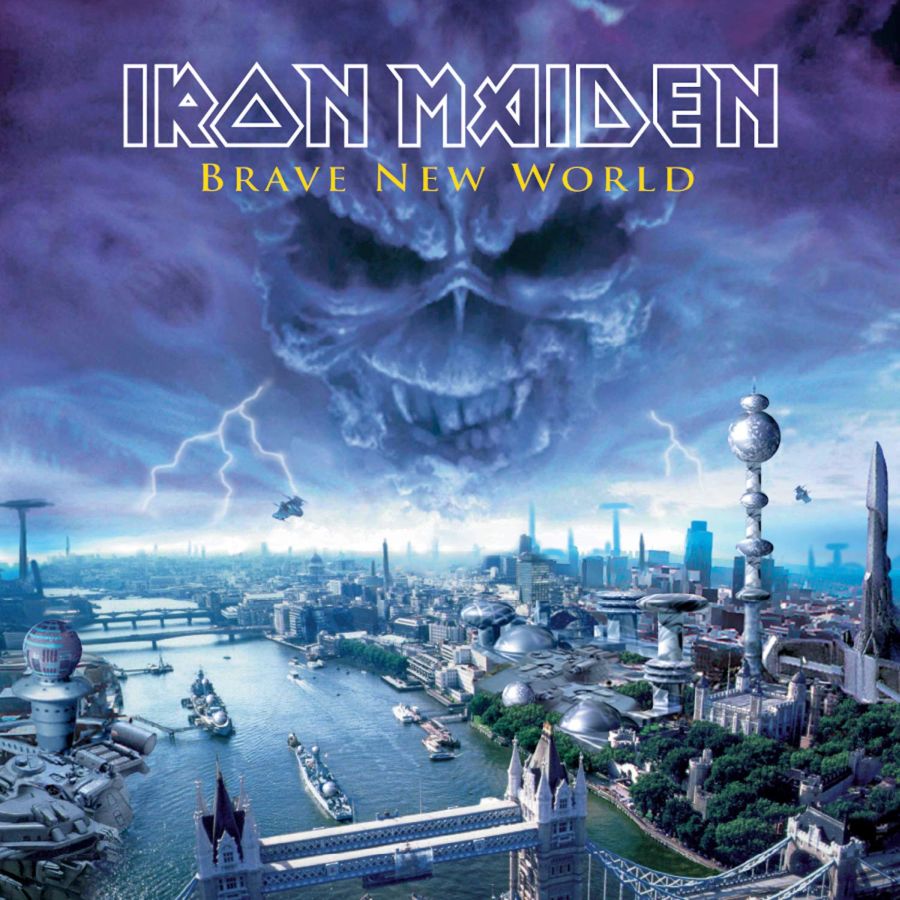
Let’s rewind again to shortly after that fateful “yes” breathed out together by Smith and Dickinson. While Harris was most worried about Iron Maiden losing popularity in North America had Bayley stayed in the lineup, Dickinson’s biggest nagging question after returning was whether the new album would be a truly artistically mature achievement rather than just a “comeback” record. That album was “Brave New World”, released on May 29, 2000 via EMI Records! Unhappy with the results of recording at Harris’s Barnyard studio on his property in Essex – which had been the band’s “sonic folklore” for the previous four studio albums – the band headed to Paris, to the Guillame Tell studio there, where in November 1999 they met up with their new producer Kevin Shirley.
By then the world had already been swept up in global hysteria over the happy news of the “six-headed steel monster with eighteen guitar strings”. Bruce described the success of “The Ed Hunter” tour as a little pit stop on the road to the new album, something that lifted the crew’s spirits and felt relaxing. For the team spirit itself, the tour was a bonding experience. For Dickinson, that tour marked the start of the campaign for the new album: “Things slowly got going, people suddenly realized we were back, and when the speculation started – ‘if they can be this good on stage, can they make a studio record this good together again too?’ – it was a very good question for us as well, because it was followed by a cascade of discussion circles within the band.”
A lot of the material for the new album was written before Iron Maiden even went off on “The Ed Hunter” tour. Adrian Smith said that the songs “The Nomad”, “Dream Of Mirrors” and “The Mercenary” were created for the album “Virtual XI”, and Blaze Bayley hinted that part of the lyrics for Dream Of Mirrors are his, though he never got official confirmation. Steve Harris added that the song “Blood Brothers” also began taking shape during this period, but was left unfinished.
The album title draws inspiration from Aldous Huxley’s novel “Brave New World”. The cover of the band’s twentieth studio album was a two-man job: Derek Riggs created the upper part of the cover, while the lower, digitally designed part belongs to Steve Stone.
Kevin Shirley was also one of those doubters who noticed the band slowly losing real focus and vision throughout the nineties. The released albums especially hadn’t convinced Shirley, and since the band was slowly losing its authority in Shirley’s eyes, there was no particular excitement when the phone call came one day inviting Shirley to take over production of the new Iron Maiden album. “I thought Iron Maiden were sinking deeper and deeper, and that was in no way encouraging. So at first I was very reserved,” Shirley said.
Shirley’s worries were unfounded. If anything guaranteed the band a status of invincibility and indestructibility, it was their age-old concern that across four decades of activity they must never neglect their fans or leave them in the lurch. Brimming with the confidence that shows up whenever you know you’re the best and unbeatable, Iron Maiden turned up at the Guillame Tell studio. They came stocked with a bag full of new ideas and a focused fervor to record the best album of their career. Although for the band this process was, to a degree, part of the usual routine, Shirley saw that a fresh approach was essential for the new Iron Maiden era.
Shirley recalls: “I grew up with old-school album production methods. That means you record the drums first, and everything else follows. But when I felt the energy of a crew with the potential to manifest and embody it phenomenally by playing together in the studio, I was dying to try something like that with Iron Maiden. Steve Harris was skeptical about the idea. Harris doubted such an approach would bear real fruit. I told Harris: ‘Look. If it doesn’t work, we’ll go back to the classic studio recording approach.’ By the time the guys got through the material a second time, I’d decided I didn’t want to work any other way.”
Harris adds: “I knew the new songs would always sound somewhat different from before, since there were now three guitarists in the band. I thought that would be incredibly hard to handle, but Kevin pulled it off brilliantly. Kevin added a special touch that fit the material perfectly, because he was someone we’d never worked with before, and at the same time an enormously positive personality. The studio isn’t exactly a place I particularly enjoy. I’m far more at home on stage. When you can admit to yourself that after a long time you’ve landed in the studio with the right people in the right place, and enjoyed it, that means a lot.”
With Shirley as the sixth-plus-one member of the band, Iron Maiden refreshed their working process! Ideas were boiling up from everywhere, and the band finished some of the songs they’d brought to the studio. The high quality of the new product was never in doubt for a single moment. The only problem could have been the question of songwriting credits and contributions. There was a danger members would clash over who gets what when crediting writing contributions. But clearly time had done its work here too, as all members showed remarkable maturity of character.
Dickinson recalls: “The first thing that went with our studio activities was the realization that we were all very calm and relaxed. Nobody was overly bothered about who owns what when their ideas were being tried out in songs. We all understood you have to give something first to be able to take. The reverse applied too. This time we approached the studio as if we were all reading instructions from the same manual!”
“The members contributed really varied ideas, and Harris had quite a job picking the best of the best,” adds Kevin Shirley, continuing: “Harris is truly the one in charge of organization in the band. Every song goes through Harris’s ears, and that was especially obvious when Iron Maiden stepped into the studio in the revamped lineup. Over the last two decades we’ve recorded five or six albums. Not much has changed in that time, but there’s incomparably more collaboration among the members. And a crew like that needs a driving engine and a watchful guardian like Steve.”
Under Harris’s supreme supervision, Iron Maiden delivered some of the strongest songs of their career on “Brave New World”. Listen to the album twenty years after its release and you can still feel the crackling sparks and the energy whipping around the studio as these outstanding songs came together, led by the catchy opening charge The Wicker Man, the wild epic The Mercenary and the anthemic mini-suites, ruled by The Nomad. The band’s sound was going through a subtle transformation, but one that shows up significantly in the update achieved. The band expanded the arrangements and some sections of the tracks even sound mildly progressive. It delivered an album that, after “Seventh Son Of A Seventh Son“, was once again the best, and on it the band again found a chemistry and zeal not heard since the album “The Number of the Beast“.
Shirley continues: “Iron Maiden picked themselves up again. They found their natural chemistry. Iron Maiden have their own story. You can’t change Iron Maiden. I tried to bring in a few novelties. Among other things, I suggested adding orchestral arrangements to the song Blood Brothers, to boost the sense of grandeur and ceremony. For a band of this caliber, it’s simply unfair to insist that the “gallop” is an outdated thing and they should try something else instead. There are things that simply define Iron Maiden. Iron Maiden show up in the studio with an identity already built, and you can’t ‘mess around’ with it because of some whim of yours. And finally, why would you even want to?”
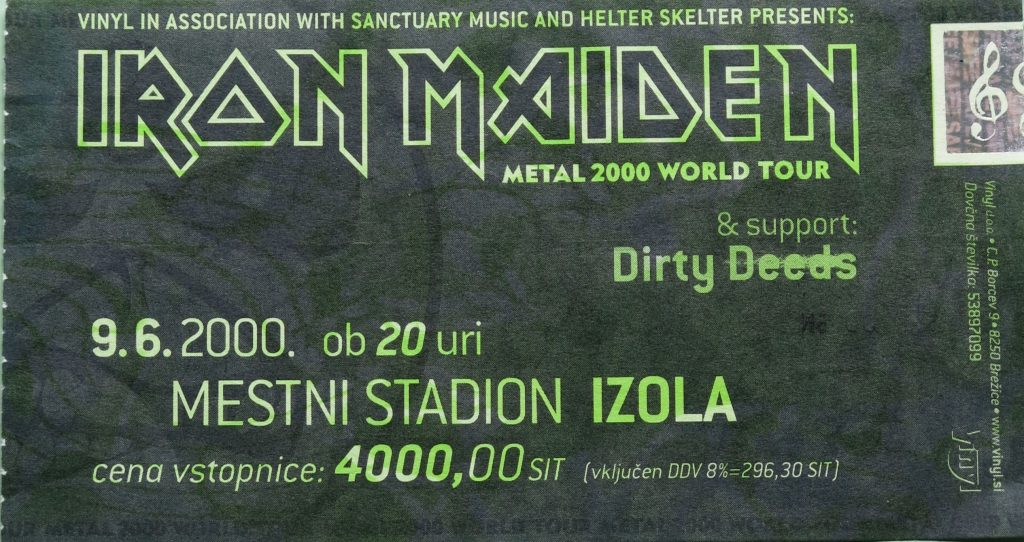
Three weeks before the album’s official release, the single for the song The Wicker Man came out. Right after the release, on June 2, 2000 the band set off on a world tour that only wrapped up on January 19, 2001. On June 9, 2000 Iron Maiden also stopped at the city stadium in Izola, which up to that day made it the band’s fourth visit to Slovenia in total. “Brave New World” got high marks on release. For the most part, huge praise from music critics. Most important, though, was that fans of the band fell in love with the album right away, which shot it to the top of the charts around the world. “Virtual XI” thus quickly sank into oblivion. “Brave New World” landed at number 39 on the Billboard 200 albums chart. On the UK equivalent it reached number seven, and it did best in Scandinavia, where it hit number one in Sweden and number two in Finland. In Italy and Germany it climbed to number three.
“Brave New World” gave the band two singles! The first was The Wicker Man, released on May 8, 2000. Iron Maiden took the single’s title from the cult British film of the same name. Interestingly, a song with the same title was also recorded by Bruce Dickinson while making the album “Chemical Wedding”, but it didn’t make the studio cut. The Wicker Man was the first song Iron Maiden tried out in the studio as a sextet. The opening riff is Adrian’s. Dickinson adds: “The song came together without the slightest effort to hit single length. When I was writing the vocal lines for it, I imagined I was on stage, in front of a crowd singing along to the melodies together as one!” The single The Wicker Man came out in several versions: as a standard CD, a double CD and a twelve-inch vinyl. For the single’s extra tracks the band used available live recordings from “The Ed Hunter” tour, namely from the Milan show (September 23, 1999), which a good dozen Slovenian fans of the band also attended, meaning this single doubles as a lovely souvenir for them. The standard single-CD version has live versions of Futureal and Man on the Edge, while the double-CD version adds live versions of Powerslave and Killers. The latter two also appear on the B-side of the twelve-inch vinyl version. The cover for “The Wicker Man” single was done by Mark Wilkinson, after the band turned down Derek Riggs’s work.
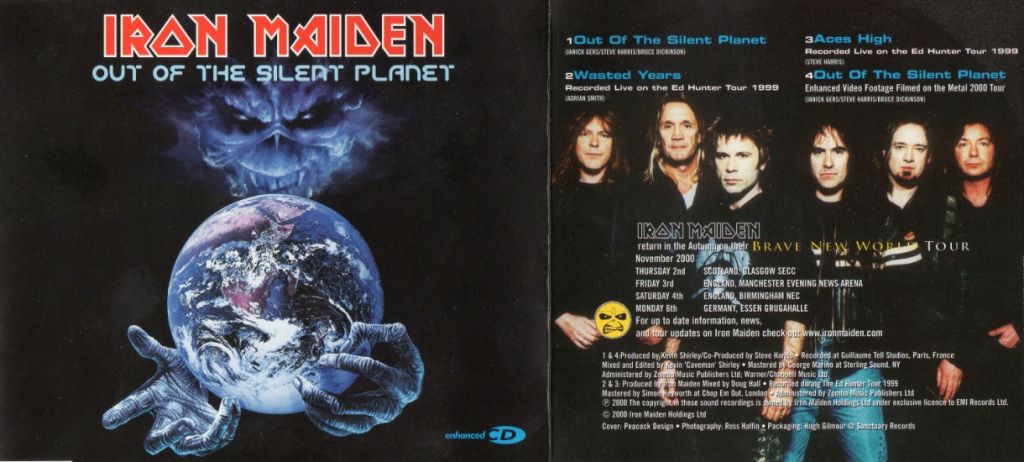
The second and last single from “Brave New World” came out on October 23, 2000, for the song Out of the Silent Planet. This one also appeared in three versions – a standard CD plus seven- and twelve-inch vinyl. With different covers. Mark Wilkinson did the cover for this single too, and the content of all three versions is the same, which is very unusual for this kind of band maneuver. The single adds live versions of Wasted Years and Aces High, again from the Milan show. The seven-inch vinyl version has only Aces High on the B-side. The solo in Out of the Silent Planet was contributed by Janick Gers. For the song’s title the band found inspiration in the science-fiction novel written by C. S. Lewis in 1938, as well as in the film “Forbidden Planet”, made in 1956.
The album took the band on a tour of the world’s biggest venues. Among others, Iron Maiden played London’s Earl’s Court and New York’s Madison Square Garden, and the world tour, called “Metal 2000”, hit its peak with the band’s appearance in the middle of the Rock In Rio festival, in front of a half-million-strong crowd of white-hot Brazilian fans. In terms of Iron Maiden’s comeback, “Brave New World” was a feat of colossal proportions. After it, the band ramped up its activities so much that it’s still barely catching its breath today.
“Bruce has pointed out a few times that Iron Maiden pay me a ton to give them the best I’ve got, but otherwise the success and chart positions of albums don’t mean much to me,” said Shirley, adding: “What matters to me is whether there’s noticeable progress. Whether I see evolution. The band was truly on its knees when it came to record ‘Brave New World’. Today it’s absolutely wonderful to watch them flying around in their own plane, loaded with all that gear and crazy stage production. All of it is, quite simply, brilliant!”
“Iron Maiden are the best heavy metal band in the world,” says Bruce Dickinson. And not without reason: “The camaraderie in the band is scarily good. People don’t even grasp how good the musicians in this band are. That’s why we can defy things and handle them. Also, none of us is content to be ‘second best’. We’re not old ‘farts’ who are together just to make a few ‘bucks’. This is something worth doing, and something you have to do flawlessly and completely!”
Author: Aleš Podbrežnik