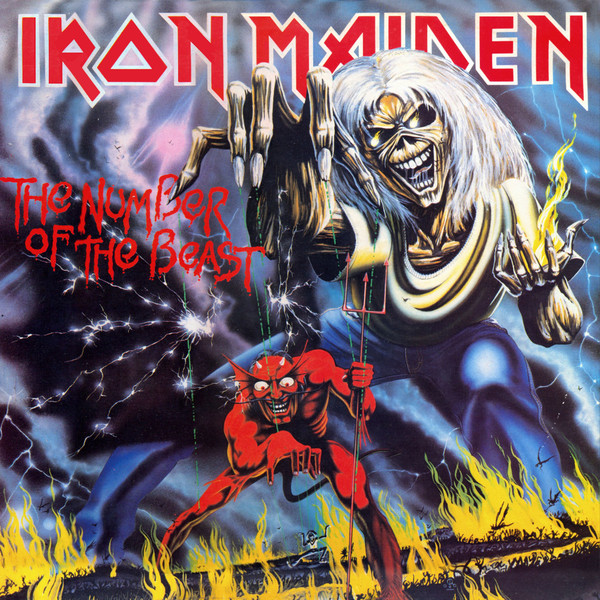
Label: EMI Records
Release date: March 29, 1982
Production: Martin Birch
Album length: 39.11 min
Genre: Heavy Metal
Rating: 9.5/10
Alongside Metallica’s Master of Puppets, The Number of the Beast is probably the best-known metal record of all time. There’s hardly a critic or a ranking that doesn’t put it at or near the very top. The Number of the Beast is also the first record without Paul Di’Anno, who left the band (or rather, got fired) after the 1981 tour because of ever-worsening problems with alcohol and drugs. Paul’s spot wasn’t easy to fill, but Di’Anno was replaced, outdone and overshadowed by former Samson frontman Bruce Dickinson. Still one of the best metal vocalists around, the “air raid” siren brought a more polished, technically demanding, operatic singing style to the band, one that earned him a place among the greatest vocalists of all time. That’s also a big part of why, with The Number of the Beast, Iron Maiden dropped the NWOBHM sound that still dominated Killers altogether and started playing traditional heavy metal. For the first time in the band’s career, The Number of the Beast really delivers that true “trademark” Iron Maiden sound they still play today. Even though The Number of the Beast brings some truly superb tracks, the eternal trio of The Number of the Beast, Run to the Hills and Hallowed Be Thy Name, plus the fantastic Children of the Damned, 22 Acacia Avenue and The Prisoner (and the rest aren’t exactly trash either), I still have to say the record is a little overrated. Iron Maiden can offer much better. Still, this is an outstanding record that stands as one of the biggest milestones in music.
The unstoppable carousel of heavy metal gets spinning with the hard-hitting Invaders, which right away introduces us to the album’s dark themes. Invaders confronts us with the fear and terror of an attack by merciless Viking warriors, from the first sighting of Viking longships approaching the shore to the final bloody showdown from which the fearless Vikings, of course, walk away as victors. Great Britain in particular had no end of trouble with Viking raids between the ninth and eleventh centuries, so it’s no wonder Iron Maiden picked the Vikings as the conquerors of the lyrics. The chorus is rather average, overshadowed by the power and energy of the whole song, and Bruce, with his fantastic vocals, eclipses Di’Anno from the very first moments of the record. Invaders is also the song that kicked off the band’s series of battle songs, with the best known being The Trooper.
Children of the Damned, a great song with a dark, melancholic atmosphere, retells the story of the 1963 film of the same name. This cult chiller tells the story of six children with supernatural abilities. United Nations scientists move them to London to decide their fate, but the reins are taken by none other than the military. The miracle children resist, which leads to an inevitably tragic end. The atmosphere of this incredible, sorrowful song, with a sense of loss and tragedy hanging in the air, is fantastically built by the interplay of acoustic and electric guitars, and it closes with a phenomenal solo that recreates the chilling climax of the lyrics, with the last surviving child at the stake. Because of that similar mood, Children of the Damned can be compared to Remember Tomorrow. Dickinson is simply dazzling vocally, and he says himself that Black Sabbath’s Children of the Grave had a strong influence on how he sang this one. Without a doubt one of the Maiden’s most recognizable songs.
One of the band’s most overlooked songs is definitely The Prisoner. Strange, since it’s supposedly even one of Adrian’s favorite songs. The Prisoner is based on the cult British series of the same name, which captivated viewers in the seventies, including Smith and Harris, who name it as one of their favorite shows. They paid tribute to it with a great, fast track in which Burr drums one of the best performances of his career with Maiden, but the drums are nothing compared to Adrian’s incredible solo and the infectious chorus. It’s interesting how the band got hold of the intro dialogue that opened every episode of the 17-part series. They already had a recording of it, but to use it they needed permission from the series’ producer and lead actor, Patrick McGoohan. The job naturally fell to the band’s manager, the usually calm and cool Rod Smallwood, whose heart reportedly sank into his boots in front of the great actor. McGoohan answered Rod’s request in cold, actorly style: “What was the name of the band again?” “Iron Maiden,” Smallwood replied. “A rock band, you say… do it!”
On 22 Acacia Avenue, we meet again with the familiar practitioner of the oldest profession, Charlotte. 22 Acacia Avenue is light-years better than the first installment of the Charlotte the Harlot series. With its incredibly complex structure, varied sections and great lyrics, it has earned its place among the band’s biggest classics. Interestingly, the first version of the track was written by Adrian with his band Urchin (at the tender age of eighteen… yet another proof of Adrian’s genius!), and Harris happened to hear it at one of the gigs and, once Adrian joined Maiden, suggested they build it up and put it on the record.
The title track, along with Fear of the Dark, is probably the one that’s best known to the wider public. No wonder, since it’s an eternal classic that kicks off with a chilling biblical quote (which isn’t used quite correctly, by the way), with great riffs in the middle of the song and Bruce screams so high you’d think they couldn’t possibly be coming from human vocal cords. The lyrics, loosely based on the horror movie Omen II (1978) and one of Steve Harris’s nightmares, were, where else but in puritanical America, once again misinterpreted, and the band was immediately branded devil worshippers and Satanists. If the narrow-minded Yanks had taken a closer look at the cover of the record and the The Number of the Beast single, they’d have seen that it’s not the Devil we should be afraid of after all… One more fun fact: for the opening speech, the band wanted to hire cult B-horror actor Vincent Price, but he demanded a whopping 25,000 pounds. Maiden then heard about a stage actor who read horror stories on a radio station and had him deliver the quote in the style of Vincent Price… and we got one of the most recognizable intros ever!
Run to the Hills is another one of the most recognizable songs in the media, and sadly so overplayed that you can hardly hear the record without skipping it. If Maiden hadn’t run it into the ground like that, Run to the Hills would surely have gone down as a classic too, since it features Harris’s great “trademark” bass gallop, which imitates the galloping of horses. Lyrically it’s a pretty interesting piece as well, made up of two views of the wars for the American West, the first from the Native Americans’ side, the second from the side of the “palefaces”.
With Gangland we get the first example of Clive Burr’s songwriting skills… sadly, it didn’t work out, since Gangland is a thoroughly average track, probably even the weakest one on the record. Gangland isn’t a bad song as such, but a track with a mafia theme is below par by Maiden standards.
With Total Eclipse, Clive proved himself more, since it’s an exceptionally overlooked track that only got its rightful place on the 1998 reissue. A song with an apocalyptic theme about the end of the world, its dark subject matter fits in superbly with the rest of the tracks.
The album ends the way the band’s next three records end too: with an incredible epic track. The Number of the Beast closes with the hard-to-describe Hallowed Be Thy Name. For many it’s the best song Maiden ever wrote, and I’d even argue it’s one of the best songs, period. If I had to write a list of songs you simply have to hear before you die, Hallowed Be Thy Name would probably take first place. Really, the only way to describe it is with the words pure brilliance. The magical atmosphere created by the incredible guitar intro over the sound of church bells, Bruce’s out-of-this-world interpretation of the fantastic lyrics, which capture the thoughts of a man sentenced to death by hanging in his final moments, and the sinfully good instrumental section that dominates the second half of the song: one of the band’s peaks. Hallowed Be Thy Name is a song you simply can’t get tired of, and after countless listens it still gives you goosebumps.
With “The Number of the Beast,” Iron Maiden reaped worldwide fame and crowned themselves the kings of heavy metal. “The Number of the Beast” is an immortal record that, 25 years after its release, still sounds as fresh as if it had been recorded yesterday. It’s fast, melodic and packed with songs that lodge themselves in your memory. It launched several eternal classics, for both the band and heavy metal as a whole, and became one of the most influential records in music history. There’s no list of the best metal records without “The Number of the Beast” somewhere near the top. That TNotB really is this good is confirmed even by the troublemaker Paul Di’Anno, who called it a masterpiece when it came out and said his vocals couldn’t have achieved that. But the best is still waiting around the corner…
Author: Rok Klemše
Tracklist:
1. Invaders (03:24)
2. Children of the Damned (04:36)
3. The Prisoner (06:03)
4. 22 Acacia Avenue (06:38)
5. The Number of the Beast (04:51)
6. Run to the Hills (03:54)
7. Gangland (03:49)
8. Hallowed Be Thy Name (07:13)
Lineup:
Bruce Dickinson – vocals
Steve Harris – bass guitar
Dave Murray – lead and rhythm guitar
Adrian Smith – lead and rhythm guitar
Clive Burr – drums