Label: EMI Records
Release date: April 11, 1988
Producer: Martin Birch
Album length: 43.51 min
Genre: Heavy Metal
Rating: 10/10
By 1988, Iron Maiden were sitting at the artistic and commercial peak of their career, which came as no surprise to anyone who’d followed them since the early eighties, when the arrival of vocal thunderer Bruce Dickinson rocketed them to the top of the heavy metal pack. 1988 was a huge year for the band: they headlined and ‘conquered’ the prestigious Monsters of Rock festival at Donnington, and before that they dropped the cult album »Seventh Son Of a Seventh Son«, still their only concept project to this day and one of the most ambitious achievements of their entire career, one that (once again) pushed past the boundaries of traditional heavy metal and flirted (especially on the title masterpiece) with some symphonic prog-rock influences.
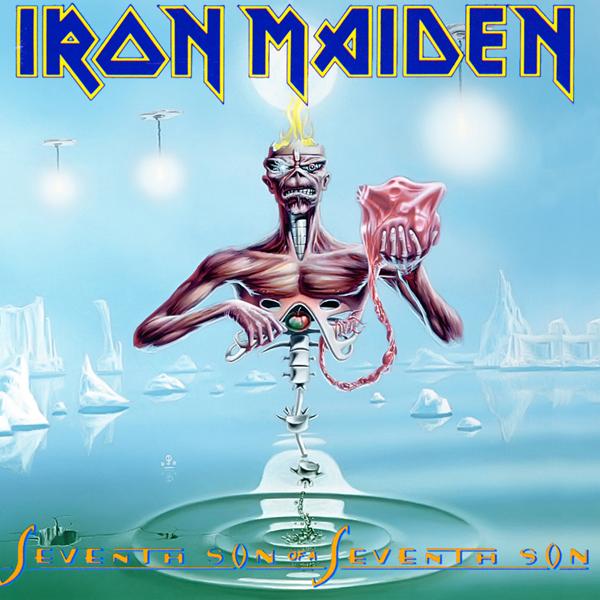
Bassist and band leader Steve Harris drew the inspiration for the esoteric concept running through the »Seventh Son of a Seventh Son« lyrics from a book and the folk tale of the seventh son of a seventh son, an exceptional individual gifted with supernatural abilities, clairvoyance among them. The prophecy hanging over his birth carried a burning riddle: once he reached adulthood, would this miracle child use his extraordinary talents for good or evil, and with that choice ultimately seal the fate of humanity? Fitting the concept, Eddie in his new reincarnation, shown on Derek Riggs’ excellent cover art, went through a fantastical metamorphosis from the futuristic cyborg of »Somewhere In Time« (1986) into the seventh son of a seventh son, reborn in the middle of Antarctic glaciers and frozen images of his dark past.
Unlike the phenomenal but often criminally overlooked »Somewhere In Time«, with its brilliant use of guitar and bass synths, on »Seventh Son of a Seventh Son« Iron Maiden finally decided to bring in real synthesizers, giving the symphonic arrangements a far more ‘organic’ sound, even though their previous experiment with guitar synths had been the most successful on the metal scene at the time (especially compared to Judas Priest and their »Turbo« (1986) album). Still, Harris’s hugely ambitious vision for the sound of »Seventh Son« demanded an even grander, more epic production with a whiff of mysticism if Iron Maiden were going to pull off the concept of the miracle clairvoyant.
The cult bassist had always been a big prog rock fan and once even said he ended up in metal only because he wasn’t technically skilled enough to play prog, so for years he’d been itching to steer Iron Maiden into more complex arrangement and rhythm territory for a while, which was also their logical sonic evolution. The first hints of more complex arrangements could already be heard on some earlier records, especially the masterpieces »Powerslave« (1984) and »Somewhere In Time«, but »Seventh Son of a Seventh Son« was the album with which Iron Maiden left their biggest mark on the emergence and development of progressive metal.
The rest of the band liked the idea of the new, conceptual direction too, which means singer Bruce Dickinson, who left no songwriting credits on »Somewhere In Time«, once again teamed up very successfully with Harris and guitarist Adrian Smith to write some of the album’s most appealing tracks. »Seventh Son of a Seventh Son« isn’t a fully conceptual album, since not all the ideas are properly tied together, something some band members, led by esoterica buff Dickinson, still regret today, but amid the prevailing mystical vibe that’s almost negligible.
Most of the lyrics touch on the usual Iron Maiden themes, i.e. the eternal conflict between good and evil, heaven and hell, with a pinch of esoterica thrown in. All the compositions on the album were built around the title track, which forms the epic peak, while the record also holds three hugely successful singles led by the big hit »Can I Play With Madness«, which long ago became practically folk songs among the metal crowd. In fact, most of the album, including the opening anthem »Moonchild«, reportedly inspired by the novella of the same name by the infamous Aleister Crowley, ranks among Iron Maiden’s longtime classics.
The conceptual nature of the most melancholic and mystical album in Iron Maiden’s career up to that point is also reflected in the acoustic opening and closing verses, which deliver a mysterious, dark prophecy. The energetic catalyst »Infinite Dreams«, crowned with a philosophical-mystical lyric and punching harder by the second after its opening guitar solo, never became a regular live staple compared to the album’s other singles because of its demanding vocal performance, but it’s easily one of the best compositions here, with plenty of unexpected twists, tasteful guitar harmonies and a mighty chorus.
The aforementioned »Can I Play With Madness«, the album’s best-known track and big hit, boasts a cheerful chorus that lodges itself in your ears in no time, so it’s no surprise it was such a success. Partly also because, arrangement-wise, compared to most of the other »Seventh Son of a Seventh Son« material, it offers fairly simple, straightforward listening fun. And of course, let’s not forget the unforgettable accompanying video starring the late Monty Python funnyman Graham Chapman. »The Evil That Men Do«, layered with melancholic guitar passages and dealing with the age-old fact of human wickedness, was one of the better »Seventh Son of a Seventh Son« tracks when it came out, but over the years, because it’s been played live too often, it lost a hefty chunk of its original atmospheric charm.
The best and most ambitious »Seventh Son of a Seventh Son« piece is the epic title-track masterpiece, a short excursion into symphonic progressive rock, powered by metal of course, with a markedly melancholic-dramatic mood, varied use of keyboards, heaping gallons of dramatic guitar harmonies and unusual time changes, all conjuring up assorted dark, folkloric images. Dickinson’s vocal performance was a chapter in itself, conjuring an esoteric ambience in his typical thunderous way, and there’s even a short spoken narrative bit right before the climax of this mighty epic. Iron Maiden later repeated the winning recipe of epic synth use on »Mother Russia« from »No Prayer For the Dying« (1990), which has a similarly melodramatic atmosphere thanks to the synths and dark visions of mystical images in the middle of the Siberian tundra. On the somewhat overlooked melancholic treat »The Prophecy«, which features a triumphant chorus and an excellent Celtic-troubadour ending, guitarist Dave Murray also left his songwriting stamp alongside Harris.
Another famous single, »The Clairvoyant«, is, alongside »Moonchild« and the title track, a central conceptual piece of »Seventh Son of a Seventh Son«, reportedly inspired by the death of some (alleged) psychic, but then it fit perfectly with the concept of the clairvoyant seventh son of a seventh son. The opening bass solo is followed by a mighty transition into the epic section, with Dickinson at the peak of his vocal powers, guitar harmonies in thirds and relentless drum crotchets from ‘good old’ Nicko McBrain. The often-overlooked anthem »Only the Good Die Young« is the album’s epic closer in the best Iron Maiden tradition, with Dickinson in phenomenal form while both guitarists once again properly ‘let loose’, and it also has one of the best lyrics of their entire career, applauding the sad but often all-too-true fact that decent people mostly die young while scoundrels often live to a ripe old age, unless they happen to take their own lives, of course.
The prog-leaning masterpiece »Seventh Son of a Seventh Son« was the finale of Iron Maiden’s epic album trilogy, kicked off by »Powerslave« and »Somewhere in Time«, and it’s a worthy successor to both of those triumphant predecessors, with keyboards adding a whole new dimension to individual tracks. The Iron Maiden lineup from 1983 to 1988 is rightly still their most revered, and at the end of the eighties they were truly at the top of their game. Keeping up the level of quality Iron Maiden delivered throughout the eighties was of course really hard, and after Smith’s departure in 1989, a logical consequence of the rest of the band not wanting to continue the ambitious sonic evolution of the time, things slowly slid downhill artistically for a while, though even in the ‘difficult’ nineties, when their popularity melted fast in favor of the ‘brutal-depressive’ metal/rock wave from America, they never made a truly bad album (»The X Factor« from 1995 is even one of their most overlooked achievements).
Author: Peter Podbrežnik
Tracklist:
1. Moonchild (5:38)
2. Infinite Dreams (6:08)
3. Can I Play With Madness (3:30)
4. The Evil That Men Do (4:33)
5. Seventh Son of a Seventh Son (9:52)
6. The Prophecy (5:04)
7. The Clairvoyant (4:26)
8. Only the Good Die Young (4:40)
Lineup:
Bruce Dickinson – vocals
Steve Harris – bass guitar, bass synthesizer
Dave Murray – guitar
Adrian Smith – guitar, synthesizer
Nicko McBrain – drums, percussion