

This year marks fifty years since the release of “In the Court of the Crimson King,” the debut from English band King Crimson, now recognized as the album that laid the cornerstone of the progressive rock movement. A musical phenomenon from the moment it came out, “In the Court of the Crimson King” is without a doubt one of the most important and best rock records of all time.
On October 10, 1969, this monumental work laid the foundations of prog rock, and in part also of heavy metal and jazz rock fusion, British style. It arrived right after the birth of perhaps the most important band in the history of progressive rock, and yet all five compositions on the album still sound fresh today, while some of the lyrics are even more relevant now than they were fifty years ago.
King Crimson’s formation at the end of 1968, out of the ashes of the comedic-experimental-psychedelic outfit Giles, Giles & Fripp, was the official birth of the genre we now call progressive rock, or art rock, as some music critics called it back then. In the second half of the sixties, with the Beatles slipping into their “long-haired” experimental phase and the arrival of bands like Frank Zappa and The Mothers of Invention, Pink Floyd, Family, The Moody Blues, Traffic, Soft Machine, Procol Harum and The Nice, to name just the most important ones, big changes started happening in rock music.

With ever more experimentation and the breaking of genre boundaries, rock music kept shaking off its long-standing, often unfair stigma as “unserious music.” By weaving in elements of classical music, jazz and a few other genres, it started turning into something close to an art form, often an intellectual one, if not outright socially critical, a kind of music that sometimes forced the listener to put a few brain cells to work, while certain records were works of art in both content and packaging. “In the Court of the Crimson King” belonged to that latter category.
Audiences were mostly tired by then of the often naive simplicity of rock and roll and the plain melancholy of the blues, while psychedelic rock, after the fall of the even more naive hippie movement in the late sixties, was quickly losing its initial appeal. After the “flower power” optimism, British rock increasingly came to be dominated by darker, more melancholic and often aggressive sounds that tore down every sonic convention up to that point.
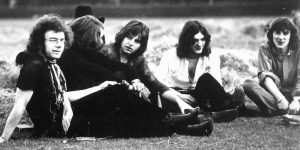
Total musical freedom at the time meant a lot of creative independence and experimentation, without much pressure on bands from the labels, while on the other side were musicians who, on top of being one hundred percent professional, wrote music with heart and soul and created works of gigantic scale. King Crimson unexpectedly found themselves at the head of this experimental movement, which got its name precisely with the release of “In the Court of the Crimson King,” and were recognized as the pioneers of a new musical current. Sure, some of their fellow countrymen like Genesis, Yes, Jethro Tull and Van der Graaf Generator had been around at least a few months longer, if not more, but their studio beginnings in 1968 and 1969 didn’t yet show the far more complex, instantly recognizable style that came later.
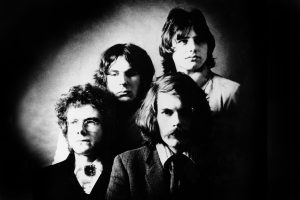
The original King Crimson lineup was a one-of-a-kind beast: one lyricist who was a full-fledged member, plus four professional musicians whose styles were mostly rooted in jazz and classical music. Besides jazz, their musical role models came from late 19th- and early 20th-century classical music. The only rock influence was the Beatles, whose songs like “Lucy in the Sky with Diamonds” they played at some of their early gigs.
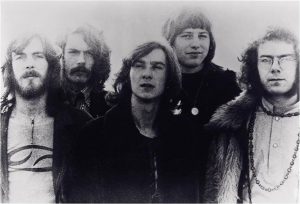
Those influences apply above all to Robert Fripp, a guitar master and musical genius of rare talents who accepted no frames or limits in his music and stubbornly ignored almost all outside influences. With King Crimson, who in this early period still worked without his dominance and dictates, with all the members contributing equally to the songwriting, Fripp discovered and crossed every boundary then known in rock, jazz and classical music, and pulled the best out of his bandmates.
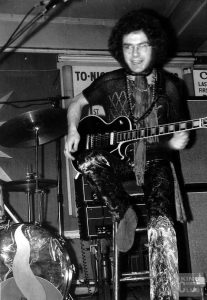
Fripp, who later, alongside his solo career, collaborated extensively with giants like Brian Eno, David Bowie, Peter Gabriel, Peter Hammill, Andy Summers and David Sylvian, to name just a few, quickly established himself as a guitar genius with unusual mannerisms, one who gets bored extremely fast with any repeating musical form, be it a single riff or a chorus. Today he’s the only original member of the band and, among those in the know, one of the most respected musicians in rock, despite his jazz-leaning guitar style. Anyone who listens to his solo in the King Crimson evergreen “21 Century Schizoid Man” will instantly understand why Fripp shot so lightning-fast to the top of the world’s most innovative guitarists, and why his guitar became the central element of King Crimson’s music.

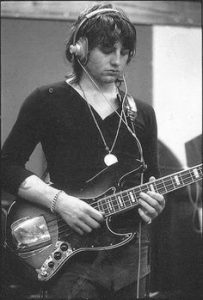
Also a founding member of King Crimson at the time was the legendary, sadly late singer and bassist Greg Lake, who came over from The Gods. Besides singing, Lake handled the bass, though most agree Fripp kept him from developing more fully as a guitarist. Maybe Lake’s bass playing (and later guitar) wasn’t all that impressive, especially next to his far more technically gifted King Crimson successors on the instrument, like John Wetton, Tony Levin and Trey Gunn, but his clean, sincere and melodic voice was the main virtue that, in the view of most King Crimson fans, made Lake the best singer in the band’s history.
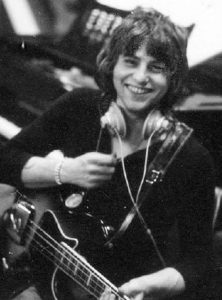
He only came into his own as a guitarist as a member of the inimitable Emerson, Lake & Palmer (ELP) and, briefly, in the early eighties, as a stand-in touring member of the supergroup Asia. His solo career yielded two studio albums on which he worked with the late guitar legend Gary Moore. Lake’s best vocal moment on the King Crimson debut is captured on the epic “Epitaph.”
The all-around “star” of this lineup was definitely multi-instrumentalist Ian McDonald, who, besides playing sax, flute, the then-revolutionary Mellotron, the rest of the keyboards and guitar, co-wrote every song on the album. He also came up with the outstanding orchestral arrangements that created the at times almost transcendent atmosphere of the King Crimson debut, adding some ambient light and warmth to its prevailing dystopian darkness.
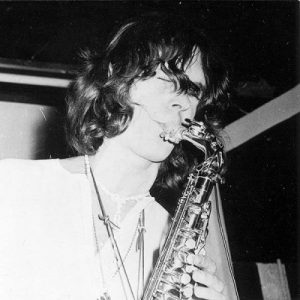
After he left, King Crimson never again caught the kind of perfect mysticism that McDonald’s woodwinds and Mellotron radiate on their studio debut. McDonald later recorded the album “McDonald & Giles” (1971) with King Crimson’s founding drummer Michael Giles, and then in the mid-seventies became a founding member of the hugely commercially successful international band Foreigner, recording their first three albums with them.
Michael Giles, surely one of the best drummers of his day, and someone Stewart Copeland (The Police, ex-Curved Air) once called his main drumming role model, gave individual songs on the King Crimson debut an almost hellish rhythm. By weaving jazz elements into his drumming (Giles was a classic jazz drummer, which was long one of the golden rules for every drummer in this band) and with his brilliant cymbal work, he delivered yet another stylistic leap in drumming technique.
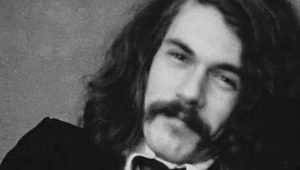
As the oldest member of the band, he also gave them a musical maturity that most musicians lack at the start of their creative journey. Fripp and Giles had already worked with Michael’s brother Peter, a bassist, in the “embryonic” version of King Crimson called Giles, Giles & Fripp. In 1968 they put out their only record, “The Cheerful Insanity Of Giles, Giles & Fripp”, a psychedelic treat seasoned with goofy Monty Python-style humor, and at the same time a complete commercial flop.
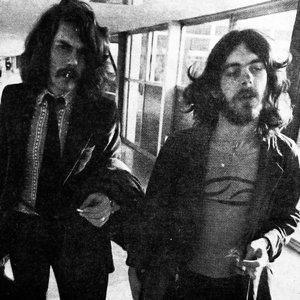
Peter Sinfield, the band’s fifth member, wrote the lyrics on the group’s first four albums, and also took care of the graphic concepts, stage lighting and sound equipment. His role in the band was similar to Keith Reid’s in Procol Harum. Later, this former computer specialist and mythology buff took on a bigger role as a live musician too, helping the band out on the VCS3 synthesizer. There’s no doubt Sinfield is the one who breathed a soul into the group with his poetry and shaped its image. The guy wasn’t just a musical visionary, he was completely disconnected from this world and obsessed with neo-romantic philosophy and Celtic mythology.
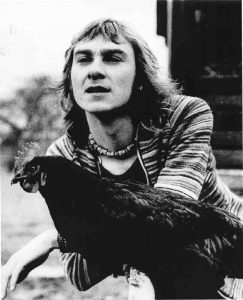
His romantic, fantastical, mystical and pseudo-apocalyptic lyrics, which in spirit come closest to close encounters with J.R.R. Tolkien, William Shakespeare, William Blake, Edgar Allan Poe and Samuel Taylor Coleridge, were an indispensable part of the band’s early period. He was also the one who came up with their name, a metaphor drawn from the Arabic name for the medieval demon Beelzebub (the Arabic Bil Sa Bab translates as “man with a purpose”) and one of the church’s labels for the “heretical” medieval imperial oddball Frederick II Hohenstaufen. Sinfield’s best contribution to this album is without doubt the lyrics for the title track.
The complexity of the music on “In The Court of the Crimson King” is remarkable, offering a near-perfect fusion of the best musical ingredients: from rock and jazz to classical. For its time the record had solid sound, but later reissues and remasters, especially under Steven Wilson, made it even better, fresher and almost identical to the original recording. The long closing improvisation on “Moonchild” can finally be heard completely clearly on the newer versions of the record.

Stylistically, King Crimson were light-years ahead of their peers at the time, even if that only lasted a short while, about a year. Even their later, commercially far more successful contemporaries, led by Yes, Genesis and Pink Floyd, needed quite a bit of time to find the right creative chemistry, develop a recognizable sound and make a name for themselves worldwide. Either way, there was no other group back then that united so many different musical elements so perfectly, ranging from hard rock and jazz to late 19th-century classical music. Somebody once said that if Wagner were still alive today, he’d surely be working with King Crimson. The lyrics were at least as complex as the music itself, mostly thanks to Sinfield, who was far too overlooked back then and is hugely respected today, an “invisible” onstage but always equal member of the band.
The real bomb on “In the Court of the Crimson King” is the opening track, still incredibly punchy and nihilistic today, “21 Century Shizoid Man”. It serves up a whole palette of completely new musical dimensions right away, and with its guitar riff structure it comes closest to an embryonic heavy metal, which Black Sabbath started developing down to the last detail not long after. At its core, this track is a fusion of rock and jazz with a heavy emphasis on red-hot saxophone arrangements.
After a half-minute of opening hiss, like a tea kettle at the very edge of boiling, the red-hot main riff suddenly explodes, one no metal band would be ashamed of even today. In the same breath Lake’s traumatic, digitized-sounding vocal joins in, deliberately run through an effect to create an even stronger sense of the horribly disfigured, spiritually devalued and schizophrenic 21st-century man, a prisoner of his own mental matrix. The line “nothing he’s got he really needs” means he’s stuffed with all sorts of corporate stuff while being totally robbed of what he needs most (love, basic human relationships and spirituality).
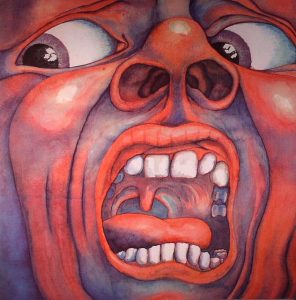
A decadent, schizophrenic, devalued world echoing with the neurotic screaming of the schizoid man of the post-apocalyptic 21st century is the best description of this track’s visual side, which blends perfectly with the album’s striking cover. Fripp steps in with his complex soloing, almost immediately joined by McDonald’s sax, and together they build the track up to a complex middle section where drummer Giles delivers some of his best moments on the record. This central part, called “Mirrors”, is the most complex and shows Fripp in his best light. Even today this classic is a trademark of the phenomenon known as King Crimson, and it has since been covered by numerous more or less famous artists.
The only surviving recording of the original King Crimson lineup, less than two minutes long, from their 1969 Hyde Park show
An instant jump from a cold, rationalist, apocalyptic world into light and fantasy comes with the romantic ballad “I Talk To The Wind”. This gorgeous track makes for a striking contrast with its predecessor. The at times psychedelic flute arrangements only add to the magic and mysticism of the song, which in atmosphere comes closest to some midnight gathering of Celts at Stonehenge. McDonald’s flute is mostly responsible for that mood, while Lake’s esoteric vocal radiates incredible warmth that melts perfectly into the structure of this very pleasant, symphonically tinted ballad. The gentle sounds of flute and Mellotron keep making sure Fripp’s trademark guitar doesn’t sound too dark in the transitions. Both instruments act as a kind of counterweight to the heavy riffs of Fripp’s guitar and bring indescribable beauty into the music.
“Epitaph”, a post-apocalyptic, deeply melancholic and gloomy prophecy of the 21st-century “zeitgeist”, is the central (symphonic) epic of this record. Lake’s superbly sung melancholic vocal, reflecting resignation at the doings of modern man pushing himself toward destruction, is without doubt the standout element of the track. You can already hear it in the “March For No Reason” section, which still gives plenty of people goosebumps today. With his dramatic and at times mysterious voice, Lake proves again and again that he was one of the finest singers of his era. “Tomorrow and Tomorrow” is the moment when the main chorus repeats several times, making the song melodic enough even for some less demanding listeners.
Another beautiful mystical ballad follows. With its long improvisation in the second half of the song, “Moonchild” already hinted stylistically at where the band would head in the coming years, and it’s also the only track on the album that caused considerable bafflement among the critics of the time. Opinions are still pretty divided today. The last eight minutes are a complete studio switch-off in the form of a long improvisation with McDonald’s Mellotron and Giles’ drums and percussion up front. By their own account, they left that improvisation in on purpose to show all the labels and critics what creative freedom really is.
The song is split into three parts. The opening melodic section is yet another gorgeous romantic ballad with a deeply felt Lake vocal, bringing ambient warmth after the dark and melancholic “Epitaph”. In time it tips over into the instrumental “The Dream” and finally into the esoteric, slightly oriental “The Illusion”. Those eight minutes are given over to a longer improvisation on the then-innovative Mellotron, guitar and drums. After all sorts of sounds the atmosphere calms down again, especially toward the end, when the final, oriental part of the song, “The Illusion”, kicks in, with the Mellotron dominating. Anyone who’s bothered by longer instrumental improvisations, or sees them as pointless “sound exercises”, can’t expect to ever like this song as a whole.
The closing retro-romantic medieval epic “The Court of the Crimson King”, one of the most recognizable creations in the group’s history, opens with the pompous intro “Return of the Fire Witch”. Up front are the symphonic arrangements of Mellotron and McDonald’s flute, carrying the listener off into a black-tinted fantasy world, straight to the courtyard of the crimson king, who is immortally entertained watching troubadours, fairies, witches and other jesters and performers. At court, after all, everything revolves around him.

The melodic main theme repeats several times, while the lyrical message is different each time. The band slowly returns with the sounds of the flute. In the closing section, “Dance Of The Puppets”, the main melodic chorus repeats a few more times until it ends the record in a romantic way. This evergreen was also released as King Crimson’s first single and, alongside “21st Century Schizoid Man”, is their best-known work, one that has likewise been covered many times over the decades.
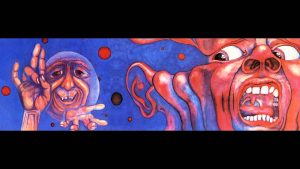
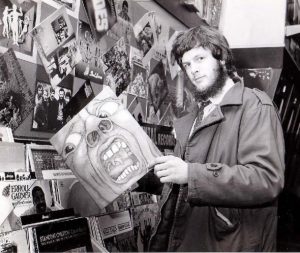
The screaming cover of the “schizoid man of our century,” whose eyes reflect boundless sadness reminiscent of Munch’s ‘The Scream,’ and his antipode, the “crimson king” in the form of a grinning ‘Moon’ with a human face and vampire teeth on the other side of the sleeve, is undoubtedly one of the best covers in the history of rock music, even if it comes with a rather sad story: its creator, Barry Godber, died of a heart attack at the tender age of 24. It combines music and visual art with this band’s progressive visions in an almost perfect way. Fripp, the painting’s current owner, reportedly rescued it at the last minute from falling apart in the late Godber’s studio.
“In The Court Of The Crimson King” is a legendary, now cult record for every prog rock fan and the leader among those that laid the foundations of progressive rock. After its release, King Crimson ventured into musical territories that still baffle many people today. At the same time, it’s one of their rare records that most fans of more conventional rock sounds can listen to with a clear conscience, since it’s one of their more accessible achievements. It’s also the best possible starting point for anyone just getting to know their music.
The unforgettable original lineup of Fripp, Lake, McDonald, Giles and Sinfield radiated incredible creative energy and perfect musical harmony, and it was truly the only lineup in the band’s history that had a shot at becoming a commercial success after their debut. Sadly, that lineup was done by the end of 1969, when Giles and McDonald went their own way over differing musical visions. Lake soon followed, joining Emerson and Palmer to create Emerson, Lake & Palmer.
Who knows what this band’s future would have looked like had they stayed together, because long after those three musicians left, King Crimson never managed to build a stable lineup, despite the many splendid musical names who passed through the group in the seventies. Every King Crimson record that followed was a chapter of its own, but they never quite managed to recapture that original atmospheric magic, even though “In the Wake of Poseidon” (1970), their second studio effort, was a very successful, for some even too obvious, approximation.

By combining mysticism and metaphysical messages (“I Talk To The Wind,” “Moonchild,” the title track) with a biting critique of the already dying peace movements and the looming breakdown of modern civilization (“21 Century Schizoid Man” and “Epitaph”), King Crimson captured the longing of modern, materially cramped people for freedom, love and self-fulfillment.
That, along with the technical professionalism of the individual players, was the winning combination that won over the hearts of an always picky audience, since even the most demanding music connoisseur could find something to love. It’s just one more proof that King Crimson were (and still are) a band that offers the most in its music, while refusing to cling to tried-and-tested musical formulas or trends and always following only its own progress. Parallel worlds come alive in their music, along with many of the musical and artistic movements of the 20th century. This legendary album is living proof of what creative freedom once was, and an eternal monument to its beauty.
article by: Peter Podbrežnik
