Interview date: 10/29/2007
Richie Kotzen, guitar hero, singer, writer of countless songs, once part of the notorious bad-boy crew Poison and after that part of the Mr. Big camp, is going through a true creative bloom these days. Less than 11 full months rolled off the calendar between 2006 and 2007, and the guy dropped two studio albums. He can boast a rich collection of solo studio albums and, most importantly, a recognizable sound he’s developed, which breathes soul into his vast body of work, flowing through collages built on the heritage of blues, soul and R&B, with the erotic side of it occasionally dosed out in bouncy jolts of rock music. So Richie is a born songwriter, but first and foremost a guitar hero with shrewdly fast fingers, which have earned him the tribute and respect of music crowds everywhere.
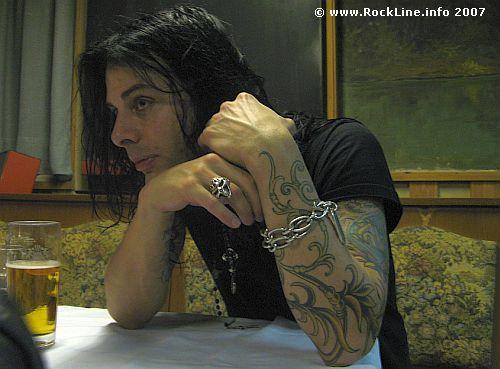
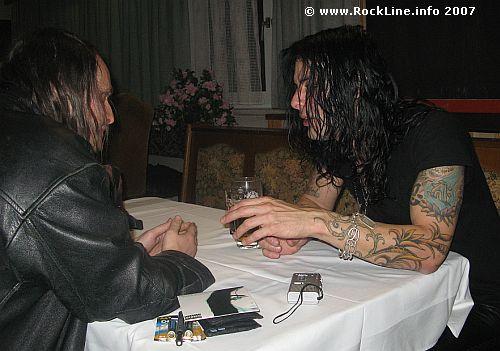
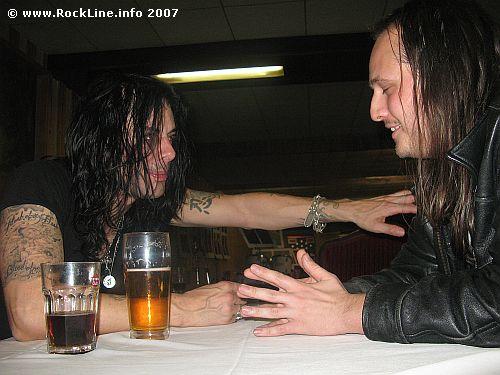
Daniel and I did the interview at Bluesiana Rock Caffe, by now the famous second home of our RockLine crew, in the little town of Velden am Woerthersee (known in Slovenian as Vrba na Koroškem) in Austria. The owner and local promoter of a whole phalanx of heavyweight acts, mostly rooted in the blues, who’ll be passing through her place by the end of this year, the warm-hearted and always sparkling Gudrun, once again played the perfect host and welcomed our two-man delegation with great care and warmth. Richie made time for us after the show. Twenty minutes had passed since the gig, which was long, hot and charged with energy, running well over two hours. When the tour manager invited us into the backstage area, Richie was just killing time with a beer in his hand, still wrapped in a towel over his head as we sat down next to him. A legal-and-formal overture followed, and…
RockLine: Are you enjoying the tour?
Richie: I am. I’ve got a great band behind me.
RockLine: Is this your first time playing in Austria? How does it feel in this corner of the world?
Richie: Yeah, it’s my first time here. It’s great, I’m very happy.
RockLine: You’re back to focusing intensely on your solo career, two solo albums less than a year apart, you’re doing well!
Richie: You know how it is with me. I’ve always been a solo musician, I’ve always done solo stuff. I’ve been doing things as a solo artist since 1989. Then of course there’s that old, old story. I joined Poison in between, then Mr. Big, but at heart I’m a solo musician. I’ve got 16 solo studio albums out there. This is about exploring my own roots, what I’ve always been, what I’ll always be, what I’ve always done and always will do. I’ve always been the kind of guy who wrote songs. Even in Poison. That’s part of me. I enjoy it, I simply love it. There’s nothing better than going on stage with great musicians who play your songs, and enjoying it while you watch the reactions from the crowd following you through the show.
RockLine: That really sounds great. Right now you’re touring as a power trio (guitar/vocals, bass, drums). Tell us, where did you run into the other two guys on this tour, how did you all “click” together?
Richie: Here’s the thing. It took a long time to find the right bass player, really. A drummer is never a problem for me, whenever I’m looking for someone to work with, but finding the right bass player, that’s a real nightmare. When I met Johnny (Johnny Griparic, the bassist accompanying Richie on the current tour, editor’s note) it just clicked right away (snaps his fingers). Before Pat Thorpey I tried out four drummers. They were cool, but it just didn’t work. Pat and I have a shared history, we both played in Mr. Big, there’s a bond between us like we’re family, we read each other great, we communicate great. When you’ve got bonds like that, the music gets that right shape too, that feeling of authenticity, of being at home. Pat and I are like brothers. We communicate great. And it’s the same with music. That’s built on communication between people too.
RockLine: You just released a new studio album, ten days ago…
Richie: Yeah. October 19th.
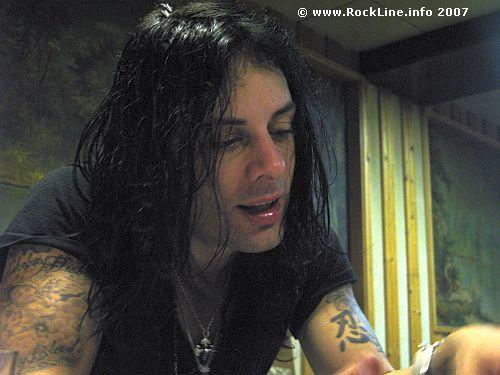
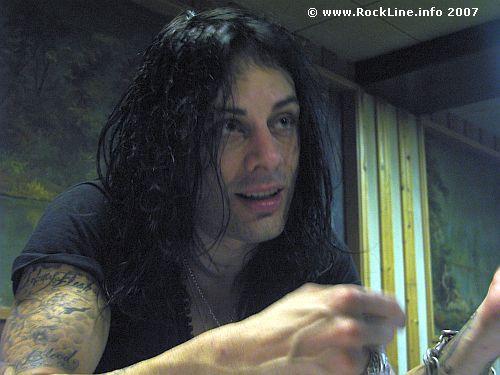
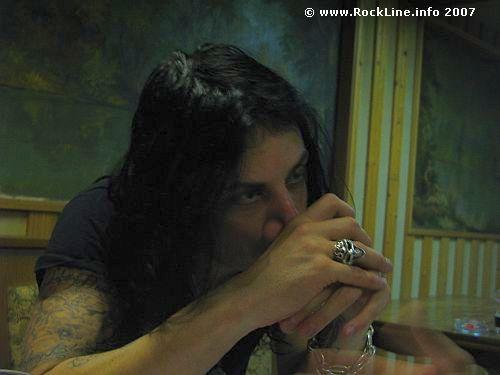
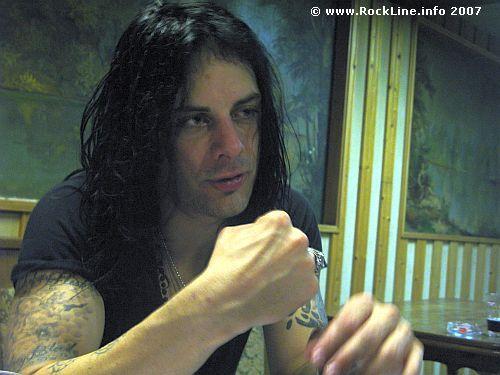
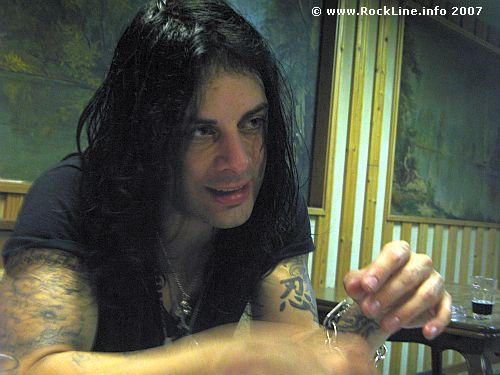
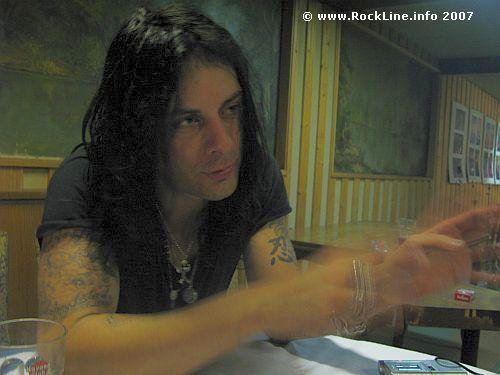
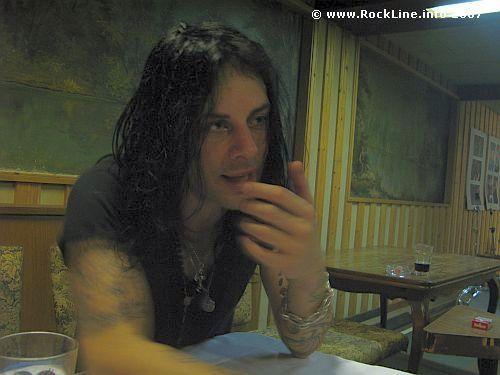
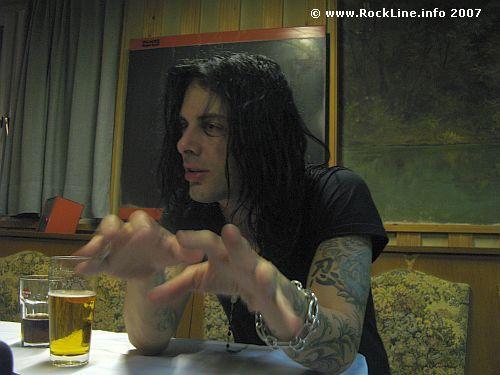
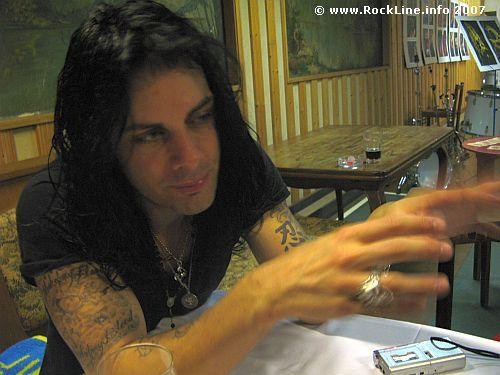
I get up from the table and grab the camera to capture some moments of the interview, while Daniel keeps entertaining our guest with questions…
Richie (notices I want to take his picture): Fuck,… Ooooh wait, let me take the towel off my head… I can’t be like this in front of a camera, with zero style!!!
RockLine: How come your new album came out under two different titles, for the Japanese and the American market?
Richie: (meanwhile ruffles his sweaty hair and smooths it back down, like a true pro who cares about his reputation and looks, and approaches the question a little flustered…): Yeah, in North America, actually in North and South America, we titled it “Go Faster”, for the simple reason that people can relate to it more easily, it sounds more familiar, closer to home for the crowds on that side of the world. In Europe and Japan it’s called “Return Of The Mother Head’s Family Reunion”. The material on the releases for both markets is exactly the same.
RockLine: How well do the crowds know your name, say, when you compare Europe, Japan and the US?
Richie: Right now it’s about even. Years ago I had the most success in Japan. Then recently my name has really taken off in South America. Simply because of the big advantages the internet offers for moving and spreading information. These days when people head out of the house, they know exactly what they’re going to buy at the store, which album. In the old days it was really hard to find an album when you walked into a store, if you didn’t already know it was out there. Now things are easier. You can find everything on the internet. You can pull music off the internet (“download”). I do it myself too, if I like some new record. Why not, if the stuff is available…
RockLine: When did the desire to become a musician ripen in you, or rather, when did you know you’d head toward a music career?
Richie: Oh man,… I wanted this as a kid. It’s in me. When I was five years old, somewhere around there. When I was little, growing up in the family circle, I was the family’s designated entertainer. Of course they knew how to egg me on, I wouldn’t even realize when they’d talked me into some silliness, they liked to tease me a bit. When my parents saw I had talent, they paid for piano lessons. At five years old. When I turned seven or eight, I started learning electric guitar. By twelve I already had a local band. So I didn’t do many things in life, I just played music.
RockLine: When you released your solo studio debut “Richie Kotzen”, you were still very young…
Richie: True. At fifteen I could already do things on guitar that older, renowned musicians of the time couldn’t do at 45. I could play anything. It started when they ran an article about me in some music magazine, on the recommendation of Shrapnel Records, when I was 17. That’s how word about my name started to spread. And then Shrapnel Records called me the year after I turned eighteen, and that’s how I recorded my first solo record for that label.
RockLine: And then came your breakthrough with Poison. How do you see that moment in your musical career?Richie: Well, probably, yeah. As far as my early career goes, definitely. Poison had sold 20 million records before I did anything other than twiddle knobs in a studio. It was interesting when I joined. They needed a guy in the lineup who’d write music, songs. Because before me in Poison it was C.C. (C.C. DeVille, the Poison guitarist whom Richie replaced after joining the band, editor’s note), who contributed most of the material, and Bret (Bret Michaels, singer of Poison, editor’s note), was more focused on writing lyrics, but most of the material before I came along was written by C.C. Then I showed up. Okay, at the audition I played their material and screwed everything up. My amp blew up in the room where I was jamming with the band at the audition. Then they asked if I had any original material of my own, and I offered them two songs. Until You Suffer Some, which was originally called Fire And Ice, and then Stand. And they liked it! Then we got together again and played the thing once more together and they said: “Okay, you’re in!” That was the turning point of my career. If that hadn’t happened then, chances are I wouldn’t be here tonight. Then again, you never know, maybe my name would even be bigger today, because around the time I joined Poison, Interscope Records was inviting me to sign a new deal for a new solo studio record.
RockLine: Tonight here at Bluesiana you played the song Stand. How come you decided to slip it into the current tour’s repertoire?
Richie: I wrote that song before I joined Poison. It means a lot to me, it’s part of me, it’s a milestone in my career. Stand has a special place in my life, so I decided to play it live tonight too. Bret then tweaked the lyrics a bit in Poison, but that was his thing, totally Poison’s free call. This time I’m playing it completely my own way, the way it was written in the original. And people love it when they hear it live.
RockLine: How did you get through the transition from a rock band back to a solo career?
Richie: No problem, since I started my career as a solo musician, so it was totally natural for me. When did you first hear my name? Not in Poison, but as a solo artist after I released my debut “Richie Kotzen” on Shrapnel Records. Do you know the magazine “Kerrang!”? The article they published, the review of my first record, was complete bullshit. I’d put out three solo albums, and only then came the move to a band. In the shoes of a solo artist I feel very comfortable, I get along great with it.
RockLine: You tackled a really interesting cover of Shapes Of Things by the Yardbirds tonight, here at Bluesiana…
Richie: You know Stevie Salas? Stevie Salas is a guitarist who made a name for himself after playing with Rod Stewart,… okay Stevie’s not gonna pay me for advertising him in this interview, heh, heh, heh,…. anyway, Stevie was the first guy I met after I moved to Los Angeles. A few years went by, and one time I was in the studio recording a studio album, Stevie happened to come by and heard me playing that very song, and he said I had to put it on the album. So it came out as a bonus track for the Japanese market only. And Stevie Salas plays bass on it. If it weren’t for him, I wouldn’t have taken it on. He said: “You sing like Rod Stewart, you play like Jeff Beck, so record this song!” And that’s what happened. So, I didn’t say I play like Jeff Beck, Stevie did, ha, ha, ha,..
RockLine: Even though you always appear on your solo releases as both singer and guitarist, does it ever bother you that people mostly know you as a guitarist?
Richie: I don’t give a damn. I simply don’t care how they think. A person can’t exist living in worry about what people think of him. If you always wanted to think the way other people think, how would you ever know what you think yourself? That’s a terrible thing. When you wake up in the morning you have to ask yourself: “What do I want to do today?” And stick with it and make it happen. That’s how everybody should live, at least that’s how I live, how I function. I wake up in the morning, get up, the urge grabs me to write a song, I do that. Then I have to pick my daughter up from school,… I don’t care what people think. If I do something wrong, say I put someone in an uncomfortable situation or hurt them, then I feel bad and I’m sorry. In that case I do care what that person thinks of me. But as long as I feel like I’m on the right path in my life, I couldn’t give a damn what people think about what I do. Envy, for instance, is a terrible thing. Somebody has something, somebody else wants that same thing, then a third one starts talking about it, they’re thinking about how to screw you over, living with your mind on those kinds of relations is awful. You have to live with what you’ve got and stick with what’s meant for you. I started talking kind of rough, like a “caveman”, but I think it makes sense. Does what I’m saying make sense to you two?
RockLine: Absolutely. What can you tell us about your musical influences and the music you love most?
Richie: I grew up in Pennsylvania, in America, on the East Coast. In the time when I was growing up, up in this northeastern part of the US, there was a lot of R & B and soul music on the radio. Take Hall and Oates, their song Sara Smile, or Rich Girl (starts singing the lines): “You’ re a rich girl, you’ve gone to far away, and you know it don’t matter anyway…...”, you know that one? Well, that’s Hall And Oates. That band was like God to me. Then The Spinners, say, the song I’ll Be Around (Richie sings again): “Whenever you call me, I’ll be there, whenever you wan’t me, I’ll be there,…”. When I was growing up, soul music was really strong on the scene, but they played rock too and mixed the two together, soul and rock. And that merging of soul and rock excited me and pulled me in the whole time. And when I was little, I tried to imitate the artists I listened to, I wanted to sing like The Spinners, I’d wake up in the morning, get up and start singing their songs,… When I was a few years older and started learning guitar, Eddie Van Halen impressed me. Eddie was the first guitarist I heard play where I said to myself: “That’s it! That’s what I want. That’s how I want to play!” You know what’s the most interesting thing when I look at young people today? Say, if I were a kid today, right this moment, I’d never become a musician, because the people making music today aren’t those musicians from the days when I was growing up. You know what I’m getting at? There’s no Eddie Van Halen anymore, no Randy Rhoads, and there are no guitarists who’d impress you, in the sense of showing through their work something truly their own. If I were a kid today, I’d be trying to imitate, say, Allen Iverson (NBA basketball player, editor’s note), I’d play basketball, I’d skate (“skateboard“). And then these guys with chains around their necks, grills in their teeth, extravagant hairdos and all the rest of the junk, come along to make music, and that’s awful. Times are different now. I don’t know how it is over here with you, but what I described, you can see that in the US. And that’s why I’m over here in Europe all the time.
RockLine: When I listen to your music, I hear Hendrix in it.
Richie: Really?!?!? You know what’s funny. I never sat at a turntable listening to Hendrix. I like him, I know his music. What I like about him is the freedom. And what I want to bring through the music I write is freedom. I want to be free. I don’t want limits, chains and templates, molds and ready-made recipes I’m supposed to stick to. When I express myself, I want to express myself, and when I’m alone with myself, I find that stillness and clarity in my head, with no thoughts, and that’s when I let go, and whatever happens, happens. That’s when the ideas come out and that’s when I make music. I think that’s what Hendrix did too when he showed up on the scene. He just let things flow. Today most people are just calculating how they’ll do this and that in music, and you know what? What made Hendrix so special and made him stand out so strongly when he showed up on the scene was precisely that he wasn’t busy calculating how things would sound for him, he just surrendered to the flow. That’s why I would never compare myself to anyone. But when I play, I want my head to be empty and clear. And when I’m about to play my music at a gig, I don’t think ahead about how I’ll play things, so I play every song differently every time. Night after night, show after show. My opinion is that music should be like that, or rather that it should be understood that way.
The tour manager comes in and signals that the official 15 minutes for the interview ran out a long time ago.
Richie: Oh fuck,.. who cares? I’m enjoying this, we can talk all night, I really couldn’t care less…
RockLine (practically at that very moment the tape in our recorder runs out, which means exactly 30 minutes have gone by. The “cap” clicks in the machine, we’re “cooked” and have to wrap up the conversation anyway, so the last question follows): Tell us Richie, what’s your next step in your music career?
Richie: No idea, I really don’t know, and you know what? I really don’t stress about it. When the time comes, I’ll definitely know what I want. When I don’t stress about planning ahead, the situation you find yourself in at that moment simply leads you there. And that’s when the situation tells you, and you know the right time to act has arrived. That’s also when you find and figure out how to go about the action.
RockLine: Richie, really, thanks for your precious time, I feel like we had a truly excellent chat, we wish you lots of fun on the tour from here on out, and above all that everything works out well for you.
Richie: Thanks to you two as well, it was a pleasure chatting with you.
Photo Gallery