Location: Nove Jarše / Ljubljana / Slovenia
Interview date: 05.06.2009
True, not enough water has flowed since our first interview with Lene kosti for RockLine to fill the Pacific Ocean basin, but in the half year since the band’s singer Milan Krušič and I last sat down together at the K 300 club in Ljubljana’s Dravlje, mulling mostly over the band’s big reunion, a dynamic wind full of major changes has blown through the group. All of it has led to Lene kosti being a firmly consolidated crew today, taking decisive steps toward realizing their own musical vision. The band’s first official release is already on the horizon…
RockLine: Last time we talked about a month after your official reunion. Let’s pick up from your gig at the Gromka club at the end of December 2008. That was the first real chance to gather your true supporters, the lovers of heavy metal, in front of the stage….
Milan: Well, there weren’t many true supporters. The crowd at that gig was very mixed, and mostly it was dominated by people who came purely out of curiosity. I thought our show was phenomenal, but it was our first introduction to Ljubljana, where we wanted to signal that Lene kosti are seriously active again. The event itself went and developed according to plan, but the makeup of the crowd surprised me. Everything from hip-hoppers and Rastafarians to a few metalheads and our older fans.
RockLine: What followed was some “manufactured” labeling by certain individuals, claiming that Lene kosti are a band that supports Nazism. Even that you’re no longer welcome at Gromka, and something similar trickled out of Gala Hala too, even though you were supposed to play there in March 2009. It seemed like someone wanted to put sticks in your wheels and deliberately get in your way.
Milan: After that gig, some people obviously got scared of Lene kosti. There was supposedly some kind of incident. Some skinheads were said to have come to the gig, allegedly saying they know Lene kosti, that we’re their friends and so on, which isn’t true. And somebody put that to good use to try to keep us from carrying on, because that’s just how it is in Slovenia: if you’re afraid of somebody, you try to take them out by every possible means. Personally, I’ve never experienced a lower act than declaring us a skinhead band that supports Nazism. But if you look at it from another angle, it also confirmed that we’re on the right track. The people who tried this actually paid us a compliment, acknowledging that Lene kosti are an important player on the Slovenian metal scene. To close this story once and for all, I’d just like to add that Lene kosti have absolutely nothing to do with Nazism or “skinheads”. These insinuations are extremely nasty and dirty. We have as much in common with skins and Nazism as a frog has feathers on its head.
RockLine: You could have used those insinuations as a marketing card, like Strelnikoff, who once put a rat in Mary’s arms instead of baby Jesus and used it for an album cover?
Milan: Lene kosti aren’t a band that plays on that kind of provocation and builds and spreads its name that way. Our name, Lene kosti, is our music and our presence on stage.
RockLine: So basically you’re completely innocent, but somebody’s head went “click” over all this, and…
Milan: In the period after the Gromka gig I was pretty enraged, shocked. I was even ready to seek justice in court. Later I did receive written apologies saying the whole thing was a misunderstanding, but that doesn’t wash away the bitter aftertaste. You know, it’s as if five nuns showed up at a Saxon gig and everyone then declared them a Christian band that blindly follows nothing but the teachings of the Bible.
RockLine: Then came February 2009. At Ljubljana’s Cvetličarna you played before the now truly legendary old school German heavy metal band Grave Digger. That gig matters for Lene kosti because a “profiled” crowd came to hear you, one devoted to a love of heavy metal.
Milan: We played at the invitation of my personal friend Manni Schmidt (Manni Schmidt is the guitarist of Grave Digger, editor’s note), and here too I have to stress again that there were tons of insinuations and attempts to block us from the Slovenian promoter of the Grave Digger show in Ljubljana. We had quite a few problems with that, but they got sorted thanks to Manni Schmidt, who explicitly confirmed that Grave Digger don’t want any other Slovenian band before their set at this show in Ljubljana except Lene kosti. The gig was a complete success for us. We finally got broader feedback and reactions from the audience to our performance. All of it was positive and encouraging. We also got extraordinary praise from Grave Digger themselves and the other bands on the bill.
RockLine: I also heard people say you were the only band in Ljubljana worthy of opening for Grave Digger, even though they were touring with Alestorm and Taletellers.
Milan: That can only be a great honor for us. I also remember clear, precise warnings from both support bands before the show about what we could and couldn’t touch on stage during our set, and after the show members of both bands came up to us and wanted to be “best buddies” already. That gig was one of the career highlights for Lene kosti, and it certainly won’t be the last.
RockLine: During the song Russian Girl, Grave Digger guitarist Manni Schmidt also joined you on stage. What did he have to say about it after the show? Did he have a good time in your company?
Milan: After we agreed on our slot before Grave Digger in Ljubljana, I invited Manni to join us on stage for one of our songs. Manni agreed without hesitation. I have to stress, though, that Manni didn’t even know Russian Girl when he walked on stage. He just asked me what key the tune starts in. The rest he figured out on the fly, on stage. That fact alone proves he’s an extraordinary musician. After the show Manni honestly said he’d offered us the chance purely because of our friendship, and that he hadn’t expected us to be the kind of band we are. Later in conversation he promised me that if there’s ever an opportunity, he’ll try to book us in a similar way. Even in Germany. He was very surprised, because he hadn’t expected the level of our band. Jens (Jens Becker, bassist of Grave Digger, editor’s note) and Stefan (Stefan Arnold, drummer of Grave Digger, editor’s note) were also thrilled with our gig.
RockLine: I personally spotted all the members of the band down in front of the stage during your gig in Ljubljana. The only one missing was singer Chris Bboltendhal.
Milan: Chris usually doesn’t show himself in the crowd before shows, he’s more of a reserved type. But Thilo (Thilo Hermann, former Grave Digger guitarist) “flew” to Chris backstage during our set and wanted to call him to come watch Lene kosti, and Chris just said: “Yes, I can hear. It’s Milan screaming with Lazy Bones!”
RockLine: Then came March and the announced gig at the Metal United festival, alongside stronger, better-known bands of Slovenian metal like MetalSteel, Interceptor and Sarcasm. The idea was excellent, but then the up-and-coming youngsters Chaosstar jumped in for you. What happened, why didn’t you play?
Milan: Chaosstar, also an excellent band, jumped in for us at the last moment because I got a nasty injury to my arm. I tore the ligaments in the elbow of my right arm. I got put on sick leave and sentenced to rest. The problem isn’t that I couldn’t sing and jump around on stage, the problem is that if anyone from my job saw me on stage, I’d get fired on the spot. So I’d like to point out that the insinuations that we in Lene kosti got scared of other bands are unfounded. Lene kosti aren’t afraid of anybody. We’re not competing with any band either. We just “run” our own vision, that is, our own music. And if someone started a band to compete with somebody, they should sign up for Eurovision instead.
RockLine: Alongside that, other important shifts were happening for Lene kosti at the same time. I’m thinking of the recent refresh of the Lene kosti lineup itself. What were the main motives that led to it?
Milan: Bassist Davor Kastelec told us right at the start that he joined us only for basic help. That is, until the band gets a permanent member on bass! We organized a few auditions, the guys showed talent and skill, but nobody clicked with our approach. The Lene kosti concept is set by the three of us with the Kavaš brothers, and those guys just didn’t fit that concept. And then one day the phone rang. On the other end was some young guy who said he wanted to play with us. A week or so later we had an audition, and in through the door of our rehearsal space walks Gregor Brenko, the son of our former bassist Dare Brenko. That was the first surprise. The second followed because Gregor clicked with us instantly. Both musically and personality-wise. We took him into the band right away. Another important thing that happened to us comes down to a big wish we’ve had since the very start of our career, back in the eighties, to use a double bass drum pedal in the drumming. That role was filled for a while by our former drummer Perko “Animal”, who lives in Australia today. When the band re-formed last year, our first drummer Igor Kremenšek – Fico came back. He’s a classic drummer, he uses a single bass drum pedal. We were pushing for him to maybe get used to a double pedal. Well, it somehow didn’t work out. In Lene kosti we were aware that we could climb a step higher if we integrated a double bass drum pedal into our music. So Igor decided to leave the band. No bad blood. Relations between him and us are totally normal even today. We’re still friends. That’s how Miha Nedoh came to us (Miha Nedoh is the drummer of Forgotten Eden, and occasionally helps out in Requiem and Razvaline, editor’s note), sat down behind the drums, and already at our first rehearsal it became completely clear that we want exactly what Miha brought with him. I barely sang at that rehearsal because I kept laughing the whole time.
RockLine: Right around that time there was a big bang with Requiem, which actually led you to Miha.
Milan: Yes. Miha was recommended by our guitarist Marc, who also plays for Requiem. After just a few conversations within the band, we already had a good feeling that everything would work well with Miha. To start with, the mere fact that Miha decided to help us was important for us, even though we’re still waiting to see whether Miha intends to officially become a permanent member of the lineup or not.
RockLine: The band’s energy grew by 100% after the change on drums!
Milan: That’s what we were aiming for. That’s what we always wanted. Exactly what we are now, with the rhythm foundation we have at the moment. That was one of our top priority goals.
RockLine: This May too, you in Lene kosti were very active on stage.
Milan: The first of the gigs was at the Bikerski festival in Ivančna Gorica. It was a farewell gig with Fico and a christening for Gregor. Another very good gig for us. Then came the long-awaited show in Austria at the Mairock festival in the little town of Scheifling. That gig was our first time trying out Miha, and it brought a whole new, different dimension to the stage. We started out more restrained, but after two songs we floored the gas pedal. The Austrian crowd was on our side pretty quickly.
RockLine: But it was only at the gig at Orto bar, at RockLine fest II, two days after Scheifling, that I felt that Lene kosti maximum.
Milan: Well. We try to give our maximum at every gig. The show in Austria meant that we were actually playing abroad for the first time in our career. Maybe there was a bit of stage fright in there. I’d never even addressed an audience in English before. But we were aware the whole time of our reach, of what we have to offer, and it was just a question of whether people would take to it or not. Maybe the feeling that we were holding back, besides what I listed, also reflected a bit of tension, because we didn’t know how people would receive us. In the end an absolutely positive vibe won out.
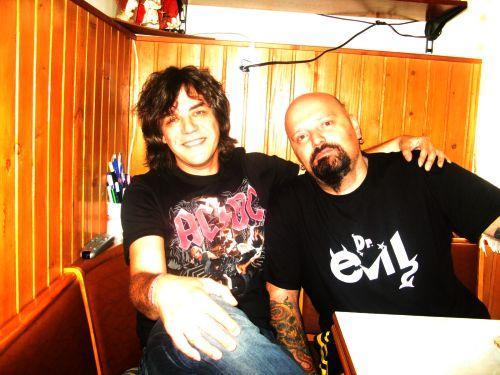
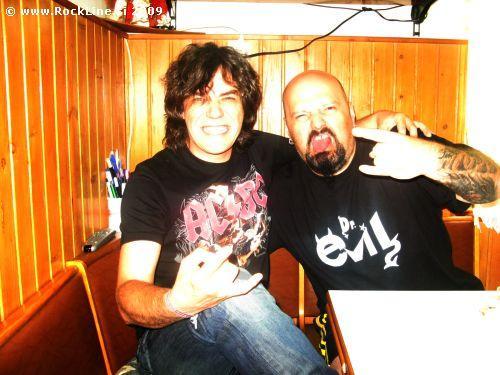
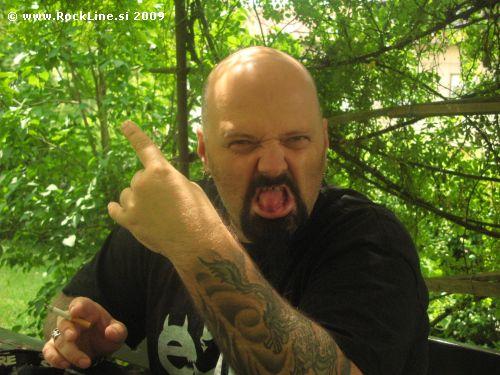
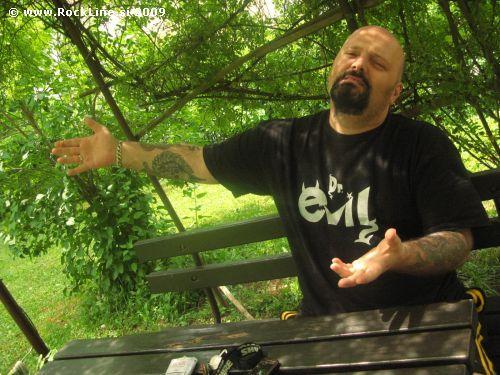
RockLine: And then came RockLine fest II, in the company of Chaosstar and Shutdown. There you provided a real fun adventure. You dressed up as a crazy surgeon, Dr. Evil. So Dr. Evil was born. That’s your trademark now.
Milan: Yes. From now on Dr. Evil is my trademark, my new name in show business. About that gig, I’d like to say that both Shutdown and Chaosstar are bands that gave their maximum at that show. Excellent bands. We got on great with each other backstage too. It was full of fun and positive energy. We’d prepared something special for the Orto bar gig. And my idea is to try to deliver that at every one of our shows from now on. I’d like to build on all of it. If we had enough cash, we’d try to out-do bands like Alice Cooper or Lordi. We’re doing our best. The rest of the crew also know that I’m a classic stage entertainer type. People were shocked when I stepped on stage. The reactions were unique. I also have to stress that this RockLine fest, counting from the day of the reunion to today, as we’re doing this interview, was by far our best show. From the technical side, from the way we played the repertoire, to the crowd’s response. There were quite a few people at that gig who’d heard we once existed and came more out of curiosity. The show itself was also excellently organized, everything went without a hitch.
RockLine: Milan, you’re one of the few singers in Slovenia with an extraordinary talent as a stage entertainer, which you also know how to put to good use and are able to. That fact is, as far as I’m concerned, hugely important, it gives you a certain advantage, a big ace that was laid in your cradle. Do the guys ever feel pushed aside, neglected, because you demand a lot of room on stage for yourself?
Milan: Absolutely not. Everything I do on stage, I do absolutely for the benefit of the band anyway. It seems to me we’ve started to reach a professional attitude toward our work. That goes for all of us on the team. All the agreements between us before a show are also consistently respected on stage, with no deviations. I do have to add, though, that back in the eighties I was one of the first in Slovenia to start entertaining the crowd with this kind of nonsense on stage. Somewhere around 1985, I came on stage drenched in blood and so on…
RockLine: Too bad I missed all that, but I do remember the anticipation before the Orto bar gig. Behind my back I heard, when the guys, except you, were already on stage: “So Krušič isn’t here yet? I wonder what he’ll pull today!”
Milan: At the Haliaetum Open Air festival in June this year, everything we showed at Orto bar will just be built on even more. But I won’t say anything about what I’ve got in mind for our gig at that festival in Izola.
RockLine: Well, and finally we can also say that the first outlines of your first official release ever are appearing on the horizon.
Milan: Thank God, I can finally say out loud that we’ve reached the step where we’ll release the album that’s been 30 years in the waiting. The studio where we’ll record is actually booked, the songs are written. To our seven or eight standard songs we’ll add four or five new ones. There’ll also be two guests from abroad on the album. I’d like the names to stay a secret for now. They’re two eminent guests who are names in heavy metal that you can’t overlook. They’re at the top of world heavy metal, and both come from Germany.
RockLine: In Germany they’re surely some kind of metal tutors, if not legends already.
Milan: Yes. For the release of this album of ours we’re preparing something that no Slovenian band has done so far.
RockLine: So seven, eight classic Lene kosti songs will be played anew?
Milan: Yes. With the new, current lineup. All the old songs will be rearranged from scratch, with Miha on drums and Brenko junior on bass. I also came up with the idea of releasing this album in a run of only 1000 copies, as a kind of rarity. We’ll try to sign most of the copies. The booklet is supposed to collect archive photos, some newer pictures, newspaper clippings.
RockLine: And the rest of the material, which you haven’t played live so far, probably comes from old riffs that have been standing around, faithfully waiting and going moldy in storage.
Milan: That’s right. These four songs we’ll still include on the album are songs we’ve jammed in rehearsals but never played live. They’re at least 15 years old. But we count them as new because they’ve never been presented to the wider public before.
RockLine: The so-called “lost candies”, next to classics like Russian Girl, Stones Of Death, Warrior…
Milan: Of course, of course. They’re written in the traditional Lene kosti style, like the songs you list.
RockLine: And with a refresh that goes by the name of the devastating rhythmic march of the double bass drum pedal undercarriage.
Milan: Yes. Totally.
RockLine: So in the fall you’re heading to the studio.
Milan: Yes. Right now we’re talking with various labels about releasing the record, otherwise we’ll go the self-release route. Like I said. We’d print only 1000 copies, for all our die-hard fans. Then we’ll see what the demand is like and whether it’s worth reprinting.
RockLine: The eminent guests who’ll appear on the album also bring an important springboard for Lene kosti’s potential breakthrough abroad.
Milan: Yes. I believe that the mere fact those two guests will appear on the record will make our album interesting in Japan too. But it’ll primarily be released for our Slovenian market.
RockLine: And then as many gigs as possible, so the album really gets presented.
Milan: Of course. After the show before Grave Digger we realized it really pays to look around abroad, so we’re making contacts abroad. All three bands we met in Ljubljana in February at that show were interested in playing together somewhere abroad too. If you get that kind of confirmation, there’s definitely something to it, and we can seriously count on foreign countries in the future, just as they can count on us.
RockLine: Well, let me ask you something that doesn’t concern Lene kosti. How do you experience the Slovenian metal scene in 2009? Is it any different from the eighties or the early nineties?
Milan: It’s no different. There are always some idiots who throw sticks in your wheels. There are still people in the crowd who, instead of coming to enjoy our show, or leaving the hall if they don’t like it, watch our shows and judge us afterwards and lecture us on what would be better for us, nitpick, look for faults in us and so on… On the other hand, I’d like to mention one person who is a regular at our shows, who’s always watched us with interest at gigs and been encouraging. That’s Gregor Čulk from Interceptor. We’re friends with that band, I like it because they do their thing, we do ours, and you don’t feel any rivalry, at most support and respect.
RockLine: That should always reign among all bands. The question is whether we’ll ever see it.
Milan: Yeah, we probably never will. Here we’ve got festivals with certain criteria that force you to behave like the lowest of the low to be able to play them. From forcing bands into advance ticket sales, to preliminary votes and so on… On the other hand, in the same breath, those very same festivals invite bands from abroad that nobody here has ever heard of, and even pay them for it. Just look across Slovenia’s northern border: at shows it’s not hard to see that the local promoters there offer domestic bands the chance and support to present themselves on stage, before the bigger headlining bands. You don’t feel that here. Lene kosti won’t sell ourselves like that. If anybody wants us on stage, they should know that we won’t crawl after them and beg them for gigs. As long as there are conditions where bands have to sell tickets in order to even play, play for free so that 500 people watch you from the floor and drink 500 beers during your set and so on… that way is humiliating for bands. We had a chance to play at the beginning of June at a festival before Saxon and Grave Digger near Stuttgart in Germany, but we canceled the gig because of my elbow injury. The invitation was official, from the promoter. And if you get an invitation like that from abroad, then I don’t see why I’d suck up to somebody here, beg them and crawl after them, asking if I can play some gig.
RockLine: What about new ideas? I mean totally new ones, for new songs. Is anything in the works?
Milan: We have so many riffs that have never been used that we could put out three albums right away. We don’t even have to worry about that. Besides, it happens every so often that Marc presents a new riff at rehearsal. That’s how the instrumental The Sting came about recently. I liked the riff so much that I didn’t want to “spoil” it with vocals. So it stayed an instrumental. The song was done entirely in just 20 minutes.
Photo gallery