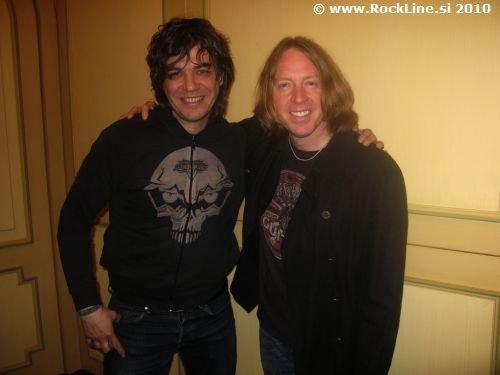
Legendary Foreigner in Full Bloom Again, With No Plans to Climb Down from the Rock Saddle (2010)

Location: Hotel Principe Di Savoia / Milan / Italy
Interview date: April 11, 2010
With over 50 million records sold worldwide, three quarters of that number on US soil alone, Foreigner are a band that can truly brag about their career. The dream commercial success comes with a body of outstanding albums boasting a unique combination of classically built hard rock and a crafty dosing of more or less finely calibrated pop art prosthetics. The result is a distinctive AOR rock vocabulary that gave us a handful of instantly recognizable, poisonously sweet, ear-invading super-hit evergreens across the first six albums. Foreigner are one of those “cut-out” bands who win over the realm of rock with the splendor of their sonic and compositional perfection. And there’s no arguing with that. On March 1, 2010, Foreigner released their comeback album “Can’t Slow Down” in Europe (!) via Ear Music Records (RockLine review HERE). Although they showed up in Europe last year for a few summer festival gigs, only this spring did they set off on a proper headlining tour. With the first dates focused on Europe, followed by a visit to North America, their stop in Milan on April 11, 2010 meant they played Italy for the first time in their career.
Hotel Principe Di Savoia is no small fry. Amid all that luxury, a middle-class guy parking his tin “egg” among a horde of gleaming Ferraris, Porsches, Mercedes S-Classes and so on… feels like being launched into the orbit of a new fantasy. When he steps over the threshold of the five-star hotel and his eyes wander curiously over the expanse of rooms and residences, with bedecked chandeliers watching from the ceiling, flirty, scantily clad bunnies at every step and the rest of the staff dishing out overly sugary greetings of obligatory politeness, there’s nothing left for such a little fellow to do but start believing he’s landed on another planet.
Enter the tour manager of Foreigner. Everything’s okay. He’s routinely friendly and obliging, as the ethics of his professional attitude toward every media outlet demand. He picked bassist Jeff Pilson to spill some beans about Foreigner and himself for RockLine. Bassist Jeff Pilson, who logged years of career in melodic hard rock outfit Dokken, recorded three studio albums with Dio and made it among the film stars when he contributed the character of bassist Jorgen of the band Steel Dragon in the film “Rock Star” (2001), is not just “some guy”. Although he’s a strict professional among rockers, his fame never dictated even a shred of haughtiness, though he could easily afford it. So the interview, originally timed for 15 minutes, swelled by a full 10 minutes amid a most interesting and exhaustive conversation.
RockLine: You’ve been a regular member of Foreigner for some years now. How did you join the band?
Jeff: In 2000 I appeared with Jason Bonham in the film “Rock Star”. While we worked together on that film, really good working chemistry developed between us. When Jason started working with Mick Jones in early 2004, he managed to convince him to put Foreigner back together. So Jason suggested they call me too, and when I arrived and we tried out how playing together felt, we immediately clicked, right on the same wavelength.
RockLine: This year you released a new studio album, “Cant’ Slow Down”, the first in 15 years. How did the rest of you in the band get involved, given that Mick Jones is now the only original member of the Foreigner lineup?
Jeff: The writing of the new material was tackled primarily by Mick Jones, singer Kelly Hansen and Marti Frederiksen, who also produced the new record. All the songs were written in rough form separately from the rest of the band. When it came time for each of us to play our parts on those songs, it was basically routine. The process unfolded very naturally. The band’s been together a few years now, so there’s real creative chemistry around. Drummer Brian Tichy and I work together great. It was actually very simple. Let me put it this way: we did the hard work with ease.
RockLine: Did your playing and ideas have any influence on the final result, especially the sound of the new album’s songs?
Jeff: Not really. We all knew what kind of album we wanted. We knew it had to sound like Foreigner. And we wanted to add some new elements to that. Especially ones that are recognizable in today’s market, but that also help shape the characteristic Foreigner sound and style. So that was our goal. My job was to play bass guitar.
RockLine: Today’s youth no longer embrace rock music the way they used to, or don’t embrace it at all. Their taste is subordinate to whatever MTV sells. What do you think about that?
Jeff: They say everything goes in circles. Rock music has a long cycle. I believe we’re at the end of the hip hop cycle. There’s been a lot of good hip hop in recent years. Young people find themselves in it, which is all well and good. But the funny thing is that more and more kids are being exposed to classic rock since RockMan and Guitar Hero came along. For them that kind of music is new and feels fresh, since it’s unlike anything their generation listens to. That’s why those of us in Foreigner are also noticing more and more younger people coming to our shows, who identify with the fact that we’re a rock band. Whether that will tip the scales in favor of more rock exposure in the media, I don’t know, but I have a feeling the phenomenon that’s already happening will pull in more and more young people in the future. Young people like the energy rock has. At that point some new band from the young generation will emerge and rediscover rock, and that should set the whole machinery in motion and bring rock music back into the focus of everyday life.
RockLine: Can you describe a typical Foreigner fan in 2010?
Jeff: Typical? Not anymore, ha, ha, ha… At our shows we see kids who are 15 and folks who are 75. And everything in between. As for Foreigner’s music specifically, its effect is that it transcends many musical frameworks and limitations. They heard our classics on the radio thirty-plus years ago, and at the same time we’ve been a rock band all along. But everyone who listens to us and comes to see us live has something in common. They’re looking for melody. That’s the essence of a true Foreigner fan. Knowing how to recognize a melody. Striving to recognize melody.
RockLine: As a musician you’ve achieved a lot of success. In the past with Dokken, today with Foreigner. What does that mean to you?
Jeff: I’m very grateful for the opportunity I was given to work with these great people. I’m very grateful that I recorded some truly big albums with them and that I’ve been part of this big rock scene for so many years. Otherwise it can happen that after you finish a job, you have to wait years, washing dishes or getting by some other way in the meantime, until a new opportunity comes along. I was very lucky to be actively present on the scene the whole time. I think I’m a lucky guy in that regard.
RockLine: What does a musician have to do to break the ice, succeed on the scene and become a big name?
Jeff: Who the heck would know? There’s no recipe, no formula. If there were, I could write a very successful book about it. I’d become a billionaire. Many have tried and failed, ha, ha,… Still, I think the key thing in all of this is quality. In the case of a band like Foreigner, quality has been a consistent companion through all the years, a kind of constant in our music. That’s helped keep Foreigner together over the years and kept the band’s commercial success going for a long time too. As for me personally, I have to say that if you love something, the way I love music, you can do even the hard stuff more easily, and with great distinction too. At heart I’m a grafter. I’ve spent many hours in the studio playing, writing, arranging. But never in my life did I do it because I had to, or first and foremost for the money, but because I love doing it. I think the whole thing starts with passion. And I also believe people can tell real music made with passion from studio math that dictates something has to be made just because it has to be made. People can tell what’s emotion, what’s passion, they hear the special qualities. They identify with that. Real, great songs work precisely because they stir up special feelings in you. It’s not that simple. People really have to make an effort to tell these differences apart and recognize them within the music itself. But like I said. It all starts with passion and with being honest and open with yourself about your feelings. Many times in my career I tried things in music on other people’s advice. But many times it’s smart to listen to what people advise, yet try it out yourself. You listen to yourself, to what your heart tells you, and then you decide. Often you get the right answers to the questions you’ve asked yourself. Then you know exactly what you have to do, and it turns out in the real world too that you decided right when you listened to your heart. Even if the decisions don’t bring you some kind of mega success, you know those are the moments when you feel best inside. Although my individual decisions often didn’t pay off for me, they always pointed me where I needed to go. On the road to the goal I wanted. So: passion, and staying true to your inner feelings. That’s the key. Intuition. In today’s world the whole thing has become extremely complex. The music business has narrowed a great deal. Today there’s only a handful of people who control it. When I started my music career in the eighties, the people at the top of the music business were first and foremost musicians. They let music evolve and breathe. Today the music business is ruled by corrupt people who just do balance sheets and calculate how much they’ll earn where. That’s why in today’s “mainstream” the range of musical offerings has narrowed sharply, and you can only find success in a few genres. And what happened as a result? More and more people in music started to resemble each other, because they simply wanted to fit into this mold that’s supposed to lead them to success. And today that mold gives a musician little room to maneuver. Creativity isn’t encouraged anymore. Quite the opposite. It’s not welcome, while conformity is. “Be like them, be like them,….” That’s why a lot of the music made today is monotonous, uninspired. That’s why I think the music business is in trouble, and why many musicians today don’t have long careers. Simply because they’re not real. They’re not connected to the level that guarantees a long life on the scene along with success. But over time, people will discover a parallel path – whether through the internet or through web-zines (!) – for how to present real music and how to communicate with real musical talents, that is, musicians who carry creative potential. I predict these people will bypass the record labels, which will become a thing of the past. They’ll be narrowed down to prestigious, quantity-limited distribution only. When that happens, music will flourish again. I firmly believe it will happen. That’s why it’s all the more important to stay true to what you believe in. People will eventually realize they’re doing themselves harm when they try to please the taste of today’s music corporations, which leave little room. If you negate your feelings, you cause yourself a kind of disorder.
RockLine: You’ve answered my next question.
Jeff: And I think the next ten too, ha, ha, ha,…
RockLine: When you listen to a song, can you tell on your own that it will eventually become a classic? Can you predict that a song will become a classic?
Jeff: Hmmm…. When I was still in Dokken and heard the Foreigner song I Want To Know What Love Is, I knew it would become a classic. I got the same feeling when I first heard the song Waiting For A Girl Like You. Of course I couldn’t have foreseen back then that a song like that would also stick to “mainstream” rock and stay there, that’s clear. But when I first heard Waiting For A Girl Like You, I thought it was a damn good song. To some extent I realized it would become a classic, though I didn’t know then that it would really happen. I had a similar feeling when I heard Love Bites by Def Leppard. But I sure never thought the song Cum On Feel The Noize by Quiet Riot (originally Slade) would ever become a classic, ha, ha, ha,…
RockLine: What influence did record labels have on Dokken’s music at the time when the band was big? And how would you compare that with the situation today?
Jeff: Labels used to influence bands by letting you be who you were. They encouraged you to do that. There was always some pressure, of course. They aimed for you to come up with a hit single, or some song that would be at least reasonably successful. That was always there. But it wasn’t like today. Today everything is based on pushing hits. I remember in the early eighties, just before Dokken broke onto the scene, a guy named Mike Bolen worked with us on the album Breaking The Chains. He was vice president of Elektra Records, and later became president of Chrysalis Records and Island Records. Anyway, he loved our music and kept encouraging us the whole time. He wore his hair tied back in a ponytail. He said that if Dokken’s debut never went gold, he’d cut off his ponytail. The record didn’t go gold, and Mike had to cut off his ponytail. And he did, ha, ha, ha,… Thirty years later it did go gold, right after Mike’s ponytail had grown back. I bring up this example only because I wanted to stress how devoted this man was to our work. Not just anybody, but one of the label’s leading men. The label didn’t force success on us; only after a while did we have a breakthrough with the release of the following records. And we got to success because the label encouraged us in what we were doing. They didn’t tell us what we had to do, they just encouraged our wishes and our work. Nobody forced us to be like other bands, say Motley Crue, they put our talent above all else. They told us: “Lock yourselves in the studio and make the best record you can!” And for that they gave us the best conditions. They gave us everything we needed. They set us up with the best recording studios and assigned us the best producers. Back then that was their job. To let us be what we were and squeeze the best out of us. That strategy worked great back then. I still believe it’s the best strategy. The strategy for how to create an artist. With today’s corporations, which have to immediately turn an investment into guaranteed profit, that’s simply not possible. It actually took Dokken three records to break through and succeed. “Tooth And Nail” did go gold, but only our third record, “Under Lock And Key”, brought us real success. You don’t find that kind of dedication from the people running labels anymore. Nor do they believe in supporting bands to help them out on tours and everything else. That’s why I think the music business, because of that mindset, is in big trouble.
RockLine: What are Foreigner’s plans for next year, and do you have any other solo plans and so on?
Jeff: In Foreigner we have countless plans. Since we’ve released an album we all like a lot, we’ll be presenting it to people next year too, so we’re planning lots of shows for next year as well. It’s a bit too early to talk about future releases for now, but I can say with certainty that the band is preparing some surprises on that front. Some interesting releases are in the works for the end of the year and the start of next year. As for my solo career…. I’ve always wanted to put out an album of music I especially love, but I never found the right time for it. I have a few songs ready that I hope to release someday on a proper album. There are also new collaborations with George Lynch on the horizon.
RockLine: Was there any offer to stay in Dio after you recorded the album “Master Of The Moon” with them?
Jeff: Of course they offered me a spot on the team. But my wife was pregnant at the time. We were expecting our first child, so there were no plans for me to go on tour with Dio. At that point I’d have turned down an offer from any band, Foreigner included. When Foreigner came to me, they told me they needed me for a job that would only last a weekend, ha, ha, ha,… When that happened I was doing a lot of production. But with my daughter Rudy nine months old, I couldn’t even imagine going on tour. But things changed over time, ha, ha,… Anyway, I’d have gladly accepted the invitation from Dio and played with Ronnie James, if that had been possible at the time.
RockLine: What was your experience working with Ronnie James Dio?
Jeff: It was unique. I love Ronnie’s work, his music, very much. Right now I hear and read that he’s getting through his illness successfully. That was a special band. Ronnie and Vinny Appice are both great friends of mine. We had a good time. It’s rare to be in the same band with the right friends. The thing worked great. Ronnie was outstanding every night. That’s also why Foreigner works so well, because Kelly (Kelly Hansen, Foreigner vocals – author’s note) is in a very good mood every night too. It was a pleasure recording with Ronnie. We did it with a lot of “jamming”, old-school style. Things flowed spontaneously, naturally, and the magic was with us. And when the magic is there, that’s when the music is at its best. I have truly fond memories of playing with Dio.
RockLine: “Can’t Slow Down” did very well on the Billboard chart, hitting number 29 a week after release. So there are still people who like listening to Foreigner.
Jeff: That’s right.
RockLine: Did the good response to the new album surprise you?
Jeff: Actually, yes. Even though we were a few years late with the album, I want to say that we’d already been actively touring again for a few years before it came out. The surprise was a really nice one. Today, because of the music corporations pulling the strings, it’s hard to get new Foreigner-type music onto radio stations, onto TV with new videos and so on… But we also found some welcome support through the retail chain Wal Mart and Rhino Records. We did the right thing, and I believe quality counts. People still love Foreigner and our music. The only problem is that we have a hard time getting the chance to present our new album. The album gets to people harder than it would have in other times. The music corporations, you see, don’t want to give all music equal value. They value ours less, for example. And it means a lot to us that we can sometimes prove them wrong. Something similar happened to Dokken in the early nineties. There was an alternative rock boom. In 1995 that revolution was at its peak. That’s when John Kalodner of Columbia Records signed us and our album “Dysfunctional” sold 50,000 copies, which at that time was a phenomenal achievement for us. It was beyond all our expectations.
RockLine: Why did Jason Bonham leave Foreigner?
Jeff: He made that decision after the Led Zeppelin reunion appeared on the horizon. Everyone was talking about it and everyone was expecting it. In Foreigner too everyone understood, in fact it was completely a given for them, that Jason would play in Led Zeppelin. Even though they hoped for a reunion, Robert Plant insisted all along that it would be just a single Led Zeppelin show. And that’s how it stayed. I think they hoped it would develop into a bigger tour, but Robert was rather hesitant. Jimmy Page and John Paul Jones decided to form a band with another singer, and that’s when Jason left. We understood that. He had to do it, since his whole life was tied up in that project. We supported him a lot at the time, and we were disappointed ourselves when it didn’t pan out. Jason was really looking forward to it, and I also heard some recordings that sounded great. If they’d finished the record, it would have been outstanding. We in Foreigner were sad about it too. But then John Paul Jones went off to Them Crooked Vultures, and Jason has new plans. He’s working with the band Black Country with Joe Bonamassa and Glenn Hughes. I haven’t heard any recordings yet, but according to some colleagues, the songs sound very promising. I can’t wait for the record to come out. Jason is thrilled with the results, Joe Bonamassa is an outstanding guitarist, and Glenn Hughes still sings incredibly.
interview by: Jernej Vene
text edited by: Aleš Podbrežnik
photos: Aleš Podbrežnik & Dragan Bulič
You can read how the Foreigner show went later at Alcatraz in Milan on April 11, 2010 HERE.
Photo Gallery