Author: Peter Podbrežnik, Aleš Podbrežnik
Location: Orpheum Theater / Graz / Austria
Interview date: 28.04.2010
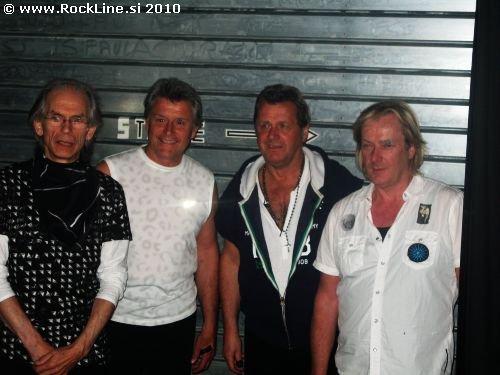
It doesn’t exactly happen every day that you share a table with a legend like John Wetton. He’s the legendary singer and bassist of Asia, and over a more than extensive musical career he’s also played in other very famous, I’d even say pioneering bands that moved the continents of rock and opened up new horizons for rock music. Those were: King Crimson, Roxy Music, Uriah Heep, Wishbone Ash, U.K. John Wetton is a man with a uniquely colored voice, and he carries an innate, refined sense for shaping the ideal melodies, the kind rock music absorbs best. This is a musician who has pretty much experienced everything there is in the world of rock. Among other things, he was and is part of Asia, who went through a real commercial “super boom” when their debut studio album sold over 10 million copies. Sharing the Asia lineup with three other eminences of progressive rock, namely Steve Howe (guitar), Carl Palmer (drums) and Geoff Downes (keyboards), is a fact that speaks for itself about John Wetton’s exceptional pedigree
We did the interview backstage at the Orpheum hall in Graz on 28.04.2010, right before the Asia concert. It was four days after the official release of the band’s new studio album “Omega” (RockLine review HERE). The band had just freshened up, and John Wetton, Geoff Downes and Carl Palmer were around and available for interviews. Only Steve Howe was nowhere to be found. It’s well known that the moody guitarist is very hard to get hold of on tour. He prefers to keep to himself and is rarely open to dialogue, whether with fans at Asia shows or with media representatives.
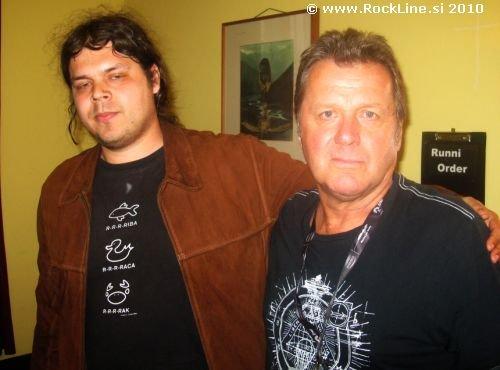
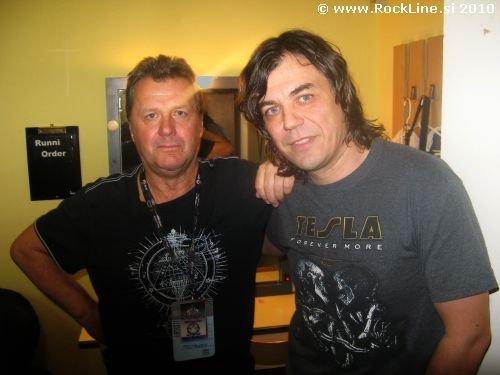
After lunch, John Wetton was already in his room. He had just put down his gigantic travel suitcase and settled into an armchair when two faces walked in…
RockLine: This year you released the new studio album “Omega”. Can you describe the story behind how it came together?
John: Some of the songs for the new album were written with me playing a 12-string acoustic guitar alongside. While I was shaping the music, the verses were coming too. They just popped into my head completely spontaneously. Then I presented these raw ideas to Geoff, and together we built the material further. Most of the material for the new album came together last summer during the North American tour. So the writing was wrapped up by the end of August, while we were still on tour. And in September we started recording. Steve also chipped in a few ideas toward the end.
RockLine: The sound of the new album is a bit different.
John: This time we used producer Bill Paxman. It was actually the first time that someone from outside produced our album. We’d always handled the production ourselves. It was very good for the band. Paxman acted as a kind of filter. At first we presented the material to him, played it for him. Geoff and I already knew exactly what we wanted with the new songs, but the producer didn’t. So he had to hear the individual songs before we went to record them. Sometimes we automatically know what we want to achieve with the songs. When we present material to a producer, he acts like a kind of referee, handing out red and yellow cards, suggesting what’s useful, what’s best thrown out, or saved and used another time.
RockLine: Is there any special message hiding behind the album title “Omega”?
John: Yes. The idea for the album title “Omega” is mine, while Geoff suggested “Tiger”, because this year, according to the Chinese calendar, is the Year of the Tiger. Why I went for “Omega” comes down to the fact that, besides being a typical Asia album title, it reminds me of the album “Alpha”. When we formed in 1981 and released our debut studio album in 1982, we looked back at what we’d done in Yes, Emerson Lake And Palmer and King Crimson. Up to the album “Alpha” we hadn’t yet worked out a musical direction. And with “Alpha” we finally established it. When we got back together and released the album “Phoenix” in 2008, it wasn’t as clear in its musical direction as “Omega” is now. “Omega” is much more of a real Asia album than “Phoenix” and kind of establishes the band’s musical direction in the present day. Many people ask me whether this is the last Asia album, given the title. I tell them: “Not necessarily.” Maybe it is, maybe it isn’t. “Alpha” wasn’t the first Asia album either, so “Omega” doesn’t have to be our last.
RockLine: Has the collaboration between the four musicians in the band changed at all after 30 years?
John: If I compare Asia today with Asia back then, I can say we’re a bit more mature now, more tolerant of each other, and more patient too. We used to clash a lot; now it happens much less often. In the time since the band was formed in 1981, we’ve come to an important conclusion: only the four of us musicians represent what Asia really is. All the other combinations that were tried out didn’t fully work. From time to time they got closer to the point of the band, but never quite. The four of us in this lineup are the magic of Asia. Whether we like it or not, things are turning out so that we’re evidently doomed to get along with each other in this lineup. Since the reunion we’ve now lasted longer than we did when we first started. We’ve recorded two studio albums and released two DVDs, and played quite a few more shows than in the early period of Asia’s career.
RockLine: How did the record label Geffen Records influence the band’s musical image during your eighties heyday?
John: Labels have always influenced us. That’s logical. Their motive is to sell as many records as possible. The only differences are in how strongly a label influences a band. You’ll rarely see a band release an album without the label meddling at least a little. It can be just suggestions on their part. At first glance those suggestions don’t seem important to the band at all, but a label can turn them into a big problem. When we were really popular, John Kalodner was at the label. We were very close with him. He always came to us with some proposals. Sometimes we found them useful, sometimes not. But the point where a label definitely steps in is when it picks which song it’s going to push onto the market and turn into a hit. That’s where we had to give in. So the choice of Asia singles always belonged to the label.
RockLine: Is it true that Kalodner always dreamed of creating a supergroup, and that’s how Asia came about?
John: Yes. That’s true. Even though John Kalodner actually picked the people who would make up the Asia lineup, it turned out the band worked pretty naturally from the start. Even without his presence, Asia could have existed. A few other people were tried out too, like Trevor Rabin and Robert Fleischmann, but in the end the combination of the four of us proved to be the right choice. And Kalodner deserves credit for getting us together. His idea was to create a supergroup made up of members coming from very well-known bands. What was interesting, too, is that we already knew each other before Kalodner created Asia. Carl and I had been very good friends for a few years before that, and Steve and Geoff knew each other from when they played together in Yes.
RockLine: Can you predict in advance that a particular song you create will become a classic?
John: I can’t predict it for my own songs, but I can for other artists’ songs. Kalodner was always telling me that my career was written in the A&R department of the label. So I called the hit Walking In Memphis by Marc Cohn, or Marlene on The Wall by Suzanne Vega. John doubted me in both cases, but both songs later became hits.
RockLine: Some motifs in the songs from your U.K. days already carried some parallels to the future sound of Asia.
John: Yes. Even back then in U.K. we were quietly hoping for a positive reaction from John Kalodner. Let me tell you John Kalodner’s opinion of U.K. He said that U.K. were a very solid band, but when he was looking for a supergroup, he was convinced that U.K. couldn’t be that supergroup. He told me to try again. After U.K. I put out the solo album “Caught In The Crossfire” and John told me: “Now you’ve turned in the right direction! All you need is people and a band.” The progression in that direction from U.K. through the album “Caught In The Crossfire” to Asia is clear and logical. It’s not hard to hear the similarities between some moments of U.K.’s music and the later stuff in Asia.
RockLine: What feelings come over you when you hear Asia’s evergreen hit Heat Of The Moment on the radio even today?
John: I still like it a lot. There’s nothing wrong with them playing that song often on the radio even today. It’s made a lot of people happy. And I’m also sure it’ll make a lot of people happy tonight, when we play it in this hall.
RockLine: How would you describe the typical Asia fan in 2010?
John: On average they’re between 40 and 45 years old. The crowd at the shows is two-thirds men and one-third women. I can tell you that based on my experience with visits to my official website. It’s mostly people between 40 and 50 who visit it. Traffic on my website is a very good reference for what we meet in front of the stage when we play.
RockLine: Do you have any plans to record a new solo studio album?
John: Yes. In September or October this year I’ll start recording a new solo album. When writing the new material, I’ll occasionally lean on the album “Battle Lines”. That’s something I’ll tackle right after Asia wraps up all the more important activities.
RockLine: And future plans with Asia?
John: We’ll be on tour until March or April 2011. Our schedules are very packed. For myself, I can say I’m genuinely lucky to even know what I’ll be doing tonight, because for tomorrow night I’m no longer sure what’s going to happen and where I’ll be. Things literally fly through our lives when we’re on tour.
RockLine: There was some activity with U.K. too, right?
John: Yes. Last November we played three shows. Just three shows and nothing more. As far as I’m concerned, I won’t be playing for U.K. anymore, and no reunion is planned either. Playing together after so long, we had a lot of fun. Those shows were very useful, since the members of the band renewed their old bonds.
RockLine: Finally, what can we expect from tonight’s Asia show here in Graz?
John: We’ll play a classic Asia show. The set will include five new songs from the album “Omega”, two from “Phoenix” and of course the classics from the albums “Asia”, “Alpha” and “Astra”. All in all it’ll run almost two hours, and there’ll be some solo spots too.
RockLine: Any King Crimson, Yes or ELP classics?
John: No. We’ll only play Asia songs.
You can read how the Asia concert on 28.04.2010 at the Orpheum hall (Graz, Austria) went HERE.
interview by: Peter Podbrežnik & Aleš Podbrežnik
text translated and edited by: Aleš Podbrežnik
photos by: Peter Podbrežnik & Aleš Podbrežnik
Photo Gallery